BOOK REVIEW: Veronika Decides to Die by Paulo Coelho

Veronika Decides to DieVeronika Decides to Die by Paulo Coelho

My rating: 4 of 5 stars

Amazon page

Veronika Decides to Die is about a young Slovenian woman, Veronika, who attempts suicide, fails, is institutionalized, and is informed that her attempted suicide damaged her heart and she has only five days to live. In the hospital she has to come to grips with what it means to be dying, but also what it means to be insane.

The book deals with the effect of Veronika’s death sentence diagnosis on her as well as on other patients with whom she interacts. The first patient Veronika comes in contact with is a depressive named Zedka who offers Veronika advice and insight. Then there is Maria, a woman who withdrew from her professional and family life to be institutionalized because she was having inexplicable panic attacks. Finally, there is Eduardo, a schizophrenic who is virtually non-functional when he meets Veronika, but who ends up in a relationship with the young woman nonetheless. These patients come to realize that they are hiding out at the hospital. They stay in the hospital because they are free to defy norms without judgment. When Veronika decides she doesn’t want to die hiding out, it has a profound impact on the others.

The book borrows heavily upon Coelho’s personal experience. He was institutionalized as a young man by parents who were disturbed when he went artsy and began hanging out with undesirables. Interestingly, Coelho has a cameo role in the book as himself. In the book he writes an article that playfully asks the question, “Where is Slovenia?” When Veronika is waiting to die from her overdose, she reads the article and decides to write a letter to the editor claiming that she killed herself because of the depressing effect of Coelho’s suggestion that nobody who’s anybody knows or cares where Slovenia is located.

In the end Veronika finds that she is truly free. Veronika seems to have everything at the beginning of the story: a job, boyfriends, and popularity. However, it’s those things that she comes to feel enslave her, and that’s what leads to the attempted suicide. In a way, Veronika is doubly freed. She is free because she is dying, and what can one do to a dying person. Second, she has been labeled crazy, and, having such a label, people expect her to act oddly. She has the freedom to do those things she has been too frightened to do all her life.

I’d recommend this book. It’s short, readable, and offers clear food for thought.

View all my reviews

Chi: The Power of What Isn’t

Every morning I start my day with chi kung (a.k.a. qi gong), and many days I do tai chi (tai qi.) For those who are unfamiliar, chi is usually defined as “life force” or “life energy.” However, defining chi is neither simple nor will one find a consensus agreement. Some say chi is  “breath,” at which point its existence becomes a much less controversial, but also less explicative, concept. Others would say that chi is much more broadly dispersed than the “living” so “life force” is an understated definition.

Chi Kung are exercises combining breathing, movement, meditation, visualization, and self-massage that are used to keep one healthy. Because yoga also contains these components (e.g. breathing, movement, and meditation; though with very different specifics) some have even been known to call chi kung “Taoist yoga.” The idea behind these exercises is that chi is lost through living (some activities more than others), and can become blocked in the channels through which it is believed to move. Various exercises are used to replenish and ensure healthy circulation of the chi. Tai chi is a series of martial arts forms that are also considered to have the effect of replenishing and / or enhancing chi.

Two questions may leap to mind, especially among those who know me as a skeptic. First, do you believe in chi–despite the lack of evidence that it exists? (When I mention this lack of evidence, I am obviously not defining chi as breath or bodily fluids, in which case the most rabid skeptic would have to acknowledge its existence. However, then an entirely different set of questions is raised about the vast and complicated nature of chi kung exercises needed to circulate oxygen, which travels through blood vessels and not through channels or meridians. In other words, there’s no reason not to abandon a lot of the Traditional Chinese Medicine (TCM) / Taoist conceptions of health if one considers a narrow definition of chi.) Second, if you don’t have any reason to believe that chi is a real thing, why bother with the exercises?

First, no, I don’t believe in chi as a substance or physical entity in the way that your average Taoist priest does. I don’t mock or ridicule those who do, and I acknowledge it could always turn out that they were right and I was wrong and that my current state of ignorance combined with an incorrect deference to Occam’s Razor led me astray.

However, I have a pretty high standard for believing a person, place, or thing exists. I need to be able to observe it.  If I can’t perceive it directly, but there is some indirect sign it exists, then that indirect sign needs to be the simplest possible explanation I can imagine given my current state of knowledge. (Yes, I realize that Occam’s Razor isn’t a law, it can always be that an unlikely explanation is the correct explanation. I also know the raft of indirect signs of chi, and, yes, I’m saying I can imagine simpler explanations than an energy source that is immeasurable but powerful enough have bodily effects.) While I don’t believe in chi (or meridians, or the yet undiscovered organ called the “triple heater”) as physical things, I do believe in conceptual chi which is an object of visualization.

Moving on to the second question, I practice these exercises because they make me healthier.

This, of course, raises another question, “How can these exercises be effective if chi is not real?”

Now I have to go Socratic on my hypothetical questioner. The Socratic dialogue goes like this:

S: Have you ever been to a scary movie?

A: Of course, I have. What kind of a troll has never seen a scary movie?

S: I’m Socrates. I’ll ask the damned questions around here, thank you very kindly.

So while you were watching said movies, did you ever get startled? That is, did your pulse ever pound a bit harder; did you ever take a gasping breath; did your hands ever grip the armrest with white knuckles; or did you ever get butterflies in your stomach?

A: Of course, that’s part of the horror movie watching experience.

S: So, then, you were under the impression that the events you were watching were actually happening, and that the killer might come out into the theater after you at any moment?

A: No, of course not. Don’t be absurd!

S: And yet this thing that was not real–that was just symbolic or conceptual–had actual physiological effects?

[At this point Socrates breaks into his superiority dance.]

I think visualizing chi flow has positive benefits both mentally and physically. The mental benefits may be clear. The physical benefits result from putting oneself in the moment and conducting activities (deep breathing and movement) that help one de-stress. This process of de-stressing helps one to be healthier. Does it matter that one does the exercises as they have been handed down from ancient China? Probably not, but I believe that trial and error (even without complete information about anatomy and physiology) yield some impressive results. Of course, there are many other systems (e.g. yoga) that can work equal wonders using an approach that is quite different in its detail. (I also don’t believe in Chakras, but can imagine great benefits from behaving as if they exist.)
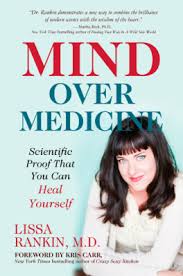
MindOverMedicineI just started reading a book by a medical doctor named Lissa Rankin. Rankin’s book, entitled Mind Over Medicine, presents evidence from a large body of scientific literature suggesting the mind often plays a major role in wellness by way of mechanisms that aren’t yet fully understood, but which defy the traditional view of Western medicine.

Rankin was intrigued by the vast number of anecdotal cases of what doctors call “spontaneous remissions.” Spontaneous remissions are when a patient becomes healthy in a way that defies explanation (i.e. they had no treatment, they had insufficient treatment, and they had an illness for with the body’s immune system is normally believed incapable of doing the job on its own.) She wasn’t satisfied with these one-off stories involving placebos, fake surgeries, busted radiology equipment, faith healing, etc, but rather wanted to see what the scientific literature contained by way of scientific double-blind studies on the subject.

She found there was evidence to support mind over matter when it came to illness, and that there was a fledgling explanatory literature. She also learned that while there was a large database of spontaneous remissions, there had not yet been an attempt to determine whether there were common characteristics of those who showed the “placebo effect” (getting well while being in the placebo group of a double-blind study) or other spontaneous remissions.

My point is that there is good reason for skeptics to consider that there may be a lot more to health and well-being than our current paradigm suggests.

BOOK REVIEW: How to Meditate by Lawrence LeShan

How to Meditate: A Guide to Self-DiscoveryHow to Meditate: A Guide to Self-Discovery by Lawrence LeShan

My rating: 3 of 5 stars

Amazon page

LeShan’s book offers a secular and scientific guide to meditation. By secular, I don’t mean to suggest that it’s devoid of mention of religion. On the contrary, How to Meditate delves into a wide variety of meditation styles that have roots in religion, and it quotes from spiritual teachers across a range of religions–including the mystic branches of Christianity and Islam. I mention the latter because the book seems tailored to bringing individuals into meditation that do not normally think meditation as being their bag, which could include atheists, secular humanists, or those whose religious practices don’t involve a mystical component. I just mean that the book is secular in that it doesn’t advocate a specific religion or suggest that one needs to hold any particular spiritual beliefs to benefit from meditation.

Also, by scientific I don’t mean to suggest that the book gets bogged down in the minutiae of EKG’s or the like. How to Meditate is readable to the general reader, except perhaps for chapter 11, which deals with using meditation in psychotherapy. [However, by the author’s own admission, one can skip that chapter with no great loss if you aren’t a therapist.] What I do mean to say is that LeShan takes an approach to meditation that is grounded in real-world, observable results. He tells the reader of the mental and physical benefits of meditation as they are discussed in the scientific literature.

In other words, if you think that meditation is only for hippie-types who believe in auras and astral planes, this book may convince you otherwise. On the other hand, if you’re one who believes in auras, astral planes, or the idea that only one true guru / path exists, you’ll probably be miffed by this book. There are a couple of chapters devoted to ideas that people believe that both have little evidence of grounding in reality and which detract from meditation. This includes ESP, auras, strange maps of reality, and guru-worship.

The core of the book is chapter 8, which explains how to do meditations of eleven different kinds. The book addresses single-point awareness, breath counting, thought watching, bodily awareness (specifically, Theravada Buddhist style meditation), word association (1,000-petaled lotus), mantra meditation, meditation on “I”, movement meditation (particularly Sufi-style), sensory awareness, safe harbor meditation, and unstructured meditation. The first ten are all types of structured meditation, and an earlier chapter is devoted to distinguishing structured from unstructured approaches to meditation. There is also an earlier chapter that discusses a broad taxonomy of meditation and sub-classes of meditation.

The book is logically arranged for the most part. It begins with a chapter on why one should meditate. This first chapter sets up two chapters that deal with the psychological and physiological effects of meditation. There is one oddity of organization. The core “how-to” chapter is bookended by a chapter on ESP and one on various pitfalls of spiritualism. It would seem these two chapters should go together as they both deal with things that detract from meditative practice, and not with the central chapter wedged between them.

The last couple chapters and the Afterword aren’t as beneficial for the general reader as the first 3/4ths of the book or so. One of those chapters is the aforementioned chapter for psychotherapists and the other deals with the social significance of meditation. The last chapter before those that I found superfluous, however, is one addressing the question of whether one needs a teacher to learn meditation. This pro and con discussion seems like a good way to end this book.

There is a long afterword by Edgar N. Jackson that adds a perspective on what we should take from LeShan’s book. I suspect that if page count were not a concern the book would have ended on the chapter that talks about decisions about a teacher. The last two chapters and the Afterword seem to have been added for the twin-fold purpose of hitting a target page count and to add a couple of niche audiences—namely students of psychology and fans of Edgar N. Jackson (i.e. Christians with an interest in mystical approaches to their religion.)

Overall, I’d recommend this book for those who are new to meditation, those who are seeking to expand their practice to new types of meditation, and those who are interested in the mind in general. As I mentioned, if you think of meditation as a route to see the glow of chakras or to commune with the dead, this probably isn’t the book for you—you’re likely to find its disregard for such otherworldly endeavors to be unappealing.

View all my reviews

Picture Your Unhappiness in its Underwear

I was writing some six-words on Smith Magazine the other day. I do this now and again as an exercise to get the creative juices flowing. There are a series of themes, and I try to write in as many of them as I can in less than 20 minutes, writing in a free form, stream of consciousness style.

When I got to the category HAPPINESS the first six-word to jump to mind was: “Picture your unhappiness in its underwear.” This one drew a nice response, which began me thinking about whether this advice might have actual merit–as opposed to being a non-nonsensical statement that might at best function as a Zen koan.

As I thought about it, three legs of the stool came to mind.

1.) Have a sense of humor. Anger and sadness have a hard time taking hold if one can manage a good laugh. I’ve found that being able to dance personal tragedy into comedy has been a great coping mechanism. One does have to be conscientious about not becoming a snarky person. One risks beginning to see the world through a crap-colored lens just as a means to comic fodder (or from a martyrdom complex.)

Perhaps even if one can’t formulate humor, one can still use laughter. There’s a system called laughter yoga that is based on the belief that you can create the same range of physiological responses from “forced” laughter as one does from spontaneous laughter. It’s a sort of chuckle pranayama (breathing exercises.)  While I don’t know much about the system, I can believe that it has merit based on what I’ve read about human emotions.

2.) Lay the source of your unhappiness bare. This sounds simple enough. One must know what is making one unhappy in order to turn that frown up-side-down.

That being said, human beings have an astounding ability to attribute all negative happenings in their lives to external factors. Like politicians, we like to take responsibility for what is going right (regardless of whether we are responsible or not), and we love to place the blame for failure firmly elsewhere (even it it’s mostly our fault.) This may be an evolutionarily-hardwired coping mechanism, but it can keep one in the doldrums.  If one continually says, “He makes me so mad” or even, “His actions make me so mad,” then you’re forfeiting control over your emotional state. Jerks and bitches might be an intermediary cause of unhappiness, but ultimately one’s own perceptions and responses lead to the negative emotional state.

This is where the hard work of mind training comes into play. Instead of being swamped by negative thoughts, one has to recognize them early, find the root cause, and recognize that our desire to for things to be a certain way is ultimately what makes us unhappy. We may want people to think we are smart or beautiful, and intimations to the contrary (whether intended or not) make us fume.

Don't be an angry monkey!

Don’t be an angry monkey!

One of the few things I remember explicitly learning in high school was about what our psychology teacher called a “gestalt of expectations.” Like most ideas one remembers though only taught once, I remember it because it had a memorable story attached to it. The story goes like this: “A man is driving through the desert in the American southwest. Now, out in the southwest, gas stations can be few and far between. So the man runs out of gas, and realizes that the station he passed 20 miles back is his safest bet because–contrary to what he had thought– the next one going forward might be another 50 miles.  So he starts walking. It’s hot. He’s hungry. He’s thirsty, and only has some lukewarm water that’s getting hotter by the minute. The backs of his hands and his face are getting sunburned. He starts thinking about how the little two-pump gas station is going to gouge him. He realizes he’s desperate, and so he figures the attendant is probably going to sell him gas at $6 a gallon, a bottle of cold water for $8, and don’t forget the jerrycan at $20.  These thoughts and the heat keep making him madder and madder. Finally, he gets to the station, and the attendant comes out and say, ‘Oh my, Mister, you must have had a horrible time.’ And so the man on the verge of heat-stroke punches out the attendant, a kid who only wanted to help him out.” Once one starts attributing one’s unhappiness to external sources, one can easily mis-attribute unhappiness because one thinks one knows what is in the minds of others, when really one doesn’t.

3.) Unhappiness, like standing around in one’s underwear, is–at most–a temporary state. As Taoists have been known to suggest, one’s darkest hour is a time to rejoice, for surely it will  get better from there. The only way one can remain in a perpetually unhappy state is to carry it with one long past its time. Just like the only way that can always be rained on is if one carries around a complicated mechanism with a showerhead and tank and keeps refilling that tank so that the shower never runs out. Otherwise, the dry season will come eventually.

Tulip 7

Night falls on Bangkok

Night falls on Bangkok

I’m speed-walking down the sidewalk off Sukhumvit Road like one of those elderly mall-walkers.  Like the mall-walkers, there’s an irony to my speedy step. I’m on vacation. I have no particular place to be, and no particular time by which I need to be there. Unlike the mall-walkers, my path is perilous. I have to weave around street-food vendors deepfrying springrolls or grilling satays (and fight my stomach’s urgings), evade the grasping taunts of idle tuk-tuk drivers, and wave off T-shirt vendors selling shirts featuring elephants, thaiboxers, and Singha beer.

I don’t know why I’m moving so quickly. It feels natural. It’s the pace of the city. To walk slow would be to swim against the current. If you want the truth, I walk fast because in the back of my mind, in the deep recesses of irrationality, I feel that if I slow down the city will collapse into me, forming a black-hole. It will start with a few tuk-tuk drivers, a beggar, a prostitute, and a few street vendors converging on me. They will create a gravity, attracting more vendors, beggars, drivers, and hookers. If I don’t walk fast, I fear that I will be crushed in the center of a dense mass of humanity.

Leaning against the marble wall of a bank façade, a master of timing, an Indian man blinks, touches his forehead, and grimaces–as if my approach causes him some sort of psychic pain. I brace myself for the scam. He steps away from the wall into my path, gently extending an arm.

He says, “Sometimes, you think too much.” He’s trying to convince me that he has insight into my soul by making a statement that, while perfectly correct, contains no information content whatsoever. He’s smooth in behavior and handsome of feature. I bet he makes a mint in his chosen profession.

An instantaneous battle rages inside of me. On the one hand, I’m an introvert– or perhaps a sociopath– something like that. Whatever my affliction, interacting with strangers is draining. On the other hand, I’m curious about everything. I know the man is a scam artist. It’s not that I was never on the turnip truck, but I fell off a couple of decades ago, and while it took me several bounces to come to a stop, I eventually became quasi-worldly. While I know he’s a scam artist, I don’t know what kind. I so desperately want to know that I stop.

After a greeting, he says, “I can tell your future. There are two women in your life, I can tell you how it will work out.” His speech is clear, and well-spoken, like he was born in Mumbai, but moved to Cincinnati when he was 15. He is, in all respects, a smooth operator.

However, he’s wrong already.  As I said, I’m not exactly a people person. It takes all my mental energy to even be monogamous, as opposed to nul-agamous. The idea that I’m maintaining two relationships would be a bit laughable to anyone who could really “see into my mind.” Whenever I hear about one of these guys who has two separate families, I always think, “How many hours a day did the good Lord grant you?” Because I can’t fathom living that way and not being in an utter state of exhaustion every minute of every day. I’d be a wreck.

However, I give him points for playing the odds. I’m a middle-aged man with a gray goatee walking down the street in Bangkok. I’m probably the only one fitting that description who hasn’t fallen desperately (and pathetically) in love with an “eighteen year old” bar girl who the man secretly thinks is 16, but who, in reality, is 29.

Incredulity must show in my face, because he changes tack. “Let me show you proof of my abilities.”

He extracts a flip-style pocket-notepad from the inner pocket of a tweed sport-coat that is grossly out-of-place in steamy Bangkok, but which lends credibility. He scribbles down something on a page so that I cannot see. He then tears off the strip of paper containing his writing. He wads the paper up.

“I want you to think of the English-language name of a flower. Have you got it?” he asks.

“Yeah,” I reply.

“Now think of a number between six and nine. Have you got it? Now think of them together.”

In my mind I see, Tulip 7.

He hands me the wadded up scrap. I unravel it. It reads, “Tulip 7.”

He then opens his day-planner and asks me to put in any amount that I feel is fair and he will tell me about my future.

What he doesn’t know is that I’m the exact wrong person to pitch his act to. As a skeptic, I make Descartes look like gullible. (After all, Descartes developed a “proof for the existence of God”–granted everyone deserves a nadir of thought, and that was clearly Descartes’.) The most fundamental thing that studying Economics and Political Science taught me was that humans are completely incapable of making meaningful predictions. I’d seen this guy’s act before from a guy named Professor Bruce Bueno de Mesquita, but instead of getting a few baht on the streets, the political scientist got millions of American tax dollars for convincing the CIA that he could tell the future.

As I walk away, he says, “You have an ailment. I can tell you about it.”

I think, Good one, that’s a true test of my powers of skepticism, and I continue to walk, thinking out how the mentalist scammer did his trick… and wondering if I have cancer.

BOOK REVIEW: Unbelievable by Stacy Horn

Unbelievable: Investigations into Ghosts, Poltergeists, Telepathy, and Other Unseen Phenomena from the Duke Parapsychology LaboratoryUnbelievable: Investigations into Ghosts, Poltergeists, Telepathy, and Other Unseen Phenomena from the Duke Parapsychology Laboratory by Stacy Horn

My rating: 3 of 5 stars

Amazon page

For 50 years a laboratory operated at Duke University that studied extra-sensory perception (ESP), ghosts, and other paranormal events. Today one can’t imagine an academic laboratory devoted to paranormal activity surviving, especially at such a prestigious university. Horn’s book takes one through the life of this lab. It describes phenomena debunked as either fraud or poor methodology, but it also discusses events and outcomes that have remained unexplained.

The central character in the book is J.B. Rhine, Director of the Duke Parapsychology Laboratory. Rhine was a botanist by training, but he developed an interest in parapsychology– eventually becoming the foremost expert in the, albeit dwarf, field.

When the lab opened in 1930, the universe of unknowns was much greater than when it closed in 1980. This was exemplified by Albert Einstein’s correspondence with Rhine, and the author of relativity’s attendance at a séance on one occasion. By 1980, having recorded some unexplained phenomenon, but having produced neither well-validated results nor explanations, the lab was looking increasingly like a boondoggle.

The phenomena studied included some that could be systematically studied  in the laboratory, as well as others that could only be observed in the field. The former being exemplified by the use of cards with shapes on them to study telepathy (as depicted by Bill Murray’s character in Ghostbusters.) The latter included the study of poltergeists or interviews of children about the lives of people who lived before their time (e.g. as Tibetan lamas are selected).

One of the questions confronting the investigators was whether those phenomena that could be studied in the lab were best studied there. While telepathy studies sometimes showed a weak but positive result, some thought that more robust results could only be attained under real world conditions.

In the 60’s, Timothy Leary came to call on Rhine. Leary, of course, thought hallucinogens were the key to unlocking the hidden powers of the mind. Rhine apparently took LSD on a couple of occasions before concluding that there was nothing but vivid chaos coming out of the experience. Still, there remained adherents to the notion that mind-altering drugs might unlock hidden potentials. Horn devotes several pages to the work of Sidney Gottlieb, the head of the CIA parapsychology program. It should be noted that the government programs were not stopped until the mid-90’s, fifteen years after Duke’s Parapsychology Lab shut down.

The last gasp of parapsychology was an attempt to determine if quantum entanglement might have any ramifications for ESP. Quantum entanglement is the situation in which two particles separated at great distance can influence each other instantaneously. Could the particles in two minds behave accordingly, and, if so, to what result?

View all my reviews

BOOK REVIEW: Secret Weapons by Cheryl Hersha, et al.

Secret WeaponsSecret Weapons by Cheryl Hersha

My rating: 3 of 5 stars

Amazon page

Secret Weapons is about two sisters who are trained in an MKULTRA-style behavior modification program to become femme fatales. This book was a rare find. I hadn’t heard of it before or seen it in my local bookstores, but I came across a copy at the Strand bookstore in New York (the “miles of books” place) on a trip several years ago.

Like Whitley Strieber’s Communion, this book leaves one engrossed but wondering what exactly one is reading. It is written as non-fiction, and not creative non-fiction that admits to blending elements of fiction into the fact. The writers are eager to convince the reader that this is not a hoax. About a quarter of the book is supporting documents to lend the book credibility. However, while I’m well aware of the “mind control” programs sponsored by the American government, this story doesn’t ring true to me. (In large part this is because we know the programs that operated were not nearly so successful as the one in Secret Weapons would have had to have been.) [I wrote a post about such programs that is available here. If you’d like to read some primary documents on the subject, this page at the National Security Archives has many of them.]

One might think that there are two possibilities: either it’s a true story or it’s a hoax. However, it’s a third possibility that makes this book so thought-provoking. What if the two sisters believe that the story is absolutely true, when–in fact–it wasn’t? How could this be? Their father is presented as an unsavory character. One possibility is that the father abused these girls and they created an elaborate backstory in their minds to cope with the fact that the one man who should have loved them, that they should have been able to trust, neither loved them nor was worthy of their trust.

Of course, another possibility is that it’s all true. While a lot of information did come out about Projects ARTICHOKE, BLUEBIRD, and MKULTRA, a lot was also shredded. The person working the shredder might have gone after the documentation of activities involving pedophilia first. If there is any activity that would have rightfully taken the situation from one of CIA employees being sent to country club federal prisons to them being strung up on the Capitol steps, it’s what’s depicted in this book.

Of course, it could all be a hoax as well. A story like this, if believed, elicits the publicity of the news media. That’s a powerful way to sell books.

I’ll leave the reader to decide which of the three possibilities they believe is most likely.

If you haven’t concluded this already, let me be explicit: This book contains disturbing descriptions (and even sketches.) It isn’t gratuitous to the story they are trying to convey, but if you have a weak stomach for such matters, I’d recommend you steer clear.

View all my reviews

BOOK REVIEW: On Killing by David Grossman

On Killing: The Psychological Cost of Learning to Kill in War and SocietyOn Killing: The Psychological Cost of Learning to Kill in War and Society by Dave Grossman

My rating: 5 of 5 stars

Grossman’s work reports on a line of research started by Army historian and author of “Men Against Fire” S.L.A. Marshall. Grossman not only brings us up-to-date on this thesis, he shows us its ramifications for modern society-at-large.

A two-part thesis was advanced by Marshall and continued by Grossman and others.

First, humans, like other species, are reluctant to kill within their species. (Marshall noted that in World War II about 75% of soldiers would not fire on the enemy when they had the opportunity. There is evidence this was true for earlier wars as well.

Second, the percentage of soldiers firing on the enemy could be increased by training that conditions them to shooting targets that look more human. i.e. Instead of shooting bulls-eyes, they should at least shoot a shape that looks like the silhouette of a man’s head and shoulders.

It turns out that the ability to condition combatants proved correct. There was a progressive increase in genuine engagement of the enemy by soldiers in subsequent wars (i.e. the Korean and Vietnam Wars.)

Grossman goes on to say that this type of conditioning is not limited to soldiers and police officers. He suggests that video games in which gamers shoot at humans and humanoid creatures will desensitize players to trigger pulling. Many scoff at this idea because they think that he is saying that such games make killers. What he is suggesting is a bit more subtle than that. He is saying that a person who is pre-dispossessed to go on a killing spree will be less reluctant if they have undergone the conditioning of this type of gaming. In essence, an high barrier to going on a killing spree will be lowered.

Grossman covers many other issues related to killing, such as the importance of distance. One intriguing fact is that an infantryman that kills a single enemy soldier in war is more likely to have problems such as Post-Traumatic Stress Disorder (PTSD) than a bombardier who drops bombs that may likely resulted in hundreds or thousands of deaths.

The book also talks about the role of authority, famously addressed by the Milgram experiments. Stanley Milgram found that most people would turn a knob that they believed was delivering a severe shock to a complete stranger, if they were told to do so by someone who seemed to be an authority figure.

I highly recommend this book for those interested in the subjects of:
– PTSD
– the role of violent video games in mass killings
– the psychological effects of killing

View all my reviews