Wen Fu 2: “Introspection” [文賦二] by Lu Ji [陆机] [w/ Audio]

Close your eyes and listen with care.
Turn all your attention inside.
Let your soul ride the Eight Borders
At a galloping stride.

Inner space brightens, becomes more
Compact, as one views the expanse.
Words pour forth to cleanse the soul,
As the Six Arts lend a fragrance.

Float, swim, and dive in the abyss,
Heedful for words as it all soaks in...
Sometimes the right word must be hooked,
And hauled up where it can be spoken.
But, other times, words are like birds,
That fly themselves out of the clouds,
To be downed by one swift arrow --
Quite willingly freed of their shrouds.

Mine for lines lost ages ago --
Rhymes unsung for ten centuries.
Thank tight buds for the sweet flowers
That they - soon enough - will be.

See past and present concurrently,
At once, touch mountain and sea.

The Original in Simplified Chinese:

其始也,皆收视反听,耽思傍讯,精骛八极,心游万仞。

其致也,情曈曨而弥鲜,物昭晣而互进。

倾群言之沥液,漱六艺之芳润。

浮天渊以安流,濯下泉而潜浸。

于是沈辞怫悦,若游鱼衔钩,而出重渊之深;
浮藻联翩,若翰鸟缨缴,而坠曾云之峻。

收百世之阙文,采千载之遗韵。

谢朝华于已披,启夕秀于未振。

观古今于须臾,抚四海于一瞬。

Wen Fu 1: “Poetic Experience” [文賦一] by Lu Ji [陆机] [w/ Audio]

The poet stands in the Center
And stares into deep mysteries.
He's nourished by reading Classics
And tombs of the men in Histories.
He sighs as four seasons pass by
And thinks upon ten-thousand things.
He's saddened by Autumn's leaf drop
And gladdened by the tender Spring.
He feels Winter's frost on his heart,
Though his mind may be up in a cloud.
And when he sings of ancestors'
Heroic deeds, he belts the song aloud.
He combs through great literature
Just as he roams the forest wild,
But in search of a "natural" --
Shown in elegant phrase and style.
And it's just such thoughts and feelings
That set my brush and mind wheeling.

The Original Chinese:

佇中區以玄覽,頤情志於典墳。
遵四時以嘆逝,瞻萬物而思紛。
悲落葉於勁秋,喜柔條於芳春,
心懍懍以懷霜,志眇眇而臨雲。
詠世德之駿烈,誦先人之清芬。
游文章之林府,嘉麗藻之彬彬。
慨投篇而援筆,聊宣之乎斯文。

“Rain on Lotus” by Yang Wanli [w/ Audio]

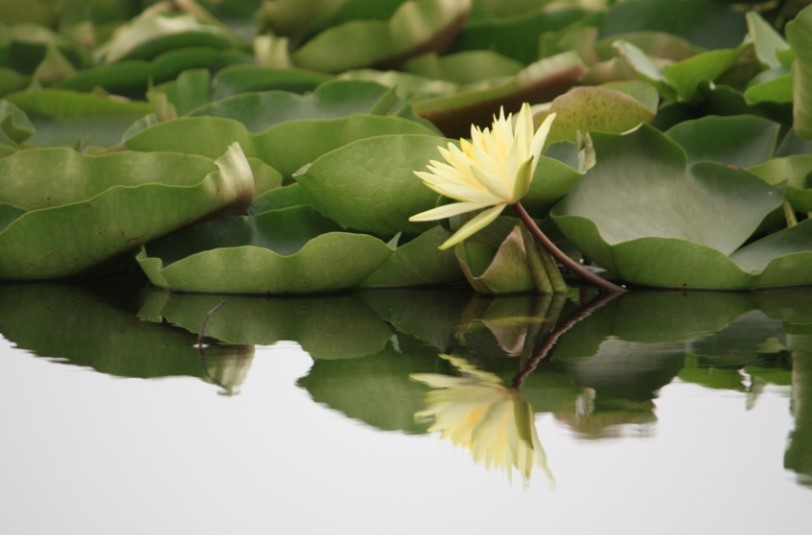
Asleep on a leaf beneath lotus blooms,
Their fragrance floats across the misty lake.
Sudden rain - taps upon the canopy;
Its sound snaps me from sleep to wide awake!

The lotus is beaded with rain droplets --
Like pearls, drops roll together and apart;
The clear blobs coalesce like mercury,
Dripping to the river... back to their start.

“Night Mooring” by Zhang Ji [w/ Audio]

The moon sets; crows caw below frosty skies.
Boats, moored to maples -- lamps glow like cat eyes.
Cold Mountain Temple, outside Gusu's bounds:
The midnight bell cuts off soft water sounds.

“The great road has no gate” by Tiāntóng Rújìng [w/ Audio]

The great road has no gate.
It leaps out from the heads of all of you.
The sky has no road.
It enters into my nostrils.
In this way we meet as Gautama's bandits,
or Linji's troublemakers. Ha!
Great houses tumble down and spring wind swirls.
Astonished, apricot blossoms fly and scatter -- red.

Translated by Mel Weitsman and Kazuaki Tanahashi; printed in: Essential Zen. 1994. HarperSanFrancisco, p. 136.

Note: While Rujing was Chinese he was teacher to the prominent Japanese Zen Teacher, Dōgen Zenji, the latter published this and other poems, hence the dual categorization of it as Chinese and Japanese Literature.

“Wine Spring” by Pan Lang [w/ Audio]

I remember viewing the West Lake
While leaning on a pagoda rail.
The boats all clustered in threes or twos.
The islets under deep Autumn blues.

Flute song arose from among the cattails.
And a line of white birds - overhead - sailed.
I planned to fix my old fishing pole,
but clouds on water had my mind & soul.
“Water Dragon Chant” by Ge Changgeng [w/ Audio]

A screen of cloud veils the mountain,
And cold monkeys squawk from green pines.
Fungi abound, but seeds dormant,
Searching for sprouts -- alas, in vain.
Somewhere near there's a fairy cave
Where flutes and lutes are often played.
Its Way is overgrown with moss,
And the old stone gate yields no clue.
Where have all the fairy folk gone?

Looking back, there's an endless plain
Where flowers fall like streaming tears.
It's easy to grow old; Where is
the messenger to bring some news?
To tell who the Golden Phoenix charms?
Waking from a deep, restless dream
What remains are blooms on the stream.

BOOK: “Spring, Summer, Asteroid, Bird” by Henry Lien

Spring, Summer, Asteroid, Bird: The Art of Eastern StorytellingSpring, Summer, Asteroid, Bird: The Art of Eastern Storytelling by Henry Lien
My rating: 4 of 5 stars

Publisher Site

I enjoyed, and was stimulated in thought, by the first half of this book, as well as by sections of the latter half, especially in the fourth chapter. (It’s arranged into four chapters, echoing the book’s central idea of a unique four-act approach to storytelling prevalent in Eastern societies. I’ll get to why I was not so fond of Ch. 3 later.) The book employs exemplary works of literature, film, and even video games to support the claim that there’s not just one approach to sound story crafting — but, rather, that Eastern societies developed distinct modes of storytelling reflecting their values and worldview. (A note on the use of the word “Eastern”: while the book draws heavily on East Asian sources, it tries to make a broader case suggesting not only South Asia but also the Middle East [i.e. everyplace not big-W “Western”] fit this mold. The book might have made a stronger case sticking to East Asia, as – for example – it might be argued that Arabia / Persia of the time of One Thousand and One Nights, being Abrahamic, was closer to Europe than East Asia in values and worldview. To be fair, the author does argue that some parts of that book are believed to have come from farther East (India and, possibly, beyond.))

The book proposes that there are two (arguably three) styles of story construction that are distinctly Eastern. The first is a four-act structure that is far from just a rejiggering of the three and five act forms with which English Literature students will be familiar. Incidentally, the book’s rather unusual title maps to the elements of this four-act structure. The second involves circular and nested story structure. I don’t know that the author succeeds in (or even seeks to) convince the reader that this is a uniquely Eastern approach, but -rather – makes an argument as to why it is prominent in Eastern storytelling.

The author picked an excellent set of works to illustrate his points. Generally, the works are both well-known and well-received among diverse audiences. The films he employs as cases include Parasite, Everything Everywhere All at Once, and Rashomon (the latter also being a literary work.) Lien uses one of my favorite Haruki Murakami novels Hard-Boiled Wonderland and the End of the World as a critical example. I was not at all familiar with the video games he describes (beyond name,) but – given that I’d at least heard of them – I assume they are pretty popular (though I can’t speak to whether they have any discernable stories and will have to take that on faith.) [I’m not sure whether One Thousand and One Nights was a good choice for Eastern literature, though it is an excellent choice as of nested structure.]

As for why I didn’t care for the book’s third part. I should point out that is the most philosophical (and the least explicitly concerned with story) part of the book, and it aims to show how values and worldview vary across cultures such that there are differences in story structure and crafting between different parts of the world. That could be a laudable objective and germane to the book’s point and it’s not why I found this section to be muddled and ineffective. The problem is that the chapter oversimplifies the issue in a way that seems to undercut a broader central argument (that Eastern modes of storytelling are underrepresented outside of the East.) Instead of suggesting that people experience conflicts along continuums (e.g. individual to group identity) and that Easterners tend come to different conclusions than Westerners do based on differing values and cultural perspectives, it engages in an elaboration of the distinctions that seems to suggest there’s some unbridgeable gulf of understanding between cultures (and, quite frankly, kind of feels like it’s shifted from making the aforementioned point to just being a thinly veiled critique of Western culture — which is fine, but probably belongs in a different book — or maybe a manifesto.) But if there were no basis for stories to resonate across this gulf, then not only wouldn’t Parasite and Everything Everywhere All at Once have killed it at both the Oscars and American box office, there’d be no reason for artists to attempt to branch out and tells stories across tribal lines. Without establishing a basis for story resonance, it’s ridiculous to argue that Hollywood should use Eastern modes of storytelling and Eastern worldviews to a greater extent. (A profit pursuing entity is always going to seek the largest possible customer base.) I’m not attempting to negate the argument that there are different approaches to storytelling among different peoples nor that more diversity of approaches shouldn’t be seen across cultures. I’m saying that this chapter doesn’t well support the argument for greater representation of Eastern modes of storytelling outside of Eastern outlets (publishers, film studios, etc.) because it spends so much time arguing the cultural differences that it doesn’t indicate how cross-cultural story resonance is possible.

Overall, I found this to be an interesting and thought-provoking read, though it was – for me – a bit muddled in the middle.

View all my reviews

“Jade Cup” by Zhang Ju [w/ Audio]

The West winds tumble fallen leaves;
Autumn 's yellow, though blooms are shy;
I brush at dust upon my sleeves;
The horses' hoofprints dot the frost;
Moonlit cocks crow amid grain sheaves;
The road to town: no passersby.

Fame 's not gained by effort or skill,
And would fade away ten years hence.
Please don't dance, but drink your fill.
Six Dynasty tales flow away:
Diluted as waters spread and spill.
The world feels like dream and pretense.

BOOKS:  木兰辞 [Ballad of Mulan] by Anonymous

The Ballad of Mulan: 木兰辞 (Simplified Chinese Characters with Pinyin)The Ballad of Mulan: 木兰辞 by Song Nan Zhang
My rating: 5 of 5 stars

Available online at YellowBridge

This is a short lyric poem (15-1/2 quatrain, or 62 lines) that tells the story of a young woman who disguises herself as a man and joins the military to fill a slot that would otherwise have required her aged and infirm father to serve. The tiny poem packs in ten-plus years, during which Hua Mulan serves with great distinction and then returns home to take care of her parents. It’s a well-known tale that emphasizes the importance of filial piety and sacrifice. Though outside of China (as well as Taiwan and other Chinese cultural enclaves,) many may know it from the Disney version which has been panned for ditching the Confucian values and replacing them with ones that were thought would resonate better with a Western audience.

The poem is mostly arranged in quatrains of five-character lines with alternate line rhymes.

It’s a quick read and there is no room for the detailed tales of heroism that are depicted in adaptations.

If one is looking for a culturally insightful telling of the story of Hua Mulan, this is the right place to look. I’d highly recommend reading it.

View all my reviews