Even imaginary monsters get bigger if you feed them

Public domain image sourced from Wikipedia

Public domain image of Epictetus, sourced from Wikipedia

There’s a story about Epictetus infuriating a member of the Roman gentry by asking, “Are you free?”


(Background for those not into Greek and Roman philosophy. Epictetus was a Roman slave who gained his freedom to become one of the preeminent teachers of stoicism. Stoicism is a philosophy that tells us that it’s worthless to get tied up in emotional knots over what will, won’t, or has happened in life. For Stoics, there are two kinds of events. Those one can do something about and those that one can’t. If an event is of the former variety, one should put all of one’s energy into doing what one can to achieve a preferable (and virtuous) outcome. If an event is of the latter variety, it’s still a waste of energy to get caught up in emotional turbulence. Take what comes and accept the fact that you had no ability to make events happen otherwise.)


To the man insulted by Epictetus, his freedom was self-evident. He owned land. He could cast a vote. He gave orders to slaves and laborers, and not the other way around. What more could one offer as proof of one’s freedom? Of course, he missed Epictetus’s point. The question wasn’t whether the man was free from external oppressors, but whether he was free from his own fears? Was he locked into behavior because he didn’t have the courage to do otherwise?


I recently picked up a book on dream yoga by a Tibetan Lama, Tenzin Wangyal Rinpoche. Lucid dreaming has been one of my goals as of late. I wasn’t expecting to learn anything new about practices to facilitate lucid dreaming because I’ve been reading quite a bit about the science, recently. I just thought that it would be interesting to see how the Tibetan approach to lucid dreaming maps to that of modern-day psychology. Tibetan Buddhists are–after all–the acknowledged masters of dream yoga, and have a long history of it. Furthermore, I’ve been doing research about the science behind “old school” approaches to mind-body development, lately. At any rate, it turns out that there were several new preparatory practices that I picked up and have begun to experiment with, and one of them is relevant to this discussion.


This will sound a little new-agey at first, but when you think it out it makes sense. The exercise is to acknowledge the dream-like quality of one’s emotionally charged thoughts during waking life. Consider an example: You’re driving to an important meeting. You hit a couple long red lights. You begin to think about how, if you keep hitting only red lights, you’re going to be late and it’s going to look bad to your boss or client. As you think about this you begin to get anxious.  But there is no more reality in the source of your fear than there is when you see a monster in your dreams. There’s a potentiality, not a reality. Both the inevitability of being late and the monster are projections of your mind, and yet tangible physiological responses are triggered (i.e. heart rate up, digestion interfered with, etc.) It should be noted the anxiety isn’t without purpose. It’s designed to kick you into planning mode, to plan for the worst-case scenario. Cumulatively, one can get caught up in a web of stress that has a negative impact on one’s health and quality of life.  For most people, when they arrive on time, they forget all about their anxiety and their bodily systems will return to the status quo, until the next time (which might be almost immediately.) Some few will obsess about the “close call” and how they should have planned better, going full-tilt into a stress spiral.


Mind states have consequences, whether or not they’re based in reality. I’ve always been befuddled by something I read about Ernest Hemingway. He’d won a Nobel Prize for Literature and was universally regarded as one of the masters of American literature, but he committed suicide because he feared he’d never be able to produce works on the level that he’d written as a younger man. There seems to be more to it than that. Many others managed to comfortably rest on their laurels when writing became hard[er]–including writers with much less distinguished careers.  The monster may be imaginary, but if you feed it, it still gets bigger.


As you go about your day, try to notice your day-dreams, mental wanderings, and the emotional states they suggest. You might be surprised to find how many of them have little basis in reality. They are waking dreams.

BOOK REVIEW: Thing Explainer by Randall Munroe

Thing Explainer: Complicated Stuff in Simple WordsThing Explainer: Complicated Stuff in Simple Words by Randall Munroe
My rating: 3 of 5 stars

Amazon page

Allow me the awkward start of explaining two things before offering my lukewarm reception of “Thing Explainer.” First, I loved “What If?” (this author’s previous book.) I thought that book was brilliant, gave it my highest rating, and eagerly anticipated Munroe’s next book (this one.) Second, I didn’t deduct because this book is a pain to read on an e-reader (at least the basic model I have.) That’s on me. I should’ve known better, and accept full responsibility. All I will say on the matter is to recommend that–if you still do want to read this book—you get a hard copy. [If you have an awesome reader, your results may vary.] The hard copy is large-format, and that’s useful because the graphics are so crucial and the text can be hard to read (some of it is light text / dark background and some is dark text / light background.)

The author uses only the most common 1,000 words of the English language to explain the operations of many modern technologies (e.g. laptops and helicopters) and scientific ideas (e.g. the workings of a cell or the sun.) It’s an intriguing question, and I can see why Munroe was interested in it. Can one convey the inner workings of objects like nuclear power plants or a tree with a rudimentary vocabulary? You can. Munroe does. However, the next question is, “Should you?” I come down on the side of “no.”

One might say, “But this is a book for kids [or people with a child-like grasp of language], you aren’t the target demographic.” Perhaps, but the book doesn’t do children any favors because the brainpower needed to puzzle out what the author is trying to convey through imprecise language can be more than is necessary to expand one’s vocabulary. [e.g. What do “tall road” or “shape checker” mean to you? If you went straight to “a bridge” and “a lock,” you may be more in tune with Munroe’s thinking than I, and thus more likely to find this book appealing.] For adults, it’s like reading essays by an eighth-grader who’s in no danger of being picked for the honor roll. Without the combination of the book’s graphics and a general background in science and technology, I suspect the book would be a muddle. I’m not against explaining ideas in simple terms, but I felt the book takes it too far and it becomes a distraction.

On the positive side, the graphics are great—sometimes funny while providing enough detail to get the point across without bogging one down. Also, Munroe’s sense of humor comes through here and there throughout the book (though it’s hampered by the lack of vocabulary.)

The book includes the list of words used as an Appendix (though you obviously won’t find the word “Appendix.”)

If it sounds like something that would interest you, pick it up. It’s hard to say that I’d recommend it, generally speaking. It’s funny and educational, but it’s also distracting and tedious. I neither hated it, nor loved it. I give it the median score of “meh.”

View all my reviews

Reflections on Vietnam

IMG_0122I was five when Saigon fell. So I can’t say that I remember the war as breaking news. However, by the time I was coming into adulthood, Vietnam remained front and center in the American psyche. Many of the most prominent movies on the war came out when I was in high school or shortly thereafter (e.g. Platoon (1986), Full Metal Jacket (1987), Bat 21 (1988), Casualties of War (1989), and Born on the Fourth of July (1989).) Even films that weren’t explicitly or solely about the war often featured characters transformed by its crucible (e.g. Lt. Dan from Forrest Gump.)


It wasn’t just cinema. While many of the most prominent books on the war came out in the 70’s and early 80’s, bestsellers were still coming out during my early adult life (e.g. The Things They Carried (1990) and We Were Soldiers Once… and Young (1992).) Even once the war wasn’t news anymore, discussion of the aftershocks continued to grace news and talk shows. I do remember my father watching an episode of 60 Minutes  which showed footage of helicopters being pushed off of aircraft carriers into the sea as American forces steamed back home. I have no idea what that story was about (perhaps the ecological and environmental effects of the war,) I just thought it was too bad that they were destroying perfectly good whirly-gigs.


Terms like “the fall of Saigon” were etched into my consciousness before I had any capacity to understand them. It fell from what? To what? I didn’t know. It’s a city, right? How can a city fall? Balls fall. People fall. Dinner plates, unfortunately, fall. Of course, I’d eventually be taught what it meant, and would mistakenly think I knew what it meant for many years. I thought it meant the defeat of those forces that would keep Vietnam from becoming a totalitarian dystopia akin to the Soviet Union or, even more apropos, Kim dynasty North Korea. Sure enough, one side–the side that America had supported–had been defeated, but otherwise this “fall” was false.


IMG_0411As one walks around Saigon today, passing a few Starbucks, a Carl’s Jr, and innumerable Circle-Ks, it’s difficult to imagine how a victory by the other side would have resulted in a more entrepreneurial or vibrant Vietnam. The college kids at the dinner, largely ignoring the friends around them in favor of texting someone else on their iPhones, seem strikingly like their counterparts in Bangalore and Atlanta. They seem mirthful and exuberant. A tour guide lets fly little criticisms about the bureaucracy, and nobody sweeps in and throws a black hood over his head. People just don’t seem scared, brainwashed, or crazy, and–believe me–everybody who survives in North Korea fits one of those criteria. (While I’ve been impressed by cool, gregarious, and well-spoken North Korean diplomats; they’re always accompanied by a sinewy, mirthless “assistant” who I’m pretty sure has a syringe of strychnine in his pocket to silence the diplomat if he goes off script.)


I’m aware that it’s difficult to see the dysfunctions of a nation as a traveler or tourist. I also realize that–to twist Tolstoy– “All happy nations are alike; each unhappy nation is unhappy in its own way.” However, what Tolstoy’s quote doesn’t convey is that all families are unhappy in some measure–and the same is true of nations. However, it’s easy enough to see extremes of dysfunction. That’s why the Kims mostly keep foreigners out of the DPRK and carefully select and manage the experience of those they do let in. It’s difficult to imagine a degree to which things could be better in Vietnam that would have made the cost of that war worth it.


I also know that hindsight is 20/20, but where fear runs rampant foresight is 20/100 with a nasty astigmatism. In my International Affairs graduate program, I specialized in asymmetric warfare, writing a thesis entitled, “Playing a Poor Hand Well.” While my thesis didn’t focus on Vietnam, one can’t study asymmetric warfare without learning a thing or two about the Vietnam war. One learns that the mathematical, attrition rate-based formulas that analysts love are worthless in deciding a victor when one side is fighting in their backyard and the other is fighting in a place of marginal importance to a population who mostly couldn’t point said country out on a map. Will matters. What made America take on such a burden on the other side of the world?  Many feared a domino effect. If Vietnam was lost to the forces of communism, soon we’d be surrounded by tyrannical totalitarian states blaring “one of us, one of us…” through loudspeakers until we relented–or something like that. In retrospect, it seems like an astounding lack of faith in the appeal of democracy and rule of law, but that’s what happens when one stews in one’s fears.


What worries me is that I still see a desire to make mountainous threats out of mere ant hills.


POEM: I Stand Before the Sea

I am a string of MEs

Strung out through eternity

But each eternity will die

Leaving in place another I


An I, a me, standing before the sea

Forget what I said about eternity

I am a finite speck of sand

Pushed and dragged by an unseen hand


Crack the speck, the TARDIS of Who

I’m every creature in the zoo

Every beast with limb and lung

Residing in every land far-flung


You think you know me? You know me not

I’ve not known me since I was just a tot

So I’ll thank you not to spoil my investigation

By classifying me by creed or nation

7 Stress Fighting Tips with Relevant Monty Python Song Interludes and Book Recommendations

In writing this post, I realized that Monty Python provides the I-Ching of life wisdom. If they don’t say it, it may not need being said. So I’ve let them expound upon my points wherever possible.


1.) Always  Usually look on the bright side: Our brains are programmed to constantly be on the look for potential problems and ruminate over solutions. This isn’t without its advantages. However, as your brain takes flight with this problem anticipation mode, it can begin to taint how one sees the world.

My high school psychology teacher told us a story of what he called the “gestalt of expectations.” The story goes like this: One is driving across southwestern America and there’s a gas station coming up, but one still has half a tank. Being from the East, one doesn’t realize how rare service stations can be in the desert, so one passes it by. Of course one runs out of gas (it wouldn’t be much of a story otherwise.) As one is walking back toward the service station, one begins to obsess over how the service station attendant is going to screw one over. After all, the unknown individual knows one is in a desperate situation. The more one walks under a burning sun, the more one inflates the gas station attendant’s ill-intentions, and one suitably escalates one’s mentally rehearsed response. Finally, disheveled and weary, one reaches the service station. A concerned-looking attendant bursts out of the station to meet one, saying, “Geez, you look beat, what can I do for you?” And that’s when one punches him right in the nose.

BuddhaBrainThe good news is that one can gradually train one’s brain to take a more positive perspective. A neuroscientist, Rick Hanson, has written a few books on how one can go about this cognitive rewiring. Buddha’s Brain is probably the most well-known of these books. The book lays out the science behind the brain and negative thinking in particular, and then goes on to present suggestions as to how one can change this cycle and yield the benefits of a more positive outlook. While the title of this book makes it seems like a religious tract, it’s really secular and scientific. If you’re still concerned, you might check out the more secularly titled Hardwiring Happiness.


2.) Make rest part of the process–and an essential one at that: Duh?  Yeah, it sounds self-evident, but  too many people think of rest as the slacking off that one does between doing “useful stuff.” What isn’t valued is given short shrift. Don’t think of rest as a necessary evil. Equating rest with goofing off results in two problems. First, the obvious one, people don’t get as much rest as they should. Second, while one thinks he or she is resting, one may be under chronic stress (the bad kind) as one’s minds churns over what they should be doing and the adverse impacts of not doing it. Just as one should have rests built into one’s workout for maximal effect, one should have rest times built into the day, week, and year.


3.) Find your bliss, and just do “it”: You probably think that by “it” I’m referring to sex. Actually, sex isn’t a bad “it,”  as its go, but it’s not the only it. Exercise, work the heavy bag, do a vinyasa (yoga flow sequence), go to work solving the problem at hand, or practice your Silly Walk. This also sounds like a “duh!” kind of statement, but far too many people wallow when they feel overwhelmed. What do they wallow in? Negative feelings. They worry that they can’t possibly hit the deadline or find the perfect solution. They worry that they’ll let someone down. They get angry at other people, the world, or a god or gods for putting them in their present predicament. They bristle at the unfairness of the universe. All of this snowballs into a stress monster–to mix my metaphors up nicely. If one can’t meditate or keep one’s mind on one’s breath, one may find relaxation in exhaustion. It’s all about inertia. It’s hard to get moving when one thinks one’s world has gone to shit, but that movement will make one feel much better–even if it doesn’t seem it can solve the problem at hand. One might need to change one’s life’s course altogether and become a lumberjack.


4.) Don’t create false monsters:  Remember what Michel de Montaigne said, “My life has been full of terrible misfortunes most of which never happened.” As this is really just expanding on a point in item #1, instead of elaborating, I will offer you this Monty Python skit to consider.


5.) Exhale: Each exhalation trips the “rest & digest” circuit (i.e. the Parasympathetic Nervous System [PNS])  just a little. Granted, this subtle relaxation effect is easily overwhelmed by the countervailing forces of stressors and even the antagonistic effect of inhalation with its–also minute–fight or flight mode (of the Sympathetic Nervous System [SNS.]) Still, if you don’t know what to do, controlling your breath while elongating each exhalation is a good start. This will help in two regards. First, it helps the PNS gain a little ground. Second, it’ll break your conscious mind’s obsession with the problem (or potential problem) at hand. One’s mind will wander and one will lose track of the breath, but the more one practices quietly returning one’s attention to the breath the better off one will be. Becoming frustrated with these diversions only strengthens the stress monster–so don’t do it.

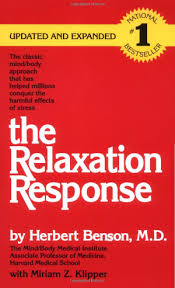
Relaxation ResponseThe bible of the rest and digest mode is Herbert Benson’s Relaxation ResponseThis book was first written over a quarter of a century ago, but it remains readily available. It’s telling that Walter B. Cannon’s work on “fight or flight” mode predates Benson’s work by such a long time. In other words, the medical and scientific community were researching the body under stress for decades before it ever occurred to anyone to think in terms of rest mode as a state that could be studied and advanced–as opposed to just being the normal state of affairs. This should give one an insight into how the human mind goes about considering problems.


6.) Recognize that stress is like cholesterol–there’s a good kind as well as the bad: Acute stress can serve one well during instances of danger. We have this response for good reason. The problem is chronic stress. When one’s body is in a stressed state, it’s not taking care of general maintenance tasks like healing itself. That’s fine in a short term, but problems compound over time. Chronic stress brings a high likelihood of illness because the body isn’t dealing with its run of the mill chores as it should be.

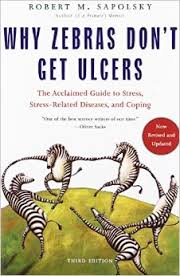
ZebrasUlcers_SapolskyThere are a number of books that expand upon this issue and which offer advice for keeping one’s stress of a healthy type. Robert Sapolsky’s Why Zebras Don’t Get Ulcers is among the best. It’s a long book and goes into great detail, but Sapolsky’s sense of humor helps to continue reading when the scientific minutiae might seem overwhelming. Another book on this topic that I found to be quite informative was Lissa Rankin’s Mind Over Medicine.  Rankin is a medical doctor, and so she offers a little different perspective from that of Sapolsky. (The latter is a biologist / neurologist.)


7.) Realize that you are a speck in a vast universe and, so, how big or long-lasting can your problem be?: Yeah, it’s a double-edged sword because it’s–in a way–a demoralizing thought as well as a comforting one. Therefore, one should first watch this bit of Monty Python wisdom:


But then one can keep things in perspective through the realization that one is not yet dead.

Blinders (Literal and Figurative) in the Martial Arts

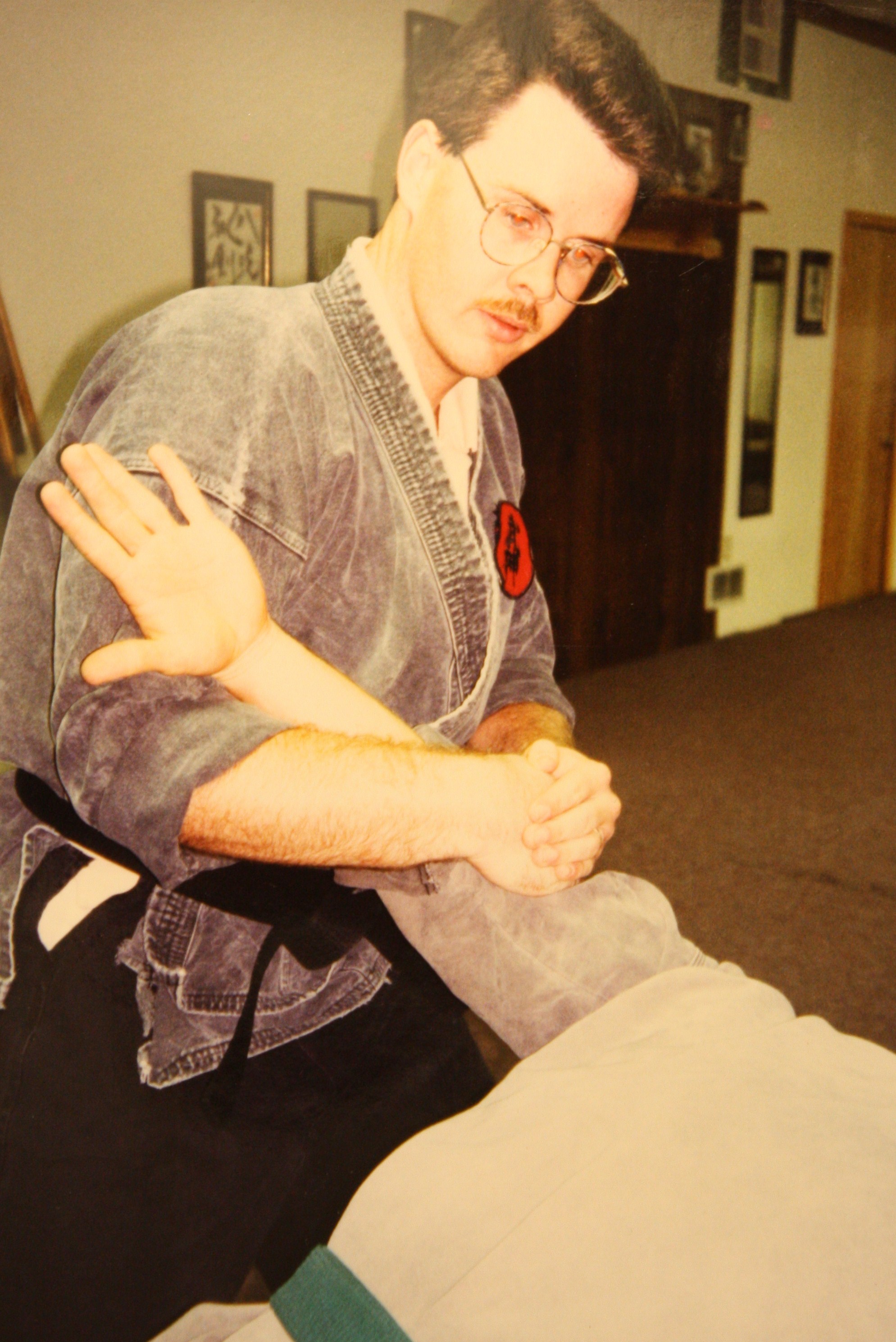
IMG_2553Many years ago I was training at a dōjō that had a practitioner who was a teacher for the blind. He requested that we put together a self-defense workshop for his students.  (If you’re wondering what kind of evil jackass would attack a blind person, rest assured that—sadly–such a level of jackassitude exists in the world.) The request presented an intriguing challenge. How does one adapt techniques that are premised on being able to see what the opponent is doing? Or maybe one shouldn’t adapt existing techniques but rather start from square one?


In preparation for working up a lesson plan, the person that asked for the workshop briefed the black belts. We learned that very few of the blind students lived in complete darkness. Instead, they displayed a wide range of different visual impairments. He even brought a large bag of goggles that simulated various impairments so that we could train in them to better understand what would or wouldn’t work with different types of impairment.


There were goggles that had funnels over the eyes such that one could see two little circles clearly while the rest of the world was black. There were others that had a complete field of view, but had translucent tape over the lenses so that everything was reduced to fuzzy blobs—as if one were looking through Vaseline. There were lenses that had a crackle effect such that one could only see veins of area clearly. There were goggles with no peripheral vision, and ones with only peripheral vision. He also had some goggles that blacked out the world entirely. Completely blind individuals may not be as common as one would think, but they certainly exist. Putting on any of the goggles was disorienting at first. A couple of the black belts even got vertigo or nausea when they moved around too quickly.


Now imagine what it would be like if one had always had the goggles on, that it was the only worldview one had ever known. Furthermore, imagine that everyone you interacted with on a daily basis all wore the same variety of goggles. You wouldn’t see it as an affliction or a limitation. To you, your view of the world would be full and complete. You would engage in behaviors that might seem odd to an outsider with unobstructed vision (e.g. sweeping your hands around in big arcs, turning your head at unusual angles, or calling out into the “darkness”), but these behaviors wouldn’t seem odd to you because you’d know it as natural behavior for someone who experienced the world as you did.  Because everyone you dealt with would see the world in the same way, it wouldn’t occur to you to think about whether there was another way to behave.


The preceding paragraph serves as an analogy for culture. One’s own culture is often invisible, especially if you don’t get outside of it much. All the people around you confirm your belief that you’re seeing the world as it is and behaving in the only natural and normal way imaginable. Sure, you may notice other people’s cultures—their skewed worldviews and the anomalous behaviors that result– but that’s because they do “strange things.” Still, some individuals will maintain that their culture doesn’t display any of the “odd” ways of behaving that more “exotic” cultures do.


But it does. Every culture is a mix of the good, the bad, and the ugly of how a people goes about living in the world given their cultural blind spots and skews. It includes collective coping mechanism for dealing with fears of uncertainty, and those are often the ugly side of culture. They encourage ingroup / outgroup separation, as well as primitive and superstitious approaches to dealing with those events, people, and behaviors that are out of the ordinary.


It’s easy to display double standards when one is blind to culture. I will give an example from my own life. It’s only been since I’ve been living in India (and traveling in Asia) that I’ve become aware of how many people are upset by Westerner’s secularization of Eastern religious / spiritual symbols and imagery. That’s a mouthful; so let me explain what I mean by “secularization of Eastern symbols and imagery.” I’m talking about “OM” T-shirts / pendants, bronze Buddhas, Tibetan thanka paintings, mandalas  (on T-shirts or posters), miniature shrines, or tattoos that are purchased because they are trendy, aesthetically pleasing, or vaguely conceptually pleasing without any real understanding of the tradition from which they came or intention of honoring it.


Granted it’s easy to miss the above issue if you’re a tourist because: a.) Many of said Eastern traditions practice a live-and-let-live lifestyle that make their practitioners unlikely to be confrontational about such things (in contrast to  practitioners of Abrahamic traditions (i.e. Judaism, Christianity, or Islam.)) b.) There are merchants in every country who are willing to sell anything to anybody for a buck, and so there are vast markets for tourists that offer up these symbols and images in droves.


It still intrigues me that it once caught me off guard that there were Hindus, Buddhists, Jains, etc. who were dismayed by the secularization of their traditions. I’m agnostic, but I was raised in a Christian household. Therefore, I can imagine the animosity aroused by the following conversation.


A: [Wearing a simple crucifix [or Star of David or crescent & star] pendant on a chain.]

B: Hey, A, I didn’t know you were Christian [or Jewish or Muslim]?

A: Because I’m not.

B: But you’re wearing a crucifix [or other Abrahamic symbol] pendant?

A: Oh, yeah, that. That doesn’t mean anything. It just looks cool. It’s kind of like the Nike swoosh.

B: [Jaw slackens.]


Now replace the crucifix with an “OM” shirt, and an inquiry about whether “A” is Hindu. Does it feel the same? If it doesn’t, why shouldn’t it?


Every martial art represents a subculture embedded in the culture of the place from which it came.  [Sometimes this becomes a mélange, as when a Japanese martial art is practiced in America. In such cases the dōjō usually reflects elements of Japanese culture (e.g. ritualized and formal practice), elements of American culture (e.g. 40+ belt ranks so that students can get a new rank at least once a year so they don’t quit), and elements of the martial art’s culture (e.g. harder or softer approaches to engaging the opponent.)]


The way that culture plays into a country’s martial arts may not become clear until one has practiced the martial arts of different countries—particularly in their nation of origin. While my own experience is limited, I have practiced Japanese kobudō in America (and extremely briefly in Japan), Muaythai in Thailand, and Kalaripayattu in India. I’ll leave Muaythai out of the discussion for the time being because I can most easily make my point by contrasting Japanese and Indian martial arts.  The Japanese and Indian martial arts I’ve practiced each reflects the nature of its respective culture, and they couldn’t be more different.


IMG_4525What are the differences between the Japanese and Indian martial arts I’ve studied? I’ve been known to answer that by saying that the Japanese martial art rarely uses kicks above waist level, while in Kalaripayattu if you’re only kicking at the height of your opponent’s head you’ll be urged to get your kick up a couple of feet higher.  What does that mean? The Japanese are expert at stripping out the needless and they work by paring away excess rather than building difficulty. The impulse of the Japanese is to avoid being showy. KISS (Keep It Simple, Stupid) appeals to the Japanese mind. (Except for the “Stupid” part, which would be considered needlessly confrontational and gratuitously mean-spirited.) There’s a reason why Japanese martial arts don’t feature prominently in global martial arts cinema. They don’t wow with their physicality; efficiency is at the fore.


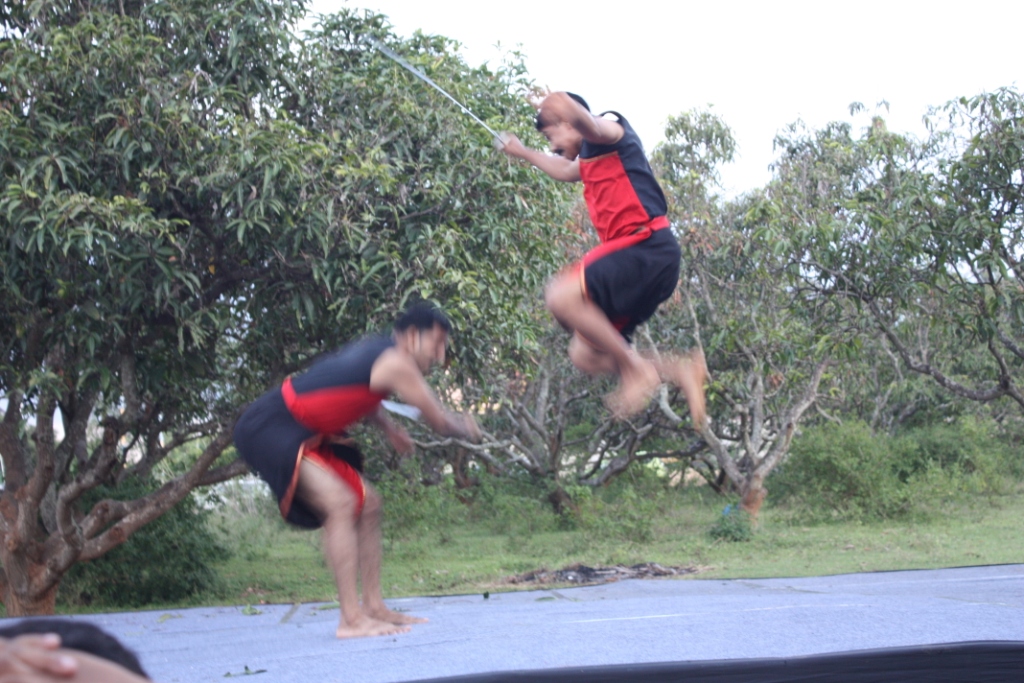
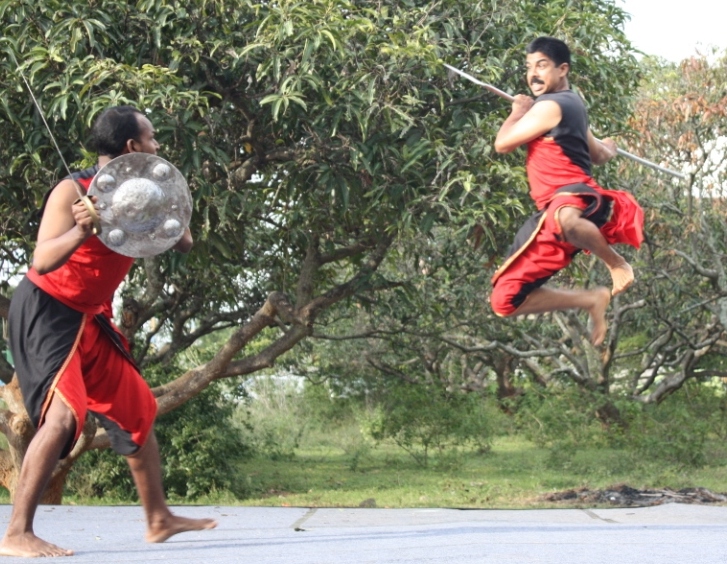
IMG_2246On the other hand, Indians are a vastly more flamboyant bunch, and Kalaripayattu is extremely impressive to watch and in terms of the physicality required to perform the techniques.  The Indian art isn’t about simplifying or cutting away the unnecessary. One has to get in progressively better shape as one advances to be able to perform techniques that require one leap higher, move faster, and be stronger. The Indian art isn’t about paring away excess, it’s about making such an impressive physical display that the opponent wonders whether one is just a man, or whether one might not be part bird or lion.


It might sound like I’m saying that the Japanese martial art is more realistic than the Indian one. Not really. Each of them is unrealistic in its own way. It’s often pointed out that the Japanese trained left-handedness out of their swordsmen, but that’s only one way in which Japanese martial arts counter individuation.  Given what we see in terms of how “southpaws” are often more successful in boxing, MMA, and street fighting, eliminating left-handedness seems like an unsound tactic at the individual level. There are undoubtedly many practitioners of traditional Japanese martial arts who can dominate most opponents who fight in an orthodox manner, but who would be thrown into complete disarray by an attacker who used chaotic heathen tactics. Consider that the only thing that kept the Japanese from being routed (and ruled) by the Mongolians was two fortuitous monsoons. The samurai were tremendously skilled as individual combatants, but the Mongolians could—literally—ride circles around them in warfare between armies. Perhaps, a more relevant question is whether Miyamoto Musashi would have defeated Sasaki Kojirō if the former had followed all the formal protocols of Japanese dueling instead of showing up late, carving his bokken from a boat oar, and generally presenting a f*@# you attitude. Who knows? But as the story is generally told, Musashi’s disrespectful and unorthodox behavior threw Sasaki off his game, and it was by no means a given that Musashi would win. Some believed Sasaki to be the more technically proficient swordsman.


All martial arts are models of combative activity apropos to the needs of a particular time, place, culture, and use.  And—as I used to frequently hear in academia—all models are wrong, though many are useful. (Sometimes, it’s written: “All models are lies, but many are useful.”)


[FYI: to the readers who say, “The martial art I practice is completely realistic.” My reply: “You must go through a lot of body-bags. Good for you? I guess?”]

BOOK REVIEW: The Memorable Thoughts of Socrates by Xenophon

The Memorable Thoughts of SocratesThe Memorable Thoughts of Socrates by Xenophon

My rating: 4 of 5 stars

Amazon page


Xenophon gives us an alternative to Plato’s accounts of the lessons of Socrates. As you probably know if you are reading this, Socrates left nothing behind by way of written teachings. All we know of the great philosopher’s teachings come from the accounts of his students. Xenophon’s version (Memorabilia of Socrates) is stylistically different from Plato’s dialogues(e.g. Euthyphro, Apology, Crito, and Phaedo), though Socrates’ wisdom and method (questioning) remain consistent.

I enjoyed Plato’s dialogues on the last days of Socrates more than Xenophon’s Memorabilia. This owes to Plato’s narrative approach, which tells us the story of Socrates’ trial, conviction, and execution. Philosophy is more palatable embedded in a story. However, all of these works (Xenophon’s and Plato’s) are short, readable translations, and so it is worth reading all of them to get a broader access to the thoughts of Socrates.

As with Apology, Xenophon conveys Socrates thoughts on piety and corruption of the youth (these were the charges raised against Socrates that resulted in his hemlock sentence.) Socrates maintained that he was pious, but he did think it a weakness to trouble the gods with questions that men should be able to solve for themselves. His emphasis on self-reliance and fortitude is part of why we so respect Socrates. One sees the imprint of Socrates on the school of Stoicism that would come later. In Memorabilia, Socrates openly mocks those men who cannot bear adversity as well as their slaves. (Yes, Socrates wasn’t so infallibly wise as to see the folly of slavery. I no more advocate paleomania [irrational exuberance for old thinkers / ideas] than I do neomania [irrational exuberance for new ideas.] Still, people live in the context of their times, and if one expects a person to be ahead of their time in all aspects, one will be disappointed.)

Socrates discusses governance and politics frequently in this volume. To a large extent, this is by way of trying to convince men that he believed would be good for governance to participate, and convincing those who he believed wouldn’t be effective leaders (e.g. Euthydemus) not to participate. Toward the end of book (part IV) he talks about the various forms of government (e.g. Monarchy, Aristocracy, Plutocracy, Tyranny, and Democracy.) These ideas no doubt informed Plato’s illumination of eight forms of government in The Republic.

What I appreciate most about Socrates was his groundedness and appreciation of the importance of the body. One can read a lot of philosophy without hearing mention of the body (beyond the thought that it might be an illusion created by the program that runs our brain-in-a-vat system.) One gets the idea that proponents of this discipline largely think of the body as a cart that drags around their great, big, lovely brains. Not so with Socrates. In fact, he rebukes philosophers for not taking care of themselves. He mentions the importance of nutrition, exercise, and sleep [this is where he’s ahead of his time.] Also, Socrates recognizes the damage done by having too great an attachment to comfort. (Here one sees an interest point of overlap with Eastern philosophies that derive from yoga–with its niyama of tapas [austerity and self-discipline.] By the way, that isn’t the only correlation between the Eastern and Western mindset we see in Socrates. e.g. At one point, a wealthy man complains about the poor behavior of his servant, to which Socrates asks upon whom this condition should reflect poorly—the master not the servant. Confucius made a similar statement to this one.)

I think this classic is well worth reading. It’s short, readable, and offers a great deal of food for thought. If you don’t have time for multiple accounts of Socrates’ teachings, you might be kept more enthralled by the Platonic dialogues, but surely you can make time for Socrates.

View all my reviews

The New Acropolis Explorations Course and My Experience Thereof

IMG_1576Last fall I attended a panel talk hosted by the New Acropolis in Bangalore. I’d never heard of the New Acropolis before, and only heard of said event because the head teacher from my yoga teacher training course was among the panelists. I found the environment at the New Acropolis to be friendly and intriguing. The talk took place amid a small library (not necessarily small for an institution of its size) and books always put me in my happy place.


There were brochures out for an upcoming 16-week Explorations Course. “Explorations” is the name for the introductory course that’s taken by non-members to dip their toes into the New Acropolis curriculum, and see if they’d like to continue as members of this school of “philosophy.” (You may be asking, “Hey–wait a minute–why’d he put quote marks around the word philosophy. I’ll get to that in due time.) At  any rate, perusing the brochure, I decided to enroll.


The course consists of 13 lectures given over a 16-week timeline. The reason there are more weeks than lectures is that there are two sessions in which one meets briefly with the instructor one-on-one, and one session that consists of exercises that one does with one’s classmates. (The latter is one of the highlights of the course.) The course is organized into three parts. The first and longest section deals with the idea of “know thyself.” That is, it presents several approaches to developing oneself as an individual. The second section expands the scope, looking at society and the role of individuals in it. The third section is about the “philosophy of history,” (there go those telltale quote marks again) or what they refer to as “evolution,” (really?) which shouldn’t be confused with Darwinian Evolution (which–as near as I can tell–has no status in their system of teachings.)


In my opinion, the transitions from one part to the next represent downshifts in the value of the course. (i.e. The course is at its most beneficial in the first section. That’s also the portion in which it’s presenting ideas that are fairly mainstream among the various philosophical / religious systems it studies.) As the course moves into the second section, one begins to see a few ideas that are either archaic or that depart from rationalism (e.g. the word “magic” gently enters the discussion.) By the time the third section rolls around, ideas that have no relationship to observable reality are being presented as if they were a given.


I was reading Nassim Nicholas Taleb’s book entitled Antifragile the other day and he used the term “neomania.” Neomania–a term that Taleb coined for all I know–means an exuberance for the new for its own sake (as opposed to any objective improvement it represents.) Taking this cue, I will cobble together the term “paleomania”(an exuberance for old ideas for their own sake) to describe one of the main underlying features of the New Acropolis syllabus. One might easily believe that nothing of value has been learned in the past 2000 years and that modern thinkers (not to mention modern science) have nothing worthwhile to lend to the discussion.


This can be seen in the ideas presented from ancient Greece. Let me first say that I’m a big fan of Plato. His words “Be kind, for everyone you meet is fighting a hard battle” is one of my favorite philosophical quotes. However, while I like Plato, the New Acropolis pretty much deifies him. I’m sure they wouldn’t agree with that statement. However, even Plato’s ideas on those subjects about which he was least in a position to write intelligently or authoritatively are presented as if irrefutable. A couple of his most ill-informed ideas are at the forefront of two of the lessons–notably the Platonic hierarchy of forms of government and the ideas he accepted [I don’t know that these are properly attributed to him, but he seems to have believed them] about astrology. (Note: New Acropolis’s teachings about forms of government seems to be one of the biggest causes of ill will toward the organization in Europe. Plato was an elitist on the subject. He distrusted democracy–to be fair they killed his teacher under [a form of] democracy–but believed that if you could just give a philosopher unlimited power he’d do the right thing for everybody–and not just himself. Plato wasn’t a believer of Baron Acton’s “…absolute power corrupts absolutely…” an idea that came later by those with a greater body of exposure to varying forms of government.)


The first couple of lectures I attended didn’t seem in any way untoward or unusual. The first lecture was about knowing oneself, and presented two ancient approaches to this question–i.e. Greek and Indian Vedic. The Greek three-pronged model of soma/psyche/nous, which is translated various ways–but commonly as body, soul, and reason.  The Indian approach was a seven-layered variant that also started with the physical body and moved toward more conceptual elements of being.


Now, it might have occurred to me that both of these approaches take the supernatural as a given, but as they were true representations of the systems in question, I didn’t find it bothersome. This raises a point that I think bears saying, I don’t think that the New Acropolis distorts the teachings that they include in the syllabus, but they do use selectivity to frame the subject. This framing gives the student a limited view philosophy and the various approaches to leading an examined life (as opposed to the unexamined life that Socrates told us was not worth living.)


The second lecture I attended was actually the third lecture–because I was out-of-town for a class on the Bhagavad-Gita–and it dealt with Buddhism. This session was the most orthodox and arguably the least controversial of the lectures. The four noble truths and the eight-fold path were the core of the lesson, and one doesn’t get any more fundamentally Buddhist than that.


However, the fourth lecture, which was ostensibly about Tibetan Buddhism, started me wondering where the course was going. One would expect a lecture on Tibetan Buddhism to refer heavily to the words of lamas, but most of the ideas presented in this lecture were attributed to a woman who I don’t think I’d ever heard of before. Her name was Helena Petrovna Blavatsky. (If you’re saying, “Hey, that name doesn’t sound Tibetan, you are correct.”) It’s not that I don’t think that a 19th century Russian woman is capable of giving informed insight into Tibetan Buddhism. However, one becomes curious when there’s not a single Lama, Rinpoche, monk or nun in the picture. While I’m admittedly a bit of a neophyte on the subject, I’ve been to hear Tibetan monks and nuns before and have visited the local Tibetan meditation center on occasion, so I’m not completely ignorant of that system’s teachings–enough to have an idea what the most fundamental ideas would be.


So, after the Tibetan Buddhism class, my Googling fingers got to work. I just wanted to be sure I wouldn’t be asked to drink any Kool-Aid made Jim Jones style. There wasn’t a lot on the organization besides their various websites, but there were a few negative comments and would-be controversies to be found. I wasn’t too concerned by these comments for a number of reasons. First, the claims were isolated and unverifiable. To elaborate, if a person is either far to the right or far to the left, then the middle seems an extreme way off. Therefore, when a leftist organization calls an organization a “fascist cult” one has to consider the bias of the source of the claim. (Note: the same could be said from the other end of the spectrum, but I stated it that way because that’s essentially what I read in one post.) Nothing I’d seen at New Acropolis would lead me to think they were fascist, or even particularly politically conservative (if anything, I’d guess that individual members would be more likely to be left of center, but it wasn’t really an issue that came up.) Second, most of the negative comments were directed at a couple of the European centers, specifically.


I will say that, despite the fact that I didn’t believe the extreme claims, I can’t say that they weren’t cause for concern. I’ve had a little experience with organizations prone to being embroiled in drama. Even if the organization has many worthwhile attributes and individuals, that inclination to attract drama will inevitably bite a member in the ass. In my experience, one can’t just sit on the sidelines and pretend the drama won’t affect you. If you do, you’ll just be all the more surprised when you feel your ass being bitten.


My web searches confirmed that the New Acropolis was an offshoot of the Theosophical Society. This wasn’t kept a secret. In fact, I believe it was mentioned in the Tibetan Buddhism lesson, and I know it was intimated at various junctures in the course. I was aware of the Theosophical Society, and–in particular–the falling out that Jiddu Krishnmurti had had with them. (A parting of ways that was apparently amicable on Krishnamurti’s side as well as on the side of some from the Theosophical Society’s side–though some Theosophists apparently went dark.) Krishnamurti is among my favorite thinkers, and it was a concern that New Acropolis was an offshoot of an organization whose beliefs were so at odds with his own. I don’t want to deify Krishnamurti (that would be ironic as he was explicit that he didn’t want followers and believed followers were missing the point), but many of his ideas resonated with my own–particularly those on organizations to advance personal or spiritual development (of which he [& I] are quite skeptical.)


Krishnamurti opposed the idea of religions, sects, and paths as means to betterment.  The New Acropolis would likely agree with Krishnamurti’s stance on religion as they’re explicit in their antipathy for the ritualism of religion. However, Krishnamurti went further to oppose entities that proposed that they had a path to guide one to some enlightened state. This is where the New Acropolis would presumably part ways. They seem to believe they have such a path. The aforementioned framing that they do seems to designed to carve out the waypoints so that future courses can work on building the path.


There’s  a common saying that a good education teaches one HOW to think and not WHAT to think. By that definition, I wouldn’t classify the New Acropolis’s approach as a good education, generally speaking. The course is set up for a one way flow of learning. There’s no time for discussion or refutation of the concepts presented in the course. The teacher presents concepts in a lecture format, and there are designated times in which students can ask questions (in many cases outside the class time when peers might have ideas to add or questions  to build off.) Despite the nominal homage to ancient Greece, the New Acropolis pedagogic approach is at odds with the Socratic method by which students are asked questions rather than being presented with answers.


What’s my beef with their use of the term “philosophy?” Depending upon how it’s used, I don’t have a problem with it. When they’re explicitly talking about their particular philosophy, (i.e. New Acropolis’s philosophy) it’s perfectly acceptable. It’s only when one uses the term in a general sense, e.g. as in “school of philosophy,” that students might expect that they’ll learn rational approaches to consider life’s big questions for themselves, rather than learning a specific ideology’s answers to said big questions.


The term “theosophy” would be much more honest and apropos, though I understand their reticence to use that term–given their strained relationship with the Theosophical Society–which has a corner on the market of that term. The fact that the New Acropolis takes the divine or supernatural as a given is hard for me to reconcile with philosophy, which implies an open discussion and refutation of ideas–particularly of those notions for which there is little or no evidence.  I’m not saying that philosophy can’t and shouldn’t consider the question of whether there is a god (or spirits or divinity or whatever term you prefer.)  I’m just saying that taking the existence of such ethereal entities as a given flies in the face of rationality, because the existence of such ethereal entities isn’t rooted in observation or application of logic but in emotion. Faith is the domain of theology (or theosophy, if you prefer), rationality is the domain of philosophy. A lot of the teachings in this course were couched in terms of feelings or the beauty of ideas rather than in rational investigation.


It might seem that I was quite negative about the experience, and that I wouldn’t recommend it for others. That’s not exactly true. There are some individuals that I wouldn’t recommend it for, but others that I might. I did learn a lot during the course, and brought away a number of ideas that I think will be of service to me. For example, we did a throwing stick concentration exercise that was eye-opening (no pun intended), and there were many ideas and stories presented in the course that provided good food for thought. There was only one class /idea that I found not only completely baseless but also potentially dangerous.


(FYI-If you’re wondering what idea that was, it was in the penultimate lecture on astrological cycles (yeah, I know, right?)  The lecture presented both Indian Maha Yugas and Greek zodiac cycles. Guess what? According to both mythical sets of cycles we’re currently in the crappiest of times. [FYI- If there’s anything my education and experience as a social scientist taught me, it’s that notions of determinism applied to the sphere of human behavior are inevitably wrong. The physical world may be clockwork, but the minds of men are a clockwork orange.] Why do I think these conceptions of cycles may be dangerous? Because a lot of damage is done by people who go through life thinking the world is feeding them a steady diet of shit-sandwiches. This is, of course, all perception. Nature–unlike gods and other supernatural mythical creatures–doesn’t draw targets on the backs of individuals, nor weigh them good or evil. However, now you’re going to tell people who already see the world through dung-colored glasses that your [pseudo-]science shows they were born in the worst of times. That–my friends–is not helping make a better world.)


I think those interested in the course should be aware of three things: 1.) a god, gods, the divine, the supernatural, or whatever you wish to call it is taken as a given by the course (you’re not going to see a Nietzschean counterpoint in this school of philosophy); 2.) you aren’t going to get a broad-based exposure to philosophy in that a.) the ideas are all from ancient traditions and b.) the concepts presented are cherry-picked to be consistent with the New Acropolis agenda (which isn’t to imply the agenda is onerous by the standards of sects or religions, but there’s an agenda) ; 3.) you should banish any expectations of engaging in rousing class discussions or dialogues with the teacher because it’s very much a one way street.  If you’re good with those three factors, you may want to give it a try. You might find it’s the right approach for you.

10 Easy Pieces of Wisdom: and, Why “Secret Wisdom” is Bullshit

IMG_0438

Having lived in India–land of sages–for over a year now, one may wonder whether enlightenment has taken hold. Let me share some of the nuggets I’ve gleaned. This isn’t what I found chiseled on walls in Sanskrit. It’s what living and thinking in the modern world have wrought.


1.) Anger is just fear in a red dress.

It’s all just frustration / unease / discontent with one’s limited domain of control.

On a related note, I read a relevant quote from Irmgard Schloegl recently: “Look at getting mad from this perspective. If you had but five more minutes to live, and it would still be worth getting mad over, then by all means do so.”


2.) Secret paths to wisdom are bullshit–the theory is simple the practice is arduous.

It all boils down to living in the moment more, being aware of your mind, and exercising your will.

First, you start becoming aware that you were recently a jackass.

Next, you begin to realize you’re in the process of being a jackass.

Then realize that you’re about to be a jackass–but you can’t help yourself and end up with jackass’s remorse.

Finally, you begin to preempt your inner jackass.

The latter is wisdom, and it’s not for lazy people who like shortcuts.


3.) There’s no ratchet effect on wisdom–no one-way trip to enlightenment or nirvana.

Either you accept that life is a glorious lifelong struggle to be the best version of yourself, or you wallow in a sty of mediocrity.


4.) The words “just a…”–as Catholic nuns say of masturbation–result in immediate blindness.

There’s nothing that will blind you to the deepest beauty of a person, place, or animal faster than saying it’s “just a…”


5.) Stop thinking of the body as an “empty vessel.”

It results in your treating it like a rental car. You aren’t a bar of gold being hauled around in a manure spreader. You were endowed with a Rolls Royce with on-board access to a Cray super-computer, and you risk turning into a Yugo with an abacus when you fail to keep it tuned and quietly revel in its magnificence.


6.) If a teacher is happy that his students  almost reach his level, he’s part of a dying tradition.

In a growth tradition, some students will surpass their teachers, and that’s only likely if the teacher wants it to be that way.


7.)  Be a scalable hero.

Human beings are terrified by their smallness, impermanence, and ultimate insignificance. In geologic time, everybody is an inconsequential blip. You can’t get around this, but you can pick a scale of time and space in which you matter. That space is here, and that time is now. In the here and now, you can be a giant–figuratively, of course. Here and now you can’t be everybody’s hero, but you can be somebody’s.


8.) Start your pursuit of virtue by doing no harm.

Begin being virtuous by capturing the advantage in those quiet moments that need nothing but a lack of interference or insinuation. Then go on to active expressions of virtue.


9.) Vicarious living ain’t living.

Don’t sit around watching others live life.


10.) Don’t count yourself free if your impulses overwhelm your conscious mind.

People worry a lot about the control that external forces and authorities exercise over their ability to act, but often spend far too little time on whether they’re working towards liberating themselves from raw impulse, habit, and reactionary living. Epictetus used to piss high society types off by asking them whether they thought they were truly free.

If you’ve been following the science of free will, you’ll know that the current prevailing thought lands against the notion of free will. This is because brain imaging has made it possible to see how decisions are biochemically made before the mind consciously ruminates and “makes a decision.” However, the verdict is still out. The question isn’t whether we ever fail to exercise conscious free will. Of course, there are many times we fail to, maybe even most times. The whole point of emotions is to help us make decisions without adequate information to make rationally optimized decision. However, the question is whether we can learn to exercise free will. Scientist long ago verified that some yogis and monks can exercise conscious control over autonomic bodily functions (e.g. controlling heart rate from a static position.)


There it is: wisdom for the modern age stuffed in a nutshell of bullet points.


TODAY’S RANDOM THOUGHT: “That” Doesn’t Make You So Mad

Source: Avengers Movie

Source: Avengers movie

“That makes me so mad!” One hears it all the time. It has to be among the most commonly uttered phrases in the realm of emotional experience. And, of course, it’s completely and utterly wrong. Your anger is a wholly contained neurochemical response. To credit something external with your anger is to grant that person or thing power over you–to enslave yourself. (Stoic philosopher, and former slave, Epictetus was known to piss off gentlemen citizens by asking them if they were “really free.”)


This isn’t to say there isn’t just anger.  However, think about what emotions are. Our emotions are a system evolutionarily evolved to allow us to make decisions with limited or no information. Without emotions our species, if we ever came to be, would have likely become extinct by way of “paralysis by analysis.” We know that happens to people who have neurological damage that keeps them from experiencing emotion. You might think they would become cold and rational Mr. Spocks, but the defining characteristic of such people is that they become paralyzed by indecision. It turns out that we make a lot of decisions with limited information or from an inability to determine a clear winner by way of facts and reason. Emotion plays and important role in those cases.


Chances are that if your immediate gut reaction to something is anger, you probably haven’t worked out a rational argument for your preference. If one has a clear line of reasoning rooted in fact, anger isn’t necessary to justify a position or decision. If your gut reaction to something is emotional, see whether you can  noodle out a rational reason before you swing into too rash an action…. unless the crosstown bus is careening at you.