Some love attributing sacredness -- places beyond place, times beyond time, the infinite & the infinitesimal. But anything elevated to the sacred becomes a thing for which people will kill or die. Often, people don't make this reckoning until the dying 's done: -death for a sign -death for a symbol -death for a chunk of dead earth -death for a vaguely evaluated idea The agents of sanctification will kill us all.
Category Archives: ideas
That Last Lost Generation [Free Verse]

Only too eager to have the machine installed in their brains, they did what they could, and, instead, installed their brains into the machine. Data sparkled in the mind void, bouncing about and careening into other bytes and clusters. But the crash cascades always came, a cannibalistic consumption of fact, transmogrifying it into a shabby soup of quasi-reality. Brain-pans paining, densely packed with alternate realities that could never be rectified. By the time they realized the virtue of going out to play, they were no longer sure what "outside" meant -- Outside of what? Where's the exit? Where is there something else? -something simple? How's one get off this speeding bus? It became the pain that ruled that last lost generation.
ESSAY: This I Believe [Including My Views on Unicorns]
Occasionally, I’m asked whether I BELIEVE some idea or BELIEVE in X [i.e. fill in the person, place, thing, or concept.]
If I were to answer these questions honestly, that answer would almost invariably be, “No.”
But, because that can seem overly contrarian — not to mention insane — I often try to guess the sense in which the questioner is using the words “BELIEVE” and “BELIEF,” and then answer accordingly.
Like many words, BELIEVE is one whose meaning meanders, and shadows fall across it in different ways, creating different hues [and impressions thereof,] depending upon one’s vantage point.
Often, people seem to use the phrase, “I BELIEVE X ” synonymously with “I understand X to be true.” “I BELIEVE it” can mean: I behave as though X is true, [but am not necessarily commenting on the degree to which X is supported by evidence or reason.] I, on the other hand, try to use BELIEVE in the sense of: “I accept the truth of X and behave accordingly, but I don’t really have any solid basis on which to rest this conclusion.” I like to draw as few such conclusions as possible, though sometimes it’s hard not to. For example, like most people, I live my life as if we are living in base reality — as opposed to being in some “Matrix”-like computer simulated world, but — if pressed — I’d have to admit that I can’t really support this belief convincingly.
If I were to be asked whether I BELIEVE there is a force that inexorably pulls me toward the Earth’s center, using my own interpretation of the word “BELIEVE,” I would reply in the negative. Before you ask how I can be so anti-gravity [pun not intended, but acknowledged,] let me say that I firmly understand there to be such a force as gravity. This is not to say that I fully understand the mechanism by which gravity works — which I certainly do not — but rather to say that I recognize the truth of such a force’s existence. I can experience gravity in my pathetic vertical leap, and even note it in the very impressive vertical leap of skilled athletes. I see it in the red leaf, twirling as it falls to the ground. I feel it upon takeoff as an airplane’s seat raises against my butt. Furthermore, I recognize that there are many scientists who’ve come to understand a great deal more about gravity than I, but also that none of what they’ve learned through their vast number of controlled observations contradicts my basic idea that I’m being pulled toward the planet (and it toward me.)
At the Jaipur Jantar Mantar, I was once asked whether I BELIEVED in astronomy and astrology? The questioner clearly thought this was a closed-ended, yes or no, question — as if the two fields dealt in identical content. Of course, from my perspective, it was a question similar to: “Do you BELIEVE in Zebras and Magical Unicorns?” — which is to say, not at all a straightforward and closed-ended yes or no question. [Incidentally, the reason I used the modifier “magical” is because I do “believe” in unicorns. I just call them “Indian Rhinoceroses” [Latin name: Rhinoceros Unicornis.]]
The long and short of the matter is this: I strive to BELIEVE as little as I can, and to hold even those BELIEFs only so tightly that they might fall away in the face of learning. Otherwise, what’s learning for [or is it even possible?]
BOOK REVIEW: Baudrillard: A Graphic Guide by Chris Horrocks
Introducing Baudrillard: A Graphic Guide by Chris Horrocks
My rating: 4 of 5 stars
Jean Baudrillard was a French Postmodernist philosopher who passed away in 2007. To those who aren’t navel-gazers of the philosophical variety, he is best known – if he is known at all – for having influenced the conception of the game-changing sci-fi movie, “The Matrix.” While I haven’t yet read “Simulacra and Simulation” – the book said to have inspired the Wachowskis, it seems that the influence of Baudrillard on the film’s world is that he provided abstract ideas that the film takes in a more literal sense. If this book represents his ideas well, Baudrillard didn’t claim that we are in a computer simulation run by an AI [or by anyone / anything else, e.g. an alien overlord] (that would be more in line with ideas presented by Swedish Philosopher, Nick Bostrom.) Baudrillard’s claim is that we are increasingly building and gathering around us a world of things that are — at their most fundamental level – signs and symbols. However, it’s also true that there are some quotes and concepts that make there way into “The Matrix,” probably most famously, “the desert of the real.”
A film [and its source novel] that might be said to more directly reflect Baudrillard’s ideas is “Fight Club.” Which isn’t to say that Baudrillard deals with issues of lost masculinity [he is, to many in academia, infuriatingly contrarian on gender related issues — proposing seduction as the source of feminine power to balance the masculine.] Instead, the ideas that play into “Fight Club” are that human beings have become – first and foremost – consumers, and second that people are striving for hyperreality — an existence that is more real than real. These core ideas: 1.) human as consumer, more so than producer; 2.) the world as a simulation; and 3.) the pursuit of hyperreality are book’s bedrock.
Built on that bedrock is a flow of topics. There are considerations of what Baudrillard’s ideas mean for art and entertainment. What is art? Is high art and low art a meaningful distinction? Baudrillard’s ideas are contrasted with various schools of thought that were active at the same time such as Marxism, psychoanalysis, and feminism. Of course, as a postmodernist, Baudrillard takes aim at the arrogance and absurdities of modernity, e.g. criticizing the prevailing notions about “primitivism.”
As the subtitle suggests, this book uses graphics. In the case of this book, they are mostly cartoon drawings, along with a few diagrams. Some of the cartoons repeat key text and definitions [like a text-box, but including whimsical cartoon images] and other depict debates between Baudrillard and his contemporaries.
I found this book was an informative outline of Baudrillard’s thinking. Baudrillard’s ideas are complicated, and thus conveying them clearly is a challenge, still I think that there were points at which the author could have favored clarity over scholarly precision in his discussions. If this were a philosophy text, that wouldn’t be valid criticism, but as this book is meant to be a basic introduction, I think it’s fair to say.
To What Degree Can Yoga Be Whatever One Needs It to Be?
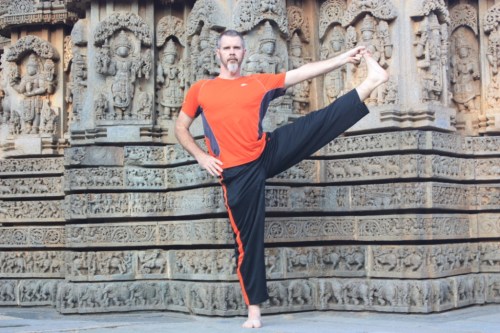
To what degree can yoga practice be whatever one needs it to be?
If one is expecting the definitive answer to this question, one won’t find it here. While I’ll share my views, I’d love to get some comments, because shared wisdom may help myself and others to hone in on a more coherent answer.
There is a continuum of views on this question. On one hand, there are people who have very rigid notions of what a yoga practice can (or should) consist of. “Everyday, one should do precisely x repetitions of Surya Namaskara (Sun Salutations), y repetitions of nadi shodhana (alternate nostril breathing), z repetitions …, and every full moon one should do…, and every six months one should do… shatkarma, etc.” In some circles, this rigidity may extend to what deity one worships, the nature of one’s personal philosophy, what one should eat, how one should dress, and how vigorous one’s practice should or shouldn’t be.
Near the rigid end of the spectrum are those who rail against drawing secular and / or culturally-neutral elements from yoga, and / or engaging in a revision of yogic culture. [Cultural revision, in this case, referring to a shift from the traditional culture which is Indo-centric to a more Westernized approach (e.g. this may be seen in different modes of teaching and / or in interaction between students and teachers.) I’m afraid this may remain unclear to anyone who hasn’t spent time in both: a. a traditional yoga ashram / shala; and b. a Western-style yoga studio. To those who have, it’s likely apparent that these two places each have a culture that may share elements (especially superficial one’s like symbology, etc.), but which aren’t identical.] The recent controversy generated by a paper by a Michigan State University professor, Shreena Gandhi, who suggested that Americans practicing yoga were engaging in a kind of white supremacy is a case in point.
I find myself rejecting the aforementioned extreme for a number of reasons. First, if yoga practice should be one thing, how come there are so many different “one things” that it should be? If one set was objectively superior, one would expect it to come to dominate, but we don’t see that. Secondly, it fails to acknowledge the wide variety of varied needs. There can even be logical inconsistencies embedded in these rigidities. For example, if one says that a practitioner should do 15 rounds of Surya Namaskara per day, and, also, that they shouldn’t increase the rapidity of breathing by much, then one is limiting the base of students. Some students simply can’t do 15 rounds in a session, while for others it’s an inadequate warm-up because it doesn’t tax their system in the slightest. Thirdly, while I’m not a Sanskrit scholar, from what I’ve been taught, the early writings don’t suggest the kind of doctrinaire approaches to yoga one sees today. One can see in Patanjali’s Yoga Sutras a sparse and vague set of dictums that aren’t consistent with the idea that one needs to accept and embrace any and all of the trappings that have come along in the past few thousand years.
Now it might seem that I’m at the footloose and fancy free end of the spectrum. But I’m afraid that I cringe too hard every time I see a story about “ice cream yoga.” (Or fill in the quote marks with whatever the mashup-du-jour consisting of an activity that some individual finds nifty, and, therefore, assumes will pair excellently with yoga.) At the far end of the spectrum are people who think one can engage in any activity (or set of activities) and label it yoga, and it is yoga. I don’t think I can quite get on that bandwagon either. While I don’t offer my support to the people who have very fixed and limited views of what yoga is, I can empathize with them at times. These include: 1. the person who has the Om symbol emblazoned over 80% of their wardrobe [or — more astoundingly — has it tattooed on his body] but who thinks it translates to “namaste,” “yoga,” or to any other mistranslation. 2. the practitioner who believes the ultimate question of the universe is which print of Lululemon captures her spirit animal, or, 3. the individual who thinks the sports bra and yoga pants she wears for practice seems like reasonable attire in which to visit a Hindu (or virtually any other) temple.
This leaves me somewhere in the middle on the issue. The single question I would ask to determine whether something is a yoga practice or not, is:
Is one working towards quelling the turbulence in one’s mind by dispassionately observing one’s body, breath, and / or mind?
This probably seems like an insane criteria because if one is doing the Gerbil Yoga version of setu bandasana (back bridge while devoting one’s attention to petting a rodent) then one isn’t actually doing yoga. However, if one is sitting at a bus stop watching the air go in and out of one’s nose and adjusting the pace of said flow, then one is doing yoga. Crazy, right? A back bridge is much more yoga-esque than sitting at a bus stop apparently doing nothing. Don’t even get me started on how one could be in a yoga studio doing a perfectly traditional yogasana like ardha chandrasana while your mind is in an internal monologue — i.e. rant — about how miserable one is in the and how one can’t wait to hit the bar after class, and you’re not really doing yoga. On the other hand, one could be being screamed at by one’s boss in the office while watching the emotional turmoil bubble up, and one would be doing yoga. Crazy as it may sound, it’s the best I’ve been able to figure.
Let me know where you fall on the question.
5 Things to Which My Introverted Self Has Been Oblivious
5.) In the absence of information, people write their own stories, and everyone gives himself the leading role in his own story.
Therefore, sitting in the corner, minding one’s own business, deep in introspection, may balloon into: “He’s giving me the silent treatment. I bet he hates me and wishes I would die.”
4.) Quietness may be interpreted as arrogance.
I was told this by a teacher in Middle School, but — at that stage in my life — that seemed an impossibility. In those days, I was self-conscious about being introverted — and I was shy, to boot. (That’s not redundant. If you think it is, I’d recommend Susan Cain’s Quiet) Because I felt that I so blatantly lacked confidence, it seemed hard to imagine that someone would misinterpret my quietness as being over-confident and / or narcissistic. How could it not be obvious that I lacked the confidence to be arrogant, but people see a lot less than one (or they) might think they do.
3.) Miss eye contact, miss a lot.
It’s not just that one misses non-verbal communication, it’s that it might be assumed that you caught a signal when you didn’t.
2.) When you are in deep introspection, you may have total inattentional blindness, but others may not recognize that.
You may be familiar with inattentional blindness from the gorilla – basketball pass video. It’s the fact that we can’t mentally multitask, no matter how much we might think we can. If our attention is given over to one task we may miss even the blatantly obvious. Most people don’t think this is the case, and it doesn’t feel that way. That’s because we are usually quite good as bouncing our attention between different events and stimuli. (Though never without a degradation of performance.) However, if you’re entranced in introspection, you may look like you’re giving the evil eye to the angry hoodlum at the bar, or that you’re seeing the projectile flying at your face, but maybe not.
1.) If one doesn’t outwardly express emotions, some people may not realize that you have them.
It seems self-evident that everybody experiences fear, anger, or sadness on occasion. Some more frequently. Some less. Some wear emotions on their sleeves, some hold their cards close to the chest, and every point in between. Part of the problem is that our intuitive understanding of what it looks like to be without emotion is flawed. As is discussed in Antonio Damasio’s book Decartes’ Error, a true lack of emotion (as seen in those with damage to parts of the brain involved in emoting) may look like the inability to make a decision (i.e. paralysis by analysis,) rather than our traditional notion of Star Trek’s Spock — a perfectly rational decision maker who can’t be insulted and doesn’t get sarcasm.
5 Bizarre Moral Dilemmas for Your Kids to Worry Over
5.) Can “innocent until proven guilty” survive the next generation of predictive models?
I started thinking about this post as I was reading Dean Haycock’s book Murderous Minds, which is a book about the neuroscience of psychopathy. In that book, the author evokes The Minority Report, a Philip K. Dick story turned into a Tom Cruise movie about a police agency that uses three individuals who can see the future in order to prevent violent crimes before they happen. Haycock isn’t suggesting that precognition will ever be a tool to predict crime, but what if a combination of genetics, epigenetics, brain imaging, and other technology reached the point where the tendency toward violent psychopathy (not redundant, most psychopaths function fine in society and don’t commit crimes) could be predicted with a high degree of accuracy. [Note: unlike the Tom Cruise movie, no one is suggesting all violent crime could be anticipated because a lot of it is committed by people with no risk factors whatsoever.] One is likely to first go to the old refrain (Blackstone’s Formulation) that it’s better that 10 guilty men escape justice than one innocent man be punished. Now, imagine a loved one was killed by a person who was known to have a 99% likelihood of committing a violent crime?
Of course, one doesn’t have to lock the high-risk individuals away in prison. What about laws forcing one to take either non-invasive or invasive actions (from meditation retreats to genetic editing) to reduce one’s risk factors? That’s still a presumption of guilt based on a model that — given the vagaries of the human condition — could never be perfectly accurate.
4.) What does “trusted news source” mean in a world in which media outlets tailor their messages to support confirmation bias and avoid ugly cognitive dissonance? (i.e. to give viewers the warm-fuzzy [re: superior] feeling that keeps them watching rather than the messy, uneasy feelings that makes them prefer to bury their heads in sand and ignore any realities that conflict with their beliefs.) Arguably, this isn’t so much a problem for the next generation as for the present one. The aforementioned sci-fi legend, Philip K. Dick, addressed the idea of media manipulation in his stories as far back as the 1950’s. However, it’s a problem that could get much worse as computers get more sophisticated at targeting individuals with messages tailored to their personal beliefs and past experiences. What about if it goes past tweaking the message to encourage readership to manipulating the reader for more nefarious ends? I started to think about this when I got the i-Phone news feed which is full of provocative headlines designed to make one click, and — if one doesn’t click — one will probably come away with a completely false understanding of the realities of the story. As an example, I recently saw a headline to the effect of “AI can predict your death with 95% accuracy.” It turns out that it can only make this prediction after one has shown up in an emergency room and had one’s vital statistics taken and recorded. [Not to mention “95% accuracy” being completely meaningless — e.g. in what time frame — minute of death, day, year, decade? I can come up with the century of death with 95% accuracy, myself, given a large enough group.]
3.) When is it acceptable to shut down a self-aware Artificial Intelligence (AI), and — more importantly — will it let you? This is the most obvious and straightforward of the issues in this post. When is something that not only thinks but is aware of its thoughts considered equivalent to a human being for moral purposes, if ever?
2.) When is invisible surveillance acceptable / preferable? This idea came from a talk I heard by a Department of Homeland Security employee, back when I worked for Georgia Tech. He told us that the goal is eventually to get rid of the security screening checkpoints at the airport and have technology that would screen one as one walked down a corridor toward one’s gate. At first this sounds cool and awesome. No taking belts and shoes off. No running bags through metal detectors. No having to pitch your water bottle. No lines. No dropping your laptop because you’re precariously balancing multiple plastic bins and your carry-on luggage. [I don’t know if they would tackle one to the ground for having a toenail clipper in one’s bag or not, but — on the whole — this scheme seems awesome.] But then you realize that you’re being scanned to the most minute detail without your awareness.
One also has to consider the apathy effect. If one can make an activity painless, people stop being cognizant of it. Consider the realm of taxation. If you’re pulling a well-defined chunk of pay out of people’s income, they keep their eye on how much you’re taking. If you can bury that tax — e.g. in the price of goods or services, then people become far less likely to recognize rate changes or the like.
1.) If society can reduce pedophilic sexual abuse by allowing the production and dissemination of virtual reality child pornography (computer generated imagery only, no live models used, think computer games), should we? This idea is discussed in Jesse Bering’s book, Perv. It’s not a completely hypothetical question. There is some scholarly evidence that such computer-made pornography can assuage some pedophiles’ urges. However, the gut reaction of many [probably, most] people is “hell no!” It’s a prime example of emotion trumping reason. If you can reduce the amount of abuse by even a marginal amount, shouldn’t you do so given a lack of real costs / cons (i.e. presuming the cost of the material would be paid by the viewer, the only real cost to the public would be the icky feeling of knowing that such material exists in the world?)
BOOK REVIEW: Trying Not to Try by Edward Slingerland
Trying Not to Try: The Art of Effortlessness and the Power of Spontaneity by Edward Slingerland
My rating: 5 of 5 stars
This book’s paradoxical title is perfect for its paradoxical subject matter, which is famously expressed in such quotes as, “When nothing is done, nothing is left undone” [ver. 48 of the Tao Te Ching.] Slingerland lays down the ancient Chinese wisdom of wu-wei and de, but provides something novel by putting it in the context of the positive psychology and neuroscience of today. Wu-wei literally means “no doing,” but can be more meaningfully defined as “effortless action.” De (pronounced “duh”) is a charisma seen in people who have mastered the effortlessness and spontaneity of wu-wei.
While the book is built around the varied approaches of four Chinese philosophers—two Confucians (i.e. Confucius and Mencius) and two Taoists (i.e. Laozi and Zhuangzi)—the author relates this philosophy to the present-day thinking found in Daniel Kahneman’s “Thinking, Fast and Slow,” Mihaly Csikszentmihalyi’s conception of Flow, and the neuroscience of the subconscious.
The book consists of eight chapters. The introduction and the first two chapters outline the concepts of wu-wei and de using both Chinese and Western stories and examples to help clarify these arcane ideas and put them in the context of the social and spiritual spheres. Chapter 1 offers an extensive discussion of the operation of the brain as it relates to the discussion of effortlessness and spontaneity.
Chapters three through six make up the core of the book, and present the approach and thinking of Confucius, Laozi, Mencius, and Zhuangzi, respectively. This “boy-girl-boy-girl” Confucian-Taoist organization offers the reader sound insight into the varied approaches and allows one to see the evolution of thinking. Confucius gets the first cut, but his approach to effortlessness and spontaneity involves a great deal of effort and planning. It might seem that Laozi’s approach–which does away with effort and planning–might be more apropos, but it’s hard to imagine anything of benefit actually being spawned by such a loosy-goosy approach. The more nuanced approaches of Mencius and Zhuangzi offer additional insight, but do not eliminate the paradox. It’s this paradox that’s the subject of chapter seven.
The final chapter examines what the reader can take away–given that the paradox of wu-wei seems inescapable. The author proposes that, paradox or not, there is value in pursuit of effortlessness and spontaneity, and progress can be made by understanding and accepting said paradox.
The book has no graphics, but is annotated and has a bibliography–as well as an appendix table that summarizes the various approaches to wu-wei.
I enjoyed this book and found it fascinating. It’s highly readable, having humor and a wide range of examples from ancient myths to pop culture. The book offers a great value-added by considering the relevance of modern science and psychology to this ancient concept. I’d highly recommend this for individuals interested in Chinese / Eastern philosophy, as well as anyone hoping to bring a little more effortlessness and spontaneity into his or her life.
POEM: Nullius in Verba
Said Socrates, “Oh, those poor bastards, for they think they know.
“I may be an ignorant slut, but I know I know not.”
[I paraphrase.]
My point, if I have one, is that “know” is an overused word.
Stinking up the discourse, like a bloated, floating pig turd.
[Remember Jim Carey, in the movie “Liar, Liar”]
“I object, Your Honor”… “Because, it’s devastating to my case.”
It’s a refrain seldom stated, but oft implied.
It works quite well, if you only talk to one side.
Fault us not for we’re wired to be certain.
If the cave wall shadow might be a tiger,
you don’t wait to see whether it’s a mouse.
That said, we’ve evolved these huge honking brains.
Our prefrontal cortexes might withstand the strain–
of asking:
How do I know this?
What if I’m wrong?
Might my mind deceive?
Facts: cherry-picked or strong?
POEM: Fuel & Fools
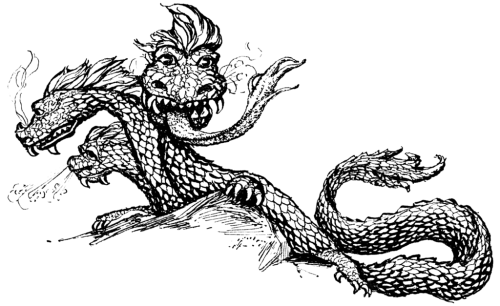
It was a fire-breathing preacher,
a hard-core and ceaseless teacher,
of lessons they said they wanted none.
Yet, it belched them out by the ton.
Spitting fire and dreadful lies
from the freedom of the skies.
And all about, its fires burned.
And people wailed like lovers spurned.
And then one day there came sage.
He found some sad, some in a rage.
“What troubles you folk,” he inquires.
“From far above, it slings these fires!
Can you save us, you wise old man,
from life in this blasted frying pan?”
“Every fire requires a fuel,
And every lie, a willing fool.
Do you feed the beast, or in its fires bask?”
“Neither, of course, and how dare you ask!”
“I can douse the flames, but they’ll flare right back,
if you fuel them with your petty, piddling yak.”
“Just do it, old man, before we all burn!”
“OK, I’ll give you this one chance to learn.”
So, pulling a hose, off the sage marched.
“Mighty dragon, you must be terribly parched?”
“You know, breathing fire IS a thirsty job.”
At a nod, minions spun the spigot knob.
The water caught the grateful dragon in the throat.
Steam rose, ash spewed, and that’s all she wrote.
With no fire to breath, the dragon flew off,
sputtering out its last ashen cough.
The town was saved, or so it appeared.
But it was as the sage had feared.
Soon, some dabbled in volatile mixtures–
at weakest moments, becoming fixtures.
And the fools? Oh, they missed the glow
of the dragon’s garish and tawdry show.
And soon enough, conditions were right
for the dragon’s fire to again alight.