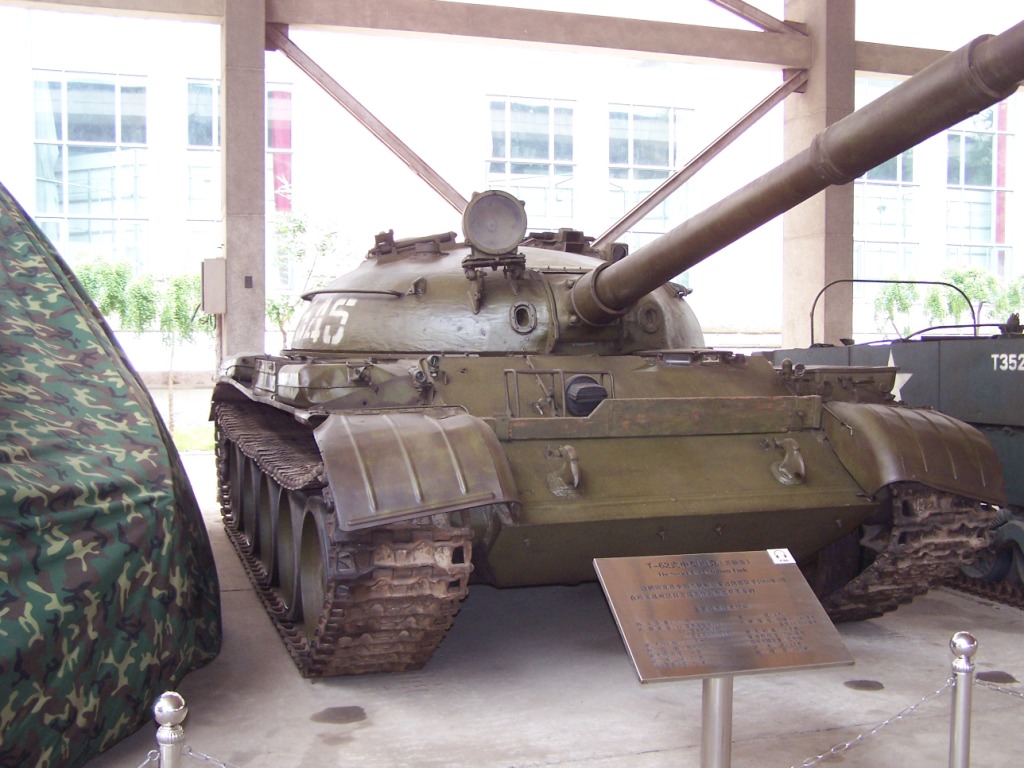
Taken in July of 2008 in Beijing’s Military Museum

Taken in July of 2008 in Beijing’s Military Museum

Taken in the Summer of 2012 on Jekyll Island, Georgia
The DuBignon family owned Jekyll Island during the 19th century. Jekyll Island was home to a millionaires’ club in the first half of the 20th century. (For my youthful readers, a millionaire back then was like a billionaire.)
This was posted in my martial arts blog, Jissen Budoka, as well.
I’ve been doing a lot of reading about Japan’s past recently. In my spare time, I’m working on rewrites for a novel in which 14th century Japan features prominently. Being my first foray into historical fiction, I’m finding the need to go back and do a lot of research about the time because the quick and dirty draft I wrote needs a lot of gussying up. I just finished reading Charles Dunn’s Everyday Life in Imperial Japan, which is about a later period but one which would have shared much in common when it comes to everyday life. Presently, I’m reading The Taiheiki–which is about the 14th century, but which blends fact and fiction.
Doing such research encourages one to consider what it meant to live during that time. We all build constructs of the world to adjust for our limitations in knowledge. Some of these constructs hold up better than others, but they’re all simplifications. When one reflects upon a time before one’s experience–and particularly regarding a place with which one has limited familiarity–there are two major forms of fallacious reasoning that can take hold:
1.) The Golden Age Fallacy: This is the thought that everything was better back in the day–back before humanity started slouching toward craptasticness.
2.) The Outhouse Fallacy: This is the idea that any society that couldn’t manage indoor plumbing couldn’t possibly be worthy of emulation.
Of course, these simplifications are both true and false in some regard, and–as absolute statements–are absolutely false. The truth is something more like what Ralph Waldo Emerson suggested in Self-Reliance. Emerson described society as a wave, receding on one side as quickly as it advanced on the other. In other words, changes maybe seen as progress, but they also bring about the destruction of valuable knowledge. In martial arts terms, the spear becomes obsolete and the art of spear-fighting dies.
 The movie entitled The Last Samurai revolves around this premise. Of course, in Hollywood fashion the forces of modernity are made entirely villanous and our heroes, the samurai, are entirely virtuous. In a way the movie is perverse in that it suggests we root for the medieval approach over our own.
When considering feudal Japan, Golden Agers point to it as a time during which virtue was paramount, craftsmanship was exquisite, and much culture flourished. They are right; but don’t set your time machine just yet because Outhouse Agers are also correct when they say that it was a time during which most of the population had no rights, wars ravaged the country, and in which farmers were not allowed to partake of many of the products they produced–but rather had to feed and cloth their families with inferior substitutes.
One should be careful to neither romanticize nor vilify the samurai. We should keep what is of value of the old ways without being a slave to the worst ways of our predecessors’ nature. One shouldn’t abandon everything old on the assumption that by definition everything abandoned to the past is refuse.
 Everyday Life In Imperial Japan by Charles J. Dunn
My rating: 4 of 5 stars
This interesting little book is invaluable for anyone researching what life was like for people in Japan before the Meiji Restoration. While it’s an essential volume for a writer of historical fiction, those interested in Japan more generally will find it readable and packed with interesting tidbits of information. For example, I would recommend it for those who study traditional Japanese martial arts (i.e. kobudō)to get a better insight into the art they study through knowing the society from which it sprang.
This type of work is relatively rare, but is a writer’s dream come true. It’s not a history book, but–as the title implies–tells one how people of various classes and occupations lived day in and day out. That is, its approach is more anthropological than historical.
The range of occupations in Japan’s pre-modern period were far fewer than in society as we know it, and so the book takes broad job classes as its primary unit of organization. It begins with the group that undoubtedly draws the most interest, the samurai. It proceeds to the occupation which is most numerous in any pre-modern society, the farmers. Beyond that, it covers the lives of skilled craftsmen, merchants, courtiers, priests, doctors, intellectuals, actors and outcasts. The concluding chapter looks specifically at life in the city, and–in particular–life in Edo. Edo is the city that would become known as Tokyō, and which became the capital of the Shogunate in 1603 and eventually the nation’s capital.
Japan’s relative isolation throughout its early history has made for many intriguing national peculiarities. It’s true that Japan’s literary, religious, and philosophical systems were greatly influenced by China, but–in all cases–these cultural elements were forged into a uniquely Japanese form. This uniqueness provides many “ah-ha” moments while reading.
One learns why warriors were required to wear extra long hakama (a very billowy form of pleated pants that look like a long skirt–though having individual pant legs.)One learns about how one got around on the early highway system in a time when infrastructure (e.g. bridges) were minimal, and who was allowed to use the roads–such as the famous Tōkaidō road. The book tells how police went about arresting armed samurai. The roles played by women in society are discussed. While this was obviously a patriarchal society, women weren’t locked entirely outside the domain of power.
This was a feudal society with the samurai owning the land and the farmers toiling in hopes of having a little left over to support their families. While farmers made silk, they were, by law, not allowed to wear it. Farmers sometimes resorted to selling daughters to brothels to make ends meet.
There were many types of craftsmen from saké brewers to carpenters to makers of lacquer-wares. Japan has a long history of appreciation for master craftsmanship as is most apparent in sword-making. The Japanese sword was the cutting weapon perfected. Its folded steel design offered a flexible spine with a hard edge that could be honed to razor sharpness.
Merchants were a class that was both looked down upon and increasingly powerful during this period. Samurai were often barely making a living then, but merchants were beginning to flourish. Japan’s first indigenous money wasn’t introduced until 1636. Prior to that Chinese coins were used, much in the same way that some present-day countries use US dollars for currency–thus avoiding inflation that would be inevitable if they had their own currency and governance. There is an extensive discussion of the early sea trade.
Some of the most interesting careers were those more peripheral. Doctors practiced something akin to Traditional Chinese Medicine. There were wandering street performers and holy men of a wide variety.
I’d recommend this book for anyone interested in Japan’s history, and would call it indispensable for a writer addressing pre-Meiji Restoration Japan.
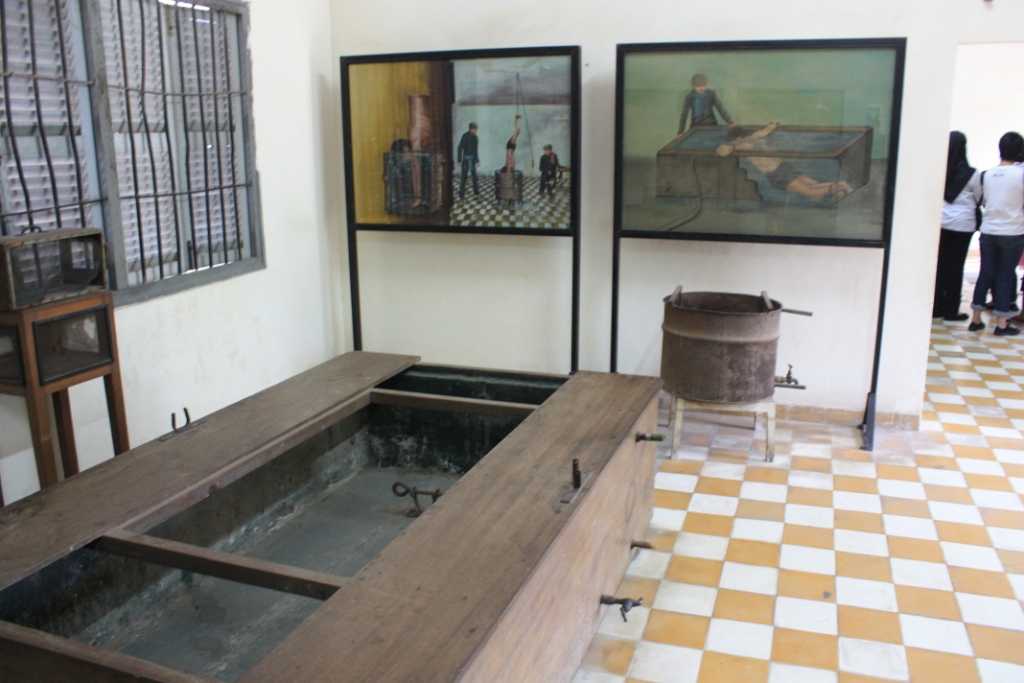
Taken in October of 2012 at Tuol Sleng in Phnom Penh.
The artworks high in the frame demonstrate how the otherwise nondescript implements of torture were used. These were a couple of the more disturbing exhibits at Tuol Sleng Museum. Tuol Sleng was a school that the Khmer Rouge pressed into use as a prison and center of torture.
 Bushido: The Soul of Japan by Inazo Nitobe
My rating: 4 of 5 stars
On the whole, people are ambivalent about feudal times. On the one hand, it was a horrible time to be alive for 99.5% of the population. Chances are that if you’d lived during that time you’d be toiling ceaselessly on the land with no hope of improving your lot in life. Everything was determined by heredity, with merit having little to do with anything. This added insult to injury because that person you’d have had to suck up to was as likely to be putz as not.
On the other hand, there is widespread nostalgia for those times because one can’t help but feel that they were the golden days of virtue. As Ralph Waldo Emerson said, we think that society is ever advancing, but, in reality, we advance like a wave–losing as much on the backside as we gain on the front.
Inazo Nitobe’s book gives us an accounting of the chivalric virtue practiced by the samurai, the warrior class of feudal Japan. Bushidō means the way of the warrior. Nitobe lived after Japan’s feudal era, in the late 19th and early 20th centuries. Nitobe was an educator, and the book has a feel of erudition. Interestingly, the author was a Quaker and received education in the West, and, therefore, is able to contrast the Japanese worldview with that of Westerners.
The book is built around discussion of the seven virtues of bushido: justice, courage, benevolence, politeness, sincerity, honor, and loyalty. Each of these virtues has a chapter devoted to it (Ch. 3 through 9.) But first the book introduces bushido as an ethical system, and then it explains the effect that Buddhism, Shintoism, and Confucianism played in the development of this system.
Later chapters outline the education and training of a samurai, the importance of stoicism, the institution of suicide (seppuku), the symbolism of the sword in Japanese society, the role of women, the role of bushido as an ethical system in the present-day (his present), and its proposed role in the future. It is interesting that the book begins by discussing those things that influenced the development of bushidō, and it ends with discussion of how bushidō influences the larger world.
Our views of virtue have changed, but at some level remain consistent. The seven virtues are all still considered virtuous, but we don’t regard them in the same way today. In some cases we are undoubtedly better off with today’s views, but that’s not always the case.
Consider the seventh precept, loyalty. We still value loyalty, but in today’s world the rule of loyalty has an ever-present Shakespearean addenda: “to thine own self be true.” In other words, we no longer believe in loyalty that is blind as was valued in the days of old.
Sincerity, by which Nitobe generally means honesty, is also seen in a different light today. As depicted in the Jim Carey movie, Liar Liar, there’s a widespread view that it’s better to fib and make someone feel better than it is to tell the truth and hurt that person’s feelings.
One of the most intriguing chapters is the one that deals with seppuku. This is a concept that has never been well-understood in the West, and it’s a major point of cultural disconnect. While the Japanese have tended to see suicide as a means to restore honor that was lost in failure, in the West we tend to see it as a more pathetic and cowardly affair. I’ve recently been reading Ian Fleming’s You Only Live Twice, and this is one of many points of diverging attitudes between “Tiger” Tanaka and James Bond.
Bushidō is definitely worth a read. It’s thought-provoking, and is one of those books to be read slowly and conscientiously.
Ninjas, pirates, and smugglers aren’t exactly chatty. They burn, or shred, their correspondence. They sow seeds of disinformation to confuse the authorities. They lurk in the inkiest of shadow worlds behind doors we don’t even know exist. Still, who wants to do a hatchet job on a pirate? Right?
Did I mention that these are characters in the novel that I’m currently revising (or did I let you believe I was talking about in-the-flesh smugglers so that you’d keep reading.) Sorry, no one ever accused me of NOT being a deceitful bastard. Well, my friend, you’re now more than Tweet deep in this post; that’s quite an investment; it’s the modern-day equivalent of having read The Iliad, so you might as well keep reading.
Kiss the Cobra (my third working title) features a cast of characters of not only the aforementioned occupations but also monks (both the scholarly and kick-ass kung fu varieties), an Emperor, a muay Thai master, and a secret society that makes ninjas look like chatty Cathys. Like all good lies, this novel begins with a seed of truth. That seed is the rescue of Emperor Go-Daigo from imprisonment by an evil (ok, quasi-evil) shogun in 1337. From that seed, it’s my wild imagination run amok… or is it? The Emperor assigns the loyalist ninja who rescued him, Korando, to travel to Southeast Asia to acquire an artifact that legend has it will help him re-consolidate power.
Cut to the present day, a linguistically-talented young man, Matsuo (a.k.a. “Matt”), comes into possession of a scroll. The scroll is Korando’s journal, written and hidden as a confessional. Matt investigates Korando’s journal on an electronic bulletin board only to find himself being chased by nefarious characters. Matt discovers that there are still people willing to kidnap, kill, or commit treason for the secrets that Korando’s journal may possess.
The novel weaves the 14th century journal with this present-day cat and mouse game between the forces of good and evil. There’s murder and mayhem, love and betrayal, victory and defeat, virtue and vice; in short everything you love in a novel is densely crammed into this book. There’s even one character who may or may not be a Zombie–I’ll let you be the judge.
Now let me just add this screenshot of me to show you ho

Did you ever get an inexplicable chill on the back of your neck?
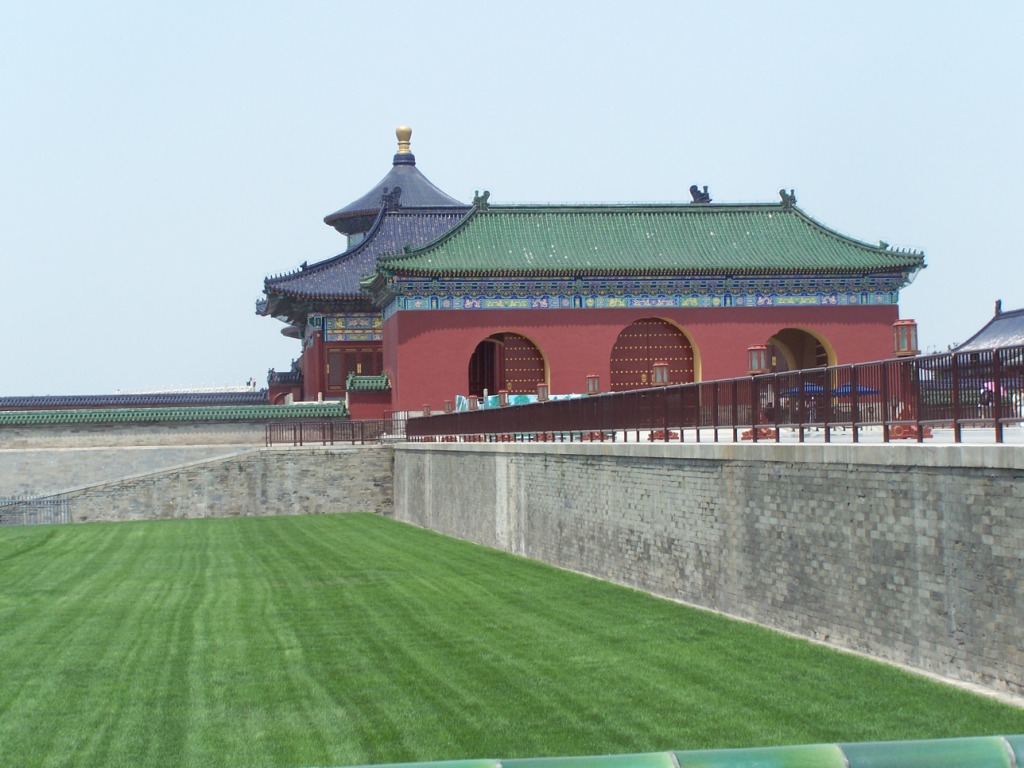
The pointy-topped building is the Hall of Prayer for Good Harvests
The Temple of Heaven is a complex of buildings used for Heaven worship. It was built in the 15th century, and is a Taoist temple (Heaven worship predates Taoism–though the Temple doesn’t.) The most distinctive building, the Hall of Prayer for Good Harvests–shown only partially in the picture–was built without any nails or spikes.
It’s located in a beautiful park south of central Beijing. The park has a rose garden and is a popular hangout for people doing tai chi, playing instruments, and dancing.
 The Bridge at Andau by James A. Michener
My rating: 5 of 5 stars
In the fall of 1956, there was a revolt in Hungary against the Soviet-puppet leadership. While this revolution ultimately failed, it was a powerful underdog story that revealed the brutality of the USSR.
Novelist James Michener was one of the journalists at the border crossing for which the book is named. He collected the stories of those who were fleeing the Soviet crackdown. Michener found what he heard to be chilling, and this book had a profound impact on Americans.
The book begins with a typical story of a woman carted off by the ÁVO (Állam Védelmi Osztag), the Hungarian secret police. She was returned several weeks later, fundamentally changed and psychologically broken. It was this type of lawless injustice that led to the revolt.
The book recounts the many trials, tribulations, moments of hope, and moments of peril of the revolutionaries. It covers the opening salvos at the Magyar Radio building and then at the Kilian Barracks (located at a prominent intersection on the Budapest’s Grand Circle [Nagykörút]) and continues to the flight of the failed and hunted revolutionaries.
Throughout the book one is constantly reminded of how ingenuity and will can succeed in the face of severe disadvantage. The Soviets came with tanks, but the Hungarians had only the few small-arms that they could liberate from those military barracks that sided with the revolutionaries. The guerrillas would put brown dinner plates upside-down in the road. These looked roughly like anti-tank mines. When the tankers stopped to investigate, guerrillas would drop Molotov cocktails into the tank’s engine inlet.
The most heart-rending part of the book deals with the children that were actively involved in the fighting, and tank-killing specifically. The small and agile children could apparently move up to the tanks unseen more easily than adults.
This may seem like just another example of a true story with a sad ending. It’s true that the Soviets came back after a feigned withdrawal, tricking the revolutionary leadership into “negotiations” that turned out to be executions. Overall, thirty thousand Hungarian casualties resulted from this two-week battle. However, the story is not as simple as “the underdog got defeated.”
Michener quotes a revolutionary who summed it up best, “Russia won, but they’d better keep two of their soldiers in Budapest for every one Hungarian they give a gun. Let the Kremlin sleep on that.”
I’d highly recommend this book for those interested in history, military strategy, or even just a compelling human interest story.
My copy of Bridge at Andau is well-worn. As a Master of Science in International Affairs student, I did a thesis on Soviet/Russian asymmetric warfare. One of the three cases that I studied extensively was the Hungarian revolution. While the ’56 Revolution was arguably the least successful of the three (the others being Afghanistan and Chechnya), it wasn’t due to lack of Hungarian will so much as the still strong state of the Soviet Union.
 The Lone Samurai: The Life of Miyamoto Musashi by William Scott Wilson
My rating: 4 of 5 stars
[Note: this was previously posted in my martial arts blog, Jissen Budōka.]
This is a concise and well-researched biography of one of Japan’s most famous swordsmen. Miyamoto Musashi, however, wasn’t just a swordsman, he was also a writer, a painter, a sculptor, a Zen Buddhist, a poet, a philosopher, and a strategist. In short, he was a renaissance man. While The Lone Samurai focuses heavily on Musashi’s many duels as a traveling warrior, it also describes his artwork as it paints a portrait of a complex and beguiling character.
Musashi holds a curious allure among figures in Japanese history. The Japanese tend to be strictly bound by societal conventions, and being respectful and well-mannered is valued above all else. Musashi flouted convention whenever it served him. He used irreverence for strategic advantage. He was an astute reader of men. He often showed disrespect in order to get into his opponent’s head. This is most famously exemplified in his Ganryu Island duel with Sasaki Kojiro.
Musashi adopted a life of musha shugyo, or warrior errantry, though he could have been much wealthier and more comfortable had he chosen to be. He enjoyed simplicity, and only owned a few possessions. In his travels, he engaged in over 60 duels, and is usually credited with being undefeated [Note: I’ve heard some dispute the outcome of his second duel with Muso Gonnosuke. Wilson calls it a draw, but I’ve heard it called Musashi’s only defeat as well.] He fought as a samurai in battle at Sekigahara as well, but his adulthood was a relatively peaceful time.
One fascinating, but controversial, claim is that Musashi had no teachers–neither in swordsmanship nor in any of the fine arts he practiced. Musashi said this himself, but some historians dispute it. If true, it really takes being an extraordinary person up a notch. It should be noted that Musashi was only 13 when he had his first duel.
There is much about Musashi that is lost to the ages, but this book does a great job of pulling together what is known and weaving it into a portrait of the man.
There is an extensive series of appendices providing background information, notes, a glossary, and even a collection of pop culture (e.g. movie and novel) depictions of Musashi.
It’s well worth the read if you’re interested in strategy, history, or the biographies of incredible people.


 Tiger Riding for Beginners