There’s No Such Thing as a Silly Question? LIAR!

I’m shocked by how easily a piece of “common wisdom” can become accepted despite being patently and demonstrably wrong. The best example may be, “There’s no such thing as a silly question.”

Oh, yeah:

“Do you wear spurs when you ride ostrich in the avian rodeo?”

“If you had to wear shoes made of cheese, of which cheese would you want them made?”

“Do you have purple-glazed doughnuts in honor of the St. Crispin’s Day unicycle rally?”

“May I twirl my way into an eternity of dandelion lunacy?”

I can do this all day.

Are you seriously going to tell me that none of the above questions is at least a little bit silly. As a person of silliness, it enrages me… well maybe not so much “enrages” as has no discernible effect… when people deny the potential for silliness. Folks, it’s all around us. So, the next time you say that there is no such thing as a silly question, my response is, “Do you really think you can make that stick like the Archbishop’s bugger to the side of an albino wino?”

Why I’m a Slacker Lately: or, Mysterious India

What's this India I hear so much about?

What’s this India I hear so much about?

I haven’t been writing, editing, or conducting research much as of late. This has probably gone unnoticed in the vastness of the cyberspace, but in the spirit of blogging I thought I’d answer a question that no one asked. I recently learned that my wife and I will probably be moving to Bangalore, India later in the year. This has kept me physically occupied with home repair and boxing up the house. In my non-labor moments, my mental faculties are largely devoted to understanding the country in which I will be living. I’ve never been there before.

India is a harder nut to crack than one might think. Yes, there is the obvious. At 1.2 billion people, it has the world’s second largest population and is screaming up on China for number one. It’s the seventh largest country by land area. It’s the birthplace of that most excellent yoga that keeps all the twisty people twisty. It’s home of tandoori chicken and naan bread, both of which I love.

However, that’s all superficial. I must sadly admit that–until recently–my in-depth knowledge has come from three sources:

1.) The Jungle Books by Rudyard Kipling

2.) A junior high school field trip to see the film Gandhi, which I had been under the impression was six hours long, but, according to Wikipedia, is only a little over three hours long. I guess that, just as kids think everyone is taller, a kid’s perception of Oscar-winning motion picture run times is greatly distorted.

3.) A ton of reading about the Indo-Pakistani rift and its strategic implications as a graduate student studying International Affairs with a focus on Strategic Studies.

With respect to number 3, the amount of study of this region was not commensurate with the fact that the Indo-Pakistani border region is generally voted “Most Likely Point of Origin for Global Nuclear Winter.” I’m not suggesting that the relationship between India and Pakistan is any more dysfunctional, unstable, or rooted in irrationality than other relationships between nuclear powers. However, the adjacency of the two countries is a problem from the perspective of strategic stability.  When alarms went off in the U.S. or the U.S.S.R. back in the day, there was at least a little time to evaluate and communicate. Being next-door neighbors makes the Indo-Pakistani conflict particularly troubling. That said, they’ve had some pretty big strain tests on their relationship without blowing up the world, so that’s a positive sign.

So why does this country, which should be so front and center in the global consciousness, remain so mysterious? One way we know countries is by those grand competitions through which nations–friends and enemies alike–interact.   In this domain, India really hides its light under a bushel. India has won 26 Olympic medals in 23 games, this is fewer than either Kenya or Jamaica–and both of those countries did it in fewer games. Yesterday, in a post about a book by Nobel Prize-winning Hungarian, Imre Kertész, I may have mentioned that Hungarians have won 12 Nobel Prizes–that’s more than India by a large margin.  Now, while India has had its problems, it’s 100 times more populous than Hungary, and has a history of publishing scientific literature in English (an undeniable advantage in this domain.) Depending upon which country Rudyard Kipling is counted toward, India has either eight or nine Nobel Prize wins. Of course, it would be ridiculous to think that India doesn’t have the human capital to excel in such domains.  While I realize it may not be a representative sample, I think almost every Indian I’ve met in person has had an advanced degree and has been smart as a whip. So it’s certainly NOT true that this is a country that undervalues education.  With a third of the world’s population, statistically speaking, they must be home to physical and mental specimens of humanity that are as impressive as any, but somehow either the will or ability to convert that human capital into winners on the global stage is missing.

I do know a little more about India. It’s the birthplace of both Hinduism and Buddhism, as well as a bunch of other religions. As a martial artist, I’ve heard that  many believe most Asian fighting systems could trace their origins back to India. I don’t know how much truth there is to this belief. Martial arts always evolve into optimization with the local conditions and culture, and, therefore, a lack of superficial similarities doesn’t discount the possibility of such a connection. One of the origin myths the Indo-centric martial arts is the story that Bodhidharma brought a fighting style to China that would be the stepping off point for most of the myriad Asian martial arts. The current consensus among historians seems to be that this part of the Bodhidharma story is not true (See: Meir Shahar’s The Shaolin Monastery.) However, that being said, there is an odd but clear connection between this most pacifistic of world religions, Buddhism, and some of the world’s most kick-ass martial arts. Whether one is talking about China’s Shaolin monks or Japan’s legendary warrior-monk Benkei, it’s clear that some exceptional martial arts have developed in tandem with the spread of Buddhism. Of course, even this just creates more questions, namely: Why should a pacifist religion have legendary fighters sprouting up anywhere near it?

I’m looking forward to getting to know more about India than that it’s huge and its Chicken Vindaloo is scrumptious. It’s a country with a long and intriguing history. I want to see its jungles, its deserts, its mountains, and its beaches. I want to visit its temples and learn from its sages. I’m eager to see its vivid colors and smell [at least some] of its pungent scents. At some point I expect to have some awesome posts about my time there, and hopefully some bold pictures as well. In the mean time, please forgive my slacking.

Drones over Des Moines: or, UAV’s in the Heartland

Source: Wikipedia; User: Dammit

Source: Wikipedia; User: Dammit

National Geographic has an interesting and well-timed article in this month’s issue called The Drones Come Home. I say well-timed because of all of the attention that Senator Rand Paul’s recent filibuster received. Senator Paul was filibustering the nomination of John Brennan as CIA Director, but his true purpose was to bring attention to the lack of transparency on policy regarding the use of drone strikes on U.S. soil. You’ll recall from your Civics classes that the 5th and 6th amendments (supported by other laws) require legal due process be conducted before anyone gets, to use the mafia-esque term, “whacked.”

The impetus for all this discussion of drones is the Obama Administration’s 2012 direction to the Federal Aviation Administration (FAA) to open the skies to Unmanned Aerial Vehicles (UAV’s) by September 30, 2015.

It should be noted that the use of armed drones for execution missions is only the most dramatic of many legal issues that will arise with the proliferation of this technology. The National Geographic article devotes more space to the use of drones by state and local law enforcement than they do to that of the Federal government.

Some other new legal considerations will include:

Searches:  I suspect that well before any government is terminating U.S. citizens at home with such devices, they will be using them for surveillance and investigation (i.e. spying.)  The Constitutional standard is that law enforcement can act on any evidence that can be seen from a place they legally have a right to be. So if you’ve got a stolen car in your front yard, they can arrest you.  However,  if the police get an anonymous tip that there is a stolen car in your backyard under your deck, things are trickier. They can ask you to see your backyard, but you can say no. They can ask a neighbor if the neighbor will allow them to look from the neighbor’s property onto yours, but, if that’s unsuccessful, they’d better be able to impress a judge sufficiently to obtain a warrant.

However, what  happens with UAV’s? Now the law enforcement officer can be parked perfectly legally on the street while his “eyes” are hovering over your backyard.  Your property rights overhead are not established (unless you are getting a check every time Delta flies over your house–I’m not.)

Extensions: What about peaking in through your window with an aerial telephoto lens? What if it’s not law enforcement, but rather the Neighborhood Watch? What if it’s not even the Neighborhood Watch, but rather the crotchety retiree at the end of the block who has self-appointed himself neighborhood watchman because he’s bored to tears… and more than a little bitter?

Sovereign Immunity: Many governments have laws that prevent you from suing them. So what happens given a scenario suggested in the National Geographic article, the government’s UAV falls out of the sky and it’s rotor-blade slices open the jugular of your four-year old daughter as she is innocently playing in the sandbox in your back yard?

There are many who are concerned that this technology is not perfected. The military is having its share of problems, and they are spending billions on UAV’s. Imagine what will happen when local governments, corporations, and other cash-strapped entities begin flying more low-budget versions?

Personal No Fly Zones: Despite the tenuous legal situation regarding the “airspace” over one’s head. You know that, sooner or later, someone will try to enforce a no-fly zone over their property. So what happens when a person sees that Sheriff’s department UAV peeping through their window, and they blast it out of the sky with a 12-gauge shotgun?

Of course, there will be a whole new wave of issues that will arise as the autonomous UAV’s are perfected. By “autonomous” I mean ones that don’t need a remote pilot, but are more “fire-off and forget.”

A [Different] Skeptic’s View of Traditional Chinese Medicine

Tai Chi Sculpture; Taken in Montreal

Tai Chi Sculpture; Taken in Montreal

I’m sick. I mean that literally for those readers who are saying, “Yes, I read your blog occasionally; I’m well aware that you’re a sick freak.”

I rarely get sick. I can usually knock colds out at the first sign of a scratchy throat with big does of zinc and remedies I’ll discuss below. I can’t remember the last time I had the flu. Let me say to any angry gods that I’m not bragging, so please don’t smite me. I hope I haven’t just fallen off some divine pestilence list (God: “Geewhiz, that boy hasn’t had the flu since like 2002, lets send him a doozy… plus throw in a side of locust plague.”) I’m just stating a fact; I’m blessed with a mighty immune system and a lack of those plague-bombs commonly called children.

However, before you, too, begin to wish evil upon me for my freakish good health, let me say that when I do get a full-bore cold, it’s a catastrophic train wreck. This is because I have a proclivity for sinusitis. That means that all those tiny little tubes by which mucus flows from one chamber to the next in my head so that it can eventually be expelled into a facial tissue become clogged up. This creates an effect similar to a trucker’s strike at a dildo factory. The phalli (phalluses?) keep coming off the line, but none of them are being shipped out, so soon everything is fucked. When I tap on the highest point on my head it sounds like one thumping on a perfectly ripe watermelon. GROSS CONTENT AHEAD: (If you’re disgusted easily, skip to the next paragraph.) So, last night my left side passages were so blocked that pus was oozing out around my left eye, and I began to have an earache as the pus tried to escape out my ear only to find my eardrum in the way. END GROSS-OUT ZONE.

So you might be expecting that I had a sleepless night and have a doctor’s appointment this morning. I’ve gone that route before. I know exactly what the doctor would do, she’d write a prescription or two: one for a round of antibiotics and one for something to reduce the pain. As a skeptic, this is the approach in which I should put my trust. They develop these medicines using the scientific method and double-blind studies.

What did I do? I diced up some ginger and made a steaming cup of ginger tea and, as it steeped, I ran through a couple qi gong exercises. Then, after drinking the tea, my passages opened up, I blew my nose and slept soundly for about four hours until it was time for me to get up and start my day. As a skeptic, Traditional Chinese Medicine (TCM) isn’t the horse on which I should put my money. It all revolves around chi (qi), life energy, a substance whose existence is to the best of my knowledge is completely unsupported by direct observation. It’s chocked full of archaic sounding treatments like “Immortal spanks the naughty dragon.” (Okay, I made that one up, but you get my point.) TCM proposes that the kidneys are integral to sexual health.

So why am I pressing acupressure points, doing qi gong (life energy exercises), and making homemade tea? The easy answer would be that, if I hadn’t, I probably would have gotten five non-consecutive minutes of sleep last night, and I’d, at best, now be sitting in a waiting room with my skull in my hands hoping to be squeezed in to a doctor’s busy schedule.  However, I have more of an explanation than that.

I don’t know much about medicine (either Western allopathic  or TCM.) So in the absence of knowledge about what one doesn’t know, one seeks analogy in what one does know.  First, everything I know makes me distrustful of the  “free lunch.” To my mind, the Western approach, in which I don’t have to do anything but pop pills periodically, is a free lunch scenario. If I to be active (or even consciously passive, i.e. restful) to achieve my cure, I’m inherently  more confident in it. In the martial arts, we groan at the sight of these “home-study black belt” courses. Any martial artist who is honest with himself or herself knows that the only way to develop the skills is by spending at least a couple of days a week in the dōjō and training outside the dōjō as well. One can’t learn martial arts like one learns music appreciation or business administration. As an economist, there’s always some hidden cost of the “free lunch.” So despite the vigorous use of the scientific method, I tend to be skeptical of Western medicine.  I’m skeptical because nothing worthwhile I’ve ever done could be achieved by just popping a pill, and I see little reason why achieving a healthy state should be any different. [If anyone knows of a pill for manuscript revision, I’d be willing to try it.]  (I’m particularly disconcerted by medicines like pain-killers that remove the symptoms while apparently doing nothing about the ailment itself.)

So I can’t say for sure whether the ginger tea, acupressure, and qi gong had anything to do with my passages opening up. It was, after all, a system under tension. GROSS-OUT BEGINS: At some point either the passage was going to open, my left eyeball was going to pop out of its socket, or my eardrum was going to rupture sending an avalanche of pus pouring onto my shoulder. GROSS-OUT COMPLETED. However, even if all the TCM approach did was to take my mind off of my misery while I was waiting, it did more for me than the pill-popping alternative.

Second, I also know a little something about systems, generically speaking. Another thing that appeals to me about TCM is its fundamental recognition that any problem will create feedback effects that reverberate through the system.  In other words, the root cause may not be anywhere near where the problem is first noted. Because of this, one may end up having to fix a dysfunction distant from the symptom in order to fix the problem. This seems consistent with other systems with which I am familiar.

I have some arthritis from a lifetime of beatings–most notably in my lower back and my ankles. It occurred to me that my back problem might be exacerbated–if not caused–by a problem with my right foot and ankle. I suspected the damaged ankle and flat foot might cause my pelvis to tilt and my lower back to be off kilter, thus wearing through the cartilage on the side of my back that gives me problems. Maybe this was, in fact, wrong. However, when I asked the specialist who diagnosed my ankle arthritis about this possibility, he looked at me like I was the biggest idiot in the world.  “You see, son, the ankle bone is connected to the shin bone and the shin bone is connected to the knee bone and the knee bone is connected to the thigh bone, the thigh bone is connected to the pelvic bone, and it’s not until this point that the pelvic bone is connected to the back bone. There’s like half a dozen things between those two problems. They couldn’t possible have anything to do with each other.”

Now let me be clear, I’m not dismissing Western medicine by any means. There are some things it does vastly better than TCM or Ayurvedic healing or any other holistic healing method. So if I show up in your Emergency Room with a piece of rebar sticking out of my skull, please don’t throw this back in my face. “Oh maybe you should massage the Valley of Harmony (LI-4), do some ‘Parting the Clouds,’ and drink a glass of lavender-infused carrot juice.”

MASTER WORKS: Apology by Plato

ApologyApology by Plato

My rating: 5 of 5 stars

Amazon page

Apology is Plato’s account of the trial of Socrates. This brief work presents Socrates’ defense of himself as well as his reaction to the death sentence verdict against him. Of course, it is all through the lens of Plato, as Socrates left us no written works.

Socrates was charged with impiety and corruption of the youth. He acknowledged both that he was eloquent and that he was a gadfly of Athens (the latter being a role for which Socrates believes he should be valued.) However, he denied both of the formal charges.

Socrates refuted the charge of corrupting the youth first by denying that he had taken money in exchange for teaching. Taking money was a component of this charge. Socrates’ claim is supported later when Socrates tells the court that he can only afford a very small fine, even in the face of the alternative–a death sentence.

Socrates says that he sees nothing wrong with taking money for teaching–if one has wisdom to share. Socrates says that he has no such wisdom, and suggests the philosopher/teachers that are taking money aren’t in error for taking money, but rather because they really don’t have wisdom themselves.

This is summed up nicely by this pair of sentences, “Well, although I do not suppose either of us knows anything really beautiful and good, I am better off than he is–for he knows nothing and thinks he knows. I neither know nor think I know.”

While Socrates raised the ire of the Athenian leaders with what they no doubt believed to be his arrogance, in fact it wasn’t that he thought himself wiser than they, but that he thought they were deluded in thinking themselves wise.

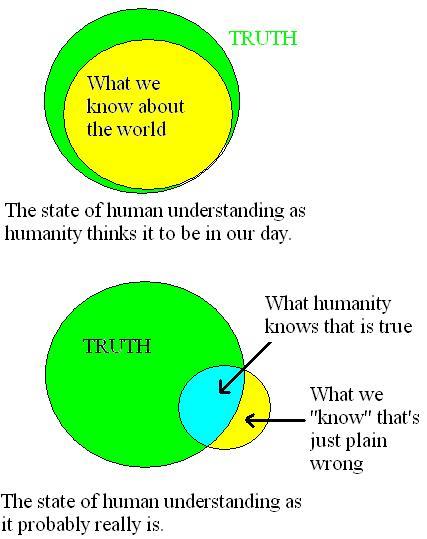
Socrates’ lesson remains valid today. It is the scourge of all ages to think that have finally attained true understanding of the world. Our posterity may know more, but we know all of the essentials and are rapidly converging on a complete picture of our world. We think our generation to be humanity’s sage elders, when, in fact, we are the impetuous teen whose growth spurt has made him cocky. I would propose to you that in all likelihood, even today, the sets of “that which is true” and “that which humanity ‘knows'” form a classic interlinking Venn Diagram. That is, some of the body of knowledge that we take to be proven true is, in fact, false. This occurs because we cannot accept that there are things we are not yet prepared to know, so we use sloppy methodology to “prove” or “disprove.” This one reason we have all these conflicting reports. E.g. coffee is good for you one week, and carcinogenic the next.

VennDiagram_WhatWeKnow

Socrates uses the method that today bears his name, i.e. the Socratic method, to challenge the arguments of Meletus, the prosecutor. The Socratic method uses questions as a device to lead the opposition to a conclusion based on premises they themselves state in the form of their answers. Socrates proposes that if it is he alone who is intentionally corrupting the youth, they would not come around–for no one prefers to be subjected to evil rather than good.

Socrates denies the suggestion that he does not believe in the gods, and in fact indicates that the very suggestion by virtue of the charges against him is a contradiction. What Socrates is guilty of is encouraging those who come around him to develop their own thoughts on god, and not to subordinate their thought to anyone–an idea the leaders found disconcerting.

Socrates goes on to say why he is unmoved by the death sentence. He wonders why it is thought he should beg and wail, when he doesn’t know for sure that an evil is being done against him.

The moral of the story is that those in power fear and will attempt to destroy advocates of free thinking.

This book should be read in conjunction with a couple other Platonic Dialogues, Crito and Phaedo.

View all my reviews

TODAY’S RANT: How’d I Get So Much Stuff?

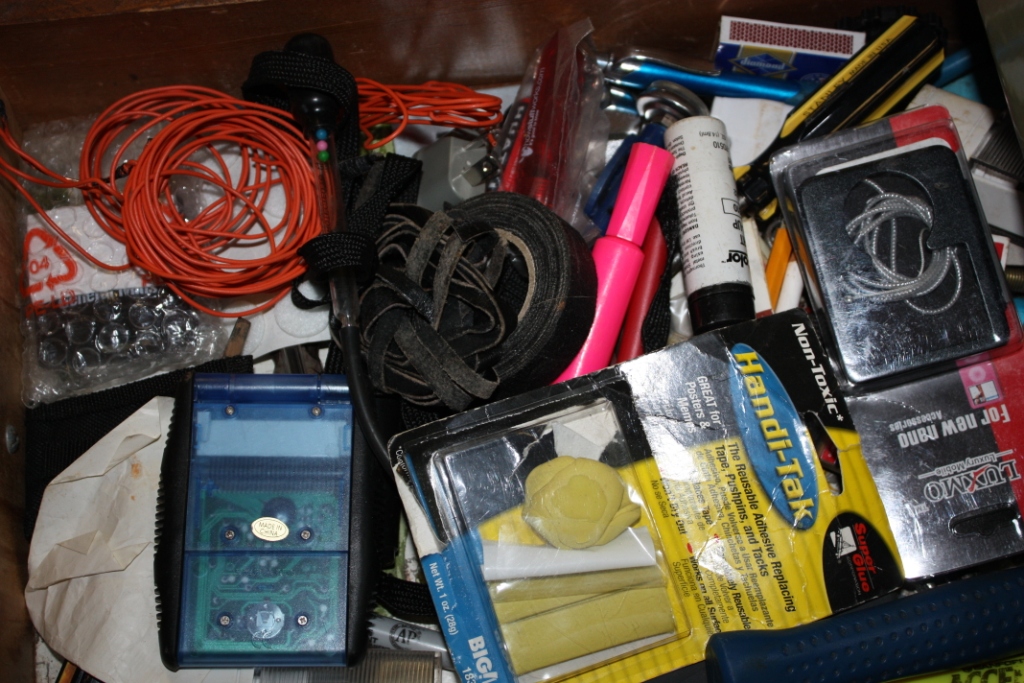
IMG_5194I don’t  like to use words like “stuff”, “things”, or the vague but picturesque “crap.”  Such words have low information content and are thus semantic lightweights. However, there are few words for the random compilation of tchotchkes, trinkets, baubles, gewgaws, kit, tools, devices, objects, gadgets, contraptions, contrivances, gizmos, widgets, thingamajigs, and doohickeys that line the drawers, shelves, and closets of my house.

You may think I’m some sort of packrat, but the sad fact is– I’m not. I’d say our household buys  less than average for homeowners. For one thing, we have no children. For another thing, both my wife and I might be classified as, for lack of a more eloquent term, cheapskates. (She’s an accountant and I’m trained as an economist, what do you expect?)  Of course, many people, perhaps most people, organize their junk better than I.

I do have one consumption fetish, and that is books. If you live in a very small town (or a large city with many small, local libraries) I may have more volumes in my house than does your local library. However, two things have slowed me down in collecting [physical] books. First, I buy most of my books on my Kindle these days. Second, I’ve come to realize that the reason I’ve bought so many books is the hope that one of them would provide some impetus for me to say something interesting, insightful, and valuable, and the entire English language canon has failed me utterly in this regard.

Still, I have a lot of miscellaneous detritus floating around in my home. You’ve heard of the 500-year flood? I have 500-year tools; that is, tools that are specifically for some task that only comes up once every few lifetimes or so. In a reasonable world, one would rent such tools. However, most tool rental places are also tool sellers. Such businesses have learned that if the tool sells new for $60, they can rent it for $50. Most people will buy it on the principle of the matter, and if they don’t… CHA-Ching. Who would rent a tool that costs almost as much to rent as it does to buy? I’ll tell you who (you thought that was rhetorical, didn’t you?), people who have the good sense to think of every object that comes into their home as an item being warehoused at their expense. People who have garage sales are brilliant. They are getting paid to store their junk in your home.

When I’m doing spring cleaning, as I am now, I frequently find containers that contain nothing. I guess I’ve just kept them around in case some pressing containment needs pop up. I keep all sorts of things because I think one day I’ll need them. However,  I never do need such items again, except the day after I throw them out.  To avoid such a situation, I don’t pitch them. However, if I keep them I won’t need them. If Joseph Heller was still alive, he could write a novel about my life.

Of course, sometimes I do need such items, but–owing to my poor organizational paradigm–I can’t find them. I then face the ultimate dilemma. Do I put the new one that I just bought with the old one that I found after I made the purchase, or do I put it in an entirely different location in the hope that when I need it again I’ll have a better chance of finding it.

No place have I felt the weight of how much “junk”  is swirling through our planet as when I was in Bangkok’s Chinatown last fall. There are miles of cramped alleyways and corridors packed to the gills with little plastic-wrapped junk, much of which seems to serve no purpose other than to satisfy the aesthetic needs of people with really poor taste or as gifts for people to whom you really want to send a statement of loathing. I had to get out of there, owing to a fear that shelving would collapse and I would be buried alive under a pile of knock-off Hello-Kitty coin purses.  I can think of no death that is more embarrassing and yet apropos of life in the modern world than that.

Of course, one of the many downsides of an economics education is the knowledge that our high standard of living is dependent upon people making and buying ever more stuff. If you are saying “what high standard of living?” and you haven’t hand-churned your own butter, darned some socks, and killed a mastodon today, I would encourage you to look into how people lived in the past. People unburdened of an economics education can make statements like, “People shouldn’t be materialistic and everybody should have a job and all jobs should pay a living wage.” However, that is like saying, “I should be able to keep my cake and I should be able to eat it as well and somebody should pay me $100 for it.”

We are still hunter-gatherers. We just hunt for bargains, and gather up geegaws.

IMG_3804

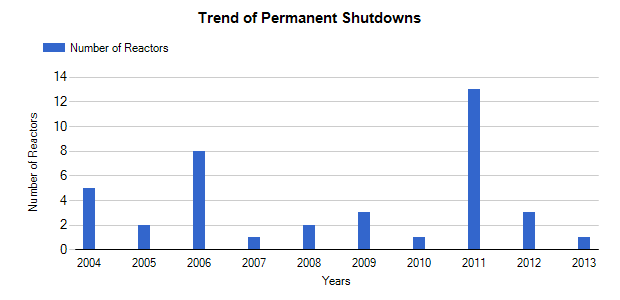
Was the Fukushima-Daiichi Incident the Final Nail in Nuclear Energy’s Coffin?

Today is the two-year anniversary of the tsunami that swamped parts of eastern Japan. Among the ongoing effects of this event was a re-chilling of attitudes toward nuclear energy–undoing a thaw that some swore was imminent. The tsunami hit the Fukushima-Daiichi plants and knocked out generators that were needed to run the coolant pumps with the power lines down. In the days after the disaster, the release of radioactivity and explosions of built up hydrogen presented some of the most prominent news stories.

Japan obtained about a third of its energy from nuclear prior to the event. All reactors were shut down in subsequent months, at no small cost to their economy. Eventually, a couple of plants were brought back on-line, providing only a fraction of the electricity of the country’s full fleet of 50+ nuclear plants.The Japanese had plans to add another 15 plants to their reactor fleet at that time, plans that have since vanished.

Even China, the world’s most prolific builder of nuclear plants as of late, had a brief moratorium on nuclear power plant (NPP) construction. However, China seems to have regained its ardor for nuclear power. France, of course, won’t be dissuaded either. However, for much of the rest of the world, doubts remain.

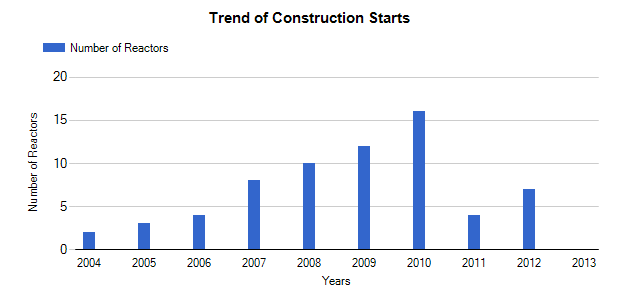
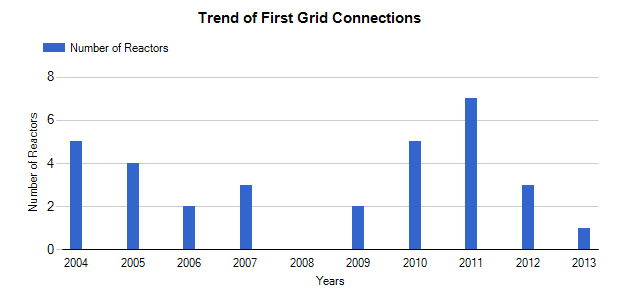
Pictures may be worth a thousand words.

Source: International Atomic Energy Agency (IAEA) Power Reactor Information System (PRIS)

Source: International Atomic Energy Agency (IAEA) Power Reactor Information System (PRIS)

Source: IAEA PRIS

Source: IAEA PRIS

Source: IAEA PRIS

Source: IAEA PRIS


The Nuclear Renaissance and International Security

Edited by Adam N. Stulberg and Matthew Fuhrmann

2013, Available Now

Buy this book

ONLINE RESOURCES
Contents

Contributors

Introduction

WRITING DEVICES: The Author Cameo in A Dead Hand

I’ll soon finish reading a novel by Paul Theroux called A Dead Hand. I won’t get into the details of the book in this post because I’ll do a review later, but there’s a writing device in it that really intrigued me. Theroux inserts himself into the novel in a cameo role as a competitor to the protagonist. That is to say, the main character is a traveling writer who writes mostly magazine articles, while Theroux a prolific writer famous for travelogues such as The Great Railway Bazaar and Ghost Train to the Eastern Star,  as well as for many novels which are written with a travel writer’s sensibility for location. (A Dead Hand takes place in and around Calcutta, India.)

I enjoyed the author cameo. It would only work well for a writer like Theroux, one who is both well-known and, because of his nonfiction work, who readers have a feel for as a person. Still, I couldn’t think of another novel I’ve read in which this has been done. I’ve only read Theroux’s nonfiction so far, so maybe this is a running gag with him.

Inserting himself offers some opportunity for adding humor. For example, there’s a part in which the main character’s friend, who is also a go-between who introduces the two writers, says, “He [Theroux] said he wanted to take the train from Battambang to Phnom Penh.”

To which the main character replies, “He would. The bus is quicker!”

This technique also gives one the impression that we are getting some inside insight into the writer. When the main character mistrusts the author, how are we to process that?

Granted it’s a little like an actor looking into the camera and talking straight to the audience.

I’m interested to hear if this is a more widespread technique than I’m aware of? Who else does this?

The Case of the Biggest Ego

Dear Leader, Version 3.0, and Dennis Rodman

Dear Leader, Version 3.0, and Dennis Rodman

I was reading an article in The Economist over the weekend about the sanctions against North Korea, and Kim Jong Un’s “don’t mess with me, I’m CRAZY!” response.

The article featured the photo above. I was immediately struck by the fact that Kim Jong Un’s head is higher, despite the fact that Dennis Rodman is about six-and-a-half foot tall and Kim Jong Un is… well, let’s just say a dwarf.  I don’t know exactly how tall Kim is, and I’m sure nobody truly does. I tried to look up Kim’s height, but the figures ranged from 5’3″ to 5’9″. This isn’t surprising. The Kim family motto is, don’t let blatant facts to the contrary get in the way of a good lie; stick to your guns, execute people as necessary, and show your skeptics the crazy eyes. Kim Jong Il was believed to have worn six-inch lifts and a nine-inch pompadour to impress his underlings with his grand total 5’2″ physique. Of course, each successive generation of the Kim Dynasty has an easier time because the country’s citizenry is shrinking due to undernourishment, a fate that isn’t shared by the Kims. (Sadly, this isn’t a joke. North Korea is one of the few nations whose average height has been in decline over recent decades.)

It’s not really surprising that Kim insists on his head being higher than his guests. (I know what you’re asking. Whose set of phonebooks is he sitting on, because there sure as hell aren’t enough phones in North Korea for him to be sitting on the DPRK listings–which is more of a pamphlet?) Anyway, kings, emperors, and dictators have always required others to scrunch down so that the royal status will remain unquestioned.

However, if there is anyone who can match a dictator’s monumental ego ton for ton, it’s a professional athlete. Consider Lance Armstrong, he sued reporters for telling the truth about him. What kind of rarefied atmosphere does one have to live in to do that?  Then there are the many athlete-rapists whose defense was “Your Honor, I didn’t know I needed permission to have sex with that person. I think my lawyer may have failed to make you aware that I’m this year’s MVP… Even an MVP needs permission? That’s some crazy shit.”

As a society, we nurture the notion that the dictates of polite society don’t apply to those who are skilled at winning games. Coaches have been known to be fired mid-season for losing, but Bobby Knight beat the hell out of kids for decades before he got fired. We deify athletes just like the people of North Korea, who can’t afford leisure activities of any kind, deify their dictator.

So this photo answers for me an intriguing question, who’s more narcissistic: a professional athlete or a professional dictator. Seeing Dennis Rodman peering at the game over the twin humps of his knees answers the question nicely.

To be fair, Rodman did get a subtle dig in with his Team USA cap;  subdued as it may have been, that must have gotten Kim’s goat. Rodman also got in a nice Coca-Cola product placement. Fun fact: I was once told by a Coke employee that there were only two countries in which Coke was not sold. Everybody guessed that North Korea was one of them, but that’s not correct. It was Burma and Cuba (don’t ask me how the latter has been making Cuba Libres all this time.) Given Burma’s reforms, I wouldn’t be surprised if today it was down to one (or none.)  [World dominance… check.]

TODAY’S RANT: Puny Machines

When the machines rise up against humanity, I will be high on their list of Homo sapiens to put through the chipper-shredder.

You may be asking, “How can such an unimportant person make such a self-important statement?”

Here’s my confession: I have killed more than my fair share of consumer electronics. Let it be known for posterity that these were all cases of manslaughter–or, I guess, machineslaughter. I never once had malicious intent, nor did I ever engage in premeditation. Furthermore, in a way, I mourned the loss of these machines more intensely than I did the death of granny.

Let me say, in my defense, machines are weaklings. The good news is that I don’t worry about them taking over just yet because you can always take out a marauding terminator with a can of soda–and even make it look like an accident.

The rant part of this post has to do with the divergence between what is advertised, and what is true.

Below is a video that Lenovo has put on YouTube to show how robust their computers are.

Here was my experience, avoiding the lunging paw of a hyper cat, I spilled a drop of milk the size of a quarter onto the upper mouse buttons. This killed my mouse instantaneously (I’m aware of the irony of me killing a mouse while my cat looked on in horror.) My entire laptop died a few weeks later from what I assumed to be related causes.

Your Experience May Vary

Your Experience May Vary

Since my last machineslaughter, I’ve  quelled my killing spree by implementing three simple rules.
1.) I don’t eat in the same room as my computer.
2.) I don’t drink within 12 feet of my computer.
3.) I must close the computer any time I leave the room, if a cat is present. (This is not so much to save the laptop as to prevent the cat from composing a witty coded email such as, “a;oreanrpwipfvchaqewutheiuancvpiwe. wpn2qeyt028hnfqv-,” and sending it out to my entire email list with his butt.)

Do I resent having to walk on eggshells around consumer electronics? A little. I’d like to be able to listen to my transistor radio while taking a bath. (Research notes: Do radios still have “transistors?” Do they still make radios?)

However, what I really resent is the manufacturer making it seem like its product is indestructible when, in fact, it’s really pretty puny.

That said, I like the fact that people are tougher than the forces of robopocalypse by virtue of the fact that we can get wet.  (Of course, by that logic, fish should be our gods.)

Until next time, keep your can of Coke at the ready (but don’t drink it, that stuff will kill you.)