
Taken at the Mysore Zoo on November 29, 2013.
I took this photo at Mysore zoo through the chain link fence, but got focus on the leopard.

Taken at the Mysore Zoo on November 29, 2013.
I took this photo at Mysore zoo through the chain link fence, but got focus on the leopard.
Every morning I start my day with chi kung (a.k.a. qi gong), and many days I do tai chi (tai qi.) For those who are unfamiliar, chi is usually defined as “life force” or “life energy.” However, defining chi is neither simple nor will one find a consensus agreement. Some say chi is “breath,” at which point its existence becomes a much less controversial, but also less explicative, concept. Others would say that chi is much more broadly dispersed than the “living” so “life force” is an understated definition.
Chi Kung are exercises combining breathing, movement, meditation, visualization, and self-massage that are used to keep one healthy. Because yoga also contains these components (e.g. breathing, movement, and meditation; though with very different specifics) some have even been known to call chi kung “Taoist yoga.” The idea behind these exercises is that chi is lost through living (some activities more than others), and can become blocked in the channels through which it is believed to move. Various exercises are used to replenish and ensure healthy circulation of the chi. Tai chi is a series of martial arts forms that are also considered to have the effect of replenishing and / or enhancing chi.
Two questions may leap to mind, especially among those who know me as a skeptic. First, do you believe in chi–despite the lack of evidence that it exists? (When I mention this lack of evidence, I am obviously not defining chi as breath or bodily fluids, in which case the most rabid skeptic would have to acknowledge its existence. However, then an entirely different set of questions is raised about the vast and complicated nature of chi kung exercises needed to circulate oxygen, which travels through blood vessels and not through channels or meridians. In other words, there’s no reason not to abandon a lot of the Traditional Chinese Medicine (TCM) / Taoist conceptions of health if one considers a narrow definition of chi.) Second, if you don’t have any reason to believe that chi is a real thing, why bother with the exercises?
First, no, I don’t believe in chi as a substance or physical entity in the way that your average Taoist priest does. I don’t mock or ridicule those who do, and I acknowledge it could always turn out that they were right and I was wrong and that my current state of ignorance combined with an incorrect deference to Occam’s Razor led me astray.
However, I have a pretty high standard for believing a person, place, or thing exists. I need to be able to observe it. If I can’t perceive it directly, but there is some indirect sign it exists, then that indirect sign needs to be the simplest possible explanation I can imagine given my current state of knowledge. (Yes, I realize that Occam’s Razor isn’t a law, it can always be that an unlikely explanation is the correct explanation. I also know the raft of indirect signs of chi, and, yes, I’m saying I can imagine simpler explanations than an energy source that is immeasurable but powerful enough have bodily effects.) While I don’t believe in chi (or meridians, or the yet undiscovered organ called the “triple heater”) as physical things, I do believe in conceptual chi which is an object of visualization.
Moving on to the second question, I practice these exercises because they make me healthier.
This, of course, raises another question, “How can these exercises be effective if chi is not real?”
Now I have to go Socratic on my hypothetical questioner. The Socratic dialogue goes like this:
S: Have you ever been to a scary movie?
A: Of course, I have. What kind of a troll has never seen a scary movie?
S: I’m Socrates. I’ll ask the damned questions around here, thank you very kindly.
So while you were watching said movies, did you ever get startled? That is, did your pulse ever pound a bit harder; did you ever take a gasping breath; did your hands ever grip the armrest with white knuckles; or did you ever get butterflies in your stomach?
A: Of course, that’s part of the horror movie watching experience.
S: So, then, you were under the impression that the events you were watching were actually happening, and that the killer might come out into the theater after you at any moment?
A: No, of course not. Don’t be absurd!
S: And yet this thing that was not real–that was just symbolic or conceptual–had actual physiological effects?
[At this point Socrates breaks into his superiority dance.]
I think visualizing chi flow has positive benefits both mentally and physically. The mental benefits may be clear. The physical benefits result from putting oneself in the moment and conducting activities (deep breathing and movement) that help one de-stress. This process of de-stressing helps one to be healthier. Does it matter that one does the exercises as they have been handed down from ancient China? Probably not, but I believe that trial and error (even without complete information about anatomy and physiology) yield some impressive results. Of course, there are many other systems (e.g. yoga) that can work equal wonders using an approach that is quite different in its detail. (I also don’t believe in Chakras, but can imagine great benefits from behaving as if they exist.)
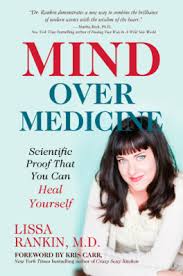 I just started reading a book by a medical doctor named Lissa Rankin. Rankin’s book, entitled Mind Over Medicine, presents evidence from a large body of scientific literature suggesting the mind often plays a major role in wellness by way of mechanisms that aren’t yet fully understood, but which defy the traditional view of Western medicine.
Rankin was intrigued by the vast number of anecdotal cases of what doctors call “spontaneous remissions.” Spontaneous remissions are when a patient becomes healthy in a way that defies explanation (i.e. they had no treatment, they had insufficient treatment, and they had an illness for with the body’s immune system is normally believed incapable of doing the job on its own.) She wasn’t satisfied with these one-off stories involving placebos, fake surgeries, busted radiology equipment, faith healing, etc, but rather wanted to see what the scientific literature contained by way of scientific double-blind studies on the subject.
She found there was evidence to support mind over matter when it came to illness, and that there was a fledgling explanatory literature. She also learned that while there was a large database of spontaneous remissions, there had not yet been an attempt to determine whether there were common characteristics of those who showed the “placebo effect” (getting well while being in the placebo group of a double-blind study) or other spontaneous remissions.
My point is that there is good reason for skeptics to consider that there may be a lot more to health and well-being than our current paradigm suggests.

Taken November 23 at Hoysaleshwara Temple in Halebidu
For almost 900 years poor schlubs have had to scrub their way around this temple, washing its ornate carvings.
I wonder how similar or different the workers of past generations looked? Obviously, they didn’t have molded plastic water jugs, but the pottery version might have looked similar (not the day-glo lime green one, but certainly the brick-colored one.) No dress shirts or ball caps back then, but the turbans and sarongs are probably not so out-of-place.
Of course, the scaffolding, rough-cut wood lashed together, gives it an ancient feel.
Probably, the most striking difference is the female job foreman.
 Poems: Three Series, Complete by Emily Dickinson
My rating: 5 of 5 stars
Three series are collected into one volume. Each series is organized into four parts: Life, Love, Nature, and Time & Eternity. The connection between these themes and the verse contained therein is generally clear, and the latter category is largely concerned with death—a popular topic for Dickinson. While Dickinson is known for being morose, her poems often manage to be both playful and dark at the same time. The best example of this odd combo of grim / playfulness may be one of her most quoted poems, The Chariot.
Because I could not stop for Death,
He kindly stopped for me;
The carriage held but just ourselves
And Immortality.
We slowly drove, he knew no haste,
And I had put away
My labor, and my leisure too
For his civility.
We passed the school where children played,
Their lessons scarcely done;
We passed the fields of gazing grain,
We passed the setting sun.
We paused before a house that seemed
A swelling of the ground;
The roof was scarcely visible,
The cornice but a mound.
Since then ‘t is centuries; but each
Feels shorter than a day
I first surmised the horses’ heads
Were toward eternity.
Dickinson’s life story is well-known, at least in broad brushstrokes. She was a 19th century poet who was introverted in the extreme, and eventually became an outright recluse. According to her own words, she didn’t take up writing poetry until she was in her 30s. This existence was facilitated by the fact that she was from a well-to-do family and had no pressing need of a husband or an income.
Dickinson’s introverted nature is touched on throughout her work, and no doubt contributes to her appeal among those similarly afflicted. The opening poem of the Second Series, another of Dickinson’s most famous, speaks to this aspect of her personality.
I’m nobody! Who are you?
Are you nobody, too?
Then there’s a pair of us! Don’t tell!
They’d banish us, you know.
How dreary to be somebody!
How public, like a frog
To tell your name the livelong day
To an admiring bog.
I enjoy Dickinson’s work, but it’s the playful nature, rather than the macabre, that appeals to me. This is accomplished by short lines, use of rhyme, or at least slant rhyme, that makes the poems melodious to the ear. I’m fond of lines such as:
Success is counted sweetest
By those who ne’er succeed
God permits industrious angels
Afternoons to play
Hope is the thing with feathers
That perches in the soul
Faith is a fine invention
For gentlemen who see;
But microscopes are prudent
In an emergency!
A word is dead
When it is said,
Some say.
I say it just
Begins to live
That day.
There is no frigate like a book
To take us lands away,
You cannot fold a flood
And put it in a drawer,–
Because the winds would find it out,
And tell your cedar floor.
He fumbles at your spirit
As players at the keys
Before they drop full music on;
He stuns you by degrees,
Deals one imperial thunderbolt
That scalps your naked soul.
For we must ride to the Judgement,
And it’s partly down hill.
While simple-hearted neighbors
Chat of the ‘early dead,’
We, prone to periphrasis,
Remark that birds have fled!
And if my stocking hung too high,
Would it blur the Christmas glee,
That not a Santa Claus could reach
The altitude of me?
This Kindle version is readable. A common complaint about good books, particularly those that are cheap or free, is that the Kindle formatting detracts from the reading experience. That is not the case here. There is a first line index at the back. This is useful as most of the poems don’t have titles, and Dickinson’s first lines are often attention grabbers.
I’d recommend this for poetry readers.
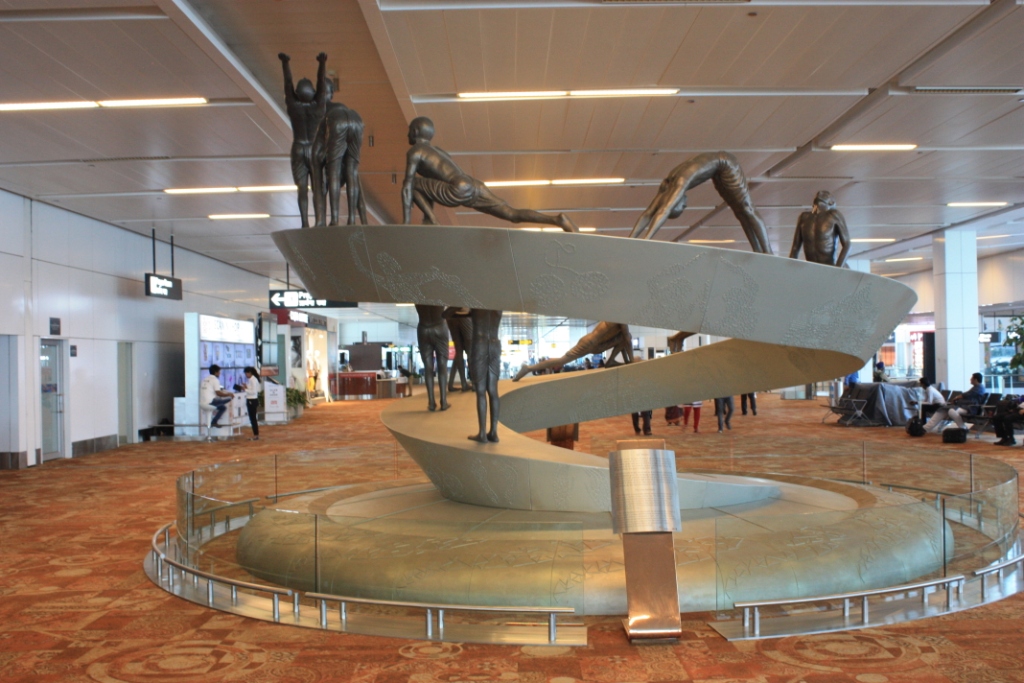
Taken October 16, 2013 at Indira Gandhi International Airport.
In the Delhi airport, there is a series of 12 bronze sculptures set up on a spiral platform that together demonstrate the yoga sequence called Surya Namaskara (i.e. Sun Salutation) The sculptor is Nikhil Bhandari.
I think this was a nice move. If ever one needed yoga, it’s in an airport–having been packed into a tiny space for hours and with high stress about whether one will get where one wants to go, it’s the perfect place to bust out the yoga.

 The Einstein Theory Of Relativity by Hendrik Antoon Lorentz
My rating: 3 of 5 stars
It’s hard to complain about this book because: a.) it’s a free kindle book, b.) the author was brilliant, a Nobel Laureate, and a man whose work contributed to the discoveries of Einstein, and c.) it’s a very short book, clocking in at about 60 pages, and so it’s not a huge time investment–though for most it will be a bigger time investment than its page count would suggest.
All that being said, I’ll be upfront and tell you that his work is the product of a different era and doesn’t establish its audience clearly.
Science writing, particularly on subjects as arcane as relativity, is a challenge. One has to pick an audience and carefully write for that audience. If ones audience is broad (i.e. not well-trained in science), this means one has to accept a lot less precision in exchange for clarity. In other words, one has to write like Brian Greene or Michio Kaku do in their popular works. On the other hand, if you want to write for technical people, you should probably feel free to show your math and sling the technical jargon.
This book tries to walk a middle ground. It doesn’t lay the subject out in clear, simple, and entertaining analogies. (With the exception of a moving car analogy early on that gets bogged down.) However, there’re no equations or highly technical and jargon-suffused discussions. (Though the section on deflection of light does get into measurements and is bit technical.)
So the question the reader needs to ask themselves–provided they haven’t had physics since high school or their freshman year of college–is whether they are willing and able to grind through reading that will require them to think hard the whole way. One doesn’t need a big science vocabulary, and you aren’t asked to ponder any equations, but you do have to noodle out what the author is saying to get value out of the reading. As I implied earlier, this book (pamphlet) took me considerably longer to read than 60 pages normally would–and I read a fair amount of popular science works.
Of course, given that it’s free, it’s worth a try if you have a Kindle. If nothing else, you should come away with some basics– such as what differentiates special from general relativity. If you don’t like the book you can always buy a Greene or Kaku book to explain the subject in a more palatable fashion.
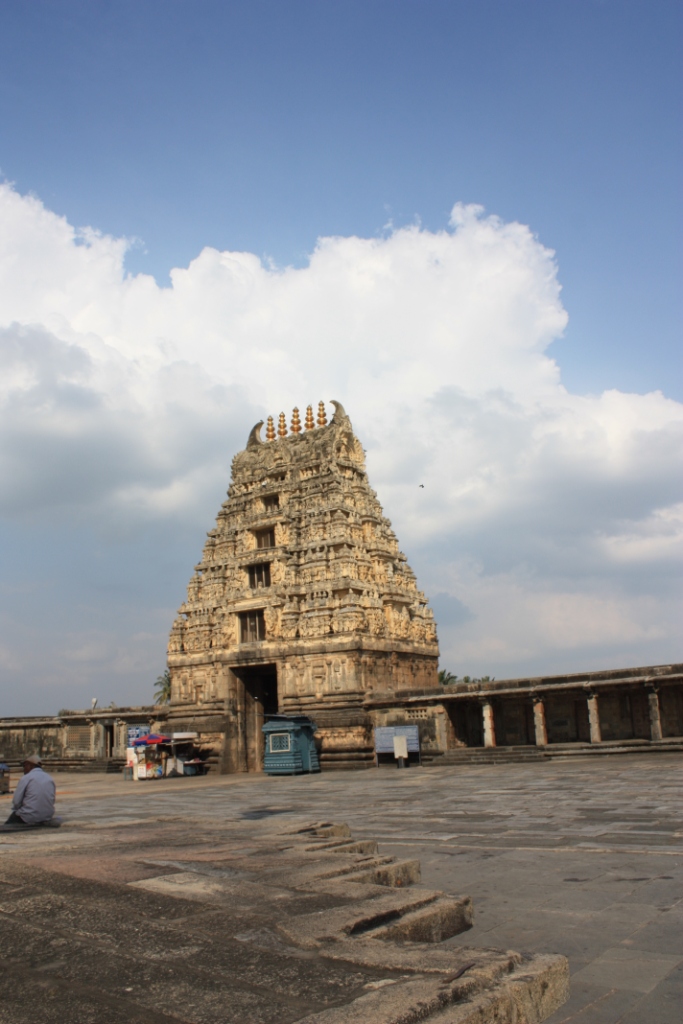
Taken November 23, 2013 at Belur.
This is the gate into the Chennakeshava temple in Belur. In the foreground is the base of a pillar that served to hold the temple lantern that let all find the temple in the darkness. (Fun fact: the pillar isn’t secured to the base. That is, it’s held in place by gravity.) The base is the same multi-sided shape as the temple mounts.
Below is a pic of the lantern pillar (it’s not as askew as it appears in the pic.) (Fun fact #2: if you type askew into Google’s browser it will twist the page askew.)

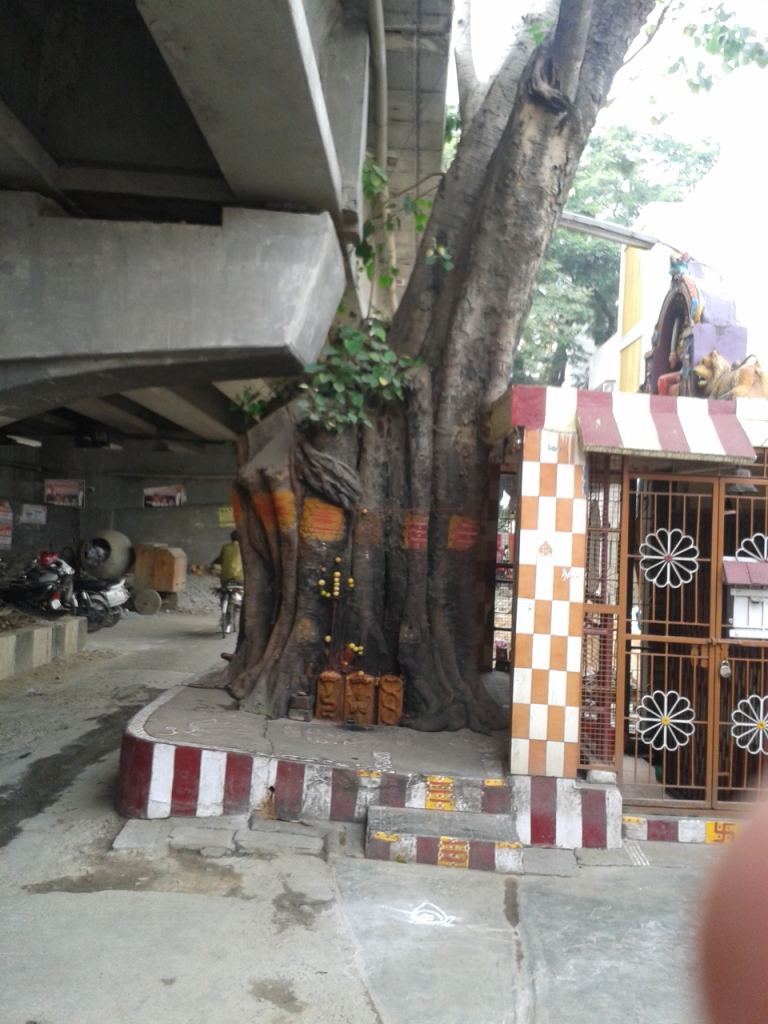
Taken December 7, 2013 in Cox Town.
I took this photo yesterday in Cox Town as we were walking over to the United Charities Bazaar (a great and highly recommended event.) It’s a tree that juts out into the road next to a small Hindu temple. When they put in a flyover, they cut away quite a bit of the tree, but the part that remains seems to be thriving.
When one moves to a new country, one experiences a wide variety of cultural insights. All of a sudden, this invisible thing called culture becomes visible. There are, of course, many norms that grate on one’s nerves with respect to the culture one has been transplanted into. In the vast majority of cases, there isn’t anything inherently wrong with the new culture–they are just differences, just shocks to one’s system. There are a few cultural proclivities that one can fairly say are objectively inferior, and it’s a testament to India that they are trying to fix these problems (e.g. by outlawing the caste, by trying to prevent killing off of girl children, etc.)
However, if one is honest with oneself, one also gains insight into one’s native culture, and its particular inferiorities. As I said, we take culture so for granted that we don’t necessarily even see the peculiarities of our own culture. One of the Indian norms that I find most laudable is the preservation of living things to the extent possible. Put alternatively, one of the norms of my own culture that I’ve come to find most dismaying is the belief that anything that causes a person the least inconvenience must die immediately.
I imagine that some Westerners in India find it to be a pain to have to step out into the street when walking down the sidewalk because there are occasionally ten-foot diameter trees hogging the whole sidewalk. In the US, they’d just cut down the big tree and replace it with a dwarf tree of some sort that would never give them a problem–and if it did, just get out the saw.
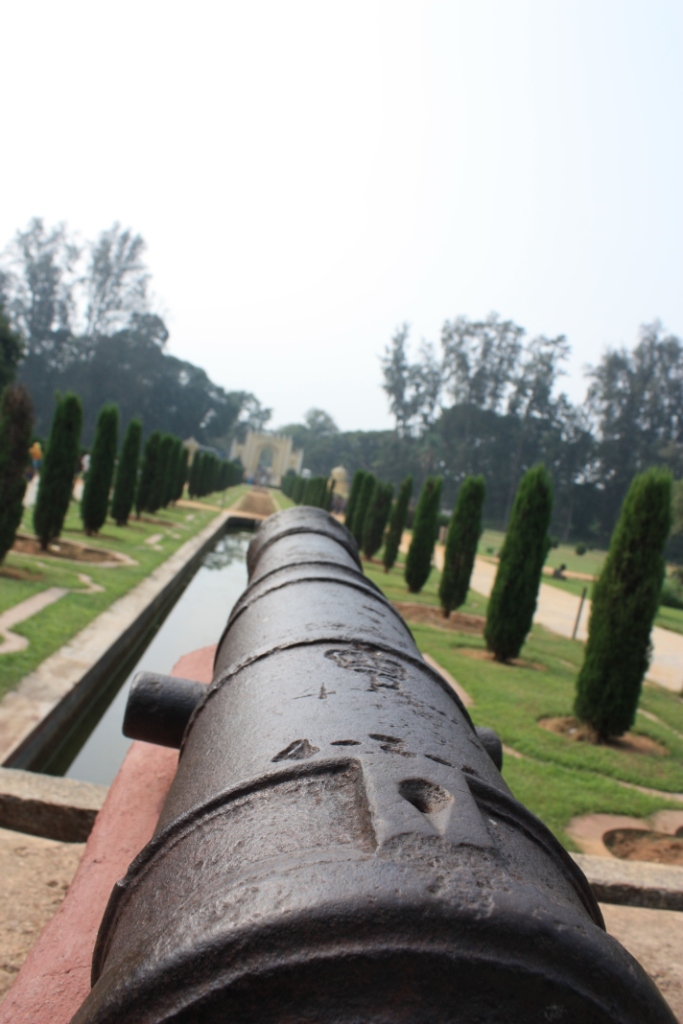
Taken November 29, 2013 at Daria Dalaut in Mysore.
This cannon points right at the main entry to Daria Dalaut, Tipu Sultan’s palace in Mysore. It seems a tad inhospitable, but one can’t be too careful.
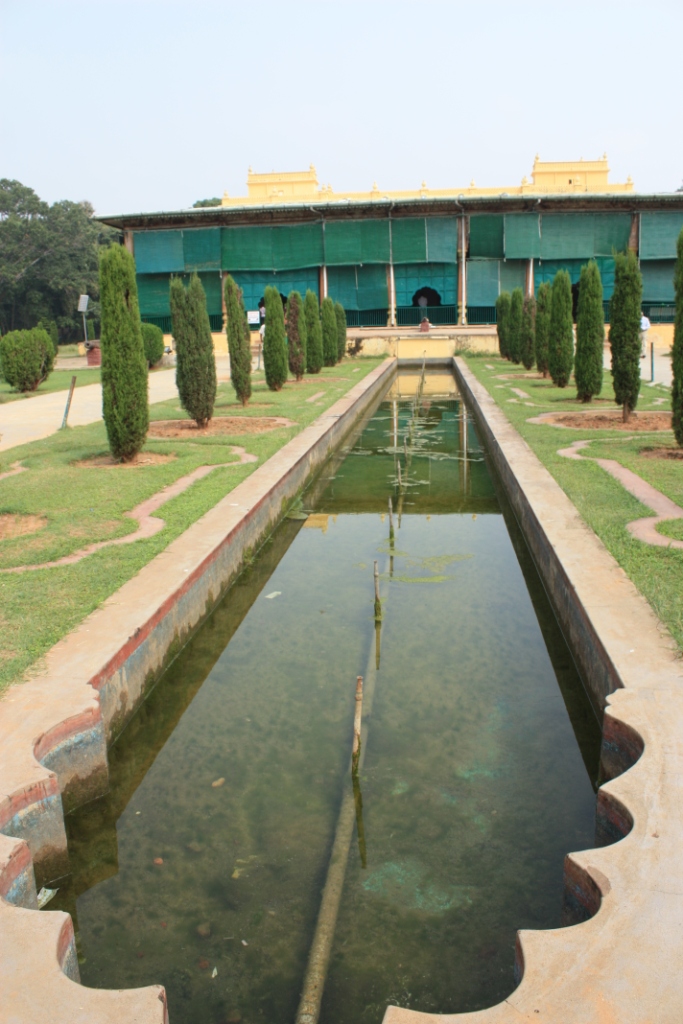
Taken November 29, 2013.
The gun doesn’t look so imposing from the end of the first cement pond, and is just a speck from the gate.
 The Warrior’s Path: Wisdom from Contemporary Martial Arts Masters by James Sidney
My rating: 5 of 5 stars
My upfront apology: Having drafted this review, I noticed that the book comes off sounding like a bunch of old folks being curmudgeonly about the current generation. As I read this book, that wasn’t the feeling I got. Therefore, it may be a matter of the points that resonated with me, and be more reflective of myself than the martial arts sensei (teachers) who have chapters in the book. [That being said, young readers be forewarned that your generation does get blasted upon not only in this review, but by the sensei in question.]
Fifteen prominent martial arts teachers offer their insights in this book. The group is in many ways homogenous. All fifteen teachers are practitioners of Japanese gendai budō (the modern-day martial arts that developed after the Meiji Restoration [1868]; as contrasted with kobudō or koryū bujutsu, i.e. old school martial arts). All of these martial artists were born in the 1910’s and 20’s and began their study of martial arts in first half of the 20th century.
These teachers are a bridge between the founders of these arts and the arts as we know them today. In a few cases, they are also bridges between kobudō and modern martial arts. For example, Hiroshi Tada was a student of Morihei Ueshiba, the founder of aikido. While we think of O-sensei (Ueshiba) as a gendai budō practitioner because he founded a modern school, he was brought up on kobudō. Furthermore, students of Gichin Funakoshi (the Shotokan karate founder), Jigorō Kanō (the Kodokan judō founder), Hironori Ōtsuka (the Wadō-ryū karate founder), and Dōshin Sō (the founder of Shōrinji Kempō) are represented.
This book is particularly important in that several of the teachers in it have passed away since the book was published. Time is receding for this generation’s thoughts to be saved for posterity. A cursory google search revealed that at least four of these teachers have passed away: Hidetaka Nishiyama (2008), Tatsuo Suzuki (2011), Keiko Fukuda (2013), and Ron Nobuto Omoto (2013.) However, some were more well-known internationally than others, so there may be a few others that passed on without attracting the attention of English-language websites. However, the youngest of them is 84 (the oldest believed living is 97), and so it’s safe to say there may not be many more chances to hear these people’s wisdom.
I’ve pointed out the homogeneity of this group, but there’s also a diversity about them. Practitioners of karate, judō, aikidō, shōrinji kempō, kendō, kyūdō, and Atarashii Naginata are represented. Despite the notoriously male-dominated nature of Japanese martial arts, at least there are two women’s voices in the mix. While all of the artists are of Japanese ancestry, they’re not all Japanese by citizenry. There are two Americans and two Canadians among the bunch, and one individual who was born in China. There are also individuals who were born in Japan but moved abroad to places like France and Brazil to spread their art.
There are a few themes common across multiple of the commentaries. It might be tempting to dismiss some of these points as the “back-in-my-day” sentimentality of the aged, but their experiences are sometimes too similar to lack veracity.
First, several of the teachers said there was much less doggedness in recent generations than in their era. People come into the dōjō (a martial arts school), dabble a little, and–if they’re not constantly entertained by new and fancy techniques–they quit. As a result, there are many practitioners who possess a vast repertoire of technique, but they aren’t skilled in any of it—and even more who get nowhere. The theme was that there is no fast-track to success in budō, one has to work at it day in and day out. It should be noted that all of these individuals were born before 1930, and yet were still teaching / training in 2003 when the book was published.
Second, this generation devoted considerable effort to developing the mind as well as the body. With the availability of better nutrition, training equipment, and sport science, young martial artists may be physically fitter than ever on average (I’m talking about competitors not those using martial arts as a fat camp), but they are also mentally weaker than ever—with limited attention spans and emotional control. Present-day martial arts students often give little credence to the value of training the mind or carrying a martial arts mindset outside the dōjō. Several of the teachers in this book mentioned practicing Zen or some other form of mental exercise, and some emphasized the importance of carrying the clarity and intention of the dōjō about everyday life.
The problem with this is that the martial arts become a young man’s game, and there becomes a lack of experience. A student does a martial art for a few years and then abandons it because his or her physical athleticism isn’t going to increase. This decreasing physical capacity translates into becoming a weaker martial artist. The only way to grow in the long-run is to become mentally stronger, more self-confident, and having better emotional control.
The problem is that this mental strength and confidence often becomes confused with arrogance or cockiness. But as Nobuyuki Kamogawa (kyūdō) points out, the problem with arrogance is that one can’t see one’s weaknesses—and, thus, can’t grow. While Japanese arts may seem overly-formal (and there can be truth to that), it shouldn’t be forgotten that part of what this formality does is (potentially) build mental discipline and humility.
I think Toshiro Daigo best summed up the problem of not living the art. He said, “But to young Japanese people, judō becomes judō when you put on your judō costume. So without the costume, judō doesn’t exist.”
Third, judō, karate, and kendō teachers bemoaned a shift away from the pursuit of victory by decisive technique (e.g. the the ippon.) Over time, there has been an increased reliance on building up a win by minor points. In judō this may mean trips instead of throws; in kendō it means going for the forearm rather than the head. In other words, competitors have become more risk-averse and less bold. Concern about this is two-fold. For one thing, there’s a worry about the dilution of these arts, but there’s also concern about the sport becoming less interesting to watch and thus losing its following.
Related to the previous two criticisms is a concern about training to build champions, while forgetting to forge good students. This was emphasized not only by some of the sport-oriented art teachers, but also by Hiroshi Tada. Tada, as an aikidō practitioner, is in the unique position being the only one of the teachers to practice a non-sport martial arts system.
Fourth, several sensei suggested the importance of learning for oneself. One of the teachers, Rod Nobuto Omoto, was an uchi deshi (live-in student), and he—as in the old days—spent a lot of time doing chores while getting little to no training. The point is not so much to criticize the younger generation, but to inform them that they must take the reins of their martial arts practice. This may come to a surprise because the educational experiences they are most used to is having information handed to them in as learnable a form as possible.
Fifth, there was a general disdain for the idea of thinking of one’s art as being inherently superior to all others. Masao Takahashi (judō) and Mitsusuke Harada (karate) both made this point. Harada proposed that abject faith in the superiority of one’s art encourages the development of martial artists who cannot defend themselves. If you think your system is inherently best, you may begin to rely on that illusion of superiority rather than on the advancement of your own skill.
Sixth, the importance of mutual benefit was emphasized throughout. Of course, for the judo practitioners, the idea of jita kyoei (self-perfection, mutual benefit) is one of the two Kodokan budōkun (martial arts maxims.) [The other being seiryoku zenyo, or maximum efficiency.] Shigeru Uchiyama said that the belief in Shōrinji Kempō (whose practitioners are also Kongo Zen pupils) is that of “…living half of your life for yourself and half for others.”
A couple of other points that caught my attention were brought up by individual teachers.
Keiko Fukuda expressed concern about women being trained in the same manner as men, and, thus, using too much strength. The 9th dan was concerned about injuries resulting from this over-reliance on strength. This is an interesting point which I hadn’t given much thought. No doubt it’s a controversial point as well. It’s hard for me to comment about whether Fukuda is just old-fashioned and a product of her time and culture (which is, I’m afraid, highly misogynistic) or whether her point is valid. However, I’d be willing to give her the benefit of the doubt as she was an extremely impressive woman.
Lest one think that these are all just traditionalists trying to keep the traditions alive, consider a quote by Yoshimitsu Takeyasu that speaks otherwise. “Not all traditions are good but we have to identify the ones that should be kept.” Rod Nobuto Omoto said simply, “Tradition is not important.” However, I think Omoto’s point is more nuanced than it seems (and perhaps more Taoist) in that what he seems to be saying is that if you make the tradition important it becomes about the tradition and not the what lies beneath the tradition (e.g. values, etc.)
Omoto also offered a great deal of thought-provoking insight into death. It was clearly a topic that he’d reflected on not only as someone coming to the end of his life, but also as one who practices budō.
I think this is an important book for martial artists of all stripes. However, I think that even non-martial artists might learn a thing or two from the insights of these old masters.


