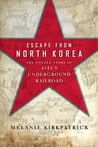
 Escape from North Korea: The Untold Story of Asia’s Underground Railroad by Melanie Kirkpatrick
My rating: 5 of 5 stars
Amazon page
Escape from North Korea is the most intriguing non-fiction book I’ve read in recent months. Kirkpatrick offers a glimpse into the operations of a modern-day underground railroad, one whose stories—sadly—are often no less chilling than those associated with its US Civil War namesake from 150 years ago.
The 17 chapters of this book are arranged into six parts. The organizational logic of the book takes the reader from the germ of an idea to flee all the way to settling into life in a free country, with all the trials and tribulations that are experienced in between. It begins as a story of one person who decides to escape, and who must virtually always get across the border into China on his or her own. Once across the border, there is help to be had if the refugee can find it before he or she gets caught by the Chinese and repatriated or is exploited by nefarious individuals. Danger is ever-present, occasionally even once the individual gets to South Korea.
Chapters 3 through 7 were particularly interesting because they looked at various classes of escapee, some of which one might not realize existed. It starts with the classic defectors, similar to those one might associate with the USSR—political, military, sporting, and artistic figures. This was the main class of refugee until people began starving in the 1990’s due to nation-wide famine.
Next is a chapter on brides for sale. Many North Korean women end up forced into slave marriages. China has a dearth of eligible women due a bias against female children, particularly combined with its one-child policy. Some women are lured across the border under false pretenses, but others, finding themselves fugitives in China, end up being exploited due to their vulnerability. Each bride fetches about $1,200 to $1,500 ($500 to $800 from the wholesaler to the retailer.) There’s also a chapter devoted to the children of such marriages, and particularly the cases in which the mother is repatriated and the child ends up orphaned because children born in China will not be taken by the North Koreans and frequently the fathers want nothing to do with the children. Pregnant women repatriated to North Korea are often forced to abort pregnancies involving Chinese fathers.
One of the most intriguing chapters was on the North Korean lumberjacks residing in Siberia. This profit-sharing deal goes back to the Soviet days. When the Soviet Union imploded, however, the arrangement was kept with some worker rights installed on paper to appease Russia’s newly developed human rights watchdogs. One might wonder how the Kims—fearful of dissidents as they are—would let a group live outside the country on a remote site that’s hard to guard. The answer is that all the lumberjacks had to have both wives and children at home to serve as hostages. Still, some decide to make the break.
There is also a chapter about the Prisoners of War from the Korean War who were trapped on the wrong side of the border.
I’m fairly well-read on the subject of North Korea, but, like most Americans, the bulk of this has to do with Pyongyang’s nuclear program. I, therefore, found some of the stories of the regime’s depravity to be beyond the pale. A sampling of such stories includes:
-guards severely beating a prisoner and then having other prisoners bury the victim alive
-the warden in a state-run orphanage having orphans fight each other for bigger food servings
-a family that killed themselves rather than be repatriated to North Korea
-individuals, such as Ri Hyok-ok, who were executed for distributing bibles
-North Korea’s provision of family information on trans-border family members as a profit-making scheme
-Kim Jong Il pulling a Pol Pot and shutting down the universities and colleges and sending students to work on farms and in factories for months in 2011 because he was afraid that the Arab Spring might be infectious
-Kidnapping foreigners on foreign soil, which North Korea has even admitted to openly.
Sadly, the woeful tales aren’t limited to the North Koreans. Kirkpatrick devotes a considerable amount of space to chastising the Chinese for repatriating North Koreans. Under international law, which China ratified, refugees shouldn’t be sent back to their country of origin if it’s likely they will be punished. China claims that individuals are economic migrants and not political refugees, and it compares them to Mexicans crossing onto American soil—without addressing the fact that Mexicans are not sentenced to hard labor or killed when they are returned to Mexico. The Chinese might also point to Hwang Jang-yop, the author of the North Korean Juche (self-reliance) policy, as an example of a “true” political refugee that they didn’t repatriate, but allowed to migrate to South Korea (where the North Koreans tried to assassinate him in Seoul several times.)
There’s even some disappointing behavior on the side of the US. In 2006, an American consulate employee in China not only turned away several North Korea refugees, but–by speaking openly over an unsecured line–got a conductor on the Underground Railroad arrested.
The end of the book contains an interesting description of how the Kims are beginning to lose the war on keeping the information age out of North Korea. From balloon drops to radio broadcasts, North Koreans are beginning to get true information about both the outside world and their own leadership. Lest one think that no one could possibly believe the propaganda out of Pyongyang, even in the absence of information inflows, there’s a story about an immigrant to America who had a hard time coaxing his family out because they believed that America was out to kill North Koreans. This father’s story of the good life in sunny Florida didn’t entirely convince them, and ultimately they had to be coaxed to their new home in stages. It’s telling that the cellphone was only introduced in North Korea in 2008. While cellphones aren’t that useful for the railroad because they can’t call outside the country, they do allow for some spread of information inside.
One might think that once a North Korean gets to freedom, everything is hunky-dory, but Kirkpatrick discusses the problems that most North Koreans have adjusting to life in South Korea. As workers, North Koreans tend to lack initiative. They just want to be told what to do, and will do no more. It’s not that they’re inherently lazy; they come from a world in which initiative is not rewarded but is often punished.
While it may be hard to believe, most of the emigrants have trouble coping with the massive amount of choice available in their new homelands. Having an entire aisle of the market devoted to laundry detergent overwhelms them. Apparently, a few—very few—have even snuck themselves back into North Korea where all they have to do is do what they’re told, eat what they can, and maybe starve to death.
I think this is an important book that should be read by anyone interested in world affairs. North Korea is truly unique in the world. One telling line from the book was, “Even during the Communist era, Russia was more liberal and prosperous than North Korea.” The continuance of the Kim Dynasty is an unstable proposition, and it’s impossible to know when it will fall and what damage will be done internationally when it does.
View all my reviews
Share on Facebook, Twitter, Email, etc.