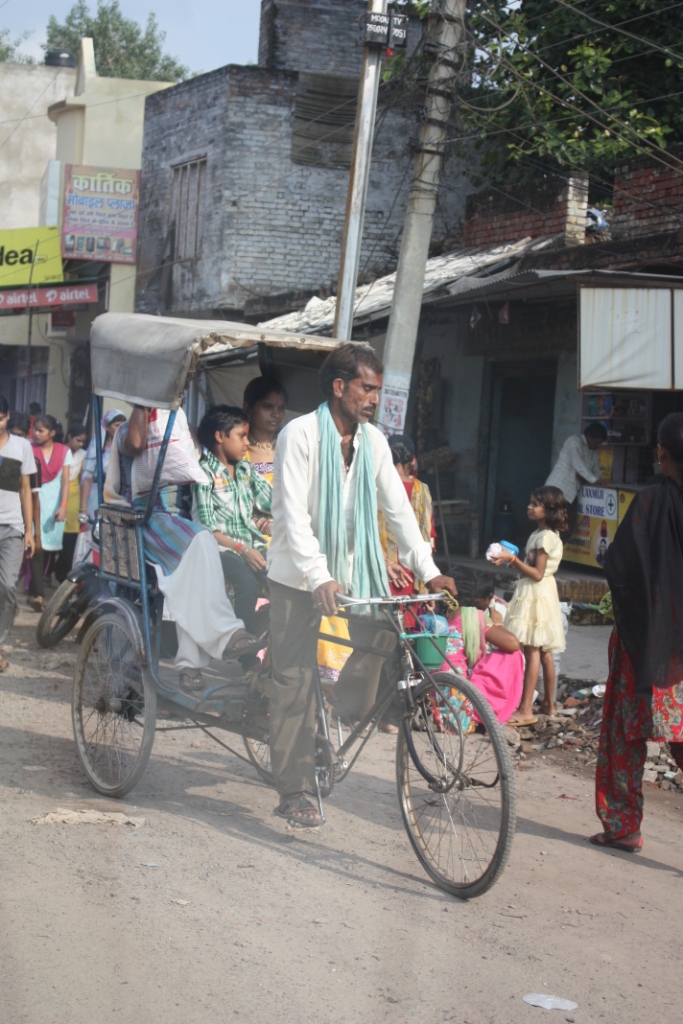
You don’t really see bicycle rickshaws in Bengaluru, but up north they’re common enough. This was taken in Agra, the town most famous for being home of the Taj Mahal. In some places these are called pedicabs. That best distinguishes them from autorickshaws (in India often called “auto” and in many other places called by the presumably onomatopoeic Thai designation of tuk-tuk) as well as from the original pulled rickshaw (where the puller walks or runs to propel the vehicle.) I don’t believe that I’ve ever seen a pulled rickshaw being used as a real means of transportation anywhere I’ve been in the world (though maybe in Cambodia.) You do see them as tourist photo ops in the same way one sees Hansom cabs and horse-drawn coaches in many US and Canadian cities.
Author Archives: B Gourley
DAILY PHOTO: The Bone Room
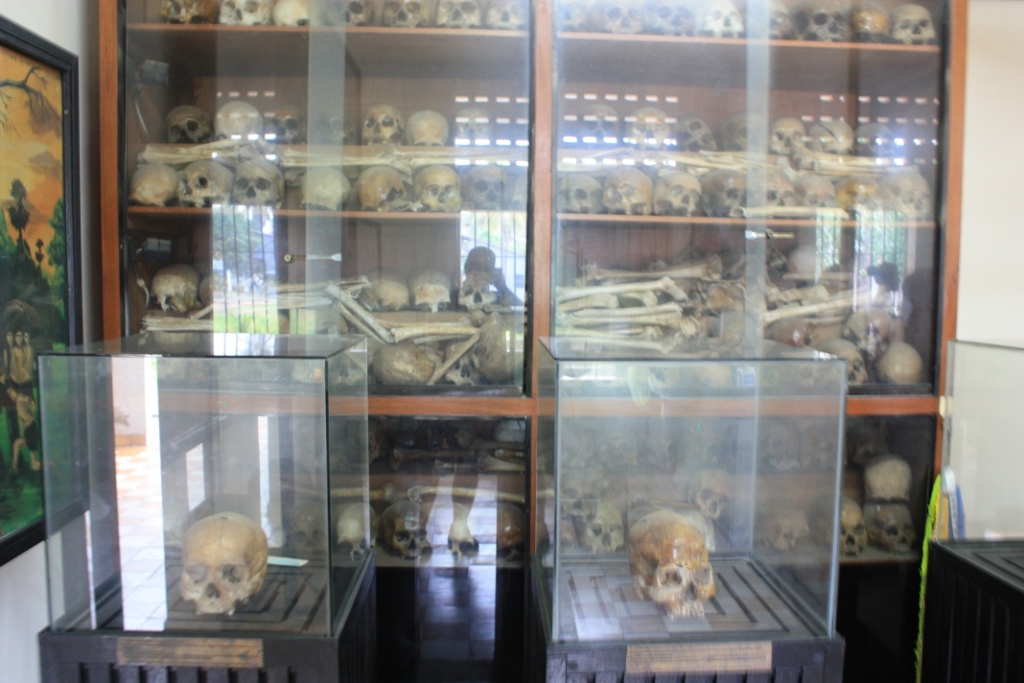
These display cases of skeletal remains are at the Tuol Sleng Genocide Museum in Phnom Penh. Just one of the many horrific legacies of the Khmer Rouge.
Seeking Expert Answers About A Possible Bengaluru Ratzilla

This fake rat is kind of big, but if you asked me how it differed from real Indian rats, I’d have to say the bling. Real Bengaluru rats aren’t ostentatious, and rarely wear jewelry.
Occasionally, I will see a rat–usually the carcass thereof–that makes me exclaim… Duh-uh-AAAaaammmmm! They often look like beavers, sans the distinctive paddle-tail, but with a whip-like, hairless rat tail in its place.
These sightings have raised some intriguing questions:
The first question is for any biologists or geneticists who–quite improbably–might read this post. Is it possible for the offspring of an English Bulldog and a Norwegian Rat to survive? If so, I’m pretty sure that I’ve seen one. If I find out where it lives, will they name it after me? Can I pay them not to?
The second question is for statisticians–particularly bio-statisticians. Let’s say that 95 percent of rats successfully live their lives underground, in walls, and out of sight. Let’s further say that I’ve seen a rat that was 1.5 feet long and 0.75 feet wide. Is it possible to calculate how large the biggest statistically likely rat would be. I’m thinking, lurking somewhere in the sewers, there is a three-foot long and foot-and-a-half wide ratzilla–probably chomping on a cigar and belching occasionally.
The third question is for an ecologist. I know that cats and other predators will attack–often successfully–prey that are larger than they are. However, given the freakish disparity in sizes that we are seeing, will the existing ecological order be overturned, and to what effect? Bangalorean cats are about the same size as American cats, but Bangalorean rats are about the size of American pigs–not the cute little pot-bellied variety but rather the kind that take a blue ribbon at a 4H County Fair. I know humans were once primarily prey, and only quite recently became dominant predators. This worries me because I know that humanity’s prey-like predilection to be scared of everything, combined with its unprecedented predatory weapon set, has fucked up the world but good. I can only image what a rat would do with a hydrogen bomb.
The fourth question for a rat neurologist. Are rats really that much smarter than turtles? I know the Teenage Mutant Ninja Turtles follow their Rat Sensei unquestioningly. I googled it. Rats live about 1 year and turtles can live to be about 40. So Splinter must have learned much faster in addition to being much smarter.
OK, the last one was not a serious question (but it’s a serious plot-hole for TMNT), but I do have one last question for the general public.
Which do you find more disturbing: a.) when you see a single mammoth rat? or b.) when you see an elaborate Vietcong-style series of tunnel openings and you know there is a billion rat army wriggling all over each other just centimeters below your feet?
Please don’t think I’m anti-rat. I know that, while we fear the plague-infested rats, it was really the fleas that gave us the Black Plague. I also know there are places like Karni Mata Temple in Rajasthan where rats are treated deferentially. There are an estimate 20,000 rats living on the temple grounds.
I guess this raises one more question for a rat nutritionist. How come these rats, which are fed and cared for, don’t get huge like the one’s lurking in the back alleys of Bengaluru.
DAILY PHOTO: The Grind Room
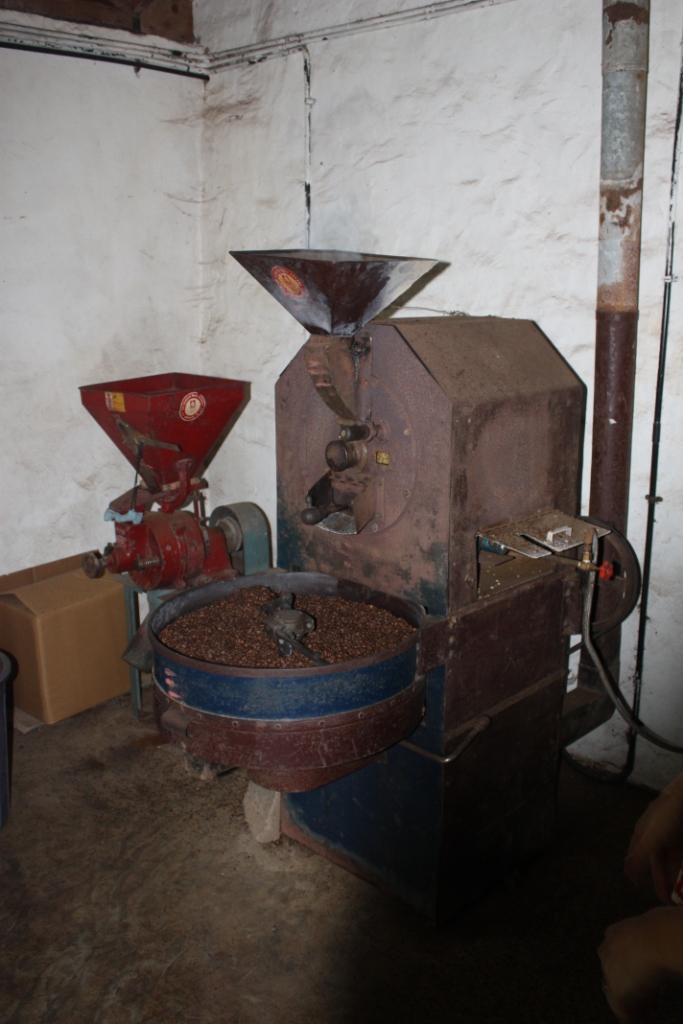
It may not look like much, but this is the Best Smelling Room… Ever! These machines are located at the Golden Mist Coffee Plantation near Madikeri. Here they roast and grind coffee.
DAILY PHOTO: Tiger Amid Bamboo
Robot Karateka Threat Underwhelming
Worried that Terminator-like robots may kick humanity out its pole position among sentient beings? You can sleep well tonight. A news report today suggests that the Karate Kid’s kicking dominance is not yet under threat by Robo-karateka. In other words, Ralph Macchio can still out kick the state of the art karate robot. The Cobra Kai’s plans to achieve world dominance via a fleet of Karate androids have been thwarted for the time being.
DAILY PHOTO: Taj Sized Doorway
DAILY PHOTO: Little Pink House on the Paddy Dike
DAILY PHOTO: Garlands for Buddha
Taken near the famous head that is enveloped by a Strangler Fig on the grounds of Wat Mahathat temple. You may know this temple as one of the sites at with Jean Claude Van Damme’s Kickboxer movie was filmed, presented as a fictional location called Stone City.
BOOK REVIEW: The Strain, Vol. 1 by David Lapham et. al.
The Strain Volume 1 by David Lapham
My rating: 3 of 5 stars
I sometimes wonder what Bram Stoker would think about the fact that his work spurred an entire industry of copy-cats. Everybody thinks that they can make an interesting and novel contribution to this vampiric genre. In very few cases, see: Richard Matheson’s I am Legend, they are correct. However, even though most of these works don’t take us into uncharted territory, they can still be entertaining. In fact, some of the versions that stay true to the concept seem more entertaining than others that moved into new territory but are patently stupid. I’m speaking, of course, of Twilight and other vampire-as-romance books that feed a widespread malady of the age afflicting teenage girls and, sadly, middle-aged women. I think The Strain, Volume 1 makes for an interesting and entertaining modern-day vampire story, without being particularly brilliant or groundbreaking.
The Strain, Volume 1 is the first installment of a graphic novel adaptation of the novel written by Guillermo del Toro and Chuck Hogan. The Introduction states that the graphic novel isn’t meant to precisely mirror del Toro and Hogan’s prose novel. I haven’t read the del Toro / Hogan book, but the synopsis indicates that at least the beginning and the characters are largely the same. I can’t comment as to how much the two works differ in detail, and whether the authors of the first book emphasized the difference so as to encourage readers to pick up both books (instead of cannibalizing each other), versus because the works are truly substantively different.
The inciting incident, apparently for the novel as well as the comic, occurs when a commercial jet liner lands in New York, coming to a stop and going out of contact with the tower. It turns out that all but three of the individuals on the plane are dead.
The graphic novel weaves together the story from two perspectives. First, the lead in the story is Dr. Ephraim Goodweather, a Center for Disease Control (CDC) employee who heads a rapid response team. As circumstances somehow indicate that this event involves a biological or toxic substance—though they have no ability to see into the plane, Goodweather’s team is called to investigate. (How they concluded with such high certainty that it was a substance in CDC’s bailiwick and not smoke inhalation or a terrorist hijacking is beyond me. But the CDC team enters on the heels of SWAT, and with operational control.) However, it’s a graphic novel with limited page constraints, so I didn’t grade too harshly on this particular type of credulity stretcher.
Second, the graphic novel begins with a vignette from the point of view of Abraham Setrakian who is a holocaust survivor and former Vampire hunter. Setrakian knows what is going on from his experience in the old world. It’s this odd couple pairing of an old man who knows an unbelievable truth and a scientist who doesn’t believe in the supernatural that makes this work interesting. The latter anchors the work in the world as we know it, but the former adds an element of mystery and charm. These mixed atmospherics are where this work really excels. The two men end up teaming up to fight a threat that will spread with unchecked fury unless they do something about it.
Unlike the hunky Vampires of Twilight fame, the vampires in Lapham’s work are meant to be as repulsive as possible. They have six-foot tongues with stingers by which they take their blood meals, and the giant slobbery maws necessary to accommodate such an appendage. Instead of having a new twist on the Vampire story, this work attempts to create value added in part by putting the horror back into Vampires in a big way (also, through skillful atmospherics.)
It should also be noted that this isn’t a work for young kids. That should go without saying, I know. Freak-show parents who reason that it’s only violence, and who have no problem with their child seeing someone take a shotgun blast to the chest, but who’ll write a death threat to networks, publishers, or congressmen if said shotgun blast exposes a nipple should be forewarned that the work has a short but sexually graphic section in it—in addition to all the stakings and proboscis stabbings.
This was an entertaining enough horror-genre take on the Vampire. Scientists may find it a bit ridiculous that their comic book counterparts go about their jobs sticking their hands in unknown substances found at the site of the mysterious deaths of almost 200 people. However, despite some credulity challenges, the book creates an interesting atmosphere for a vampire story.