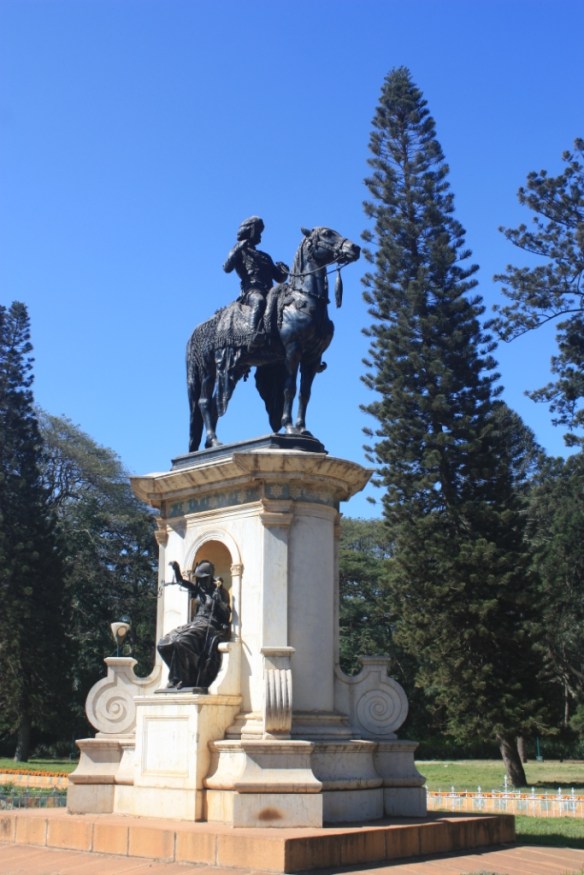
Taken on January 22, 2017 at Lalbagh Botanical Gardens in Bangalore
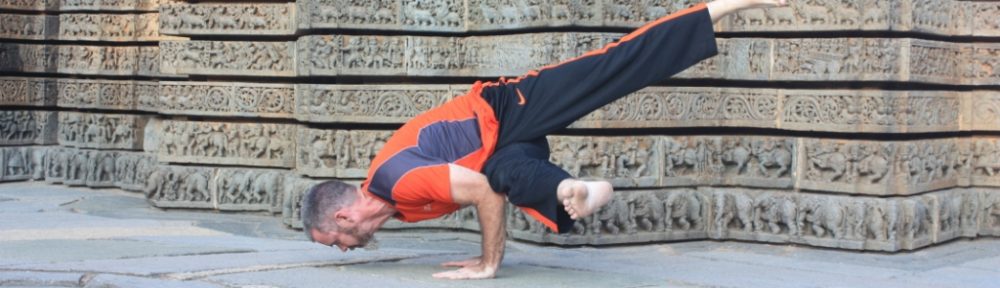

Taken on January 22, 2017 at Lalbagh Botanical Gardens in Bangalore
 Cold Days by Tibor Cseres
My rating: 5 of 5 stars
During the Second World War, there was a massacre conducted by the Hungarian military in the Yugoslavian town now called Novi Sad (known as Újvidék under the Hungarians.) The operation was meant to be a cleanup of Yugoslavian partisans, but the casualties were primarily innocent civilians. The novel is called “Cold Days” (i.e. literally translated from the Hungarian “Hideg Napok”) because the killings took place during a cold snap in January of 1942. Cseres bases his novel on this real world event, but he tells the story through the lens of four fictional military men who are sharing a cell for their respective actions in Novi Sad.
The novel weaves five narrative lines into an overall arc. Four of these are the personal stories of each of the four soldiers during the massacre and the time leading up to it, and the fifth takes place later when they are all together in the cell. The four characters have no connection before being placed in the same cell—or so it seems. At most, the officers know of each other. The five lines come together in the end and the reader sees how the four lives are no longer in strict isolation, but are connected by the events of that day—in some cases more severely than others.
Captain Büky is the highest ranking of the prisoners and is a straight-laced military man except that he takes issue with the order than keeps married men from bringing their families to station at Novi Sad. Prior to the massacre and some killings that instigated it, it’d been a routine assignment. Lieutenant Tarpataki is a new assignee, and his principal trouble is that he arrives to find that he hasn’t been assigned housing or a billet. Lieutenant Pozdor gets his men taken from his control by the police chain of command and is left hiding out trying to avoid being assigned some remedial task. Corporal Szabo is both the only enlisted man in the group and the only one who is directly involved with the violence, though a Cpl. Dorner takes the lead and Szabo is a follower.
If that cast doesn’t seem like the kind of villainous blackguards one expects of a massacre crew, I think that that is part of what the author is trying to convey. Run-of-the-mill men stumble down slippery slopes into treachery during times of war. Sometimes the worst go unpunished, while others take the fall. The author also shows that sides can matter little when it comes to such events. Anyone can suffer loss when events tumble out of control as they did in January of 1942 on frigid day in Novi Sad.
This book is translated from Hungarian. It’s sparse and simple writing, and readability is high. It’s a short book of only about 120 pages.
I’d recommend this book for those interested in tales of the horrors of war. It may have interest to history as well as fiction readers.
 Death in the Andes by Mario Vargas Llosa
My rating: 5 of 5 stars
Three men disappear from a small mining village in the Peruvian Andes. The army sends two investigators, Corporal Lituma and his adjutant Tomás, to get to the bottom of the apparent murders. Suspects include Sendero Luminoso (“Shining Path”) guerilla-terrorists and a number of locals. For some of the locals, there’s another possibility, the various demons and deities attributed to each of the mountains in the Andes.
“Death in the Andes” follows the time that the investigators spend in this remote village. There are two major story lines taking place at once. One narrative arc revolves around the investigation and day-to-day living in a tiny town under primitive living conditions. The second story line comes by night as the deputy, Tomás, recounts his love affair with a girl who was out of his league in almost every way—except, perhaps, with respect to virtuous living. The girl was in a relationship with an abusive gangster at the start, a condition that Tomás found untenable. His love-driven reaction creates all manner of drama, and that drama serves as the only entertainment to be had in this remote village.
The book is literary fiction, but it’s not purely about the characters. As suggested, there’s a strong narrative element. While the book is in a realist genre, i.e. nothing in it feels like it couldn’t happen in our universe, the fact that the story takes place in an area of the Andes where the Shining Path is strong and mother nature is harsh means that there’s plenty of tension and suspense.
This is book is translated from Peruvian, and it seemed to me that the translator did a fine job of capturing the feel of the rural Andes. A few Spanish terms are used for terms like terrorists and avalanches to create a feel of a unique character of these concepts relative to this place. However, there are only a couple of these terms and so context is sufficient for the reader to readily keep them straight even if one is not gifted in picking up foreign terminology.
In general, the book is quite readable. The most challenging part of reading it is when Tomás is telling his story because you have a three-way conversation going on over two time periods at once. (i.e. Tomás voices himself and his girl as he tells their story, but then Cpl. Lituma chimes in periodically with questions—or, more commonly, commentary.) However, the author uses dialogue tags throughout to avoid confusion. One just needs to be attentive in one’s reading of these sections.
I enjoyed this story. I picked up this book both because Llosa won the Nobel Prize in Literature in 2010 and I like to read something by winners, but also because I’ve trekked in the Peruvian Andes and translated literature often offers one a unique form of insight into a place. This was no exception.
I’d recommend this book for readers of fiction. If one is looking to broaden one’s horizons into literary fiction and /or translated fiction, this book is a good place to start. It offers humor and intrigue as well as deep characters and an infusion of geography and culture.
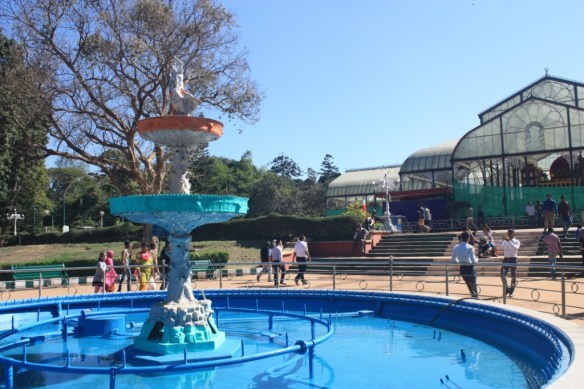
Taken January 22, 2017 at Lalbagh Botanical Gardens in Bangalore


Taken on January 22, 2017 at Lalbagh Botanical Garden in Bangalore


I know you feel my sex appeal
despite the lack of earnest squeals.
You should know, despite my glow,
the fans rarely stop to say, “Hello.”
Am I not a rockstar, superhero
because my visibility ranks near zero?
In this hour of superpowers
I think I’ll stop to sniff the flowers.
 1.) The Dispassionate Witness: A person’s default setting is to repress emotions and pretend they don’t exist. On the one hand, this seems to work because others rarely notice one’s clenched jaw or downing of Prozac, and it’s true that fist-fights rarely break out in workplaces and classrooms. On the other hand, this approach leads to a lot of passive-aggressive behavior and stress-related illness. I just read in some material on Flow and business that 2/3rds of performance issues in businesses result from strained relationships.
The alternative is to take time to observe one’s emotional state, but to watch it without dumping fuel onto the fire. This process puts one’s feelings in perspective so that one can respond in a careful, but not repressed, manner. It doesn’t mean one won’t still be mad, sad, or scared, but one will be in a position to act in a manner that is neither petty and knee-jerk, nor one that consists of gobbling antacids. This brings us to #2.
2.) The Second Dart: [Siddhartha Gotama] Buddha talked about the mind’s response to an event as the second dart, suggesting that the second dart produces much more prolonged misery than the first. Imagine one is walking along and gets hit by a dart. Ow! It hurts. But what makes it agonizing is when one’s mind becomes obsessed with the injury. It’s unfair that someone threw a dart at me. What if the wound doesn’t heal right? What if the wound heals up too well, and I don’t have a cool scar at story time?
This point is closely related to #1. One has to observe, but not let mind run wild. The first dart is real. The second dart is immaterial, a figment of the mind.
3.) Relaxation is Part of the Process: Anyone who’s attended a yoga class is familiar with closing in savasana (corpse pose.) Occasionally, a student wants to get up and walk out at this point. They “aren’t paying __ $’s to lay around on their a##.” For Americans, rest is something begrudgingly accepted between actually doing stuff.
The problem with the “rest as laziness” approach isn’t just that one is likely to suffer a relaxation deficit, but also that the rest one gets isn’t effective. But how can rest be effective? I’m glad you asked. Because when you’re doing savasana or yoga nidra (yogic sleep) you’re not just letting your monkey mind run wild as it does when one is watching television or stuck in afternoon rush hour.
4.) Breath is Anything but Mundane: Since breathing is constantly going on and one can choose not to think about it, people dismiss it as unworthy of consideration. However, breath is the one point at which we can consciously influence our autonomic nervous system. [Well, there’s also blinking, but to my knowledge there’s no evidence that one can adjust one’s energy level or emotional state through blinking–but you can with breath.] Breath is the key to improved physical performance, but it’s also a powerful tool to train the mind.
5.) Use the Belly: I haven’t studied a large number of martial arts, but I’ve trained in a diverse few that were extremely different in both approach and priorities. It could be said that these arts (budō, tai chi chuan, muaythai, and kalaripayattu) had nothing in common. Except they did. They all valued strength in a point below the navel. Sometimes it was called dan tien; other times tanden. However, regardless of the pronunciation, name, or the precise anatomical location, there was this commonality.
Strength in the belly is tied to both breath and mental concentration.


Taken in July of 2015 in Ladakh at Namikala Pass

Leh

Nubra Valley

Pangong Tso


