Taken in May of 2015 in Sri Lanka

elephant scrubbing

Every novel or short story has lessons to teach. After all, stories are nothing more than problems resolved. Sometimes fiction teaches one how to do it right, and in other instances how to do it wrong–but there’s always a lesson.
But some works of fiction teach more than others (and more effectively.) It’s a great challenge to merge entertaining and thought-provoking story lines into one piece. Below are five books that I found both illuminating and engrossing.
[The hyperlinks in the titles go to my book review.]
1.) Ishmael by Daniel Quinn: Ishmael asks one to reevaluate what one thinks one knows about the world based on a lifetime of viewing it through the lenses of culture and anthropocentrism.

2.) The Journeys of Socrates by Dan Millman: The “Socrates” in question is Millman’s [probably fictional and / or composite] teacher from the “Peaceful Warrior” books–not the Greek philosopher. This book shows us how a person whose life has been scarred by tragedy can attain peace of mind.

3.) The Little Prince by Antoine de Saint-Exupéry: The Little Prince teaches one to reevaluate what one thinks is important, and encourages one to see the world through a more child-like lens.
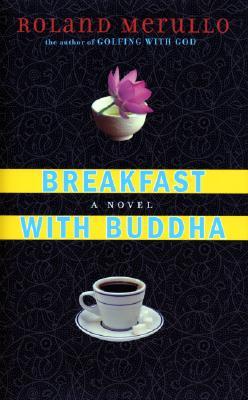
4.) Breakfast with Buddha by Roland Merullo: How can the average Joe reshape the way he [or she] views life so as to live a happier one?
5.) Veronika Decides to Die by Paulo Coelho: A young woman who attempts suicide is told by her doctor that she damaged her heart and has only five days to live.

Happy reading.

Taken in Hungary in December 2016

Kochi (Cochin), India

Kochi, India
Whenever I come across a little, unlabeled door in a place where it seems to have no business being, I can’t help but take a picture. I’ve got quite a collection of such pics, of which I present a sample.
Maybe I watched “The Matrix” too many times, but I can’t help but wonder.
 Hindu Myths by Anna L. Dallapiccola
My rating: 3 of 5 stars
Having moved to India, we picked up this book to try to wrap our heads around the vast Hindu pantheon and the myriad myths involving them. There are a huge number of tomes on the subject of Hindu mythology, but far fewer concise commentaries that look useful. We were always on the lookout for a book that would offer a sort of “Hindu Mythology for Dummies” –the quick down-low, if you will.
I can’t say that this book clarified the topic. However, I’m not sure any book could. Hindu mythology is a subject of enormous scope, while being defiant against reducibility. I was about to compare it to the challenge of writing a concise book for neophytes on quantum mechanics, but then I realized that such a book could probably be done much more effectively. For as strange as the world behaves at a subatomic scale, there’s a means to order the story and to simplify it in a way that leaves intact the gist. Along with dry descriptions of ordinary sounding events, one reads stories like that of the deity that popped out of another’s belly-button on giant lotus flower. That’s when the myths become hard to imagine–if one hasn’t been hitting the psilocybin.
That said, I did learn some interesting elements of myth from reading Dallapiccola’s book, and I think it has as effective an organizational scheme as one can hope for. After an Introduction that exposes the reader to Vedas, Puranas, and the Hindu trilogy (Vishnu, Shiva, and Brahma), there are three chapters that revolve around creation, preservation, and destruction. [For those unfamiliar, those three deities map to those processes—Brahma the creator, Vishnu the preserver, and Shiva the destroyer.]
After those three, there are another three chapters. Chapter four deals with myths about delusion, and in addition to describing Vishnu’s role in delusion (maya) it tells a couple of tales (the story of Madhu and Kaitabha, and the story of King Harishchandra.) Chapter 4 discusses the topic of grace and describes the birth of the Ganga, tells the tale of Arjuna and the Hunter, the story of Vishnu and Prahlada, and then offers a bit of insight into Shaiva saints, temple myths, and animal devotion. The last chapter is a brief overview of Hindu Mythology in modern times—especially its inclusion in popular culture.
There is a map (i.e. an India map showing major cities and crucial historical sites) and many pictures throughout the book. The pictures include photos of sculptures as well as reproductions of paintings that are of the deities and key mythical events. As far as ancillary features go, there is a half-page “Further Reading” section and the book is indexed.
This book is only 80 pages, and offers a quick overview. Whether it hits the most crucial material, I can’t rightly say. As I mentioned, there are some interesting tidbits in the book. I’d recommend it for someone looking for a quick overview. However, one should note that there are books that are more oriented toward story and less toward a scholarly level of precision in language that may be more useful for one—depending upon one’s needs.
 Khajuraho by Krishna Deva
My rating: 3 of 5 stars
Khajuraho is one of India’s most legendary historical sites; despite the fact that it’s located in a quiet, rural town that’s not so easy to travel to—at least, relative to many of the popular tourist sites of India. I could tell you that it’s so well-known because of its exquisite carvings. However, while it’s true that the sculptures are beautiful, the fact that almost no one outside of India has heard of Belur or Halebidu—sites which also have magnificent carvings—puts strain on the credulity of that explanation. It’s also not a major pilgrimage site like Varanasi. I’m afraid the explanation that remains is a touch lascivious. Imagine the Kama Sutra played out in 3-D on bas-reliefs and sculptures, and you have the scenes for which Khajuraho is most well-known. Which isn’t to say that the temples are nothing but “hein’ and shein’,” there are many of the same types of devotional imagery that one sees at other Hindu temples, and I’m sure some people go out of their way to see those devotional images.
This is one in a series of guide books put out by the Archaeological Survey of India. They are mostly sold at various historical sites and museums run by the Indian government, but can also be found at used bookstores and for sale online (e.g. Amazon.com.) This isn’t the first book of this series that I’ve read. I first stumbled upon them when I traveled to the caves of Ajanta and Ellora in Maharashtra.
The text for this book is based on a manuscript by Krishna Deva, and it’s organized to move from general to specific. After a one page Forward by the Minister of Tourism [at the time, 2002], there’s an Introduction that describes the historical and political context in which these temples were built. Then there are chapters that examine the art and architecture of the Chandella era, then the general approach to sculptures, and, finally, a look at the specifics of various temples ordered by groups. Those who’ve traveled to Khajuraho will know that the most extensive and impressive temples are in the Western Group—that’s the only group for which there is an admission fee. There is also an Eastern Group, a Southern Group, and a couple independent temples that don’t conveniently group with any others.
Almost as important as the text are the pictures. There are many color photographs that serve to illustrate the explanations being offered and which will help travelers to link up the textual discussion to what they are seeing. There are photographs on every page excepting the ancillary material.
These books also have a number of nice ancillary features. The book has a brief “Practical Information” section that provides guidebook style information (getting there, where to stay, where to dine, etc.) This includes a couple pages that are about traveling to / in India generally, and then a couple that are specifically about Khajuraho. I wouldn’t count on any of this information to not be out of date, though in little ole Khajuraho it might change less rapidly than in the cities. There is also a brief glossary and a “Further Reading” section, both of which may be of use. The book is indexed. There is also a general map of the part of India containing Khajuraho on the inside flap (both front and back.) A map of Khajuraho town might have been nice, but they do have an outlay of the Western Group, which is helpful.
I found this book (and the other books in the series that I’ve used) to be useful and informative. Furthermore, one can’t beat the price. The list price was 99Rs, but I see there’s a stamp inside mine that they’d discounted it to 50Rs. (That’s less than $1 USD.)
I’d recommend you pick up one of these guides—particularly if you are traveling to one of the more extensive sites. If you like to use guides [human guides,] you may find that there’s not a lot of new material to be gleaned from these concise guides, but they may help you organize your photos after your travels—and they don’t take up much space (a flat 12 X 23.5 X 0.5cm.)
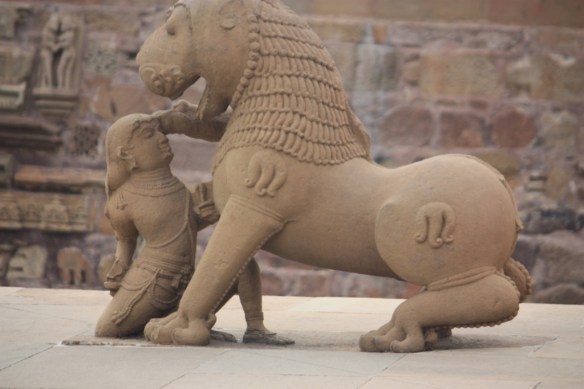
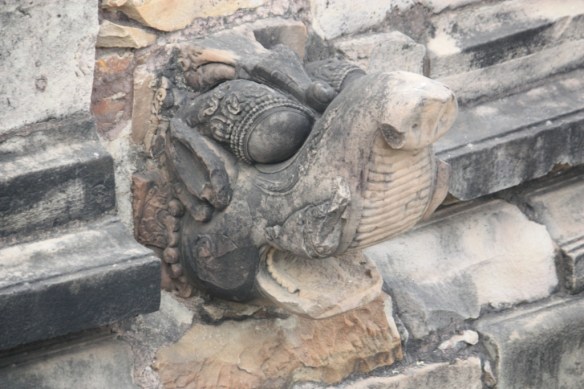
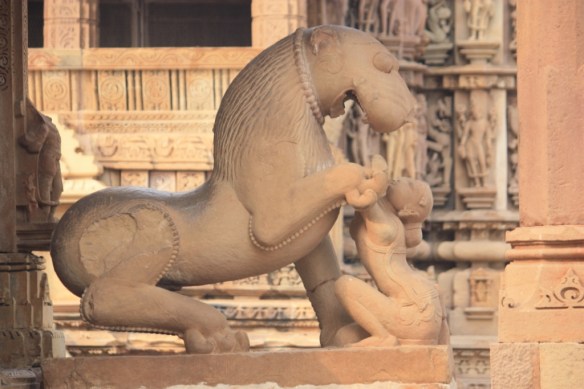
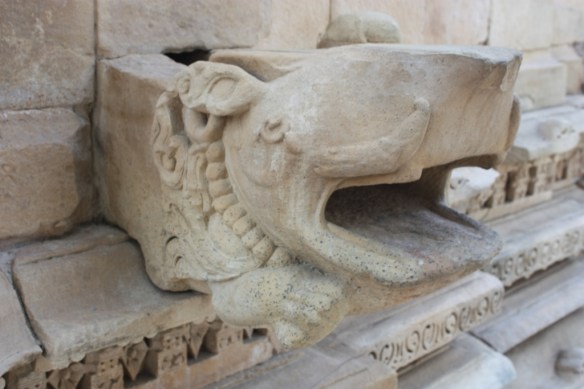
Since they don’t have a cover photo up for this book, I’ll include a couple illustrative pics that I took at Khajuraho:
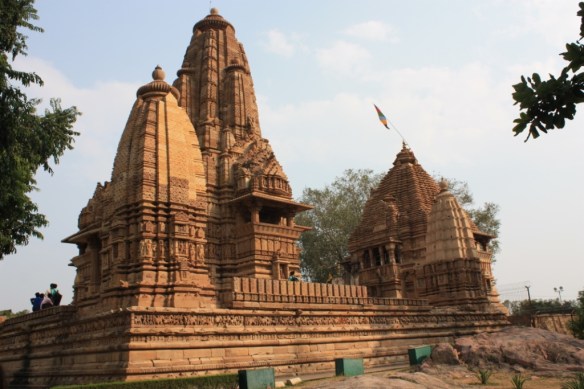
In the Western Group

In the act
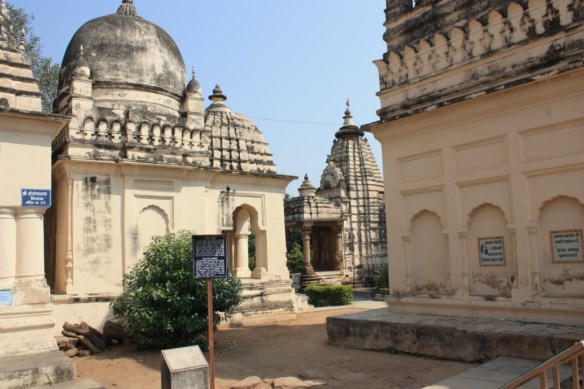
Jain Temples of the Eastern Group

Taken on December 31, 2016 in Vienna

Kunst Haus in Vienna (often written KunstHausWien) is a modern art museum featuring works by Friedensreich [Regentag Dunkelbunt] Hundertwasser, but also with temporary exhibits by other artists. The whimsical facade of the building is reflective of Hundertwasser’s style and is similar to the older and more well-known HundertwasserHaus, which is an apartment building a couple blocks away.

Taken in Budapest in December of 2016

Budapest, Hungary

Vienna, Austria

Vienna, Austria
Learning to manage and moderate one’s fears and anxieties needn’t involve strapping on a parachute, cold quitting a job, or bare-knuckle boxing in a back alley. In fact, it may be best to begin by quietly watching those anxieties at the other end of the spectrum, the one’s so subtle that conscious awareness of them can be blotted out by the noise of living–but which nevertheless have a physiological impact.
The ability to quietly and non-judgmentally witness one’s emotional state–as is taught in yoga and related practices such as Buddhist meditation–is crucial (and, in my opinion, is one of the most valuable lessons that these systems have to teach.) Crushing or repressing emotions is a demonstrably losing strategy. At best these feelings are tamped into one’s subconscious mind, still adversely affecting one’s outlook and, therefore, indirectly casting a pall over one’s life.
You’ll note that I’ve mentioned courage and moderating fear, but have not mentioned defeating emotions or quelling fear. Wrongly, our archetypes of fearlessness are characters like John McClane (i.e. the “Die Hard” movies), Katniss Everdeen (i.e.”The Hunger Games” trilogy), or Yoda (i.e. the “Star Wars” movies.) But neurologists who study patients whose brains have been damaged such that they are literally fearless tell us that the defining characteristic of such individuals is “paralysis by analysis.” In other words, Sheldon Cooper (i.e. “Big-Bang Theory”) is a more apt model. Also, the fearless tend to live short lives because they eventually do something fatally inadvisable.
We need our fear. However, while fear can keep us from doing stupid things, it can also turn us into the worst version of ourselves. Therefore, our fear needs to be moderated with courage and reason (to these, some would add “faith.”)
You may note that I tend toward the intermediate / advanced with the practices I mention. This is, in part, because that’s probably more likely the point at which one is ready to take this on. In beginning a practice, one may have one’s hands full to grasp the basics of alignment and breath.
Without further ado, here are a few yoga practices that I’ve used to help me witness my anxieties and learn to moderate them:
1.) Nauli (and other external breath retention [i.e. bāhya kumbhaka] techniques.): Breath retention can produce a subtle anxiety, even when one has full control of the timing of release and the next breath. In fact, subtle anxiety may cause one to have a less robust retention than one might otherwise. Truth be told, this practice has probably been more fundamental than any of the āsana practices that will follow, for me personally.
Note: external retentions are relatively advanced practice and should only be added to one’s sadhana after one has been taught by an experienced teacher and is somewhat experienced with pranayama.
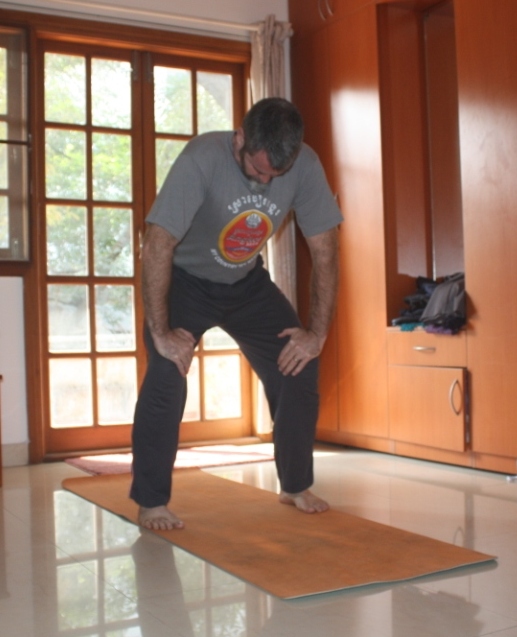
practicing nauli
2.) Eyes closed: This is particularly effective with Surya Namaskara (Sun salutations), standing poses, and–at an advanced level–balancing poses. One should make sure that ones balance is solid throughout before attempting with one’s eyes closed. We have redundant systems to help achieve balance (i.e. inner ear, proprioceptive, and visual), but–for the sighted–going without vision can be nerve wracking.
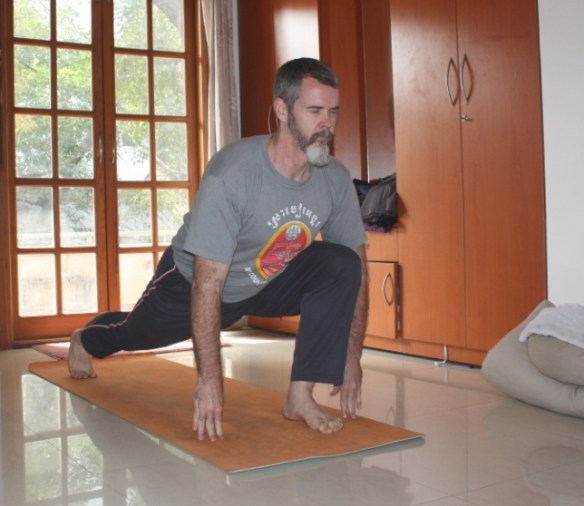
ashwa sanchalanasana in Surya Namaskara
3.) Inversions: Inversions are meant to be calming because when the blood pressure to the head increases, it triggers reactions in the body to reduce it. However, it may take some time before that promised is reached. I’ve done a more extensive post on inversions that can be read here.
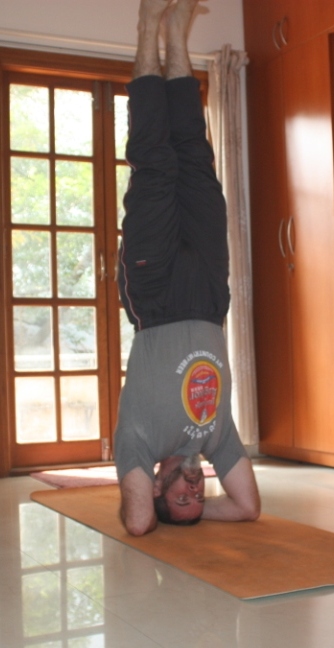
shirshasana (headstand)
4.) Standing Back-bends: (Ardha Chakrasana / Urdhva Triangmuktasana / full Urdhva Dhanurasana) Simple back-bending can create the feeling that one is about to fall back onto one’s head. One may want to begin with a simple back-bend as one might do in Surya Namaskara before advancing to the complete Urdhva Dhanurasana in which one moves into a wheel pose (Chakrasana) from a standing position. (Urdhva Triangmuktasana is an intermediary in which one’s knees are more deeply bent, and one reaches back towards one’s Achilles tendon.)
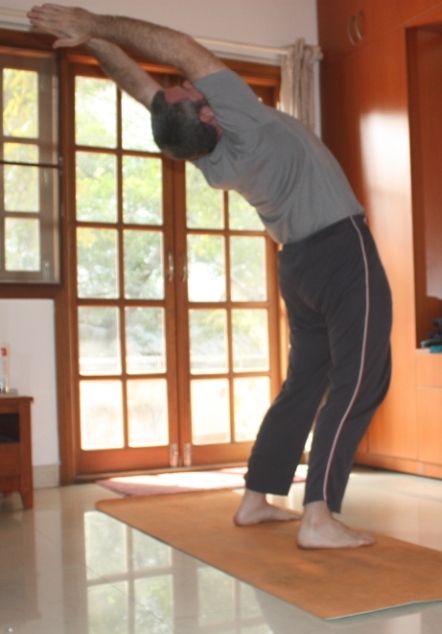
ardha chakrasana
5.) Standing Balances: Depending on one’s level, anything from tree pose (vrksasana) to bound twisted half-moon pose (baddha parivrtta ardha chandrasana) may be applicable. I’ve shown the unbound version of the latter (parivrtta ardha chandrasana.) Twisting and balancing at the same time provides a great challenge, if one is already confident with balances generally.
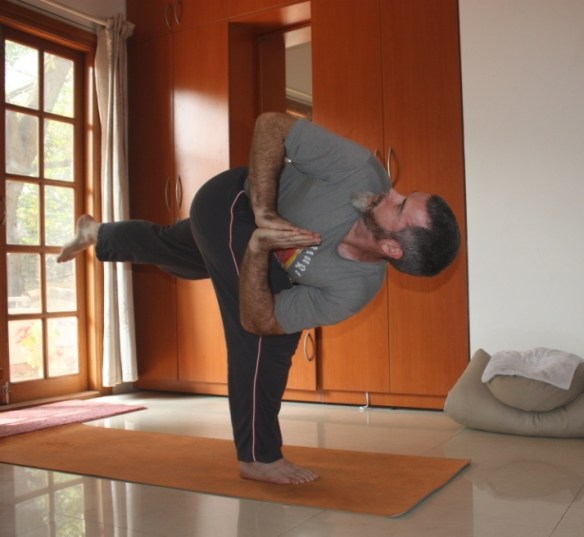
parivrtta ardha chandrasana
Happy practice.