Taken in December of 2016 at Vörösmarty Square in Budapest

Taken inside the Hungarian Parliament Building


Taken in December of 2016 at Vörösmarty Square in Budapest
Taken inside the Hungarian Parliament Building
 The Enormous Crocodile by Roald Dahl
My rating: 4 of 5 stars
The story arc of “The Enormous Crocodile” is a familiar one. It’s a variation on a theme seen in “Little Red Riding Hood” and “Three Little Pigs” to name a couple of well-known examples. First, there is a bad guy who wants to eat some helpless and / or unwitting victims. In this case, the enormous crocodile is the gluttonous cad—rather than a wolf–and the helpless victims are the local children. Second, the villain is thwarted at the last possible moment.
While it’s a tale that’s been told many times in many ways, Dahl does a good job adding his own imprint to it. An important element of the story is that the crocodile angers, alienates, and attacks several of the other jungle creatures on his way into town to find a victim or victims. Because of this, these animals conspire to thwart the crocodile’s clever plots, and this ultimately contributes to his downfall. It’s with the crocodile’s clever plots that Dahl most fully engages the imagination. The croc uses various disguises to try to lure children to within snapping distance.
It should be pointed out that the illustrations by Quentin Blake are as crucial as Dahl’s words. The color drawings really bring the book to life, and serve to make feasible the clever plots of the crocodile. (e.g. When the croc scoops up coconuts and fronds and stands on his tail in mimicry of a coconut tree, it’s the illustration that makes this seem believable—not to mention capable of being visualized by a small child.)
If you’re looking for a short young children’s story that can be read in 15 minutes or so, this is a good one.
 Just So Stories by Rudyard Kipling
My rating: 4 of 5 stars
“Just So Stories” is a collection of 12 children’s stories. The theme that runs through the dozen stories is that they are mostly tall-tale answers for questions that children might have. All but two of them focus on animals and nature, and the two divergent stories deal with the origin of written language. Since it’s such a small collection and the titles tend to synopsize the stories, I’ll include the table of contents below, which may give one greater insight into the nature of the stories.
1.) How the Whale Got his Throat
2.) How the Camel Got his Hump
3.) How the Rhinoceros Got his Skin
4.) How the Leopard Got his Spots
5.) The Elephant’s Child
6.) The Sing-Song of Old Man Kangaroo
7.) The Beginning of the Armadillos
8.) How the First Letter Was Made
9.) How the Alphabet Was Made
10.) The Crab that Played with the Sea
11.) The Cat that Walked by Himself
12.) The Butterfly that Stamped
The edition that I have (i.e. 2006 Scholastic Junior Classics Edition) has a number of black-and-white graphics (block print and line drawn style)—one or two per story. Given the genre, I imagine most editions have some kind of pictures, but your edition’s graphics may vary. A number of the stories include short poetry—usually at the end. The poetry is part of the original Kipling product and so are likely included in all unabridged editions.
I’d recommend this book for those looking for short stories that are relatable to young children.

Taken in December of 2016 in Budapest


Monochrome landscape orientation

Taken at Sümeg Castle on December 20, 2016

Close up of foot armor. One imagines this kicking up under the front plate to stab the enemy without ever breaching his armor; file under “W” for “wicked.”

Another armor close up
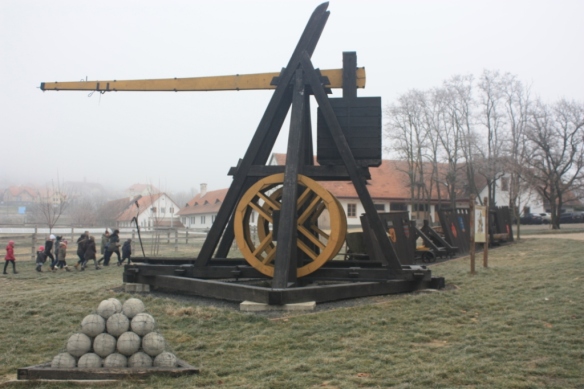
One of the trebuchet on display at the base of Sümeg castle
 The Hidden Life of Trees: What They Feel, How They Communicate—Discoveries from A Secret World by Peter Wohlleben
My rating: 5 of 5 stars
I picked up this book because it was on one of those “Best Science Books of 2016” lists, and it turned out to be the most important book I read last year. Like most of humanity, I’ve been guilty of thinking about trees largely as objects. Don’t get me wrong. Like others, I never forgot the basics of biology and always remembered that trees are alive because they grow, reproduce, and whatnot. I’ve also never failed to realize that without trees to suck up carbon dioxide and exude oxygen, we couldn’t exist—though I’ve probably not been sufficiently grateful. Still, because of the molasses-like time flow of trees, their immobility, and the fact that many can live for decades after someone chainsaws off a limb, it’s possible to feel they have more akin with rocks than with we members of the animal kingdom. (Note: trees don’t always respond as well as people think to random “trimmings.” As will be a recurring theme, our misunderstanding of this has a lot to do with time perception. If your dog’s head was in the way of the TV screen, and you cut it off with a chainsaw. You’d immediately realize that you’re a homicidal maniac and an idiot because the dog would be dead right then and there. When there’s a branch in front of your window and you hack it down, the tree may stay green for a couple of years [a blink on its time scale] and by the time it dies you’ll have completely forgotten that it was your action that lead to its demise.)
The author, Peter Wohlleben is a German forester, and this book was originally released in German before being translated to English (as well as other foreign languages.)
Wohlleben systematically dismantles the barriers between trees and us by showing the many ways in which they’re more like us than we could possibly fathom at a mere glance. The subtitle’s dual question of “What They Feel, How the Communicate” reflects just a couple of aspects of how trees are more like us than we realize. There are also chapters that investigate how trees share from strongest to weakest, and how the tough love parenting strategy of trees produces robust offspring. (Experience of time may be the way in which humans have the most trouble relating to trees. We believe there is benefit in virtually everything coming to us faster, whereas trees benefit greatly from growing slowly. Slow growth makes for sturdier trees.)
Moving back to that question of communication, one may be dubious that trees communicate because we can neither hear them nor see their gestures. But not only do trees communicate with other trees, some species communicate with members of the animal kingdom as when a tree under attack from insects releases a scent that attracts birds that feed on the attacking insects.
Wohlleben does a great thing by showing us how trees should be more relatable to us than we imagined. However, the lesson needn’t stop there. One might also take away a broader lesson that we shouldn’t assume that our frame of reference maps to the sum of reality. That maybe we should have sufficient humility to recognize the impressive intelligences of species we view too simplistically. There have been a number of books that have come out in recent years that have noted the ways in which monkeys, ravens, owls, and even octopi are much more astute than we give them credit for. Seeing this extended to the plant kingdom takes the discovery to a new level of mind-blowingness.
This book consists of 36 short chapters, each of which deals with a specific topic of interest (e.g. forest etiquette, social interdependence, climate effects, hibernation, illness, and how trees survive under challenging conditions—droughts, introduction of competitors, etc.) There are a few graphics throughout the book, mostly line drawings of trees with the species identified. The book does have notes. However, it’s really set up more like a book of short essays by a naturalist than it is your usual work of popular science.
I’d highly recommend this book for anyone who breathes oxygen.
 The Devils of Loudun by Aldous Huxley
My rating: 5 of 5 stars
In 1634, a parish priest named Urbain Grandier was tortured to exact a confession that he’d engaged in sorcery and made a pact with the devil. There was plenty of reason to believe that Grandier was a less than virtuous fellow (e.g. that he knocked up the teenage daughter of his best friend in Loudun), but no evidence of the crimes that he was actually accused of–and that the Church insisted he cop to despite his steadfast denials. However, there was some potent circumstantial evidence in the form of a case of mass hysteria by members of a convent of Ursuline nuns that was attributed to demonic possession at the time.
Huxley tells this fascinating story in great detail. At some points, perhaps too much detail. The writing style can come across as pretentious, needlessly complicated, and slow-moving at times. (For example, there are frequent quotes and snippets of poetry in French–and a few in Latin—and many of these were not translated to English in the edition that I read. Apparently, the assumption was that the reader would have a basic competency in these languages.) However, when it comes to the climax of the story, the book is as gripping as they come. Having been presented with great insight into Father Grandier, we know him to be a deeply flawed man. He’s like the priests and bishops of a Marquis de Sade novel, lecherous and libertine. Yet, he manages to become a sympathetic character as he shows virtue of sticking to his guns in denial of being in league with Satan long after the truth of his vices has been admitted. In essence, when juxtaposed to his inquisitors, he becomes the lesser of two evils.
I also don’t fault that Huxley delves into analysis, because there is a fascinating question at the heart of the event—one that deserves to be batted around. What made this group of nuns behave in such an un-nun-like fashion? There was writhing, foul language, wardrobe malfunctions, etc. Today, it’s impossible for a rational skeptic to write these events off as demonic possession. However, while the Mother Superior, Sister Jeanne of the Angels, clearly had an axe to grind against Grandier (for issues regarding organizational leadership and not so much for womanizing the townies), that also seems unsatisfactory as a cause for these sisters to behave as they did. There have been a number of cases of pretended possession, but generally these were individuals—e.g. Martha Broissier. There seems to be some fascinating psychology at work in this case.
The book is arranged in 11 longish chapters, largely following a chronological progression of events. The edition that I have has some interesting appendices as well as a bibliography. There isn’t much in the way of graphics, but as the book reads like a novel one doesn’t expect there to be.
I’d recommend this book for those who are interested in history or psychology. It’s fascinating in both domains. While I thought the book could have been a little clearer and more concise, it’s still quite readable and the heart of the story is highly engaging. I was also reading the book as a general interest reader. A scholarly reader might appreciate Huxley’s thoroughness more.

Taken on December 30, 2016 in Vienna
It’s the time of year when people think about how to be better, fitter, and smarter; so I thought I’d drop a list of books that I found helpful and thought-provoking.
If you’re interested in learning more about any of these books, the hyperlinks take you to my review in GoodReads, and from GoodReads you can get to Amazon page.
1.) THE RISE OF SUPERMAN by Steven Kotler: How do extreme athletes achieve Flow when one false move will kill them?
2.) FASTER, HIGHER, STRONGER by Mark McClusky: How do elite athletes squeeze the most out of the potential of the human body?
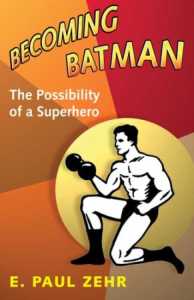
3.) BECOMING BATMAN by E. Paul Zehr: What would it take, physically and mentally, to become the Caped Crusader?
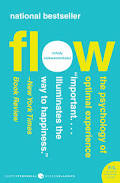
4.) FLOW by Mihaly Csikszentmihalyi: How does one achieve that state of relaxed and confident concentration in which we perform our best called Flow?
5.) Extreme Fear by Jeff Wise: How does one overcome anxiety and fear to perform one’s best?