BOOK REVIEW: The Bhagavad-Gita Translated by Barbara Stoler Miller

The Bhagavad GitaThe Bhagavad Gita by Anonymous

My rating: 4 of 5 stars

Amazon page

The Bhagavad-Gita is a philosophical poem, the title of which is translated as “Song of the Lord.” It’s often read as a stand-alone work, but it’s included in the sixth book of longest known epic poem, entitled the Mahabharata.

In The Bhagavad-Gita, Krishna teaches the warrior-prince Arjuna about sacred duty (dharma.) The setting is the battlefield at Kurukshetra as a war is about to get underway. Arjuna asks his charioteer, Krishna, to halt the vehicle between the opposing armies. Arjuna is struck with a crisis of conscience. He doesn’t want to fight and kill the men on the opposing side–some of whom are related to him by blood and others of whom are well-respected elders. Arjuna can see no virtue in the war.

Krishna, after briefly mocking what he describes as Arjuna’s newly developed cowardice, goes on to offer his explanation of why it is that Arjuna should fight. The first argument is that nobody really dies because consciousness is reborn. This makes sense if you believe in reincarnation… otherwise, not so much. A concise restatement of this argument is presented in the 11th teaching: “I am time grown old, creating world destruction, set in motion to annihilate worlds; even without you, all these warriors arrayed in hostile ranks will cease to exist. Therefore, arise and win glory! Conquer your foes and fulfill your kingship! They are already killed by me. Be just my instrument, the archer at my side!”

Another of Krishna’s argument is that if Arjuna fails to fulfill his duty he will be thought less of by others. This is an odd argument to make as Krishna makes a more compelling case for ridding oneself of ego, whereas this seems to be saying that one should put what others think of one above doing what one believes is right. That sounds a lot like succumbing to ego rather than eliminating. In the 12th teaching, in fact, Krishna tells us that the best of men are “Neutral to blame or praise…” This suggests that perhaps one shouldn’t be moved by what others will think of one.

At the core of Krishna’s argument is that one cannot escape the Karmic cycle by engaging any acts but those that are selfless. Like the reincarnation argument. One may find this logic compelling or not depending upon whether one believes in Karmic theory. Karma is the idea of cause and effect. If you do good, you’ll receive good effects and if you do bad you’ll experience bad effects. Ultimately, however, the goal is to break free of the Karmic cycle and, in theory, the only way to do that is to engage in acts that are selfless—hence doing your sacred duty. If your driver isn’t God, it’s not entirely clear how you know what your sacred duty is, at least not by way of this work. (Presumably, God talks to kings and princes, and kings and princes tell the unwashed masses what they are supposed to do. If you happened to have already done away with such a system—as most of the planet has—you may have trouble with this logic.) However, if one takes the lesson to be that one should not be consumed with personal gain when one acts, one has an argument of more general appeal.

Another argument is that devotion to God is all important, not a man’s actions in any absolutist sense. From the 9th teaching, “If he is devoted to me, even a violent criminal must be deemed a man of virtue, for his resolve is right.”

It should be noted that Krishna delivers a number of lessons beyond the need to comply with one’s dharma, and, in my opinion, many of these ancillary lessons are more compelling than Krishna’s explanation of why Arjuna must fight.

One such lesson is to concern oneself with the journey and not the destination. Krishna states it as such, “Be intent on action; not the fruits of action…” Furthermore, there are a great many teachings that will be familiar to Buddhists, such as the need for non-attachment and moderation.

The poem contains lessons of Samkhya (e.g. discussion of the three gunas) and Yoga. It describes concepts from the three original forms of yoga (predating yoga as a fitness activity by centuries): those being of action yoga (karma yoga), knowledge yoga (jnana yoga), and devotional yoga (bhakti yoga.) While The Bhagavad-Gita predates the formulation of eight limbs of yoga as described by Patanjali, it does address certain among them in varying detail. Early on, it speaks about pratyahara—withdrawal from the senses—in considerable detail. There are also references to pranayama (breath/energy control exercises) and most of the yama and niyama are listed among the virtues in the latter part of the teachings. Of course, samadhi (liberation / yoga’s 8th limb) is a central concept in this work.

While The Bhagavad-Gita remains widely cited and relied upon for guidance to this day, it’s not without its controversial elements. In the fourth teaching, Krishna explains how he created the caste system. Of course, Krishna might not have intended it to be the stain it became.

The Miller translation that I read has a few nice ancillary features. There is an introduction that offers background and context for those who have little knowledge of Indian history or mythology. There’s also a glossary that goes into detail about terms that are frequently used in the work. It’s not that there are Sanskrit words mixed into to the text. The glossary explains what the English words should be taken to mean in the context of the Hindu worldview.

What is most intriguing, however, is the afterword which is entitled, “Why Did Henry David Thoreau Take the Bhagavad-Gita to Walden Pond?” Of all the thinkers that have cited The Bhagavad-Gita, the use of Thoreau and Emerson as examples raises intriguing questions. The Thoreau of Civil Disobedience and the Emerson of Self-Reliance would seem to be as far from the message of The Bhagavad-Gita as possible. Krishna is telling Arjuna to ignore his conscience, and just do what God tells him to do—be a selfless instrument of destruction. Thoreau and Emerson both preached that one’s conscience should always be one’s ultimate guide. Thoreau went to jail because he refused to pay taxes that would support the war with Mexico. I suspect Krishna would say to Thoreau, “Hey, I’m throwing this war, and you’d damn well better do your part.” However, there are ideas in The Bhagavad-Gita that work with the American Transcendentalist philosophers. The idea of removing self-interest and egotism as a way to eliminate delusion before one makes one’s own decision is a consistent suggestion.

I have mixed feelings about The Bhagavad-Gita. Like many (most?) sources of religious doctrine, I think the central message of The Bhagavad-Gita is just another means by which to keep the masses under the control of an elite—and, specifically, fighting the wars of the royalty. However, I–like Thoreau and Emerson—also see a great deal of insight into how to be a better person in this poem.

I think The Bhagavad-Gita is worth a read, regardless of how you may ultimately feel about its message. It offers a concise summary of key ideas in Indian philosophy and psychology. It will give one a better understanding of the Indian worldview, and may teach you something about how to live in the process.

View all my reviews

TODAY’S RANDOM THOUGHT: “That” Doesn’t Make You So Mad

Source: Avengers Movie

Source: Avengers movie

“That makes me so mad!” One hears it all the time. It has to be among the most commonly uttered phrases in the realm of emotional experience. And, of course, it’s completely and utterly wrong. Your anger is a wholly contained neurochemical response. To credit something external with your anger is to grant that person or thing power over you–to enslave yourself. (Stoic philosopher, and former slave, Epictetus was known to piss off gentlemen citizens by asking them if they were “really free.”)


This isn’t to say there isn’t just anger.  However, think about what emotions are. Our emotions are a system evolutionarily evolved to allow us to make decisions with limited or no information. Without emotions our species, if we ever came to be, would have likely become extinct by way of “paralysis by analysis.” We know that happens to people who have neurological damage that keeps them from experiencing emotion. You might think they would become cold and rational Mr. Spocks, but the defining characteristic of such people is that they become paralyzed by indecision. It turns out that we make a lot of decisions with limited information or from an inability to determine a clear winner by way of facts and reason. Emotion plays and important role in those cases.


Chances are that if your immediate gut reaction to something is anger, you probably haven’t worked out a rational argument for your preference. If one has a clear line of reasoning rooted in fact, anger isn’t necessary to justify a position or decision. If your gut reaction to something is emotional, see whether you can  noodle out a rational reason before you swing into too rash an action…. unless the crosstown bus is careening at you.


TODAY’S RANDOM THOUGHT: Narrow Escapes

IMG_1330


Every living soul exists by virtue of an ancestor who narrowly escaped death. Someone in your family tree refused to quit during an onslaught by predators, as war raged on ceaselessly, or while clinging to the side of a cliff.

That potential now remains dormant.

TODAY’S RANDOM THOUGHT: Be the Change

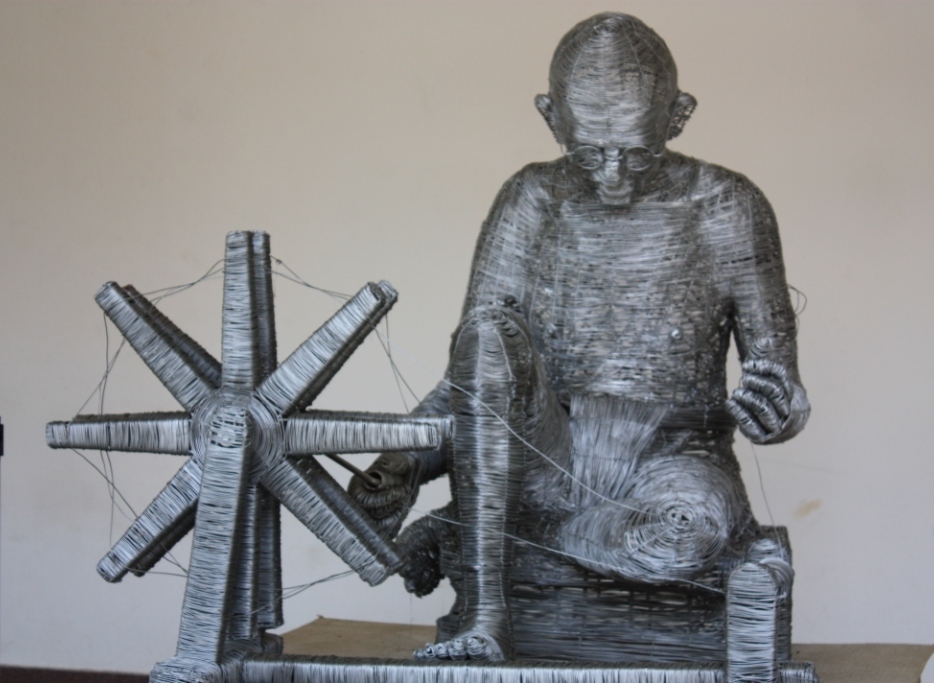
IMG_1501Gandhi is credited with saying, “Be the change you wish to see in the world.”

That’s powerful phrasing. It’s much more effective than, say: “Nag your friends until they’re the change you desire.” It’s also far more potent than: “Write your legislator to draft a new bill so that we all have to be the change you wish to see.”

It’s powerful because it acknowledges that–whatever else you do–you have to set a good example by doing what you think is right. Even if that”s painful and lonely. It’s powerful because it’s bold.

That’s why it sticks in the mind. I once read an entire book by a well-known billionaire who made his fortune in foreign currency arbitrage. I was underwhelmed by the book and the character of the author, and don’t even remember the title because I remember thinking the title should have been: “Why It Should Be Illegal to do What I Did.” This individual came to believe it was morally repugnant to upset the economies of entire nations to make a quick buck, but the lure of making that buck was too great for him to stop without the threat that someone would put him in jail for it. In other words, instead of living by the motto of “be the change,” he lived  by the motto of “If I don’t do it, someone else will.”

TODAY’S RANDOM THOUGHT: What Does It Mean To Be Educated?

controversialbooksOnly reading books that you’re comfortable with doesn’t make you educated, it makes you indoctrinated. 

BOOK REVIEW: The Art of Peace by Morihei Ueshiba and John Stevens

The Art of PeaceThe Art of Peace by Morihei Ueshiba

My rating: 5 of 5 stars

Amazon page

The edition of The Art of Peace that I read is divided into three parts. Part I is a brief biography of Morihei Ueshiba, who was known as Ō-sensei to Aikidō practitioners and other admirers. Part II contrasts the art of war to Ueshiba’s art of peace. Part III is a collection of aphorisms and brief statements outlining the art of peace.

Ueshiba is the founder of Aikidō, a martial art that was derived in part from Daitō-ryū Aiki-jūjutsu, but which is distinct from that art in many ways. (e.g. the lack of set forms and emphasis on randori.) Along with Jigorō Kanō, Gichin Funakoshi, and a few others, Ueshiba is one of the pioneers of gendai budō, modern Japanese martial arts that take as their primary aim non-bellicose objectives like sport and self-defense. This is in contrast to the koryū budō (kobudō) which evolved primarily for war fighting. In contrast to Kanō’s Judō, which was first and foremost a competitive sport, Ueshiba’s Aikidō offered a particular approach to self-defense that was purely defensive and in which movement was harmonized to the opponent’s actions so as to perpetrate the least violence possible.

The biographic portion of the book is intriguing, but on a few occasions drifts from biography to hagiography. I feel that the suggestion of supernatural abilities does a disservice in the telling of Ueshiba’s story. By all accounts, Ueshiba was an accomplished and highly skilled martial artist, and I would like to read a full biography of his life (a biography exists, but I can’t comment on how well written it is yet.) Given Ueshiba’s pacifistic views, it would be easy to dismiss him as a pie-in-the-sky idealist who had no idea of the realities of the world. I don’t believe that is the case. However, when the biography tells stories of god-like superpowers, it makes it hard to take the man seriously as a martial artist. Either Ueshiba was skilled as an illusionist / mentalist (a distinct possibility) or some of the stories were embellished to deify the man. The story that comes to mind is one in which Ueshiba voluntarily faced a firing squad and emerged unharmed due to either ninja-like or Hollywood vampire movie style actions. This story is attributed to one of his students, Gozo Shioda, who passed away in the 1990’s.

We may get an indication of the roots of this appeal to the supernatural in an early statement about Ueshiba’s childhood fascination with individuals like En no Gyoja and Kukai who are themselves attributed supernatural abilities in stories. Ueshiba is clearly a man of faith. He suggests life should be lived on basis of 70 percent faith and 30 percent science. Full disclosure: I’m more skeptical than Descartes, and obviously favor an outlook more firmly rooted in science and rationality.

Part two includes extensive quotes from Ueshiba himself. It contrasts the arts of war with Aikidō in mental and physical aspects. A core theme of the book is that the martial arts shouldn’t be about learning to die, but rather learning to live. Ueshiba criticizes the past Shoguns who used the art of war to control people. Ueshiba’s views on the purpose of martial arts are stated in this part. From a physical point of view, Ueshiba emphasizes the lack of forms in Aikidō (Bruce Lee echoed similar sentiments on this subject.) There is an interesting comparison of Ueshiba to swordsman and Zen master Tesshu Yamaoka (about whom John Stevens also wrote a biography.)

Part three reads like the work of an ancient yogi in places, and, in other places, offers the stern admonitions to train hard that one would expect from a martial arts teacher. A recurring theme is that the martial artist should purge himself of pettiness, be it in the form of being judgmental, materialistic, fearful, selfish, or malicious. He goes as far as to say, “Be grateful even for hardship, setbacks, and bad people.”

Another theme is that one should strive to be natural and to make one’s movement natural. Ueshiba’s advice in this book is about virtue and the mind, and rarely strays into the subject of physical tactics. It does offer a little advice about types of distancing, where one should place one’s gaze, the power of circular movement, as well as discussing technique in the abstract. This is not a criticism. There are other books to learn more about physical technique. However, one should be aware that if one would like to know what Aikidō looks like, this isn’t the book for you.

This thin book provided me with a great deal to think about. I’d recommend it for martial artists, as well as for those interested in the life of this extraordinary man.

View all my reviews

TODAY’S RANDOM THOUGHT: How Sad for You

success-failA man once said to me, with evident pride, that he’d never failed a test of any kind in his life.

I guess he was expecting admiration, and must have been disappointed when I blurted, “how sad for you.”

But here is a person who has never stepped outside his comfort zone, who has no idea what he is capable of, and–moreover–he’s pleased as punch with that state of affairs.

TODAY’S RANDOM THOUGHT: Bear or Squirrel?

Taken in the summer of 2011 in Hungary.

Taken in the summer of 2011 in Hungary.

There are two ways to survive a harsh winter: you can squirrel away your pile of acorns or you can bear it by just not needing much.

TODAY’S RANDOM THOUGHT: Warrior


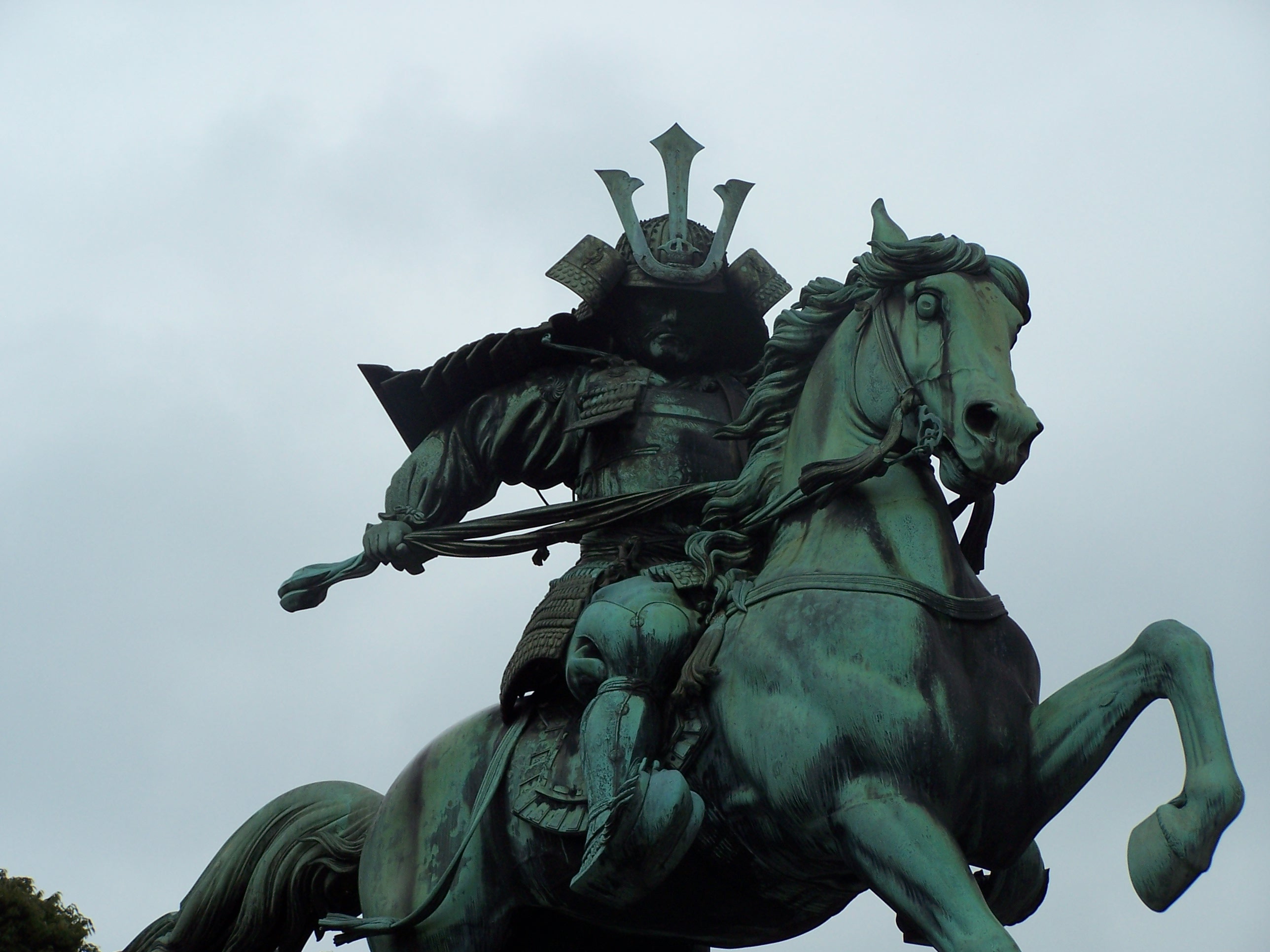
Statue of Kusunoki Masashige, famous Royalist supporter, taken outside the Imperial Palace in Tokyo in 2008.

Statue of Kusunoki Masashige, famous Royalist supporter, taken outside the Imperial Palace in Tokyo in 2008.

The defining characteristic of a warrior isn’t the ability to fight. Thugs and mercenaries fight. It’s  subordinating one’s most base instinct to survive to virtuous behavior. It’s not being ruled by fear, anger, or pride, but consciously opting to do the right thing.

TODAY’S RANDOM THOUGHT: Chasing MacGuffins

What's the "Rabbit's Foot?" Source: Paramount

“What’s the ‘Rabbit’s Foot?'” “I don’t know, but I’m going to shoot her in the head if you don’t give it to me.” Source: Paramount

Critics often bemoan the effectiveness of MacGuffins. A “MacGuffin” is an object so intrinsically valuable that people are willing to kill for it, die for it, or chase each other across the universe for it… and this is the important bit…without knowing precisely why said object is so valuable. In other words, it’s a plot device designed to propel plots forward that would have no reason to advance otherwise. Its exact characteristics are unimportant, and sometimes even its general characteristics remain unrevealed.

Prime examples from the cinema include “the case” from Pulp Fiction, the “Maltese Falcon” from the same-named movie, the “one ring” from Lord of the Rings, the sword “Destiny” from Crouching Tiger, Hidden Dragon, the “Rabbit’s Foot” from Mission Impossible III, the “Tesseract” from The Avengers, or “Genesis” from Star Trek II: The Wrath of Khan.

So, why would people kill, die, or chase after something that they didn’t understand? That’s what the aforementioned critics say, but I have my own theory as to why MacGuffins work well and frequently.  MacGuffins work because people are used to spending their lives chasing something that they don’t precisely understand. Call it bliss or legacy or a missing part of oneself. If one spends one’s life chasing after a key that may or may not achieve one’s desired goal, it would be hypocritical to not have sympathy for characters who do the same.