PROMPT: Expensive Meal

Daily writing prompt
What’s the most money you’ve ever spent on a meal? Was it worth it?

I can’t remember, but it’s never been worth it. Seems like the more one pays for a meal, the hungrier one leaves it. Enjoy your “foam reductions” if you like, but it’s not for me. I’ll take street food any day — cheap, filling, flavorful street food. It’s got character and doesn’t try too hard.

My palate may be unrefined, but — also — I’m no sucker.

PROMPT: Comfort Food

Daily writing prompt
What’s your go-to comfort food?

It depends on where I am. I recently discovered that my Busan comfort food is “Hotteok with seeds.” In Central Asia, it’s tandoor bread — by whatever name it’s called in the local tongue. In Tblisi, it’s khinkali. In Peru, a lomo saltado is a beautiful thing. Chicago is the only place I’ll eat a hotdog, but I do love one there.

As a traveler, I find it’s important to not get attached to any one thing. If you crave a bagel, you’re great if you’re in New York or Tel Aviv, but if you insist on one in Hyderabad, it will be a sad experience. But, by the same token, if you order Chicken Biryani in Des Moines, expect to be underwhelmed (or — if not — to pay an exorbitant amount, either way it’s depressing.)

Probably the single most widespread comfort food would be whatever the local dumpling is, be it called mo-mo, khinkali, pierogi, dim sum, etc. All quite unique, but with an underlying familiarity.

So, in the immortal words of (the apparently quite slutty) Crosby, Stills, Nash, and Young, “If you can’t be with the one you love… love the one you’re with.”

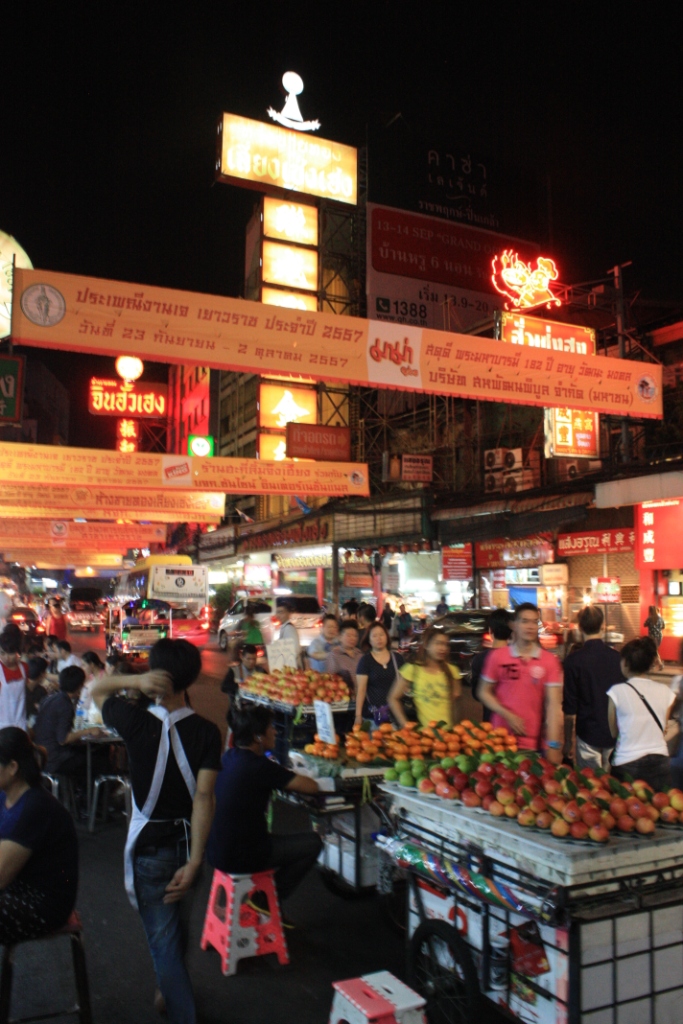
Night Market [Free Verse]

Rains have come & gone.

Neon red shape-shifts
across the puddles,
and sparkles on glistening
roadways.

People converge
on those rain slick streets,
expecting to be fed.

Vendors work crinkling tarps,
trying to remove them without
sloshing standing water --
working with controlled haste.

Fires are lit and dialed in.

Soon plumes of aroma
from street food delicacies
will stretch down the street:

Silently calling & bewitching.

5 Awesome Street Foods [You Should Have Already Tried]

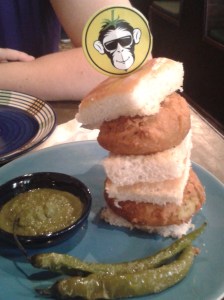
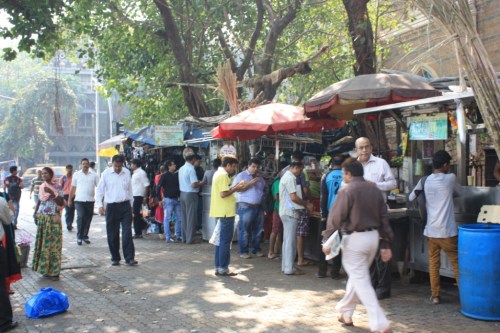
5.) Vada Pav (Potato [fritter] on a bun): India

Tip: Try it in Mumbai. While the one’s shown above were fine. The legendary Vada Pav is to be found at a stall across from Flora Fountain in Bombay.


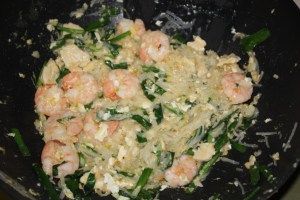
4.) Pad Thai (Noodles Thai Style): Thailand

Tip: Vegetarians beware. Fish sauce is a standard ingredient in this dish. So if you order it vegetarian, it’s not just the prawns and / or chicken one needs to be wary about–depending upon how strict one is. Soy sauce is the substitute.


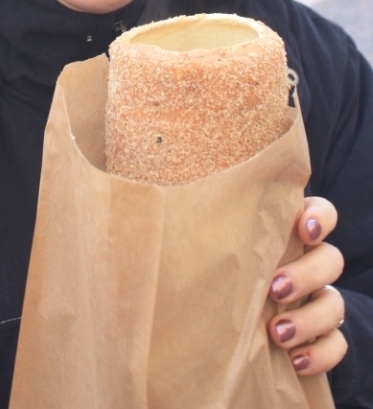
3.) Kürtőskalács (Chimney Cake): Hungary

Tip: It can be found at little stands in or near Christmas markets during the winter season. Buy it hot when it’s cold outside, and it will actually steam like smoke rising from a chimney. If  you’re in Hungary during the summer or you want a savory street food, try lángos .


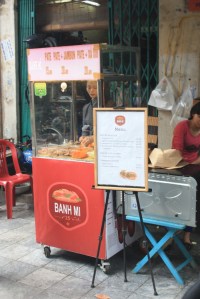
2.) Banh Mi: Vietnam

Tip: Try this sandwich on a baguette from Banh Mi 25, a famous cart at 25 Hàng Cá, Hàng Đào, Hoàn Kiếm in Hanoi.


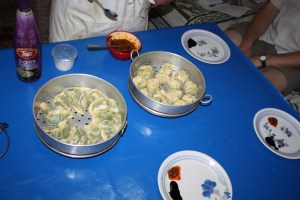
1.) Momo (Dumpling): Tibet, Ladakh, and anywhere displaced Tibetans reside.

Tip: Try the spinach and cheese momo of The Wok Tibetan Kitchen on Main Bazaar Road in Leh.


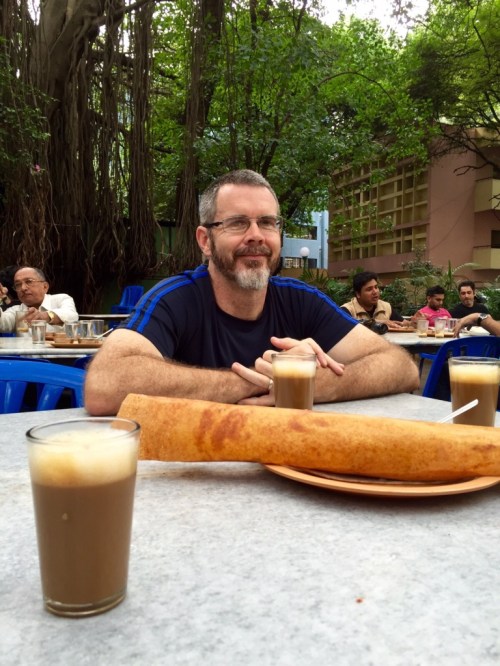
Bonus: Masala Dosa: India, particularly in the South

Tip: If you ask for a “Paper Masala Dosa” you’ll probably get something too big to fit on a plate (as shown.) It will be very thin and the potato-based filling will only be in the central part. (So it’s not quite as insane an amount of food as it may appear.)  This one is from Airlines Hotel in Bangalore. Dosa is just the Indian version of a pancake, and it can take many shapes and forms. There are a few varieties, but often it’s a rice & lentil-based rather than wheat-based flour.


BOOK REVIEW: The World’s Best Street Food by Lonely Planet

The World's Best Street Food: Where to find it and how to make it (General Pictorial)The World’s Best Street Food: Where to find it and how to make it by Lonely Planet
My rating: 4 of 5 stars

Amazon page


This is a combination guide to street food and cookbook. Each of the 100 entries consists of two pages. The first describes the food, how it’s eaten [that’s not always as self-evident to outsiders as one might think], its origins, where one can find a quintessential or famous example of the food, and whether there are any variants on the recipe. The second page is the cookbook entry, which lists the ingredients and describes the process by which they are combined to create the dish in question.

The foods are divided into broad categories of savory and sweet. The savory category is the larger by far, comprising 80 of the dishes—leaving 20 sweets. The dishes represent about 50 different countries of origin. A lot of these countries are well-known street food cultures such as Thailand, Vietnam, India, Mexico, and the US, but there are also a number of locales with which readers may be less familiar– such as Ghana, Malta, and French Polynesia. The dishes include a number of my favorites, such as Vietnamese Banh Mi, US Breakfast Burrito, Indian Masala Dosa, Thai Pad Thai, Hungarian Langos, and Singaporean Hainanese Chicken Rice. However, I also learned of new dishes that I’m eager to try, such as Croatian Cevapcici, Burmese Mohinga, and Chilean Sopaipilla.

WARNING: While I didn’t deduct stars for it, I will warn readers that this isn’t a good book to get as an e-book—at least unless you have a high-end tablet. It was a bit of a pain to read on my Kindle Touch, and the graphics (which I assume are beautiful in the print edition) were largely useless on my device. One could blow up the text easily enough (within limits, at least,) but the pages got grainy if one blew them up too much—and some of the text remained small when expanded.

There are photos. As I mentioned, on my device they were largely useless (grainy black-and-white) but your results may vary.

I found this book to be interesting and informative. While I wish the e-book had been easier to read, it was well-organized and offered a broad selection of dishes from a large number of countries.

I’d recommend this book for street food lovers and foodies.

View all my reviews

DAILY PHOTO: Bombay Vada Pav Stands

Taken in November of 2015 in Mumbai

Taken in November of 2015 in Mumbai


This row of street food stalls is located across the street from Flora Fountain in Mumbai. They don’t all sell Vada Pav, but the most popular one does. (Alternative spellings: wada pav, vada paav, or vada pao)

FYI: Vada Pav is a delicious deep-fried, spiced potato ball served as a sandwich on a fluffy dinner roll style bun. It’s a Maharashtra specialty. There’s a video below if you’d like to see how they’re made or to make your own.


DAILY PHOTO: Vörösmarty tér Lepény Vendor

Taken in December of 2014 in Budapest

Taken in December of 2014 in Budapest

This is the finished product.

This is the finished product.

Lepény is a Hungarian street-food that some might call a folded over pizza and others might call a flat-bread sandwich. It’s bread (like pizza crust) topped with cheese and various vegetative and / or meaty toppings and cooked on a grill. (I just realized it could also be considered a fancy grilled cheese that starts from a ball of dough and not from pre-made bread.)


Anyway, there aren’t nearly as many lepény vendors as there are for say Kürtöskalács (the cylindrical sweet bread that is so very, very awesome), but the vendor at the Vörösmarty tér Christmas market always had a massive line. (We did discover that part of the long lines had to do with the temperamental nature of the wood-fired grills they used and the long time it took to cook one if they let the fire die down too much.) Still, people stayed in line, and that speaks somewhat to the tastiness of this treat.

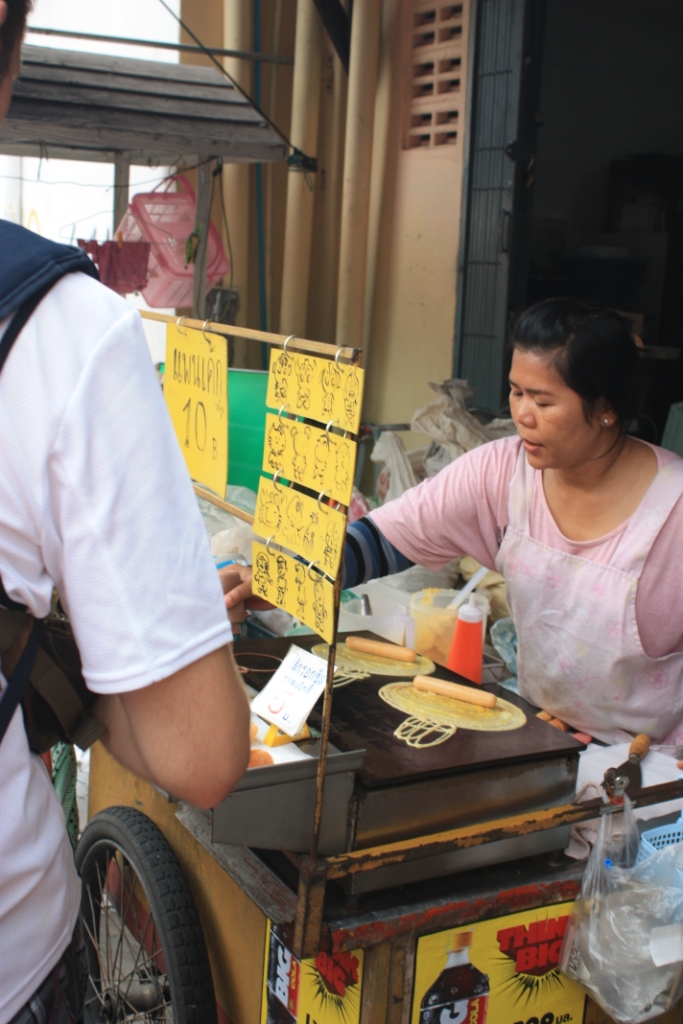
DAILY PHOTO: Street Food Art

Taken in Bangkok in September of 2014.

Taken in Bangkok in September of 2014.

This street vendor made crepes in the shape of various cartoon characters. The little drawings hanging from the front of the cart were the pictures you could select from. Or you could get a hot dog rolled in a crepe (pig in a blanket variation.)

Enough with the Indian Food Warnings, Already

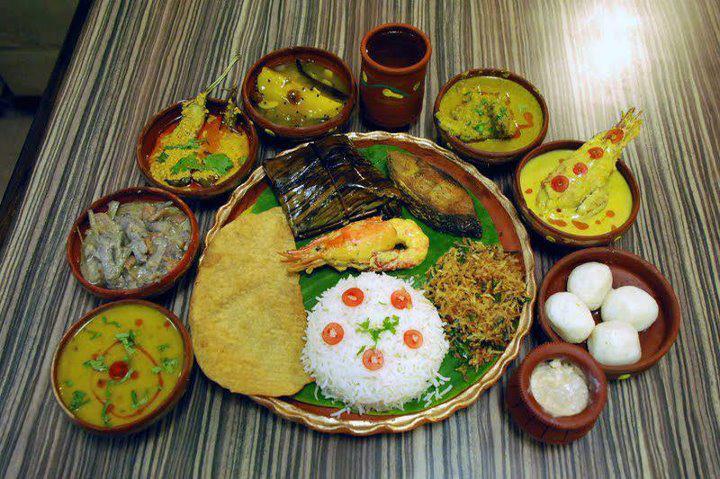
Bengali Authentic Full Meal; Source Nandinissaha (via Wikipedia)

Bengali Full Meal; Source Nandinissaha (via Wikipedia)

When I tell people that I’m moving to India, a common–but strange–response is for them to issue warnings about the food and water. I find this odd for two reasons.

First, said warnings are often issued without much firsthand experience of developing world dining (not including high-brow resorts), and without knowledge of my dining history.

Here are few facts that might help one to better understand my approach. I’ve dined on cold seafood salad in a Phnom Penh cafe. I’ve noshed on snake-on-a-stick in China. I once supped at a home/restaurant in the Peruvian Andes whose latrine consisted entirely of a squat-hole cantilevered out over a  cliff side. A couple of days in Bangkok, I consumed nothing but street-food. I was raised on a farm with non-pasteurized milk, and had a father who wasn’t above cooking up a nice-looking piece of road kill. Not a bloated opossum mind you– but I’ve gnawed clean the drumstick of a pheasant that died not by birdshot, but on the grill of a Peterbuilt. (Funny story, spellcheck wanted to change “pheasant” in the preceding sentence to “peasant.” That would have really freaked you out.) So while my home life has been first world, I’ve got a little third world in my gut.

Now you’re probably thinking, “This idiot is infinitely lucky to be alive, and given his behavior he will probably die soon.” Au contraire mon frère. It’s not that I randomly engage in high-risk behavior. Even locals get Delhi Belly if they don’t choose wisely–despite the full panoply of aggressive gut organisms working on their behalf. I’m quite aware of the hazards, and take calculated risks backed up with sensible precautions.

It’s funny that people live in terror of street food–not that there aren’t some carts that one should run from screaming. However, do you really know what the pimply-faced teenager is touching or scratching during the act of assembling your burger at Chili’s? I know exactly what the hands of the old lady grilling my moo ping on Sukhumvit Road looked like. I got a good look because there was always a line that I had to wait in– and gladly so. (FYI – sanitary wipes or hand sanitizer are one thing you should take with you wherever you go in this world.)

I’m not saying that I’ve never gotten an upset stomach, but I’ve done some remote third world travel and never experienced anything worse than resulted from any given trip to Taco Bell.

I’m quite fond of Indian food, and am sure I will cope well with having it for the majority of my meals for the next couple years. Yes, I’ll have to severely reduce my intake of ice-cold beverages and raw foods. (Ice and wash water are the hidden killers that probably cause more food-borne ailments than anything else.) However, ice-cold beverages –while refreshing and pleasant– are not really that healthy for a body in high temperatures anyway. (Flash heating or cooling of things at the other end of the temperature spectrum is bound to cause problems–one’s organs aren’t that different.) While I like raw vegetables, the human body is more efficient at extracting nutrients from cooked food, so there’s a side advantage there as well.

I think people freak themselves out and miss out on some excellent food. One individual who traveled widely once told me that she never ate the local food for fear of getting sick. I felt bad for her. She traveled to the source of some of the world’s best food, and then dined on American fast food–that’s a squandering of no small part of the travel experience. Of course, some people have very weak systems, and that may have been the case for her. (American fast food may be bad for you, but it is uniformly bad throughout the world.)

The second thing that I find strange is that when I was moving to England 25 years ago, no one warned me that I would be going to one of the most gastronomically unappealing places on the planet. Let’s face it, the reason Britain took over India in the first place was so that they could get something decent to eat. Curry is also the reason they didn’t let go easily.

Is there some bias whereby people tend to respond with negativity when one says that one is moving to the developing world, versus positive responses to moving within the developed world?  One probably shouldn’t respond with negativity to news someone is moving anywhere, but–if you must– you should tailor it to the individual concerned.  For example, if one said to me, “That shrill flute in their music is going to get on your last nerve.”  Well, sorry, but that’s probably a correct statement. (No offense, I’m sure it sounds lovely if you were brought up with it, but it will be–at best– an acquired taste for me.)