BOOK REVIEW: Yoga Body by Mark Singleton

Yoga Body: The Origins of Modern Posture PracticeYoga Body: The Origins of Modern Posture Practice by Mark Singleton

My rating: 3 of 5 stars

Amazon page

I was excited to stumble across this book because it proposed fresh insights into the history and development of posture-centric yoga. Singleton’s premise is that yoga as it’s practiced in studios around the world today (i.e. practices focused heavily on asana, or postures) has almost nothing to do with historic yogic traditions and is to a large extent European (or Western) fitness practices fed back to the world with a patina of Indian-ness instilled by a few Indian fitness teachers (e.g. T. Krishnamacharya and students.) This is a bold and stunning hypothesis. The problem is that Singleton leaves plenty of room to doubt his thesis. I’m not saying that I’m certain Singleton is wrong, but after reading the book I’m no more inclined to believe his hypothesis than when I first read the book blurb.

The book consists of nine chapters:
1.) A Brief Overview of Yoga in the Indian Tradition
2.) Fakirs, Yogins, Europeans
3.) Popular Portrayals of the Yogin
4.) India and the International Physical Culture Movement
5.) Modern Indian Physical Culture: Degeneracy and Experimentation
6.) Yoga as Physical Culture I: Strength and Vigor
7.) Yoga as Physical Culture II: Harmonial Gymnastics and Esoteric Dance
8.) The Medium and the Message: Visual Reproduction and the Asana Revival
9.) T. Krishnamacharya and the Mysore Asana Revival

One can see the flow of the book in this chapter listing. It begins by describing the ancient yogic traditions (e.g. Jnana yoga, Bhakti yoga, and Karma yoga.) Singleton then goes on to put immense weight on very few voices that were speaking globally about yoga in the late 19th century—largely European but notably including Swami Vivekananda. (This, by the way, is where I noticed the most glaring weaknesses of the book. There seems to be an assumption that what the most vocal people were saying during this time was the truth, the whole truth, and nothing but the truth.) One will note that the late 19th century is an arbitrary point to make the critical juncture for a study of yoga—this era’s sole importance seems to be in that that’s when Europeans started entering the scene (and documenting it in English and Western languages to a large extent.) I understand that there may have been a dearth of information previously; however, I’m also skeptical of equating the sum of truth with the sum of what is documented.

The book then shifts into the early 20th century when Singleton proposes the proto-postural yoga is beginning to coalesce with both Western and indigenous Indian influences. Singleton writes extensively about this period, and presents what he believes is the path by which postural practice evolved over a short time into modern yoga as we know it. The book ends in the mid-20th century with an extensive discussion of T. Krishnamacharya and his pack of brilliant students (i.e. B.K.S. Iyengar, Pattabhi Jois, T.V.K. Desikachar, and Indira Devi) who are responsible for a lot of how yoga is practiced today (for virtually all of modern yoga by Singleton’s reckoning.)

It should be noted that this book is put out by an academic press, Oxford University Press, and there’s all the front and post matter that one would expect of a scholarly press publication. This includes an introduction, notes, and a bibliography.

So, you might be wondering how I could have so much doubt about the veracity of the book’s central claim—a book written by a Cambridge educated scholar and published by Oxford University Press. It’s, after all, chocked full of facts that are designed to bolster Singleton’s argument. I’m certainly not suggesting that Singleton lied or presented false facts (however, I have–and will further–argue that he frames facts throughout the book to diminish those statements and facts that run counter to his argument while wholeheartedly accepting statements that validate his argument—even when the people whose statements he leaves unchallenged would seem to have their own agendas. I don’t know, perhaps T. Krishnamacharya was—as Singleton intimates though never explicitly accuses—lying when he claimed to have received his sequence and approach from a scripture he was taught by a Himalayan master. However, interestingly, he would be lying to minimize his role in the development of yoga rather than to increase his fame. This stands in contrast with the European authors who Singleton readily accepts who were seeking to build their bona fides as experts in the esoteric systems of India and the Himalaya, who arguably had a lot to gain from being seen as having a full understanding of these systems.)

The best way to understand the root of my skepticism is to tell a make-believe story. Imagine a race of aliens came down to Earth. For whatever reason, they want to understand (presumably among many other things) the Roman Catholic Church. One astute alien scholar notes that, after having reviewed not only the entire Bible but a vast canon of theologian discourse, there is scant mention of sitting or kneeling. However, when cameras came around, there came to be clear evidence of pews and kneelers in the church. The aliens conclude that Catholics had always stood during worship, but with the advent of the camera they began to sit and kneel. The aliens, having big and bulbous butts, conclude that the Catholics have become concerned that their own big, bulbous butts will be captured for posterity (pun intended) by the cameras and have, thus, opted to adopt postures that would more adequately provide cover. In the present day, sitting and kneeling are the bulk of what Catholics do with their bodies when [overtly] practicing their religion, and so it must be those postures–rather than abstract notions like achieving “grace” are now the most critical part of the practice. (Besides, the earliest photos of kneelers came from Protestant churches, so perhaps Anglicans taught Catholics how to kneel.)

If you haven’t figured it out, in my little scenario, the late 19th century Europeans who were writing the English language tracts that formed the heart of Singleton’s research material are the aliens with big, bulbous butts. I would propose that the Europeans aren’t viewing yoga completely objectively but through the lens of their own experience and desires. Furthermore, they are also only giving weight to what they see and hear (which may or may not be a full picture.) I would further argue that just like Catholics don’t devote much text to discussing sitting and kneeling in the documents of the Vatican library doesn’t mean there isn’t a long history of those practices. Postural practice is:

a.) not the critical end result that everyone is concerned with even if it takes up the bulk of one’s time in [overt] practice. It’s certainly true that there are a vast number of yoga practitioners whose only interest is in the fitness aspect of the practice. However, there are also many who spend most of their yoga reading time learning from Vedas and reading yogic philosophy even though the bulk of their practice time is asana.
b.) extremely difficult to convey via text but readily conveyed through demonstration and hands-on teaching. If you were a Catholic and wanted to teach someone kneeling, would you write them a three paragraph text description of the process, or would you just demonstrate how to kneel and correct any glaring (albeit unlikely) deficiencies in form.

At no point does Singleton get into the postural details of individual asana. He mentions another scholar that supposedly has done some of that work, but Singleton feels it’s not critical. However, it’s very hard to prove what he’s trying to prove without getting into that level of detail. Yes, there will be similarities between various systems of stretching because of the nature of the body. For example, European stretching systems had a forward bend that looks reminiscent of paschimottanasana (the body folds that way and stretching the hamstrings is one of the most important functions in any stretching regimen), and it shouldn’t be surprising or revealing if the first photograph of this posture was in a European gym (the fact that Scandinavians had cameras before Himalayan yogis isn’t a sound basis to conclude that Himalayan yogi’s learned to bend forward from Scandinavians.) A there are a lot of postures that two systems might reasonably independently discover, but one also can’t rule out that the Indian yogi taught the Europeans and not the other way around. (I know it’s hard to comprehend in the era of FaceBook, but failure to be documented does not equal failure to be true. The farther one goes into the past, the less of what happened is going to be documented, and some cultures are going to be more likely to document events than others. e.g. Would our aliens be right or wrong if they concluded that 85% of humans are females between the age of 12 and 24 years old because 85% of the selfies posted on the internet are among that group. )

Singleton’s book does have some graphics. They didn’t always help his case, however. I was struck by how few of the fine details of the European postures correspond to practice as we know them, while some of the very old paintings look almost exactly like present day asana. (If one accepts that the fact that they didn’t have the greatest grasp of capturing perspective back then isn’t indicative of how flat the postures and people were back then.) I’ll readily admit that I wouldn’t definitively count Singleton wrong on my subjective observation of the pictures, but it does leave me with a lot of room for doubt.

I suppose the next question is why I didn’t completely pan the book. Three stars isn’t a tragic rating. I thought the book contained a lot of good information and food for thought (even if it fell far short of proving its central hypothesis.) I particularly enjoyed the chapter on T. Krishnamacharya and his now-famous student body. I’ll also say that part of why I came away from the book with such a muddled perception of this history is that Singleton doesn’t hide facts that are damning to his case, but rather presents them and then tries to marginalize them. A prime example would be the Hatha Yoga Pridipika (HYP), a 15th century text that mentions a number of the asana considered classic yoga postures today (some of which form the core of a Hata practice)—though admittedly HYP emphasizes the importance of only four seated postures.

I can’t say that Singleton didn’t help give me pause to wonder about the truth of the received understanding of yoga’s evolution. I’ve practiced yoga in places as varied as India, the U.S., Thailand, and Hungary, and I found it shocking how similar the practice is around the world. This bodes well for the argument that yoga as it’s practiced today has coalesced recently. By way of contrast, there are many myths about how one martial art is the ancestor of another but the two systems often look nothing alike. (e.g. I’ve studied Kalaripayattu, which many believe was the ancestor art taken to China by Bodhidharma through Southeast Asia, but which today looks nothing like Kung fu or Muay Thai. Furthermore, Kung fu styles usually look quite unlike the Korean and Japanese martial arts that they are said to have inspired.) If the latter among these martial arts did come from the earlier, they evolved apart quickly. While the evolution into different martial art forms is quite possible, it raises the question of why yoga should be so similar internationally. A skilled yoga teacher would likely give a given student the same alignment adjustments for, say, Warrior I, regardless of whether the teacher was in Prague, Manila, Tokyo, or San Diego.

I can’t say that I’d endorse Singleton’s argument. It would take much more precise information for me to buy it (and it’s likely that said detailed historical information doesn’t exist.) However, if you’re interested in the history of yoga, you might want to check out this book. Your conclusions may differ from mine, but even if they don’t I suspect you’ll learn a thing or two of interest. Yoga Body was reasonably priced as a Kindle book when I bought it.

View all my reviews

BOOK REVIEW: The Voice of the Silence by Helena Petrovna Blavatsky

The Voice of the Silence: Being Extracts from The Book of the Golden PreceptsThe Voice of the Silence: Being Extracts from The Book of the Golden Precepts by Helena Petrovna Blavatsky

My rating: 3 of 5 stars

Amazon page

According to Helena Blavatsky, the three “fragments” that make up The Voice of the Silence are her translations of three tracts from The Book of Golden Precepts, of which there are 90 and she had memorized 39. The Book of Golden Precepts is said to include both Buddhist and pre-Buddhists views on spirituality.

Blavatsky was one of the founding members of the Theosophical Society, an organization that proposed and advanced a certain brand of mysticism. Mystic traditions are those which believe that one must look inward to find the divine, i.e. to know god. The Theosophical approach isn’t without controversy. Blavatsky’s allusion to a secret path to wisdom and the suggestion that most of the world isn’t ready for the high level teachings sits in contradiction to a Siddhartha Buddha who was transparent. Buddhists have been known to claim that in as much as an idea is a teaching of the Buddha, it wasn’t secret, and in as much as a teaching was secret, it wasn’t the work of the Buddha. But there is disagreement. Some believe that what Blavatsky is presenting is high level Mahayana Buddhism, but others think that it’s a hodge-podge of Kabbala, esoteric Buddhism, and yogic teachings.

The first “fragment” is also titled “The Voice of the Silence.” This section suggests that there are three stages to one’s journey: ignorance, learning, and wisdom. It states that one must take care to not to be distracted from the path by sensual inclinations or by desire. The path described mirrors the advanced stages of Patanjali’s eight-limbs. In other words, she discusses a progression from pratyahara (not explicitly named, but described as the withdrawal of sensory input), dharana (concentration), dhyana (meditation), and Samadhi (liberation.)

The second part is entitled “The Two Paths.” Liberation and renunciation are the two paths in question. The central topic of this chapter is Karma, and the questions of action versus inaction that are also discussed in the Bhagavad-Gita.

The third part is “The Seven Portals.” These seven doors through which one must pass on the way to wisdom are essentially the same as the six paramita of Buddhism with an additional one, Virag, inserted between the third and fourth spot. The portals are Dana (generosity), Shila (a.k.a. Sila, or virtue), Kshanti (patience / perseverance), Virag (illusion conquered), Virya (energy), Dhyana (contemplation), and Prajna (wisdom).

A nice feature is a “glossary” at the end of each of the fragment that explains some of the terminology and concepts. While this is called a glossary, it’s not one in the usual sense, i.e. it’s not in alphabetical order and is not exclusively definitions. It would better be described as chapter notes. The idea is to convey the information that a lay reader may need, but which the author / translator doesn’t want to muddle the text with.

I think this book is worth a read. It’s short, and for a work written in the 19th century it’s quite readable—that doesn’t mean that the message is always clearly conveyed—whether on purpose or accident.

Note: While I read this on Kindle for a nominal price, it’s available on the web free of charge (see here.)

View all my reviews

DAILY PHOTO: Enter the Jor Ong

Taken in January of 2014 in Phuket Town.

Taken in January of 2014 in Phuket Town.

Jor Ong is one of Phuket Town’s numerous Chinese Shrines. You’ll note the prominent white tiger painting.

BOOK REVIEW: The Novice by Thich Nhat Hanh

The Novice: A Story of True LoveThe Novice: A Story of True Love by Thích Nhất Hạnh

My rating: 5 of 5 stars

Amazon page

The Novice is the retelling of a Vietnamese folk tale about a young monk who is repeatedly wronged, but who always does the virtuous thing. As I read this book, I thought the story seemed familiar, and I realized that I read the same story as The Martyr by Ryūnosuke Akutagawa. Akutagawa does a much better job of story building. The Japanese writer doesn’t reveal to the reader that Lorenzo (his novice and the equivalent of Thich Nhat Hanh’s Kihn Tâm) is a female until the end—thus definitely resolving the claim that the young monk fathered a child out-of-wedlock and in contravention of vows f0r the reader at the same time as the characters in the story learn it.

Thich Nhat Hanh tells us that the novice is a female at the beginning, and he does so via backstory that serves both to give justification for why Kihn Tâm chooses to disguise herself and become a monk and to pile onto the injustice. We learn that Kihn Tâm’s female alter ego had been married, but the marriage ended with a false accusation of attempted murder of her husband. This backstory probably isn’t worth the drag for either of the aforementioned purposes—but the former is more justifiable than the latter.

What Thich Nhat Hanh lacks in gripping narrative structure, he gains in provoking thought. The Zen monk and poet gives the reader insight into how Kinh Tâm manages to be preternaturally virtuous. In The Martyr this is a black box affair. Hanh also encourages the reader to see Kihn Tâm’s accusers as the novice does, i.e. with compassion. Akutagawa does what any writer would do; he vilifies the accusers so as to make the story resonate with the average, petty, martyr-complex prone reader—as opposed to the enlightenment-aspiring reader. Hanh leaves the other monks in Kinh Tâm’s corner, i.e. when everyone else is condemning the novice, they still believe in her. In Akutagawa’s story, monastics are not inherently so perfect.

The book offers some interesting back matter. The most substantial of the appendices is an account by Sister Chan Khong of the works of Thich Nhat Hanh and his followers both during the war and afterword when they tried to establish a monastery in Communist Vietnam. The essay echoes the themes of loving-kindness and compassion that form the core of the novella, as does the essay by Hanh that brings the book to a conclusion. While this back matter is filler to make up for the fact that the story is not novel length, it nevertheless makes for interesting reading.

I’d recommend this book for those with an interested in Zen. If you’re looking for a good story, read Akutagawa’s The Martyr, but if you want to be inspired to compassion, read Thich Nhat Hanh.

View all my reviews

BOOK REVIEW: Don’t Kill Him by Ma Anand Sheela

Don't Kill Him! The Story of My Life with Bhagwan RajneeshDon’t Kill Him! The Story of My Life with Bhagwan Rajneesh by Ma Anand Sheela

My rating: 3 of 5 stars

Amazon page

There are some nonfiction books that one reads because one wants the objective, unvarnished truth about events. This is NOT that book. Some books you read knowing they are going to contain a mix of truth and falsehood–fact and fiction–and you read them believing you can gain insight from both the truth and the falsehood–if you consider the words analytically in light of known facts. This is that kind of book.

Don’t Kill Him is an autobiographical account of Ma Anand Sheela’s (a.k.a. Sheela Ambalal Patel’s) life as the secretary / spokeswoman / project manager / Pepper Potts for Bhagwan Rajneesh (a.k.a. Osho.) As such, while it is about the life of Sheela, the central character is the Bhagwan Rajneesh. This is indicative of the narcissistic but charismatic cult leader—who must be the center of attention—and the infatuated cult member for whom the “guru” is everything. What one really gets in this book is insight into the mind of a person prone to join a cult.

Chances are you know of the Bhagwan Rajneesh in one of two very different ways. As Osho, he’s an enlightened guru who penned over 600 books on spiritual topics from Taoism to Tantric sex, who attracted a vast following of wisdom seekers, and who to this day has a centers globally in his name—despite having died in 1990. As the Bhagwan Rajneesh you may know of him as a petty narcissist who built a stunningly successful cult of personality, and who in all likelihood green-lighted a salmonella attack on a rural populace in Oregon in an attempt to sway a local election so that certain dodgy practices could be carried out at his commune.

Sheela comes across as quite reasonable in the book. Gone are the days when she made replies to questions such as “tough titties” or a horrifying Holocaust joke. She claims that her former outlandishness was part of a role that she played on behalf and at the behest of the Bhagwan, but playing the victim in the face of entire world that conspired against her in her selfless virtuousness is a prevailing theme throughout the book.

Read carefully, there is plenty of evidence that all is not right with the author’s mind. She barely addresses criminal charges for which she was given sentences in total of 64 years (though, because they were to be served concurrently, the most she would have served would have been 20—and in reality she served less than two-and-a-half.) She talks more about the least of the charges–visa fraud then the attempted murder and assault convictions. She merely asserts that there was a vast conspiracy involving the German government (who extradited her), the U.S. criminal system (which indicted her), and at least two different factions of the Rajneeshee cult (one being exemplified by the Bhagwan, himself, and the other by David Berry Knapp, the mayor of Rajneeshpuram (the incorporation of the cult compound) who not only dropped a dime on Sheela but also implicated the Bhagwan)

While it’s fair to say mistakes are made in the American criminal justice system now and again, the scale of conspiracy that would have to be involved in Sheela’s case strains credulity. Her suggestion that a criminal justice system that protects defendants as much as anywhere in world is completely corrupt comes off as a bit sad and pathetic. Here and there she points out that there were one or two good people in the jail or justice system, but one soon suspects that these are just other deluded cult-prone individuals ready to drink the Kool-Aid themselves. Interestingly, while she claims there was not a shred of evidence against her, she made an Alford plea. (You’ll be forgiven for not knowing what an Alford Plea is, as it’s something only the mind of a lawyer could come up with. One pleads guilty while asserting one’s innocence. In essence, one says, “I’m really not guilty, but there’s enough evidence to convict me so I want to make a deal to get less prison time.” Of course, she makes paranoid-sounding claims that the American criminal justice system as justification for not standing up for her own innocence.

The only bad decision of any note that the author ever admits to making is slapping one of the followers, an act for which she claims both Bhagwan Rajneesh and the commune forgave her. These repeated claims that while her life was falling apart it was because almost everyone else was wicked while she was a victim wear a little thin. She claims that all the accusations against her resulted from her decision to leave because of her guru’s latest decision to bilk wealthy followers to pay for more Rolls-Royces. There may be a seed of truth in this. The Bhagwan also claimed that she embezzled money, a charge that was not covered in the charges for which Sheela was convicted. It’s as likely as not that any shortage of funds resulted from the Bhagwan’s own materialistic addictions. Whether his accusations about the bioterror attack were spurred by being spurned by this assistant cannot be known. Of course, it could also be that he wanted to separate himself from the felony indictments that were becoming increasingly inevitable.

The title, Don’t Kill Him, comes from Sheela’s repeated suggestion that, while the Bhagwan was a madman, one shouldn’t destroy the legacy. It’s this back and forth between deifying and castigating the Bhagwan that gives one insight into the mind of a cultist—but also leaves one scratching one’s head at what the author’s point is. When she suggests that he was a petty, narcissistic, greedy drug addict who should be exalted, it’s a bit dumbfounding for the average individual. It seems to be a textbook case of infatuation with the charisma of an otherwise deplorable human being. There is this widespread confusion of charisma with enlightenment that is intriguing. Early in Chapter 4 and later in Chapter 5, the author suggests that the Bhagwan set up her imprisonment as part of her education. That level of delusion is astounding.

There are those who’ll say that Sheela is right and others who’ll tell you that she is just trying to bash the Bhagwan—albeit in a very ambivalent way. I’m here to tell you that this book leaves the reader with one logical conclusion, and that’s that both Sheela and the Bhagwan were coo-coo for Coco-Puffs.

View all my reviews

BOOK REVIEW: The Equanimous Mind by Manish Chopra

The Equanimous MindThe Equanimous Mind by Manish Chopra

My rating: 4 of 5 stars

Amazon page

Imagine going to a meditation center and living by the following rules:

1. You may not have access to any reading materials.

2. You may not have access to any writing materials.

3. You must leave behind cell phones, tablets, laptops, watches, radios, and other portable electronic devices.

4. While there will be other people around, you are only allowed to talk to your instructor/mentor, and mustn’t acknowledge or interact with others. You will scarcely hear a voice unless you are in meeting with your teacher or listening to the taped lessons in the evening.

5. You will be segregated from the other sex. They will have separate living and meditation spaces.

6. You will eat only the vegetarian meals provided by the center.

7. You will spend your days mostly in meditation—meditation of a rigorously prescribed nature.

8. You have to live by these rules for ten straight days. You are strongly discouraged from attending if you don’t believe yourself capable completing of all ten days.

Could you do it? If your response is, “Sure I can, piece of cake,” you are either an exceptional person or a little deluded. And it’s probably more likely you are like the person who imagines they will be a hero in a bank robbery or mugging, but who ends up catatonically cowering in a puddle of their own piddle. Maybe it shouldn’t be a tough proposition, but it is.

The ten days described are the basic course offered at Vipassana meditation centers around the globe. Except your travel costs, there’s no cost to attend, and you aren’t even allowed to tip the staff–though you can make a donation at the end of the course to assist others. If you happen to be near a center, there’s nothing but will and 10 consecutive days of freedom to keep one from taking the course.

The Equanimous Mind charts Manish Chopra’s personal experience with the course. I bought the book because I intend to attend the course myself, and I craved insight into what the experience is like.

For those who are unfamiliar with Vipassana meditation, it’s nominally a Buddhist method, but practitioners are quick to point out that it’s actually areligious. One need not be Buddhist to attend. One could be a Hindu, a Methodist, or an atheist and get the same value from attendance. Adherents believe that this is the meditation method that Buddha himself taught. For those who thought this sounded awfully cult-like when I described it above, in many ways it’s the antithesis of a cult. There is no central guru to worship. The closest thing to the overarching guru, S.N. Goenka, passed away last year. You don’t have to join a group or swear allegiance. And not only don’t you surrender your life-savings, you don’t have to surrender one, thin dime to have the experience.

Chopra doesn’t write at all about the background of Vipassana, nor much about its philosophy or method. Instead, this book is a retelling of Chopra’s personal experience with the camp. There are many books that deal with those aforementioned topics, and so it’s no loss that this book doesn’t. It does give the reader a first-hand look at what it’s like to live in the camp and what prolonged meditation is like, and thus meets a valuable niche in lending comfort to those who are considering the course–but who are leery of what they will go through.

It’s remarkable that the author had the detailed recollections necessary to construct an entire book. The organization of the book chapters is by day, and so there are ten core chapters. (This is a good way to arrange it as there is apparently some universality to experience day-by-day. Not only are people being taught the same methods, but it seems most people who quit do so on days two or six—indicating many people hit “walls” at the same point.) One will remember that notebooks and writing utensils are prohibited. The last chapter informs the reader that Chopra began frantically outlining the book on his way home. It’s surprising that an entire book sprang from memory. The author does claim that the clarity gained through the course improved his memory.

One can’t help but wonder what the book would have read like if it had been compiled day-by-day as a journal. In other words, how much was the book was framed by the euphoria of just having completed the course? Chopra does mention some low points of the course, but, overall, the picture he paints is rosy. It may be that his experience was just overwhelmingly positive, or he could have been on a high from completing something quite difficult.

Chopra suggests that by the end he had greater mental clarity, decreased vice, increased mental capacity, and was living an idyllic life. I don’t want to sound like I’m treating the account as suspect, and I certainly wouldn’t suggest that Chopra is being blatantly dishonest. However, I worry that Chopra might have oversold the course. It almost reads like he’s been imbued with superpowers (mental, not physical–think Professor Xavier, not superman) at the end of the book. (He doesn’t suggest anything magical, but the claims are pretty impressive.) Maybe this is genuinely his experience, but it sounds a little too good to be true.

I’d definitely recommend this book for people who are considering taking the course. I’m not sure it would be of much interest to a more general reader. As I indicated, one isn’t going to learn a lot about the philosophy or history of Vipassana. One does learn a little about the methods from Chopra’s description, but it is fairly cursory. There is a fair amount of mundane information that people interested in the course will love to know (e.g. what kind of food was served and what it’s like to have to sit through one’s body aches), but which will be less than thrilling for someone who has no interest in taking the course.

View all my reviews

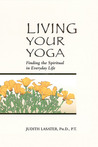
BOOK REVIEW: Living Your Yoga by Judith Hanson Lasater

Living Your Yoga: Finding the Spiritual in Everyday LifeLiving Your Yoga: Finding the Spiritual in Everyday Life by Judith Hanson Lasater

My rating: 4 of 5 stars

Amazon page

If you’re the average joe, you probably think of yoga as a series of stretchy postures–many or most of which seem physically impossible for a run-of-the-mill human. If you’re a little more sophisticated on the subject–perhaps you’ve even done a few yoga classes–you realize that breathing exercises (pranayama) and meditation (dhyana) are also an essential part of the practice. However, if you’re hardcore, you realize that there is an entire moral, ethical, spiritual, and philosophical approach to life embodied in yoga.

Lasater’s book is aimed at the latter group or people who plan to one day be in that group. You will not find out how to do a single posture (asana), and you won’t learn how to do breathing exercises or meditation. So, the book might sound like one of those navel-gazing, pie-in-the-sky, philosophical tomes. But it’s not. On the contrary, the chapters are short and readable, and each one ends with exercises to put that chapter’s lesson into practice. Now, it probably sounds more like a how-to workbook. It is, but the exercises can only be carried out in everyday life.

Admittedly, I don’t know that much about yoga, but I suspect such a book is much-needed. I do know that in the martial arts there is also a rich and well-defined moral, philosophical, and–for lack of a better term–spiritual component, and that it gets lost much of the time by a large percentage of students as soon as they step out the door of the dōjō. I suspect this is true of yoga practitioners as well. I imagine that as yoga has spread globally many of the less visible and tangible aspects of the system get left behind. I know this happens in the realm of martial arts–sometimes these elements even get lost in the homeland. It’s a natural side-effect of busy lives; people take on what they can grasp and don’t go looking for the rest.

Living Your Yoga is divided into three parts of seven chapters each (21 chapters in total.) The social circle widens as one goes through the parts. Part I deals with the yoga practitioner as an individual. Part II considers the practitioner’s relationships with others in their immediate domain–family, friends, co-workers, etc. The final part looks at the practitioner in the global context.

Each chapter focuses on a particular virtue or vice and how to cultivate it or mitigate against it, respectively. All of the chapters begin with a quote, most from the Yoga Sutras of Patanjali or the Bhagavad Gita, then there is the body of the chapter, followed by a practice on that particular theme, supplementary practices, and a few mantras.

The chapters in the first part are: spiritual seeking, discipline, letting go, self-judgment, faith, perspective, and courage. The second part deals with compassion, control, fear, patience, attachment / aversion, suffering, and impermanence. And the final part considers greed, service, connection, truth, success, nonviolence, and love.

While I suggested this book is for the hardcore yogi/yogini, it has value for a more general readership than that. It’s really for anybody interested in working on self-improvement on a daily basis, as opposed to those who restrict their development pursuits to inside the yoga studio (or dōjō or ashram.) The advice is sound, regardless of whether one ever practices an asana or not.

View all my reviews

In [Atheological] Praise of Grace & Fasting

IMG_1214Those who’ve read my posts, or who know me, probably know me to be areligious, which–contrary to popular belief–isn’t necessarily the same as being atheist. Personally, and on the whole, I’ve never found enough virtue in religion to outweigh what I believe to be its vices. That being said, I do find behaviors to applaud among the faithful.

First and foremost among these commendable activities is the practice of saying grace before each meal. Of course, what appeals to me isn’t the notion of saying, “Hey, God, you are really groovy for laying this food upon my plate, and it’s my most heartfelt wish that you’ll keep up the good work. Thank you ever-so-much,  and YEEAAAH, God!” [Though if a less borderline-sacrilegious version of this kind of grace is your bag, more power to you.]

What I commend is the taking of a moment to be still and introspective before eating, of taking time to recognize the importance of our food. Of course, one can do this same sort of thing without invoking a God or gods–and some people do so.

One can take a moment to remind oneself to be mindful of how one eats, to not eat too quickly, and to recognize when one is full. (Bodily full not mentally satiated, the two are often not the same and the former will usually arrive first.)

One can take a moment to remember a time in one’s life when one was hungry or thirsty and concerned about whether one would have enough calories or safe drinking water to get through.  In our modern age, I suspect many have never been in a situation to experience such a thought, and are the poorer for it.

One can recollect the image of some hungry soul,  scraping to gather enough food to survive.

One may simply say, hara hachi bu, as Okinawan people do to remind themselves to eat only until they are 80% full.

Whatever you think or say, the goal is to keep eating from being a mindless activity, done on automatic pilot. Failure to be cognizant of what one puts in one’s mouth is the number one killer among human beings–and not just the obese. OK, I admit that I made that statistic up. But of how many statements can it be said that one is better off behaving as if it’s true–regardless of whether it is or not.

On a related note, I also applaud the act of periodic and/or partial fasting as carried out by many religions, as long as the safety of the individual is put before religious dogma, which–to my knowledge–it usually is. One shouldn’t be what my father called a Red Lobster Catholic, the kind who went to Red Lobster on Fridays during Lent and ordered the most sumptuous seafood feast they could afford–missing the point entirely by treating themselves. One also shouldn’t fast to the point that one feels starvation, and then binge and gorge.  One should cut one’s intake in a safe and reasonable manner in order to observe what it’s like to feel biological hunger (as opposed to cravings of the mind,  or boredom hunger.) Then take advantage of the fact that one’s stomach capacity shrinks surprisingly rapidly, allowing one to control one’s intake much more easily.

One needn’t believe that one has to make oneself suffer as a sacrifice to a higher being to see the value of fasting. Fasting done mindfully, and not dogmatically, increases one’s bodily awareness, one’s thankfulness, and one’s pleasure in eating.


Training the Mind


IMG_0520Left to its own devices, the mind is like Indian traffic: chaotic, noisy, slow-moving, relentless, and brimming with latent rage. Meditation is a tool to help unsnarl the traffic jams so that one can observe the mind as something other than indecipherable chaos.


Meditation isn’t the end game. If one goes to the gym daily to lift weights, but one has no interest in–or use for–putting one’s muscles to practical use, one is engaging in an act of vanity more than one of personal development. In the same way, if one builds one’s awareness of the mind, and doesn’t use it for betterment in one’s daily life, what is the point? What do I mean by betterment? I mean defeating the petty elements of one’s nature that cause oneself and others suffering and that keep one living in a world of delusion.


Meditation trains one to take note of the daydreams and obsessive thoughts that run through one’s mind, and to do so progressively sooner—before they can coalesce into a full-blown avalanche of negativity and delusion. In meditation, we observe these errant thoughts and then let them float on down the river. As one lives one’s waking life, however, one may take time to consider what these thoughts and daydreams are doing for one. Often one can remain ignorant of the purposes these thoughts serve, realizing only that they make one feel better temporarily.


A few of the purposes that these errant thoughts may serve are:

martyrdom (i.e. thinking the world is against one so whatever goes wrong is the result of outside forces)

-ego-boosting (imaging one has the confidence to do something one doesn’t in reality)

-empowerment (fantasizing one has power in the face of feelings of powerlessness)

-wishful thinking (imagining a perfect life just a PowerBall ticket away)


So, if these thoughts make one feel better, why shouldn’t one let them fly? For one thing, they keep one from seeing the situation as it is. The fantasy or obsessive thought becomes one’s reality and one remains ignorant of what is real. The problem is that if one wants to fix the problem, one must know what it is (i.e. have a true view of it.) If one imagines that one has no role in the problem, then how can one fix the problem? If the problem is one’s unhappiness, one can always do something—even if one can’t change the external situation.  One’s unhappiness is a function of one’s mind, and is, therefore, under one’s control.


Second, by giving into obsessive thoughts and fantasies, one becomes dependent upon them as crutches, and becomes stuck in a cycle of helplessness.


Third, when one removes oneself from the problem, one denies one’s power to change the situation—or the emotional result. One makes oneself vulnerable to manipulation. If one doesn’t recognize the ability of another person to “make one mad,” one denies them that power. (But this requires accepting that one has a responsibility for one’s emotional state, a sometimes uncomfortable proposition.)


I have a theory that the steadfast pursuit of an enlightened mind will either result in enlightenment or insanity. Why should it result in insanity? Because, the process involves stripping away the coping mechanisms that got one through each day. If one has the internal confidence (i.e. fudōshin, or immovable spirit) to stare in the mirror and see one’s flaws and weaknesses, one may achieve an enlightened state. If one lacks such confidence, seeing those flaws and weaknesses may be depressing. Of course, fudōshin  is just one side of the coin, it also matters whether one has the relative freedom from stress to lead an introspective life or whether one feels the constant pressure that propels most people back into old habits. It’s easier to make positive changes when one’s life radically changes, then the power of routine and habit lose hold.


The challenge is that the pursuit of an enlightened state of mind is a constant job. Some branches of Buddhism and other mystic religions suggest that enlightenment is a tipping point, and that once one achieves that state one is forever enlightened. I’m not in a position to refute such beliefs, but it seems that it’s more like being a sober AA member–there is an ever-present potential to revert to old habits of the mind. So, one must be ever vigilant. There’s no rest until one is dead… as far as I know.

BOOK REVIEW: Seven Spiritual Laws of Superheroes by Deepak Chopra

The Seven Spiritual Laws of Superheroes: Harnessing Our Power to Change the WorldThe Seven Spiritual Laws of Superheroes: Harnessing Our Power to Change the World by Deepak Chopra

My rating: 3 of 5 stars

Amazon page

This is Deepak Chopra’s attempt to capitalize on society’s fascination with superheroes. By “capitalize” I’m not necessarily saying to “make money off of,” but perhaps to “use to his advantage in conveying his lessons.” [I’ll leave it to the reader to make judgments about the former.] There are books on the physics of superheroes, the philosophy of superheroes, and the mythology of superheroes, so why shouldn’t there be a book on the spiritual life of superheroes?

The book uses both the superheroes of mythology—i.e. Indian, Greek, Judeo-Christian, Muslim, and others—as well as the superheroes of comic books. While Chopra’s knowledge of the former is considerable, he enlists the co-authorship of his son Gotham (not named after Bruce Wayne’s hometown) to offer insight into the latter.

This book is also intended to capitalize (again, take that as you see fit) upon Chopra’s best-selling book, The Seven Spiritual Laws of Success, but without rehashing the same laws. The Seven Spiritual Laws of Superheroes format is as straightforward as its title. There are seven chapters, each corresponding to one of Chopra’s laws. Said laws address balance, transformation, power, love, creativity, intention, and transcendence.

As I read the book, there was something that rubbed me the wrong way about the writing. It wasn’t that I had major disagreement with Chopra’s ideas, but rather the way he was stating them. At first I thought this was the use of gratuitous assertion. He often began chapters with detailed statements about what superheroes are, do, believe, and understand without much—if any–substantiation of these claims. However, as I got into the first chapter I noticed that he would put one section in each chapter that discussed an example in-depth, offering at least anecdotal support for his claims.

This still left a bit of a bad taste in my mouth. It was because he used general statements like “superheroes know…” and “superheroes understand…,” and then provided a solitary example that fit his statement well, but leaving a vast cast of heroes that didn’t. It seemed a low form of inductive reasoning. In other words, he was attributing an enlightened way of thinking and acting to characters like Hulk and Wolverine.

Chopra and his supporters might make the claim that saying, “The Hulk understands X [insert any of the laws here]” doesn’t necessarily mean he understands them as an intellectual exercise, but rather that he shows this understanding through his behavior. Let me give a story that may make my meaning clearer.

An economist is giving a lecture on consumer behavior. Someone in the audience says, “Professor, how could consumers possibly behave in the way you suggest? Your theory requires complex Lagrangian optimization mathematics, which very few of them understand?”

The Professor replies, “Most of them don’t understand Newton’s work either, but they obey the Law of Gravity without fail.”

I thought about Chopra’s statements from this perspective, but concluded that his point was probably something entirely different. As an author of self-help books about the mind, when Chopra says “Superheroes understand X,” he’s not saying “Each and every superhero understands X,” but instead he’s saying, “If you want to be a superhero, you need to understand X.”

Accepting that that’s what Chopra meant, only one more qualm with the book remained. Laws can be clearly stated (OK, perhaps not tax law, but laws of physics—which seem to be more the kind of law he seeks to emulate), but Chopra’s discussion of his “laws” is vague and ill-defined. Each chapter begins with a large-font italics statement. I don’t know if this is supposed to be “the law” or not. It usually begins with a definition (some vaguely stated) and then statements that superheroes comport themselves in accordance with said definition. Maybe the unstated laws are supposed to be, “Superheroes live a life of balance,” and so on for the other chapters. As one trained as an economist, I’m well-aware of the wide-spread overuse of the term “law,” and maybe the ill-defined nature of Chopra’s laws is a recognition of this.

This book is written for Chopra’s usual audience of seekers of enlightenment. I don’t know that it’ll do well with hard-core science fiction or comic fans, and I don’t know that the Venn intersect of “spiritual self-help readers” and “comic book fans” is as big as Chopra would like. (But, I could be wrong.) Some of Chopra’s ideas about the potential spiritual ramifications of “quantum entanglement” are quite popular with sci-fi fans, but I’m not sure that that offers this book a clear audience. (It might. Chopra is a trained physician, and has some scientific bona fides—unlike many who share shelf space with him and who exist in a spiritual plane entirely unrelated to the world as we know it.)

All this being said, there are some thought-provoking ideas in this book, and the superhero and mythological examples help entertain and—in doing so—become the spoon of sugar that makes the medicine go down. Another testimonial is that I read most of this book in a single sitting, and I tend to jump from a chapter in one book to another book unless something really holds my interest.

View all my reviews