Spring Pond [Haiku]

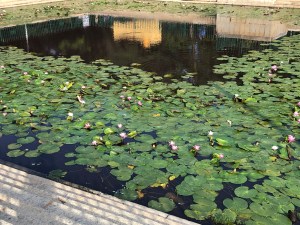
the Spring pond
is teeming with tiny fish;
which will see Summer?

“When I am dead, my dearest” by Christina Rossetti

When I am dead, my dearest,
Sing no sad songs for me;
Plant thou no roses at my head,
Nor shady cypress tree:
Be the green grass above me
With showers and dew drops wet;
And if thou wilt, remember,
And if thou wilt, forget.

I shall not see the shadows,
I shall not feel the rain;
I shall not hear the nightingale
Sing on, as if in pain:
And dreaming through the twilight
That doth not rise nor set,
Haply I may remember,
And haply may forget.

Burning World [Haiku]

bare earth flaming:
fire flickers, leaps, and jiggles,
but never burns out.

The Not-So-Distant Sea [Haiku]

the sea isn't far:
somedays you see its slim band;
others, it blends.

“The Cross of Snow” by Henry Wadsworth Longfellow [w/ Audio]

In the long, sleepless watches of the night,
A gentle face -- the face of one long dead --
Looks at me from the wall, where round its head
The night-lamp casts a halo of pale light.
Here in this room she died; and soul more white
Never through martyrdom of fire was led
To its repose; nor can in books be read
The legend of a life more benedight.
There is a mountain in the distant West
That, sun-defying, in its deep ravines
Displays a cross of snow upon its side.
Such is the cross I wear upon my breast
These eighteen years, through all the changing scenes
And seasons, changeless since the day she died.

Pansies [Haiku]

colorful pansies
catch the morning sun, and
look like peeking faces

BOOK: “Toleration and Other Essays” by Voltaire

A Treatise on Toleration and Other Essays (Great Minds Series)A Treatise on Toleration and Other Essays by Voltaire
My rating: 5 of 5 stars

Project Gutenberg — Free Access

This collection gathers together eight essays and a poem. The theme that interconnects these works is a petition to avoid petty tribalism and irrationality / superstition in the practice of one’s religion. The titular essay, “On Toleration,” sets the collection’s tone, beginning with its detailing of the murder of Jean Calas on religious grounds and its exploration of many more acts of savagery attributable to sectarian forces in alliance with authoritarian governments. The poem, “Poem on the Lisbon Disaster,” echoes the central idea of “Candide” — i.e. the idea that we live in the best of all possible worlds is patently false.

As one would expect of Voltaire, there is plenty of humor and satire throughout these pieces. The arguments are also generally well supported by facts. It is clear that Voltaire possessed a great deal of the knowledge of his day. That said, the reader may well find some factual errors. Most notably, Voltaire tends to attribute a kind of enlightened utopian vision to cultures with which he was likely largely unfamiliar as he builds a case against many within the culture with which he is familiar. This isn’t to say that there isn’t some truth to Eastern traditions being historically more tolerant of other sects than the Abrahamic religions, but the degree to which he extends these idyllic views of those outside of Europe (and the details, thereof) don’t always seem to comport with the historic record.

While some may be inclined to dismiss this book as a collection of anti-religion writings, it is really not anti-belief at all. (Though he does poke holes in many a Biblical myth, so too does he actually provide a deist argument in favor of the existence of a god or gods in the book’s final essay.) Instead, the collection is anti-intolerance, anti-superstition, and anti-authoritarianism. I’d highly recommend this book for all readers. Whatever flaws it may contain are outweighed by the great importance of its message and the cleverness with which Voltaire conveys said message.

View all my reviews

Sonnet 116 by William Shakespeare [w/ Audio]

Let me not to the marriage of true minds
Admit impediments; love is not love
Which alters when it alteration finds,
Or bends with the remover to remove.
O no, it is an ever-fixed mark
That looks on tempests and is never shaken;
It is the star to every wand'ring bark
Whose worth's unknown, although his height be taken.
Love's not time's fool, though rosy lips and cheeks
Within his bending sickle's compass come.
Love alters not with his brief hours and weeks,
But bears it out even to the edge of doom:
If this be error and upon me proved,
I never writ, nor no man ever loved.

Shadow Cat [Haiku]

even by daylight,
the black cat is a shadow --
devoid of depth.

Cherry [Kyōka]

some are made speechless
by falling cherry blossoms,
but -- for others --
speechlessness comes from
a mouthful of the fruits.