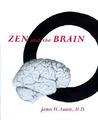
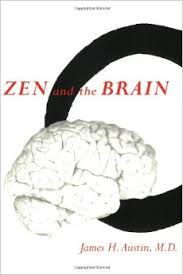
Dr. Austin’s 900-page book looks at what the brain does during (and as a result of) the practice of Zen, and is a great resource for those interested in the science of meditative practices. It’s easy to sum up the strength and weakness of this book. With respect to the book’s greatest strength, it’s that the author—like the book—straddles two widely divergent worlds. He is at once a scientist and a practitioner of Zen. This gives him rare insight into both halves of the equation. This isn’t one of those books written by a spiritual seeker who uses the word “science” and “scientific” very loosely (and in a manner that shows a lack of understanding of the central premise of science.) On the other hand, it’s not one of those books by a scientist who got all of his understanding of meditation from other books.
As for the weakness, it’s that the book was written in the late 1990’s. Ordinarily, I would say that wouldn’t matter much, but concerning our understanding of the brain, it might as well have been the Stone Age—hyperbole duly noted. One doesn’t put together a book of almost 1000 pages overnight, and so much of the references for “Zen and the Brain” are actually from papers from the 1980’s and earlier. The fMRI (functional Magnetic Resonance Imaging) machine didn’t even come out until the early 1990’s, but—of course—it took a while for the studies featuring this powerful technology to reach publication.
The book is arranged into a whopping 158 chapters divided amongst 8 parts. Some of the chapters are pure neuroscience, and there are detailed descriptions of the brain and the functions of its various parts. Other chapters are designed to give one an insight into the practice of Zen and aren’t technical at all. The author has a reasonably engaging writing style when he’s not conveying the minutiae of brain science. He tells stories of his experience as a practitioner of Zen, and passes on the wisdom of past Zen masters.
I have an unconventional recommendation for this book, which I got so much out of. I recommend you first check out the book “Zen-Brain Horizons” put out by the same author and press (MIT Press) in 2014. While I haven’t yet read that book, it seems to hold three advantages. First, it’s only one-third as long and seems to cover similar material. Obviously, it goes into far less detail. (But you may find that a plus.) Second, the 2014 book is reasonably priced. “Zen and the Brain” is one of the most expensive books I’ve bought in recent years. I’m not saying I regret paying as much as I did, because it was a useful book, but cheaper would be better. Finally, the 2014 has the benefit of access to a lot of great research from the past couple decades. If you read the 2014 book and think you need more detail about the brain, then—by all means—get this book.
1.) 10%: As this story goes, we humans only use about 10 percent of our brain’s capacity. This long-debunked myth is so well ensconced that there was a film built around the premise as recently as 2014. That movie, “Lucy”, features a titular character who accidentally ingests an overdose of a drug that allows one to exploit increased levels of one’s mental capacity. Admittedly, by the movie’s end the 10% myth is one of the lesser violations of reality because as Lucy gets closer to 100% of mental capacity all the laws of physics dissolve in her presence.
I’ll give a reference at the bottom of this paragraph from which one can learn about all the evidence of the folly of this belief. I’ll just lay out part of the evolutionary argument. The fundamental rule of the biological world is that mother nature doesn’t over-engineer. Once there is no longer any benefit to be gained in terms of enhanced likelihood of survival, we don’t evolve new and costly capacities. We don’t see people who can run 500 miles per hour or jump 50 feet vertically from a standstill. Those capacities weren’t necessary to survive the beasts that preyed upon us. Our brains are very costly, they consume 20 to 25% of our energy intake. [For the science, see: Beyerstein, Barry L.1999. “Whence Cometh the Myth that We Only Use 10% of our Brains?”. in Mind Myths: Exploring Popular Assumptions About the Mind and Brain. ed. by Sergio Della Sala. Hoboken, NJ: Wiley. pp. 3–24.]
Why does this myth get so much play? There are two likely reasons. One is wishful thinking. We’d all like to think there is much more available to us. And lucid moments of meditation or flow, we may even feel that we have tapped into a vast dormant capability. (In both the aforementioned cases, it’s interesting that the enhanced performance we may experience is a function of parts of the brain shutting down and not increased capacity ramping up.) The other reason is that people see savants of various sorts, but they don’t account for the full picture. There are people who can carry out activities with their brains that seem supernatural. However, it should also be noted that savants who can memorize phone books or tell you the day of the week for a random date hundreds of years ago [or in the future] often suffer corresponding downsides with respect to their brain activity. Of course, there are people who are just geniuses. Geniuses are endowed with more intelligence than most of us. They have a bigger pie; they aren’t just eating a bigger slice.
2.) Left and Right Brained: The myth is that some people use one of the hemispheres of their brain much more than the other, and that this explains why some people are creative and artsy and others are logical and mathematical. We must be careful about the nature of the myth and separating it from reality. The science is NOT saying that there aren’t some people inclined to be “artsy” and some inclined to Spock-like rationality. Clearly, these personality types exist. The science is also not suggesting that there aren’t some functions that are carried out exclusively in one hemisphere–e.g. language is a left brain function. The myth says that predominant use of one hemisphere is the cause of these extremes of personality type. This myth has had–and continues to have–a great following, but it’s not supported by the studies that use the latest brain imaging technology to see exactly where the brain is being active.
For the science, see: Nielsen JA, Zielinski BA, Ferguson MA, Lainhart JE, Anderson JS. 2013. “An Evaluation of the Left-Brain vs. Right-Brain Hypothesis with Resting State Functional Connectivity Magnetic Resonance Imaging.” PLoS ONE. 8(8): e71275.
Why is this a persistent myth? First of all, we all know people who fit neatly into one of the boxes, either “artsy” or “logical.” The left-brained / right-brained explanation is as good a way as any to explain these differences in the absence of evidence. It may have also been a way for people to attribute their weaknesses to an uncontrollable cause (always a popular endeavor among humans.) Secondly, once this idea caught on, a lot of people built the idea into their teachings, businesses, and academic ideas. Yogis used the notion to support ideas about imbalances in the “nadi” (channels.) Psychologists used it in their personality testing and profiles. In short, many people had a vested notion continuing false belief. Thirdly (maybe), there could be something to the issue of how we notice differences versus similarities. (e.g. A person says, “Hey, look Jimi Hendrix is playing a left-handed guitar. Lefties are creative.” The next thing one knows people are disproportionately noticing the left-handed individuals in the arts [and failing to notice the many (more) righties.])
3.) The Conscious Mind Makes All Our Decisions: We all have a conscious mind that we think is our ultimate decision-maker. The evidence, on the other hand, suggest that this is wrong. It turns out that it’s entirely possible for an entity to think it has decision-making authority, when–in fact–it’s finding out about the done deal decisions after the fact. Like the left / right brain myth, this is an idea that was firmly affixed right up until brain imaging technology became sufficiently sophisticated to see what parts of our brain were firing and when. In the wake of such imaging studies, we could see that the subconscious mind does its work first, and this has led to the widespread (though perhaps not consensus view) that decisions are made subconsciously before they filter up to our conscious minds.
There are many sources of information on this idea, but one popular book that is built around the idea is David Eagleman’s “Incognito“, a book that devotes itself to the part of our neural load iceberg that goes on below the waterline (i.e. subconsciously.) Scientists often compare consciousness to the CEO of a large and complex corporation. The CEO doesn’t personally make every decision. Instead, the CEO sets an agenda and the strategy, and–if all goes as planned–the decisions that are made are consistent with those overarching ideas.
It’s easy to see why this myth is persistent. First, if part of a process is buried from view, as subconscious thought has been (and–to a large extent–continues to be) then it’s easy to see how humanity would develop a story that excludes it and fills in from the visible parts. Second, there is immense vested interest in protecting all sorts of views of consciousness that are embedded in religions and quasi-scientific undertakings.
Thirdly, people have a deep-seated need to feel in control, and reducing the role of consciousness to long-term strategist and rationalizer of decisions would seem to make free will illusory. A number of scientists and scholars (e.g. Sam Harris) do argue that free will is an illusion. However, it should be noted that there are others who suggest otherwise (e.g. Daniel Dennett and Michael Gazziniga.) These “compatibilist” scholars aren’t necessarily arguing that the conscious mind is the immediate decision maker in contradiction of the scientific evidence. What they are arguing is that through learning, thinking, and agenda-setting, people can influence the course of future decisions–perhaps imperfectly, as when one eats a sleeve of Oreos after contemplating what one has learned about how that’s not good for you. (This goes back to mother nature not over-engineering. The conscious mind must have some role in facilitating survival or it–being incredibly costly–wouldn’t have evolved. If it can’t influence our path, it can’t enhance or likelihood of survival.)
I’ll attach this video by Alfred Mele that contradicts the notion that free will has been proven an illusion. This isn’t to suggest that I’m convinced Mele is right, but he does lay out the issues nicely and more clearly than most.
4.) The Sleeping Brain Shuts Down: I won’t spend a lot of time on this one because: a.) in a sense it’s a continuation of the consciousness myth (i.e. we lose track of this time as far as our conscious mind goes, and so we think nothing is happening because our conscious experience = what we believe our world to be.) and, b.) it’s not as ingrained a myth as some of the others. Perhaps this is because it began to be debunked with electroencephalogram (EEG) studies which began decades ago–in the 1950’s–well before the functional Magnetic Resonance Imaging (fMRI) that has been providing many of our most recent insights into the brain. (The EEG measures brainwaves and the fMRI blood flow.)
The NIH (National Institutes of Health) offers a quick and clear overview of this science that can be viewed here.
Our bodies go from a very relaxed to completely paralyzed state over the course of a night’s sleep. The paralyzed state occurs with Rapid Eye Movement (REM) sleep and may be an adaptation that kept our ancestors from fleeing out of trees or cliff-side caves during their dreams. If the body is essentially immobile, it’s not a far stretch to imagine the brain is as well. However, the brain is like a refrigerator–always humming in the background (part of the reason it uses between 1/5th to 1/4th of our energy.)
5.) Adults Can’t Generate New Brain Cells: This was the prevailing thought until quite recently. It was believed that one’s endowment of cells–at least as far as the Central Nervous System (CNS) is concerned–didn’t change / replenish once one reached adulthood. It turns out that, at least for the hippocampus, there is now evidence to support the idea of CNS neurogenesis (the production of new nerve cells.)
There’s a Ted Talk by Sandrine Thuret that explains the current state of understanding on this topic, including what activities and behaviors facilitate neurogenesis. (Long-story short: Exercise and certain healthy foods are good, and stress and sleep deprivation are bad.)
What is the basis of this myth? First, one must recognize that the studies don’t show that any and all CNS nerve cells are regenerated. That means there is an element of truth to this myth, or–alternatively stated–a more precise way of stating the idea would produce a statement of the best current understanding of medical science. Of course, telling teenagers that every beer they drink kills 20,000 brain cells irrevocably has probably proved a popular–if ineffective–reason for the continuation of this myth. (Note: at least heavy drinking is definitely damaging to the brain, though by damaging / interfering with dendrites and not by “killing brain cells.” It’s also not believed to be irreversible.)
6.) Emotion and Reason Are Forever at Odds: Most people have had the experience of boiling over with emotion. That is, they’ve experienced instances during which they believed a particular emotion didn’t serve them and they didn’t want to be caught up in it, and yet they couldn’t help themselves. It’s clear that there’s an ability to inhibit or suppress emotions; recent findings have suggest that the neural pathways involved with voluntary suppression are different from those used when one is persuaded to suppress the emotion.
Of course, there’s also evidence that continually suppressing emotion can have a downside. While it remains an unclear correlation, it’s commonly believed that suppression of emotion is related to untimely deaths from certain diseases–e.g. cancer, and there has been some evidence to support this.
Still other evidence supports the notion that there are healthy ways of regulating one’s emotional life rather than the ineffective and counterproductive process of just suppressing emotions. The key may lie in changing one’s way of perceiving events rather than telling oneself to not show emotions. Rather than one’s conscious mind wrestling with the emotion, activities like breath control have shown effective in regulating exposure to stressful situations.
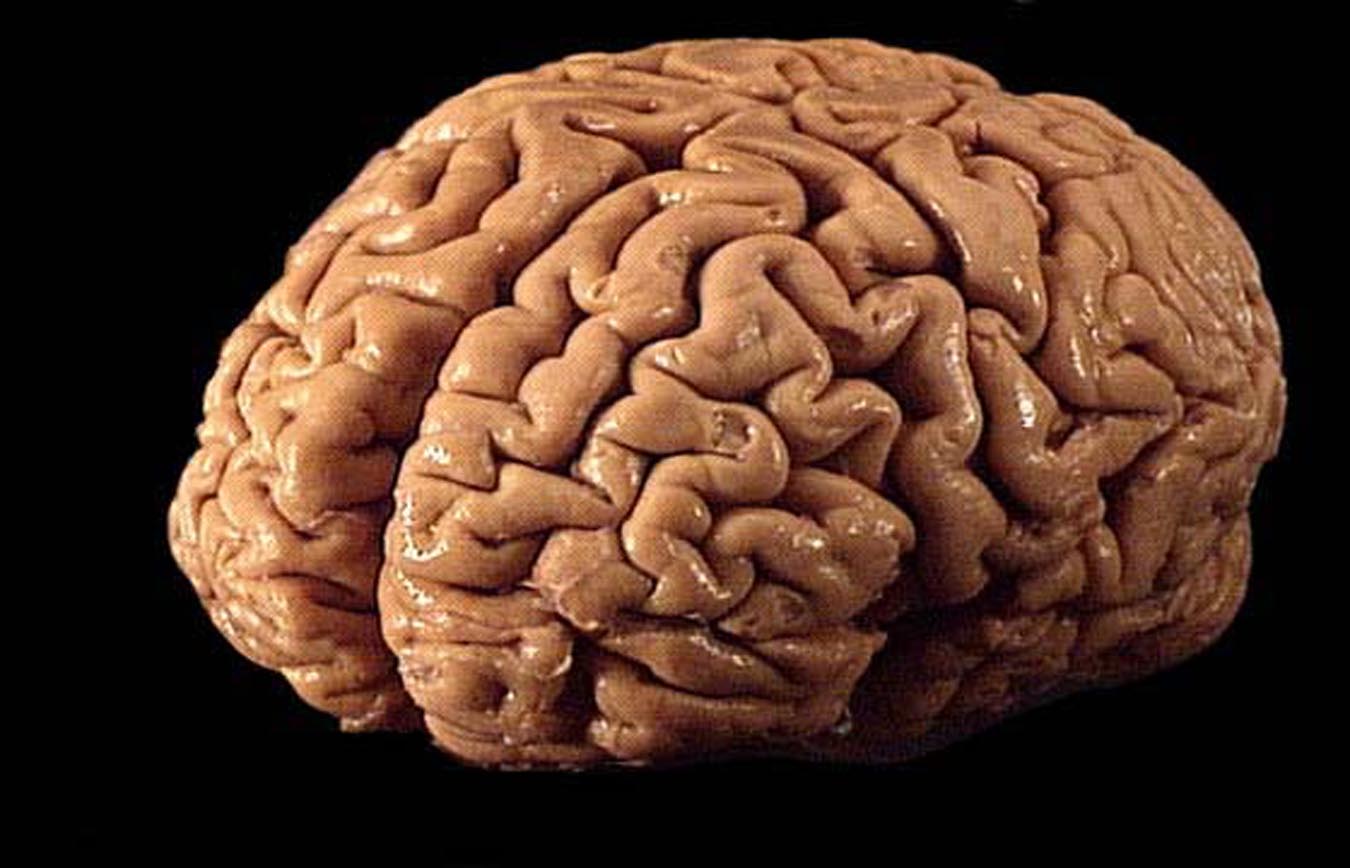
The brain is an organ we all possess, and we intuitively think we’ve got a grasp of it. Yet brain science is one of the scientific disciplines in which we have the most to learn.
Sleights of Mind explains magic tricks by telling one about the shortcuts, limits, and programming of brain (and attendant sensory systems) that facilitate such tricks. The reader needn’t be concerned that the book will spoil all the illusionists’ secrets for one. The authors carefully demarcate the beginnings and endings of spoiler sections that explicitly explain tricks. This allows a reader to skip over such sections if one doesn’t want to know the trick. I suspect few readers do skip the spoiler sections because that’s where the rubber meets the road in terms of the neuroscientific concepts being discussed. The spoiler sections are an attempt to comply with the magician’s code (the neuroscientist authors became magicians themselves) and to maintain a good relationships with the many magicians (some, like Teller or the Amaz!ng Randi, quite famous) who cooperated in the writing of the book.
Over 12 chapters, the authors explain the neuroscience of how various classes of illusion work. Most of the chapters address a specific class or subclass of illusion. The first few chapters deal with visual illusions. We look at the world in what seems like crystal clarity (at least with glasses on or contacts in), but there are many limitations and gaps in our visual processing system. While it seems like we are directly seeing the world around us, in point of fact, our visual experience is a product of the brain reconstructing information that the eyes take in—and it doesn’t do it as perfectly as our brain tricks us into believing. As the authors state it, “The spooky truth is that your brain constructs reality, visual and otherwise.” Chapter 3, deals with illusion in art, which is little outside the theme of the book, but it offers an opportunity to explain some intriguing facts about how the brain and eyes work in concert.
The next couple chapters (Ch. 4 and 5) deal with cognitive illusions. Just like our visual system, our conscious minds save energy by engaging in short-cuts that disguise the mind’s limits while offering the possibility of manipulation. The brain also works hard to reconcile what appear to be inconsistencies, and often this reconciliation leads us astray. Misdirection is discussed in detail. Our minds are primed to let certain actions and sensory inputs draw its attention, and humans are awful at paying attention to more than one input stream at a time. Teller explains that, “Action is motion with a purpose.” So, if one can give one’s movement a purpose (even scratching one’s chin) it will be ignored while movements seemingly without purpose are anomalous and draw attention. The authors introduce the reader to mirror neurons—the part of our brains that take observations of another’s actions and makes forecasts about that person’s intent. This system is highly hackable by magicians.
Chapter 5 informs us that we aren’t as good at multitasking as we think—which is to say we completely stink at it but tend to think we are awesome multi-taskers. The gorilla experiment is offered as a prime example of this situation. In the gorilla experiment, about half-a-dozen people, moving around randomly, pass a ball / balls among themselves. The subject is asked to count the number of passes. In the middle of this activity a man in a gorilla suit walks through the middle of the rapidly moving passers. When asked whether they saw the gorilla, most people say they didn’t (and those who do see the gorilla invariably offer a count of passes that is vastly off the mark.) [If this is either unclear or unbelievable, you can YouTube it.]
Chapter 6 examines multi-sensory illusions. The quintessential example is how our brains lead us believe that the sound of a ventriloquist’s voice is coming from the moving lips of a dummy. (Also, it seems like voices are coming from the lips of actors on-screen in the movies, even though the speakers are probably off to the side in the walls or ceiling.) Synesthesia (cross-wiring between senses and brain such that some people may always see the number 5 in red or hear a C-sharp in green) is introduced to the reader.
Chapter 7 explores the illusions of memory. Just as with our vision and attention, our memories aren’t as indelible as they seem to be. We think we’re calling up a transcription of the events of our lives, but really we’re remembering the last remembrance of said event. This can lead to a migration / distortion of events in the same manner as the kid’s experiment whereby one whispers a phrase into the ear of the kid in the next chair and it traverses the classroom. The original sentence “The cat is on the windowsill” invariably becomes something like “Lenny Kravitz steals puppies from the till.” (Have you ever experienced a situation in which a person remembers the details of an event substantially differently from yourself even if the broad brushstrokes are the same?) Some entertainers use pneumonic tricks to convince audiences that they have supernatural mental abilities when—in fact—they have merely turned understanding of memory to their advantage.
Chapter 8 considers how in-built expectations and assumptions are exploited by magicians and mentalists. Again, these methods work because our brains employ all sorts of energy-saving shortcuts. For example, our brains often do the same thing as Google’s search engine—filling in the blanks by taking advantage of one’s experience to avoid the need for costly cognitive processing.
Chapter 9 explains that our “free choices” are often not so “free” as we think. One of the most disconcerting, yet intriguing, facts to come from the onslaught of brain imaging studies since the 1990’s is that our decisions are made on a subconscious level before our conscious minds are even aware the decision has been made. Prior to this, we’d always been under the misapprehension that we are consciously making all these decisions–big and small–because the conscious mind is just a big credit stealer (to be fair, the conscious mind doesn’t recognize that it’s so out of the loop in decision-making.) So many of our decisions are made in predictable ways by emotional / automated responses, and mentalists use that fact to their advantage.
Chapter 10 is a catchall for topics that didn’t fit into earlier chapters, including hypnosis, superstitions, and the gambler’s fallacy (i.e. the idea that a roulette number that hasn’t come up in a while [or slot machine that hasn’t paid off recently] is bound to pay soon—regardless of the probability distribution that actually rules the outcome.)
The remainder of the book tells the story of the author’s try-out for a magic society and discusses the question of whether knowing the neurological and psychological roots of magic tricks will kill magic as a source of entertainment. I found the latter to be the more interesting discussion. The authors are optimistic about magic’s survival, and offer good reasons. After all, almost nobody believes that magicians are conducting supernatural activities [not even people who take some wildly unsubstantiated beliefs as givens.] Even knowing how the tricks work doesn’t create the ability to see through the tricks because so many of the factors that magicians exploit operate on a subconsciously programmed level, and such proclivities would have to be trained away. People who want to enjoy the spectacle of magic aren’t likely to go to the trouble of training themselves in that way.
I enjoyed this book even though I’m not particularly a fan of magic—though I did find myself watching quite a few YouTube clips of the magicians mentioned in the book. If you’re interested in how one’s mind and sensory systems work, and the limitations of those systems, you’ll find this book worthwhile. If you’re into magic, you’ll like it all the more so.
This is one of those books whose title leaves one unclear as to the book’s nature. The title has religious connotations, but its subtitle, The Practical Neuroscience of Happiness, Love, and Wisdom suggests a secular and rationalist work. The subtitle might clear things up if it weren’t for the fact that there are so many New Agey, spiritualist types who like to glom onto scientific terminology—presumably in an attempt to lend credibility to ideas that are “out there.” Thus, one may reasonably wonder whether this is just another Biomechanics of Chakra Fluffing style book—actually, I made that one up, but if you can see why such a title would be oxymoronic you know where I’m coming from. Without further ado, let me state that this book is rooted in the science of the brain, and, while it uses its fair share of concepts from Eastern religion as pedagogic devices, it doesn’t presuppose need to believe in anything [or anybody] for which there is no evidence. [What remains less clear is whether this book is properly considered self-help or pop science?] This issue with the title may be why Hanson came out with the more secularly-titled Hardwiring Happiness book a few years later that seems to cover similar territory (though, I’ve not yet read the latter.)
The central premise of Buddha’s Brain is that the brain’s neuroplasticity allows one to change the way one experiences life by changing the way one perceives and responds to life’s little trials and tribulations. Over time, one can become happier, more loving, and wiser—i.e. one can have a brain more like the Buddha’s. “Spiritual” matters are always at the periphery of what Hanson is discussing because this type of practice has historically been in the bailiwick of religious traditions—specifically Eastern (and other mystic) traditions that focus on looking inward to be a more virtuous person. However, where said traditions have often relied on assumptions unsupported by current science—such as the existence of a unitary (i.e. universally interconnected) consciousness, Hanson considers the issue from the perspective of our current understanding of the brain. In particular, he focuses on the fact that we are capable of training our brain to respond more positively to events.
Evolution, beautiful and elegant as it may be, has made us pessimistic and prone to disproportionately focus on the negative. This is because survival depended on being ready for worst case scenarios. So we imagine what that worst case is, and endlessly replay scenarios to prepare ourselves for how to deal with said worst cases. While this approach may have enhanced our ancestor’s survival probability, it can easily get out of hand and for far too many people it has. In the book, Hanson proposes three evolutionary strategies (i.e. creating separations [us / them, I / you, etc.], maintaining stability, and threat avoidance / opportunity seizure) that often end up tainting our worldview, raising our stress levels, and causing declining health and well-being. The book does get into the mechanics of stress reduction as well as how to change the way one experiences the world so as to be exposed to less stress.
Rick Hanson is a psychologist who holds a Senior Fellowship at a center at the University of California at Berkeley. He also founded his own center called The Wellspring Institute for Neuroscience and Contemplative Wisdom.
The book is organized into 13 chapters arranged in four parts. The four parts are: I.) The Causes of Suffering, II.) Happiness, III.) Love, and IV.) Wisdom. These parts are preceded by front matter which includes the first chapter which lays out the basics of the brain in layman’s terms as well as discussing the evolutionary survival strategies that sometimes fail to serve us well in modern living. More detailed discussion of the brain is introduced throughout the book at is relevant to the discussion at hand, but the level of this discussion should be approachable to all readers. Each chapter is divided into many subsections to make the reading easily digestible. One of the nice features of this book is that each chapter has a bullet point summary at the end. Actually, the author uses bullet points prominently throughout the book. There is one appendix which explores questions of nutrition for brain health. There is an extensive reference section containing largely scholarly references, as one would expect of a science book.
I mentioned earlier that I wasn’t certain whether to classify this as a self-help or popular science book. In many ways it’s both. It does give a great deal of practical advice about what one can do to change one’s life. On the other hand, it offers more background into the science than your average self-help book—though always at a layman’s level.
I’d recommend this book if you are interested in self-improvement, the science of the mind, or both.
I ran across this little story quoted in an academic paper while I was doing research for a writing project. It was written by Dorothy Gilman in a book called A Nun in the Closet. At any rate, I found it clever and thought you might as well. [I’m assuming that Gilman made this story up, rather than borrowing an old folktale–but that–as with all assumptions–could be wrong. Please feel free to correct me if you know otherwise. If she did come up with it from scratch, she perfectly captured the folktale.]
“Once upon a time, [Bhanjan Singh, a guru-like character in the book] said, when God had finished making the world, he wanted to leave behind Him for man a piece of His own divinity, a spark of His essence, a promise to man of what he could become, with effort. He looked for a place to hide this Godhead because, he explained, what man could find too easily would never be valued by him.
“Then you must hide the Godhead on the highest mountain peak on earth,” said one of His councilors.
God shook His head. “No, for man is an adventuresome creature and he will soon enough learn to climb the highest mountain peaks.”
“Hide it then, O Great One, in the depths of the earth!”
“I think not,” said God, “for man will one day discover that he can dig into the deepest parts of the earth.”
“In the middle of the ocean then, Master?”
God shook His head. “I’ve given man a brain, you see, and one day he’ll learn to build ships and cross the mightiest oceans.”
“Where then, Master?” cried His councilors.
God smiled. “I’ll hide it in the most inaccessible place of all, and the one place that man will never think to look for it. I’ll hide it deep inside of man himself.”
Ikkyū Sōjun was the Howard Stern of Zen masters. Born in 1394, he lived through most of the 15th century. Ikkyū served as a temple’s abbot for less than two weeks before he quit in disgust, vowing to move into a red-light district—apparently he wanted to live among people he found more honest and less hypocritical. The Zen master despised the corruption and snobbery of monastic politics.
Crow with no Mouth is a collection of Ikkyū’s verse, which is largely in the Zen tradition–featuring natural subjects and simple wisdom in a sparse style. Of course, as per my comments in the preceding paragraph, there are a few poems on topics such as cunnilingus and debauchery—so it’s not what one would call a child-friendly collection (unless one enjoys explaining the sexual exploits of a lecherous monk to one’s child.) The more explicit poems may seem like a diversion from the Zen path, but perhaps not. Maybe Ikkyū offered them as a way to train the mind, to observe one’s reaction to shocking commentary as a means of changing one’s way of thinking.
A few of my favorite lines of a more traditional nature include:
-“you can’t make cherry blossoms by tearing off petals to plant; only spring does that”
-“sometimes all I am is dark emptiness; I can’t hide in the sleeves of my own robes”
-“it’s logical: if you’re not going anywhere any road is the right one”
-“the edges of the sword are life and death; no one knows which is which”
-“even in its scabbard my sword sees you”
-“a flower held up twirled between human fingers; a smile barely visible”
-“in war there’s no time to teach or learn Zen; carry a strong stick; bash your attackers”
Here are a few of those jarring lines that I mentioned above:
-“that stone Buddha deserves all the bird shit it gets”
-“all koans just lead you on but not the delicious pussy of the young girls I go down on”
-“ten fussy days running this temple all red tape; look me up if you want o in the bar whorehouse fish market”
-“my dying teacher could not wipe himself; unlike you disciples who use bamboo; I cleaned his lovely ass with my bare hands”
-“don’t hesitate get laid that’s wisdom; sitting around chanting, what crap”
-“who teaches truth? good/bad the wrong way; Crazy Cloud knows the taste of his own shit” [Crazy Cloud was Ikkyū’s name for himself.]
When he left the monastery, Ikkyū shredded the certificate that served as his monastic credential. Some of his students found it, and pieced it back together. That led to the following verse:
-“one of you saved my satori paper I know it piece by piece; you pasted it back together; now watch me burn it once and for all”
Ikkyū’s verse asks us to reevaluate what it means to be sacred or profane. The orthodox view would be that Ikkyū fell from the sacred life of a monk. However, Ikkyū tells us that one can degrade what is important by raising the wrong things to sacred status. Conversely, some of what we believe to be profane is just rooted in habitual and ill-reasoned ways of thinking.
I’d recommend this work for those who love the spare form of Japanese poetry, and who don’t mind a hard jolt to their psyche occasionally.
Welcome to a special–not really–Friday the 13th edition Reading Report. Were I one to plan ahead, I might have read something horrifying for this week, but I’m afraid there’s nothing to inspire dread… well, I don’t really know what your dread threshold is, but unless you have phobias about good posture or classic literature, I think you’re safe.
I bought The New Rules of Posture this week, and spent a lot of my reading time with my nose in it. It’s one of those books that has one periodically getting up to try some movement or postural experiment, but I’m about 2/3rds of the way through nonetheless. It’s written by a dancer turned Rolfer, and offers good insights on the subjects of posture and breathing for those of us who are interested in evaluating and improving such things. The line drawings, many anatomical in nature, are helpful and the readability is high for a such a book. I suspect I’ll finish it in the upcoming week and will have a review up within a couple weeks.
I finished only one book this week, Why Do People Get Ill?I’ve mentioned this book in earlier reports, and will soon be doing a review, so I won’t spend much time on it now. It’s essentially about the roles that stress and the inability to articulate one’s feelings about illness play in catching a disease as well as its progression.
As one can see, I’ve been on a body-mind nexus reading kick lately. I’m trying to educate myself about anatomy, physiology, and related biological sciences as a means to improve the operation of body and mind. In addition to the featured titles above, some of the other books I’ve been reading during the past week include: Zen and the Brain (there was a fascinating chapter on indigenous opioids–i.e. morphine-like substances produced within the body–among this week’s chapters), The Trigger Point Therapy Workbook, and The Sensual Body.
Moving beyond the body / mind books, I did do some reading that wasn’t research related. I’m about 40% through The Painted Word, having read the entries for the letters D, E, and (part of) F. My favorite word from the week was “dromomania” which means an intense passion for travel or wandering. As in, “I, Bernie Gourley, have a bad case of dromomania.”
The short story collection that I’m currently reading (I try not to neglect this medium) is Meeting the Dog Girls. I read about half-a-dozen stories this week (most of them are short, and a few of them–it could be argued–don’t really constitute stories), and I’m about 20% of the way through. Absurdism is a prevailing theme, though in some stories more than others. So far, I’m enjoying this collection. It’s mostly light and easily digestible reading, but has some intense moments.
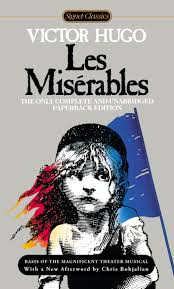
With respect to novels, I slipped away from Mo Yan’s Life and Death are Wearing Me Out, and resumed reading Victor Hugo’s Les Misérables–a book which I started a while back. I’ve got to admit that reading 19th century literature can be a struggle, and–at the risk of offending–Hugo could’ve used a modern-day editor. (I realize that an alternative interpretation is that modern-day people–myself included–could use an attention span.) I’m only about 10% in, but I got through a powerful moment during which the gendarmes bring Jean Valjean before the Bishop. If you’ve read it (or seen one of the movie or theatrical adaptations) you’ll know what I’m talking about.
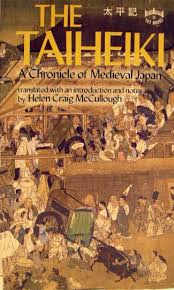
The only other book I spent any significant time was The Taiheiki, and if–like me–you think reading a translation of 19th century French literature can be a challenge, try reading a translation of 14th century Japanese literature. As I’ve mentioned, this book is research for the novel I’m working on. The challenge is the vast cast of characters. It’s a blend of history and fiction, and if you don’t know who was allied with whom during the war between Emperor Go-Daigo and the Hojo, it’s hard to figure out who you should be rooting for–unless it’s talking about the legendary warrior Kusunoki Masashige or one of the few other really well-known samurai. (Kusunoki was the lord of a small and inconsequential province and his name would likely have been lost to history–despite being a brilliant General–had he not become Japan’s national paragon for the virtue of loyalty.)
I was excited to stumble across this book because it proposed fresh insights into the history and development of posture-centric yoga. Singleton’s premise is that yoga as it’s practiced in studios around the world today (i.e. practices focused heavily on asana, or postures) has almost nothing to do with historic yogic traditions and is to a large extent European (or Western) fitness practices fed back to the world with a patina of Indian-ness instilled by a few Indian fitness teachers (e.g. T. Krishnamacharya and students.) This is a bold and stunning hypothesis. The problem is that Singleton leaves plenty of room to doubt his thesis. I’m not saying that I’m certain Singleton is wrong, but after reading the book I’m no more inclined to believe his hypothesis than when I first read the book blurb.
The book consists of nine chapters:
1.) A Brief Overview of Yoga in the Indian Tradition
2.) Fakirs, Yogins, Europeans
3.) Popular Portrayals of the Yogin
4.) India and the International Physical Culture Movement
5.) Modern Indian Physical Culture: Degeneracy and Experimentation
6.) Yoga as Physical Culture I: Strength and Vigor
7.) Yoga as Physical Culture II: Harmonial Gymnastics and Esoteric Dance
8.) The Medium and the Message: Visual Reproduction and the Asana Revival
9.) T. Krishnamacharya and the Mysore Asana Revival
One can see the flow of the book in this chapter listing. It begins by describing the ancient yogic traditions (e.g. Jnana yoga, Bhakti yoga, and Karma yoga.) Singleton then goes on to put immense weight on very few voices that were speaking globally about yoga in the late 19th century—largely European but notably including Swami Vivekananda. (This, by the way, is where I noticed the most glaring weaknesses of the book. There seems to be an assumption that what the most vocal people were saying during this time was the truth, the whole truth, and nothing but the truth.) One will note that the late 19th century is an arbitrary point to make the critical juncture for a study of yoga—this era’s sole importance seems to be in that that’s when Europeans started entering the scene (and documenting it in English and Western languages to a large extent.) I understand that there may have been a dearth of information previously; however, I’m also skeptical of equating the sum of truth with the sum of what is documented.
The book then shifts into the early 20th century when Singleton proposes the proto-postural yoga is beginning to coalesce with both Western and indigenous Indian influences. Singleton writes extensively about this period, and presents what he believes is the path by which postural practice evolved over a short time into modern yoga as we know it. The book ends in the mid-20th century with an extensive discussion of T. Krishnamacharya and his pack of brilliant students (i.e. B.K.S. Iyengar, Pattabhi Jois, T.V.K. Desikachar, and Indira Devi) who are responsible for a lot of how yoga is practiced today (for virtually all of modern yoga by Singleton’s reckoning.)
It should be noted that this book is put out by an academic press, Oxford University Press, and there’s all the front and post matter that one would expect of a scholarly press publication. This includes an introduction, notes, and a bibliography.
So, you might be wondering how I could have so much doubt about the veracity of the book’s central claim—a book written by a Cambridge educated scholar and published by Oxford University Press. It’s, after all, chocked full of facts that are designed to bolster Singleton’s argument. I’m certainly not suggesting that Singleton lied or presented false facts (however, I have–and will further–argue that he frames facts throughout the book to diminish those statements and facts that run counter to his argument while wholeheartedly accepting statements that validate his argument—even when the people whose statements he leaves unchallenged would seem to have their own agendas. I don’t know, perhaps T. Krishnamacharya was—as Singleton intimates though never explicitly accuses—lying when he claimed to have received his sequence and approach from a scripture he was taught by a Himalayan master. However, interestingly, he would be lying to minimize his role in the development of yoga rather than to increase his fame. This stands in contrast with the European authors who Singleton readily accepts who were seeking to build their bona fides as experts in the esoteric systems of India and the Himalaya, who arguably had a lot to gain from being seen as having a full understanding of these systems.)
The best way to understand the root of my skepticism is to tell a make-believe story. Imagine a race of aliens came down to Earth. For whatever reason, they want to understand (presumably among many other things) the Roman Catholic Church. One astute alien scholar notes that, after having reviewed not only the entire Bible but a vast canon of theologian discourse, there is scant mention of sitting or kneeling. However, when cameras came around, there came to be clear evidence of pews and kneelers in the church. The aliens conclude that Catholics had always stood during worship, but with the advent of the camera they began to sit and kneel. The aliens, having big and bulbous butts, conclude that the Catholics have become concerned that their own big, bulbous butts will be captured for posterity (pun intended) by the cameras and have, thus, opted to adopt postures that would more adequately provide cover. In the present day, sitting and kneeling are the bulk of what Catholics do with their bodies when [overtly] practicing their religion, and so it must be those postures–rather than abstract notions like achieving “grace” are now the most critical part of the practice. (Besides, the earliest photos of kneelers came from Protestant churches, so perhaps Anglicans taught Catholics how to kneel.)
If you haven’t figured it out, in my little scenario, the late 19th century Europeans who were writing the English language tracts that formed the heart of Singleton’s research material are the aliens with big, bulbous butts. I would propose that the Europeans aren’t viewing yoga completely objectively but through the lens of their own experience and desires. Furthermore, they are also only giving weight to what they see and hear (which may or may not be a full picture.) I would further argue that just like Catholics don’t devote much text to discussing sitting and kneeling in the documents of the Vatican library doesn’t mean there isn’t a long history of those practices. Postural practice is:
a.) not the critical end result that everyone is concerned with even if it takes up the bulk of one’s time in [overt] practice. It’s certainly true that there are a vast number of yoga practitioners whose only interest is in the fitness aspect of the practice. However, there are also many who spend most of their yoga reading time learning from Vedas and reading yogic philosophy even though the bulk of their practice time is asana.
b.) extremely difficult to convey via text but readily conveyed through demonstration and hands-on teaching. If you were a Catholic and wanted to teach someone kneeling, would you write them a three paragraph text description of the process, or would you just demonstrate how to kneel and correct any glaring (albeit unlikely) deficiencies in form.
At no point does Singleton get into the postural details of individual asana. He mentions another scholar that supposedly has done some of that work, but Singleton feels it’s not critical. However, it’s very hard to prove what he’s trying to prove without getting into that level of detail. Yes, there will be similarities between various systems of stretching because of the nature of the body. For example, European stretching systems had a forward bend that looks reminiscent of paschimottanasana (the body folds that way and stretching the hamstrings is one of the most important functions in any stretching regimen), and it shouldn’t be surprising or revealing if the first photograph of this posture was in a European gym (the fact that Scandinavians had cameras before Himalayan yogis isn’t a sound basis to conclude that Himalayan yogi’s learned to bend forward from Scandinavians.) A there are a lot of postures that two systems might reasonably independently discover, but one also can’t rule out that the Indian yogi taught the Europeans and not the other way around. (I know it’s hard to comprehend in the era of FaceBook, but failure to be documented does not equal failure to be true. The farther one goes into the past, the less of what happened is going to be documented, and some cultures are going to be more likely to document events than others. e.g. Would our aliens be right or wrong if they concluded that 85% of humans are females between the age of 12 and 24 years old because 85% of the selfies posted on the internet are among that group. )
Singleton’s book does have some graphics. They didn’t always help his case, however. I was struck by how few of the fine details of the European postures correspond to practice as we know them, while some of the very old paintings look almost exactly like present day asana. (If one accepts that the fact that they didn’t have the greatest grasp of capturing perspective back then isn’t indicative of how flat the postures and people were back then.) I’ll readily admit that I wouldn’t definitively count Singleton wrong on my subjective observation of the pictures, but it does leave me with a lot of room for doubt.
I suppose the next question is why I didn’t completely pan the book. Three stars isn’t a tragic rating. I thought the book contained a lot of good information and food for thought (even if it fell far short of proving its central hypothesis.) I particularly enjoyed the chapter on T. Krishnamacharya and his now-famous student body. I’ll also say that part of why I came away from the book with such a muddled perception of this history is that Singleton doesn’t hide facts that are damning to his case, but rather presents them and then tries to marginalize them. A prime example would be the Hatha Yoga Pridipika (HYP), a 15th century text that mentions a number of the asana considered classic yoga postures today (some of which form the core of a Hata practice)—though admittedly HYP emphasizes the importance of only four seated postures.
I can’t say that Singleton didn’t help give me pause to wonder about the truth of the received understanding of yoga’s evolution. I’ve practiced yoga in places as varied as India, the U.S., Thailand, and Hungary, and I found it shocking how similar the practice is around the world. This bodes well for the argument that yoga as it’s practiced today has coalesced recently. By way of contrast, there are many myths about how one martial art is the ancestor of another but the two systems often look nothing alike. (e.g. I’ve studied Kalaripayattu, which many believe was the ancestor art taken to China by Bodhidharma through Southeast Asia, but which today looks nothing like Kung fu or Muay Thai. Furthermore, Kung fu styles usually look quite unlike the Korean and Japanese martial arts that they are said to have inspired.) If the latter among these martial arts did come from the earlier, they evolved apart quickly. While the evolution into different martial art forms is quite possible, it raises the question of why yoga should be so similar internationally. A skilled yoga teacher would likely give a given student the same alignment adjustments for, say, Warrior I, regardless of whether the teacher was in Prague, Manila, Tokyo, or San Diego.
I can’t say that I’d endorse Singleton’s argument. It would take much more precise information for me to buy it (and it’s likely that said detailed historical information doesn’t exist.) However, if you’re interested in the history of yoga, you might want to check out this book. Your conclusions may differ from mine, but even if they don’t I suspect you’ll learn a thing or two of interest. Yoga Body was reasonably priced as a Kindle book when I bought it.
For the purposes of this post, wisdom is neither a collection of trite adages, nor is it an accumulation of arcane or esoteric scripture. Wisdom is:
1.) the ability to quiet the mind
2.) the ability to suppress inclinations to be petty in a healthy way
3.) the ability to override instinct with conscious thought when it’s beneficial to do so
4.) the ability to know when it’s beneficial to do so (see #3)
5.) mastery of (rather than being mastered by) one’s emotions
The objective of these activities is to increase happiness, reduce strife, and exercise better and healthier decision-making.
While these are secular objectives, the pursuit of this form of wisdom has to a large extent become entwined with certain breeds of religion or spiritualism. Mystical religious traditions are the style of spiritualism that are most commonly associated with these pursuits. (Here I use mysticism in its scholarly sense, i.e. traditions that believe in a god or gods and who believe that the space in they can interact with said god is to be found inwardly. This is as opposed to the ill-defined colloquial meaning of mysticism that has a negative connotation and is infused with judgement about hippy-dippiness.) One sees the pursuit of this form of wisdom in yogic philosophy, in most branches of Buddhism, in Taoism, etc.
I’m not sure why this connection should be so entrenched. Why should agnostics and atheists forfeit the pursuit of such forms of personal improvement? Maybe the scientifically-minded think that they are knowledgeable and knowledge is wisdom, and so they think they are already on the path. I can tell you that knowledge isn’t wisdom. I base this on the experience of knowing intellectually brilliant people who couldn’t get along with anyone, who perpetually said the wrong things, and whose personal lives were a wreck. Skeptics and geeks are as subject to strained relationships, stress, and unhappiness as their pious neighbors.
Another possible explanation is that many scientifically-minded people just don’t think that such goals are achievable because the routes to them have too often been couched in supernatural terms. However, there’s a growing literature on how these objectives can be pursued that is rooted in neuroscience and neuroplasticity, and for which the presence or absence of a deity is irrelevant. I’ve been reading a book called Zen and the Brain lately that offers an understanding of the effects of meditation that is firmly rooted in the science of the brain. I also recently purchased a book entitled Buddha’s Brain that takes a look at how neuroplasticity allows for a “rewiring” the brain to a healthier state. (Yes, I realize the irony of citing two books that have religious references in their titles in this post. I’d argue that this is how inexorably tangled these pursuits have become with religion. However, both of the scientist/authors of the aforementioned books, James H. Austin and Rick Hanson, have books with more secular titles if you’d prefer.)
I was once eating in a university cafeteria when I heard a religious man make the argument to a fellow he was trying to “educate” that went like this: “If there’s not a God, why should I be nice to my wife–why shouldn’t I kick the hell out of my dog?” My first thought was that this man desperately needed therapy. If the only reason he wasn’t being a violent asshole is because he feared the wrath of an invisible, omnipotent entity who–by they way–would have to be showing a complete indifference to what people do to each other in real-time, then he’s an accident waiting to happen. If he either: a.) loses his fear of said deity, or b.) begins to think that the deity is telling him to go another way (since whatever the deity is “telling” him is almost certainly just his mind telling him), then his wife and dog are in great peril.
My second thought was, “this is the cafeteria in an institution for higher learning, how’d this guy get in without at least the rudimentary training in logic to imagine a basis of moral behavior that’s not rooted in the supernatural smiting ability of a deity [who–I might add–sees a helluva lot of smite-worthy activity on a daily basis.]”
If you’re considering an action that seems questionable, you don’t need to ask what Jesus would do? You can start by asking the question: Would my life (or those of my loved ones) be adversely impacted by living in a world in which everybody did what I’m about to do in the manner I intend to do it? (Implied is the idea that, if the action in question involves doing something to someone, you would be subject to being on the receiving end of same action sooner or later.) If the answer is “yes,” don’t do it. If the answer is “no” there still may be reasons not to do the activity that have to do with what is good for you personally. (We’ll get into that a little further down.)
I realize that the above standard isn’t perfect, but it’s far less subject to user error than WWJD and it explains why the fellow from above shouldn’t beat his wife or his dog unless he likes rigorous and regular beatings himself. Some people might say that they don’t think they or their loved one’s would be adversely in the slightest if everyone went about walking around naked. Others might believe that they would be stressed out (or overstimulated) in such a world. However, the above approach has already gotten us to the fringe of questionable activity. Yes, some people might be traumatized if their neighbors walked around in the nude. But I suspect if everybody did it (as per the question) it would become not weird (definitely not harmful) in short order. There are those people who are so fragile that they can’t sleep knowing that a couple engaging in intercourse in privacy of a room three doors down are probably not using a missionary-approved posture. Said people need the kind of wisdom I’m talking about more than any because part of it is accepting that there may be more in heaven and earth than is dreamt of in their philosophy. Now that we know how to kill stray asteroids, if humanity ever dies out it will be at the hands of people who can’t bear anyone living by rules not those that they took for themselves.
At any rate, I think there are two reasons why the above approach is difficult for homo religiosis (religious human.) First, there are many activities that homo religiosis wants to see universally abolished because their religion considers forbidden, but which don’t adversely impact others. (e.g. Jains are pretty easy-come-easy-go, but imagine you were told you’d have to forgo onions because of that religion’s moral belief that no food should come from a plant that’s killed by harvesting. [FYI: Let me laugh now at the religious people who say “but there’s nothing crazy like that in my religion?” That just means you are so untraveled and uneducated that you can’t fathom how completely wacky some of your “moral” beliefs / practices are. e.g. How about eating salmon on Fridays as a sacrifice in lieu of eating a hamburger? That’s just nutty on all sorts of levels.])
Second, many believers really do believe that they have a special place in god’s heart and, therefore, aren’t subject to the same limitations as those poor, god unloved people. The idea that said person shouldn’t commit rape because they wouldn’t like it if someone else raped them or their sister or their mother is non-sense, because their god would never let someone else get away with shit like that with them. (Yes, there are people who’ve lived sheltered enough lives to believe that god punishes others but–at most–“tries” them.)
Most of us must accept that when it comes to being a person, we are the same as all the other people. While one may be stronger, faster, smarter, or in some dimension more talented than others, this doesn’t endow one with a different set of rights and responsibilities. On a genetic level there are no chosen people.
Earlier I mentioned that the “if everyone else did it” standard might leave one on the horns of a dilemma as to how to behave or what decision to make. Here’s where we’ve got to use our brains because the hard and fast rules go out the window. Evolution has programmed us with some guidelines that were beneficial given the constraints of the world our ancestors lived in. However, this programming of pleasure and pain may or may not be great advice given the ways in which humans have changed our own world.
Let me give some examples. Our nervous system suggests we eat foods that are sweet and fatty. We crave chocolate and bacon, and pleasure centers in the brain light up when we consume these foods. In our hunter / gatherer existence, this was excellent guidance because a.) these foods were relatively rare, b.) these foods had dense caloric content, c.) sweet foods are less likely to be poison, and d.) we worked our asses off in physical labor (i.e. high caloric demands.) However, today these high caloric foods are mass-produced, we require almost no caloric expenditure to obtain them (or to do most anything else in our cubicle-dwelling work lives), and in some cases people are literally (I don’t use “literally” lightly) killing themselves with such foods. So part of the wisdom I’m talking about is developing the capacity to exercise conscious control over decisions about whether to eat such foods, how much of such foods to consume, and what activities to do to counter act the flood of empty calories. Our biology is a harsh mistress, and it can require intense efforts to keep such impulses under control.
We are also programmed with love, a trait which has served us well over all. I know some of you are cringing about the idea of “evolutionarily programmed love”–so unromantic. It’s simple. Those who could build connections with others disproportionately survived to pass their genes on. This further fed into our species’ rise because, while we think of ourselves as the planet’s dominant species, we produce the most vulnerable 1 year olds (or 8 year olds for that matter) of any species on the planet. A human three-year-old is good for two things–learning and food. It takes a lot of love to make sure its the former and not the latter. An extremely intense experience of love is essential to our species’ ability to not just wander off and let our pain-in-the-ass children get eaten. This gives us plenty of time to teach kids more than just how to elude a saber-tooth tiger. We have time to teach kids language, social niceties, and trigonometry.
We can, therefore, use our gigantic brains to noodle out whether a given action is best for us, in addition to whether it does no harm to those around us. The complexity of our brains allows us to rewrite our rule book in unprecedented ways. Some of the religious “morality” that seems vacuous (e.g. don’t eat shellfish, but feel free to own as many people as you can afford) probably had a logic in that time (e.g. people were getting sick from eating shellfish because they didn’t yet know how to prepare it.) The problem is that one has to be ready to jettison obsolete advice, and that’s hard to do once it’s entrenched as dogma. This is where being Homo sapiens, the thinking human, comes into play.
This is one book in a large series of books put out by the Oxford University Press. All of these “Very Short Introduction” books are brief summaries of the state of research on a given topic in the arts, sciences, or humanities. Based on this book, I’d say the series is geared toward a readership of educated non-specialists. I say “educated” because the book did get into some technical areas, and while it doesn’t presume any particular knowledge of the science of sleep, it does use a scientific vocabulary with occasional academic sentences (i.e. packed with precise detail and lacking concern about readability.) That said, I’d say the readability is higher than the journal articles from which the information for the book was drawn. I suspect I’ll read more from this series. They are cheap on Kindle, provide a concise injection of the basics for a wide range of topics, and are pleasantly readable if you’re used to reading academic literature.
This particular book is about sleep. While, on average, sleep takes up one-third of a person’s life, it’s a subject that is often taken for granted. Like water, one doesn’t really think about it until one isn’t getting enough. However, as the book discusses in detail, all sorts of problems are associated with sleep deprivation, insomnia, and parasomnias (i.e. sleep events like sleepwalking, night terrors, nightmares, bedwetting, sleep-eating, and groaning.)
The book is written in nine chapters covering: the history of sleep, sleep generation and regulation, a brain on sleep, reasons we sleep, variation in sleep throughout one’s life-cycle, the nature of poor sleep, the connection between sleep and health, and the effect of our shift to a round-the-clock society.
There are a number of fascinating questions addressed by this book including:
1.)What does sleep do for us?
2.)Have people always tended to sleep eight hours per night?
3.)Why are some people morning people and others night owls?
4.)Why does one feel drowsy after lunch, but not necessarily when it’s time to hit the sack?
5.)How long can one go without sleep?
6.)Do all animals sleep?
7.)How do sleep and hibernation differ?
8.)Why do teenagers and the elderly have such odd (but different) sleep habits?
9.)Why do people sleepwalk, sleep-eat, groan in their sleep, or have night terrors?
10.)What is the effect of long-term insomnia on health?
11.) What happens to sleep if one has no rising and setting sun cues?
12.)What is jetlag and how can one fight it?
I learned some interesting facts, such as:
1.) On average, women report more insomnia, but, paradoxically, tend to sleep better than men.
2.) Pre-industrial people slept for about 10 hours a night on average, it’s believed.
3.) Many parasomnias occur mostly during REM (Rapid Eye Movement) sleep.
4.)The government can deprive prisoners of sleep for 7.5 days without it being considered torture (then they have to allow a full 8 hours sleep before another 7.5 day period started.)
5.) Long-term insomnia has been linked to heart-disease.
6.)Shift workers have a 50% greater incidence of breast and prostate cancer than day-workers.
7.)Visiting teams win 46% of the time if they are in their home time zone, 44% if they are traveling ‘with their body clock,’ and only 37% if they are traveling against their body clock.
I found this book interesting and informative. However, there are many books on the subjects of sleep and dreams that are more catered to a popular audience. Such books delve into intriguing cases and don’t dig as deeply into the minutiae of the science of the subject. I’d recommend this book, but not for readers who get bogged down or bored with scientific and technical discussions. If you’re looking for a book that’s loaded with pithy facts and fascinating stories, you can find a book closer to the mark by journalists who focus on science writing and who’ve got more flare for creative writing.

 Zen and the Brain by James H. Austin











 Tiger Riding for Beginners