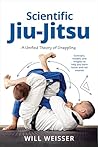
 Scientific Jiu-Jitsu: A Unified Theory of Grappling by Will Weisser
My rating: 4 of 5 stars
Publisher Site – YMAA Publication Center
Release date: June 2, 2026
This book outlines principles of positioning, alignment, and movement used to gain advantage while grappling. It is not a technique-centric book but rather is a concept-centric one. Weisser does for Brazilian Jiu-jitsu what Jiichi Watanabe and Lindy Avakian did for Judo with their book alternatively titled The Secrets of Judo or The Art and Science of Judo. Watanabe and Avakian focused more on both technique and elementary physics than does Weisser, but there is common ground in ideas of what positions make a body strong and what movements bring vulnerability. The biggest area of divergence between Watanabe’s book and Weisser’s is simply the difference between Judo and Brazilian Jiu-jitsu. Watanabe and Avakian direct the vast majority of their attention to how one gets the opponent to the ground and relatively little on what to do when one gets there, and Weisser’s book is the other way around — i.e. primarily assuming at least one person is already on the ground.
Weisser’s book does assume that the reader has a background in Brazilian Jiu-jitsu, using terms specific to that system without necessarily providing elaboration. I say this just to point it out as (to be fair) I realized that I would have thought nothing of it if it used Japanese Jujutsu / Judo terminology in the same way. (I did have to go to Google at one point to elucidate what turned out to be a Dragonball-Z reference that went right over my head.)
Weisser’s book uses a combination of graphics, including photographs. I found it easier to see the linkage between what the author was describing in the text and what was in the photos in some cases than in others. Often, there was a single photo catching one static situation, and if the grapplers were closely entangled (as grapplers are want to be,) it was not so easy to see — even with different colored uniforms. [Note: I should point out that I was reading an ARC galley, and so that may all be sorted in the final formatting.]
As one who knows little of Brazilian Jiu-jitsu, but with some experience with other grappling systems, I found this book readable and thought-provoking. The statement of ideas is clear, and I’d recommend it for grapplers looking to engage in thinking about first principles of grappling.
View all my reviews