Five Wise Lines from Chōmei’s Hōjōki

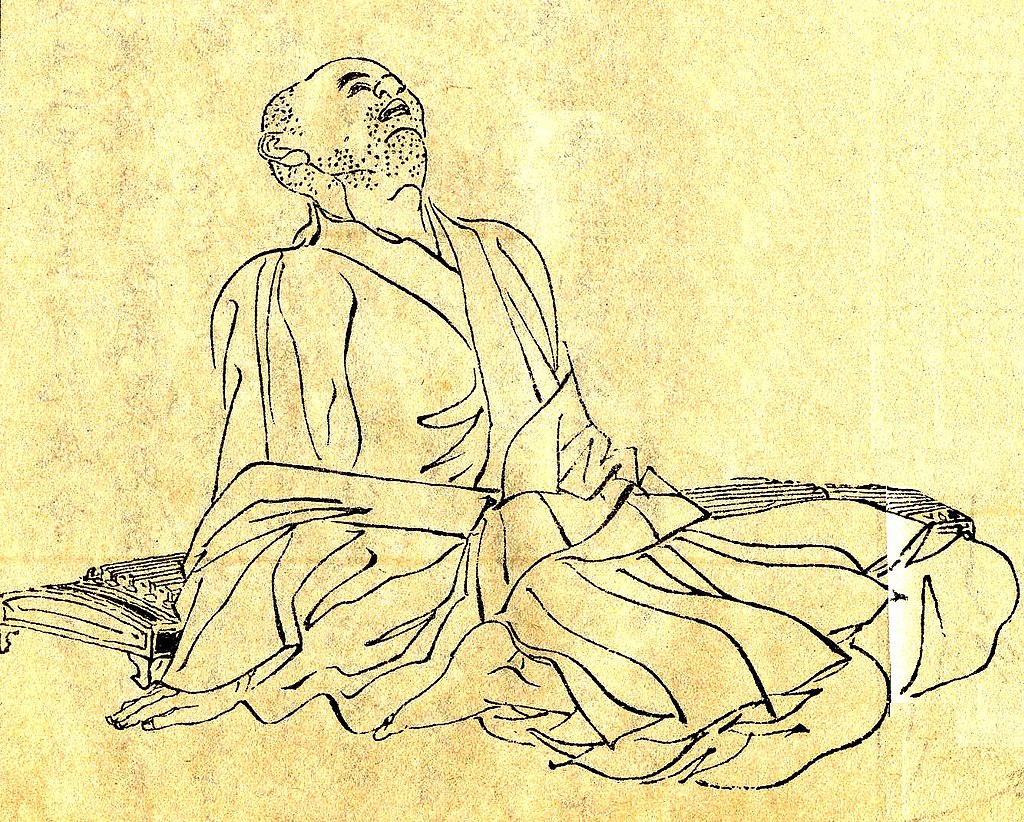
drawing by Kikuchi Yōsai

On flows the river ceaselessly, nor does its water ever stay the same.

 Kamo no Chōmei, Hōjōki

No one owns a splendid view, so nothing prevents the heart’s delight in it.

Kamo no Chōmei, Hōjōki

Knowing what the world holds and its ways, I desire nothing from it, nor chase after its prizes. My one craving is to be at peace; my one pleasure is to live free from troubles.

Kamo no Chōmei, Hōjōki

These days, I divide myself into two uses — these hands are my servants, these feet my transport.

Kamo no Chōmei, Hōjōki

When I chance to go down to the capital, I am ashamed of my lowly beggar status, but once back here again I pity those who chase after the sordid rewards of the world.

Kamo no Chōmei, Hōjōki

Reference: Saigyō Hōshi, Kamo no Chōmei, Yoshida Kenkō. 2021. Three Japanese Buddhist Monks. New York: Penguin Books. 112pp.

Available Here

Ikkyū’s Poetry: The John Steven’s Wild Ways Selection / Translation

Wild Ways: Zen Poems of IkkyuWild Ways: Zen Poems of Ikkyu by Ikkyu
My rating: 5 of 5 stars

This is the John Stevens selection and translation of poetry from Ikkyū’s Crazy Cloud Anthology. Ikkyū was what might be called a mad sage of the Rinzai sect of Zen Buddhism. He once showed up at a temple in his vagabond rags and was turned away, when he came back the next day in the ceremonial robes that revealed him as a preeminent monk and was subsequently treated like royalty, he took the robes off and told the abbot that it was apparently the robes that were honored and deserving of a meal. Ikkyū was known not only for his rejection of dogmatic and highfalutin approaches to Buddhism, but also for his love of sex, brothels, meat eating, and poetry. Much of the poetry touches on those two subjects (disdain for dogma and pretension and love of pleasure,) though there are also poems that explore nature and the kind of imagery one might be more likely to expect in Japanese poetry.

Ikkyū mostly wrote in quatrains, using a Chinese style of verse. Though Ikkyū was no more dogmatic about following poetic protocols than he was following monastic precepts, and often went with the flow.

I read the Stephen Berg translation, Crow with No Mouth several years ago. I would put this one on par with that one. There are actually several translated selections from the Crazy Cloud Anthology poems that are available. If you are interested in Ikkyū’s poetry, this is as good a place to start as any. It should be noted that while some of the poetry is around sexuality, it’s not particularly graphic but more suggestive.

View all my reviews

Of Samurai & Cats: Issai Chozan’s Neko no Myōjutsu

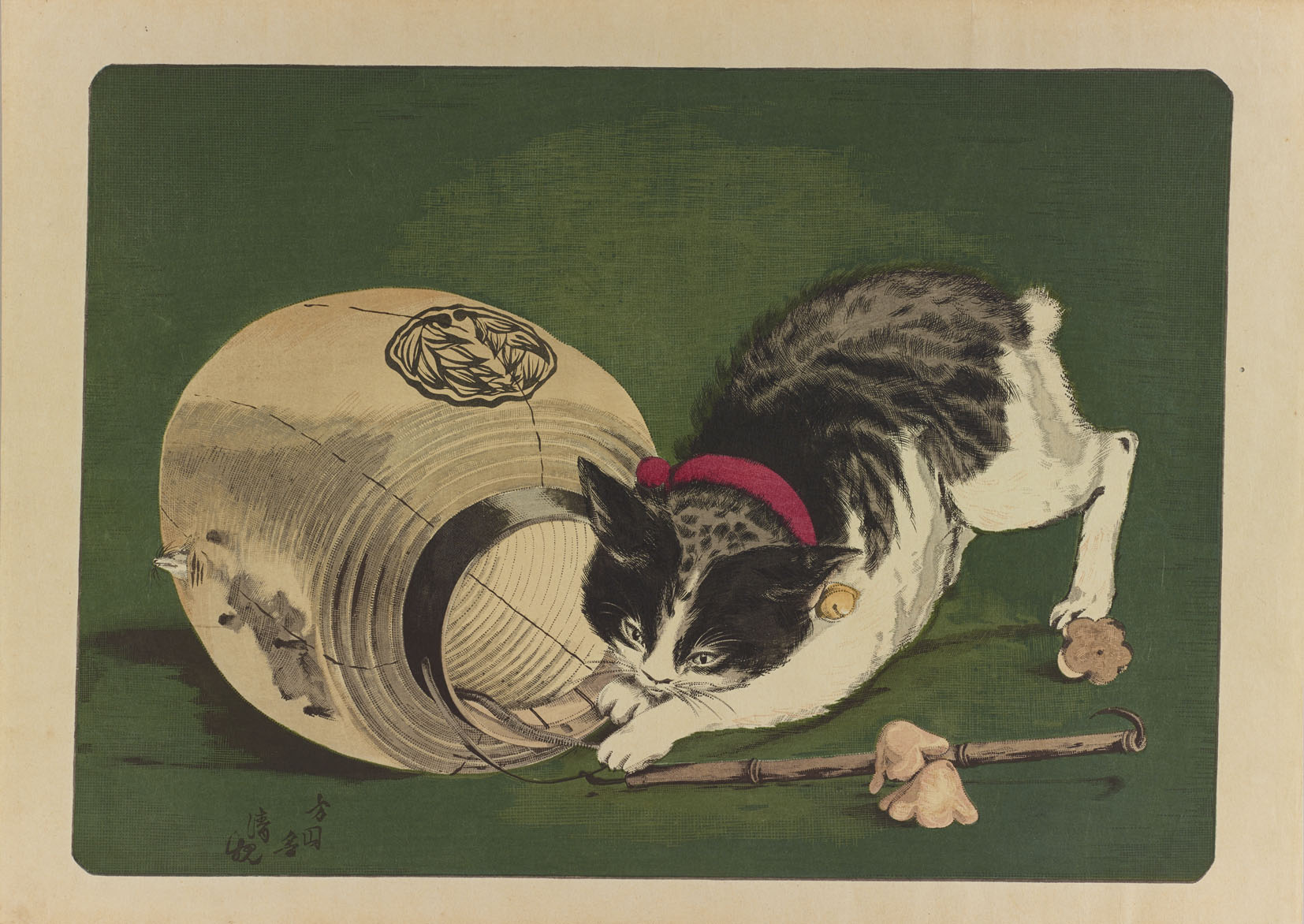
Cat & Lantern (1877) by Kiyochika Kobayashi

BACKGROUND: Issai Chozan’s Neko no Myōjutsu (“Eerie skills of the Cat”) was published in the book Inaka Sōji in 1727. It’s an example of dangibon, a light-hearted form of instructional short story, a form for which Issai Chozan is said to have been one of the originators. On the surface a story of rat-catching cats, in reality it’s a lesson in strategy and philosophy of combat.

SYNOPSIS: I’ll include citations and links below, so you can read the story in its entirety, should you choose to do so. But for now, a brief synopsis: A samurai, Shoken, has a rat in his house, and it’s driving him crazy. Shoken’s housecat is terrorized by the rat. The samurai brings in the best rat-catching cats from the neighborhood, and each is soundly defeated by the rat. Shoken decides to take matters into his own hands, chasing after the rat with a wooden sword (bokken,) but the rat evades each attempted strike and, ultimately, bites the samurai on the face. Finally, Shoken brings in a legendary elder cat from across the city, a cat who doesn’t look like much, but who effortlessly evicts the rat from Shoken’s house. The balance of the story is a conversation between the successful old cat and three of the skillful younger cats who’d failed to catch the rat (as well as with Shoken.) Each of the three explains its approach to achieving victory, and in turn the master cat explains the limitations of each one’s approach. The old master goes on to explain how when he was younger, he’d met a tomcat who slept all day, and yet no rat would come within miles of it. He asked how the tomcat achieved this, but the tomcat was unable to explain it.

THE LESSON: The first cat, a young black cat, explained that it was a master of technique. The black cat was agile and strong in movement of all kinds and practiced diligently to streamline and perfect all of its techniques. The old cat pointed out that focus on technique still left the black cat with too active a mind, thinking too much about how it would defeat its opponent. The master went on to say that there is value in technique, but it can’t be allowed to be the extent of one’s abilities. He emphasized that one’s clever actions must be in accord with the Way.

The second cat, a tabby, proudly proclaimed that all of its effort went into building its energy or spirit (ki, also called chi,) and that it could defeat most rats with a gaze (though not the one in question.) The old master explained that spirit is a fine thing but being too conscious of it hurt the second cat’s ability. The master went on to say that one can never be sure that the opponent won’t have more spirit than one, and so complete reliance on ki can lead one to a defeat.

The third cat, a gray one, said that its philosophy relied on yielding and never forcing a fight. The old master explained that this was a misunderstanding of the principle of harmony, and that this kind of yielding was a man-made contrivance that was not in accord with nature and often led to muddiness of the mind. While the old cat goes on to say that none of these elements (technique, ki energy, or yielding) is without value, it’s clear as he continues that the answer isn’t as simple as being a combination of them, but rather requires a completely new way of being, of experiencing and perceiving the world.

To Shoken, the old cat explained the importance of not thinking of swordsmanship as a means to defeat an enemy but, rather, a means of understanding life and death. The old cat went on to discuss mushin (i.e. “no mind,”) a serene state of mind that allows one to be flexible to whatever comes along. The old cat emphasized the importance of eliminating distinctions of object and subject through a process of self-realization and explained that the process of seeing into one’s being one can trigger satori (sudden enlightenment.)

CITATIONS:

Matheson Trust for Comparative Religion translation, available online at: https://terebess.hu/zen/neko.pdf

Ozawa, Hiroshi. 2005. The Cat’s Eerie Skill. Essence of Training in Japanese Culture: Technique Acquirement and Secret of Kendo. Online at: https://tenproxy.typepad.jp/recent_engagement/files/essence_of_training_in_japanese_culturee.pdf

Suzuki, D.T. 1959. The Swordsman and the Cat. Zen and Japanese Culture. New York: Pantheon Books. pp. 428-435

Wilson, William Scott. 2006. The Mysterious Technique of the Cat. The Demon’s Sermon on the Martial Arts. Tokyo: Kodansha International

BOOK REVIEW: A Beginner’s Guide to Japanese Haiku Translated by William Scott Wilson

A Beginner's Guide to Japanese Haiku: Major Works by Japan's Best-Loved Poets - From Basho and Issa to Ryokan and Santoka, with Works by Six Women Poets (Free Online Audio)A Beginner’s Guide to Japanese Haiku: Major Works by Japan’s Best-Loved Poets – From Basho and Issa to Ryokan and Santoka, with Works by Six Women Poets by William Scott Wilson
My rating: 5 of 5 stars

Amazon.in Page

Release Date: March 28, 2023

This is a delightful, nicely arranged, and well-translated anthology of haiku. A couple things should be clarified off the bat, given the book’s title (particularly for haiku neophytes.) First of all, “Japanese Haiku” may sound redundant, but the point is that this collection is entirely haiku translated from the work of Japanese poets – historic and modern. There’s been a huge international production of haiku for quite a while, and even national sub-styles such as American Haiku, but this anthology includes none of that.

Secondly, one needn’t put too much stock in the “beginner’s” wording of the title. I understand their point. If you’ve done a lot of haiku reading, you will see quite a few familiar poems, and there are none of the related forms (e.g. tanka, kyoka, renga, haibun, etc.) However, with respect to the first point, the beauty of good poetry is that one can re-read it and get something new out of it each time, and this is especially true if it’s a different translation, which allows one to both take in something of the translator’s perspective as one applies one’s own. Furthermore, this book has many fine features that will particular benefit experienced and analytical haiku readers. For one, it has the original poem both in Japanese characters as well as Romanized phonetic Japanese. (The latter makes it easy to see how the poet worked sound and syllabic arrangement.) There’re also brief biographies for all the poets, which is both useful for knowing what informed their craft, but also interesting in that a surprising number of these haiku poets lived colorful lives.

There are three sections to the book that work in the direction of increasing levels of obscurity. It begins with the big four of haiku (Bashō, Shiki, Buson, and Issa.) Then there’s a section with a large number of notable, but not Bashō-level poets. Finally, there are lesser-known poets, many of whom were quite prolific and had unique takes on the form. The latter two sections include poets that span from the contemporaries of Bashō to twentieth century poets.

If you enjoy haiku, I’d highly recommend this collection. I learned more about suspensive form in haiku and the varying styles of free verse haiku poets in Japan just through careful reading.


View all my reviews

BOOK REVIEW: The Spirit of Japanese Poetry by Yoné Noguchi

The Spirit of Japanese PoetryThe Spirit of Japanese Poetry by Yoné Noguchi
My rating: 5 of 5 stars

Amazon.in Page

Free Online at Wikisource

This book-length essay, originally published in 1914, discusses the unique style and aesthetic of Japanese poetry. It’s written for an audience of English language readers and advances its objective not only by presenting illuminating translations of Japanese poetry, but also by comparing Japanese poetry to English language poetry.

Noguchi takes a no-holds-barred approach to literary criticism that is both the strength and weakness of the book, sometimes it feels as though the author’s boldness is granting deep insight into the subject, but other times it reads as though the author is tribally narrow-minded and curmudgeonly. By “tribally narrow-minded,” I mean that he takes the view that the Japanese aesthetic and approach to art is always and in everyway superior to non-Japanese art (in this case, English language poetry.) Interestingly, he frequently compliments specific artists, e.g. Walt Whitman, but doesn’t have anything nice to say about English language poetry in general. By “curmudgeonly,” I mean that he takes the popular — if biased –view that the world is going to shit, and – in the section on modern poetry – it is only after discussing how the art has fallen on hard times that he can discuss a few modern poets who’ve produced some poems worthy of adoration [and some worthy examples of the modern form (Shintaishi.)]

One might think this bigoted view would cripple his book (as bigoted views usually do,) but because what he’s promising is depth of insight into the Japanese poetic aesthetic, he is able to succeed just fine. [Also, to be fair, being highly opinionated and pretentious were hallmarks of critics of his era – just usually not so nationalistically.] Noguchi does a great job of selecting evocative examples, providing powerful translations, and illuminating the Japanese mindset as it pertains to art and poetry.

If you’re interested in Japanese poetry and the psychology that influences Japanese artistic tastes, this short book is highly recommended. [Just be prepared to be offended if you aren’t a hardcore Japanophile.]


View all my reviews

BOOK REVIEW: Monkey: New Writing from Japan: Vol. 2: Travel ed. Ted Goosen & Motoyuki Shibata

MONKEY New Writing from Japan: Volume 2: TRAVELMONKEY New Writing from Japan: Volume 2: TRAVEL by Ted Goossen
My rating: 5 of 5 stars

Amazon.in Page

Out: December 28, 2021

This anthology of travel-themed short writings by prominent Japanese authors includes: short stories, essays, poems, excerpts from longer works, and even an illustrated story [i.e. “The Overcoat” by Satoshi Kitamura.] The nature and degree of travel varies considerably with some pieces being travelogues or setting-centric fiction, but other pieces explore travel in a more symbolic sense (e.g. “Hell” by Kikuko Tsumura or “Decline of the Aliens” by Hideo Furukawa.] And one piece, “Cardboard Boxes and Their Uses” by Taki Monma deals more with the topic of being shut in, so it might be considered a study in travel through its absence.

The anthology includes works by literary stars such as Mieko Kawakami, Haruki Murakami, and Yasunari Kawabata, and showcases translation by some of the most well-know translators of Japanese literature. [The edition ends with a dozen brief statements by translators about what they have found particularly daunting to translate — not necessarily because the literal translation is difficult but because the elegance of the origin language can be lost to clunkiness in the translated language.]

Among my favorite pieces were “The Dugong” (a historical fiction story with a “Journey to the West” feel to it,) Haruki Murakami’s essay entitled “Jogging in Southern Europe” (which anyone who’s ever exercised amid people who don’t exercise will find amusing,) “Five Modern Poets on Travel” [particularly the tanka of Kanoko Okamoto and the haiku of both Hisago Sugita and Dakotsu Iida,] and “Every Reading, Every Sound, Every Sight” by Jun’ichi Konuma. That said, I don’t think there was a clunker in the bunch, each piece was well-composed and translated, and I’d highly recommend reading this book.


View all my reviews

BOOK REVIEW: The Three-Cornered World by Natsume Sōseki

The Three-Cornered WorldThe Three-Cornered World by Natsume Sōseki
My rating: 5 of 5 stars

Amazon.in Page

This novel was originally entitled Kusamakura or “Grass Pillow,” and it’s the Alan Turney translation that bears the title The Three-Cornered World. Turney drew from a concept that Natsume presents in the book – i.e. that an artist lives in the triangle created by the collapse of a corner called common sense. It’s a poetic and philosophical novel that is very much character-centric. In other words, if you must have an intriguing story, this book is not so much for you. However, if you find ideas and clever use of language appealing, you’ll love it.

The premise is that an artist takes retreat in the mountain countryside, and becomes infatuated with a local woman with a storied past. As the book tells us of the artist’s experience, it discusses aesthetics, the philosophy of art, and the place of emotion in artistic experience. This book is often compared to Bashō’s travelogue (i.e. Narrow Road to the Deep North) as it involves a great deal of elegant imagery and the occasional interspersed poem.

While the book is light on story, I was wowed by the author’s thought process and his use of language. While I’ve never read the original in Japanese, Turney’s translation is beautiful writing in its own right and I suspect it captures the sparse beauty for which Natsume’s work is famed. It is definitely worth reading.

View all my reviews

BOOK REVIEW: The Penguin Book of Japanese Short Stories ed. by Jay Rubin

The Penguin Book of Japanese Short StoriesThe Penguin Book of Japanese Short Stories by Jay Rubin
My rating: 5 of 5 stars

Amazon page


This book contains 35 short stories by many of the most prominent Japanese writers (at least among authors whose works are translated into English,) including: Jun’ichiro Tanizaki, Natsume Soseki, Yukio Mishima, Banana Yoshimoto, Yoko Ogawa, Akutagawa Ryunosuke, and Haruki Murakami (who contributes the book’s Introduction as well as two stories.)

The stories are arranged into seven sections that are apropos for modern Japanese literature: “Japan and the West” (3 stories,) “Loyal Warriors” (2 stories,) “Men and Women” (6 stories,) “Nature and Memory” (5 stories), “Modern Life and Other Nonsense” (5 stories,) “Dread” (3 stories,) and “Disasters, Natural and Man-made” (11 stories.) This organization scheme, which might seem random applied to most literature, offers some insight into the Japanese mind and experience.

“Japan and the West” reflects a Japan in the vanguard among non-Western nations entering into developed nation status. For a time, Japan sat in the unique situation of being the only rich nation that wasn’t majority Caucasian, and the uneasy balancing act that many Japanese felt is reflected in these three stories. “Loyal Warriors” reflects the long shadow of the feudal samurai era, and – in particular – the custom of ritual suicide. It’s true that “Men and Women” has a certain universality to it, though the individual stories speak to the Japanese experience and history. The section entitled “Nature and Memory” is really more about the latter than the former, and the stories all reflect a concern about remembering, forgetting, and the imperfection of memory. “Modern Life and Other Nonsense” explores the modern corporate existence. “Dread” are the horror stories, a genre that has a lengthy history in Japan. “Disasters, Natural and Man-Made” reflects Japan’s experience with many devastating earthquakes and two atomic bombs.

In the interest of brevity, I’ll not describe or comment upon all the stories. Instead, I’ll pick out a few that I found particularly moving. This doesn’t mean that there aren’t many gems among the others. But my intention is merely to give the reader a taste of what is in this volume.

– “The Story of Tomode and Matsunaga” by Tanizaki Jun’ichiro: A writer receives a letter from a woman whose husband has a history of pulling extended disappearing acts. She asks for the writer’s help because she believes he may know her husband. The writer makes a connection to an acquaintance he has frequently socialized with in bars. The writer notices the man’s appearance in town seems to line up with the dates the woman gave for her husband’s disappearances. It might seem like a mystery solved, but the two men look nothing alike.

– “Patriotism” by Yukio Mishima: A junior military officer comes home and tells his wife that he has been put in the untenable position of having to arrest his comrades. Deciding that there is no honorable path, he decides to commit seppuku (ritual suicide,) and – given societal norms – this means his wife, too, will be expected to end her own life.

– “Smile of the Mountain Witch” by Ohba Minako: A mythical mountain witch is transposed into a modern urban setting.

– “Peaches” by Abe Akira: A man revisits a memory from his youth involving his mother and a cart of peaches, realizing that events couldn’t have happened as he remembers, he reconstructs events as he re-imagines his story.

– “Mr. English” by Keita Genji: We meet an office worker who seems like a bit of a jerk, but as we get to know his story, he is humanized.

– “Hell Screen” by Akutagawa Ryunosuke: A prima donna artist painting a hellish artwork for his Lord insists that he must have seen scenes to accurately depict them, and thus he is drawn into the hellishness of his work.

– “Filling Up with Sugar” by Suwanishi Yuten: A woman’s mother has a rare and incurable disease in which the body slowly turns into sugar.

– “Hiroshima, City of Doom” by Ota Yoko: As the title suggests, this is a story of the devastation of Hiroshima by atomic bomb at the end of the Second World War.

– “Weather-Watching Hill” Saeki Kazumi: This description of the 2011 earthquake and tsunami reads a bit like a journalistic account.

– “Same as Always” by Sato Yuya: This is a chilling tale of a mother who uses the release of radiation as a result of the Fukushima Dai-Ichi nuclear plant melt-down as a pretext for murdering her baby in a way that won’t look like murder. It’s so wrong in so many ways, but extremely evocative.

I enjoyed this collection immensely. The stories are great, and I would highly recommend it for readers of short fiction – particularly if one enjoys the cultural insight that comes from reading translated literature.

View all my reviews