FIVE WISE LINES [December 2025]

William Blake painting of Urizen praying to the world he created, an illustration from "Song of Los."
William Blake:
Urizen prays to the world he created (1795)
Song of Los

I must create a system
or be enslaved by another man’s…

william blake; Jerusalem: The emanation of the great albion

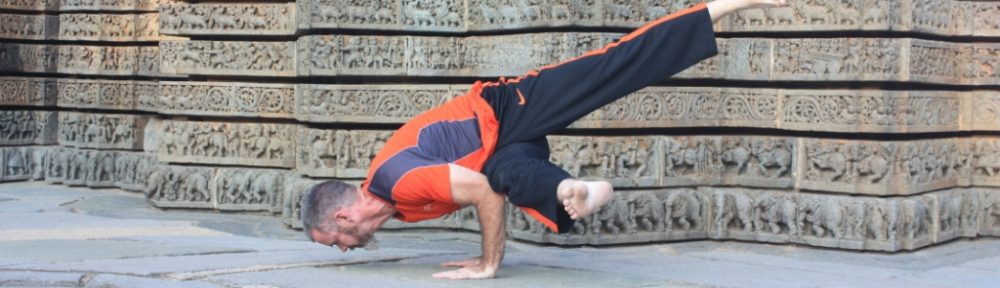
Saying Yoga exists to make one more flexible
is like saying that it exists to wring farts out of one’s body,
both will happen — neither is the primary objective.

Me

He that is without sin among you,
let him first cast a stone at her…

JESUS; John 8:7

The best government is that which governs least.

Henry david thoreau, Civil Disobedience

Gods always behave like the people who make them…

zora neale hurston; Tell my horse

“Bad Government” by Guan Xiu [贯休] [w/ Audio]

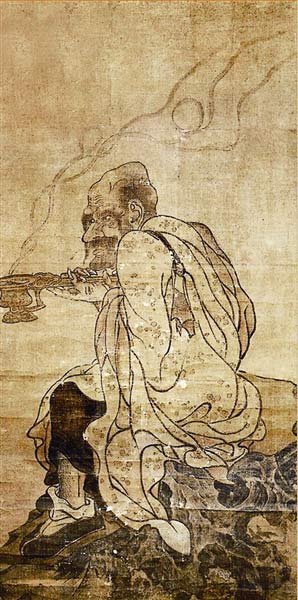
“Venerable Ingatha” by Guan Xiu [One of his 16 Arahat paintings]
Sleet and rain, as if the pot were boiling.
Winds whack like the crack of an axe.
An old man, an old man,
At sunset, crept into my hut.
He sighed. He sighed as if to himself,
"These rulers, so cruel. Why, tell me
Why they must steal till we starve,
Then slice the skin from our bones?

For a song from some beauty,
They'll go back on sworn words;
For a song from some tart,
They'll tear down our huts;
For a sweet song or two,
They'll slaughter ten thousand like me,
Like you. Weep as you will,
Let your hair turn white,
Let your whole clan go hungry...
No good wind will blow,
No gentle breeze
Begin again.

Lord Locust Plague and Baron Bandit Bug,
One east, one west, one north, one south.
We're surrounded.

NOTE: This the J.P. Seaton translation found in The Poetry of Zen (2004); Shambhala Publications: Boston, MA, pp. 67-68. For the author’s name, Seaton uses “Kuan Hsiu,” the Wade-Giles romanization of the name.

PROMPT: Excited

Daily writing prompt
What are you most excited about for the future?

I think humanity has a golden age coming. Unfortunately, a.) as John Maynard Keynes pointed out, “In the long run, we are all dead.” Accordingly, I don’t expect I’ll live to see that great age. And, b.) said great age is likely to come on the backend of a tragic period whose reach and devastation will make the Second World War seem like a puny and short-lived regional skirmish by comparison. [I also think there’s a good chance I’ll miss the worst of this, but there’s no accounting for the rapidity at which it might move (and the process has begun.)]

The root of this combination of relative near-term pessimism and long-run optimism is the observation that we are experiencing a technological revolution that there is no reason to believe won’t end in machines that are both smarter and more capable than we, and we have no plan for what to do in that scenario. We have no conception of what an economy looks like in which machines do everything faster, more cheaply, and more efficiently than human labor. I wouldn’t be so pessimistic if our institutions and legal frameworks were trending better and better, but — in fact — after years of spreading rule of law and democracy, we are starting to see global shrinkage and a rise of a strange populist authoritarianism that I can only imagine being catastrophic under the stress test that is to come.

Why the long-term optimism? Nothing lasts forever, and tough times breed tough and capable people. [Whereas comfort addiction is a major factor in our near-term predicament.] I think the Golden Age will be humans learning not to be defined by production / consumption but by developing the human body and mind to its utmost capacity.

A lot of people are worried about population collapse. I am not so worried about that. I think that: a.) humanity could use some thinning; b.) we do fine with long time scale threats. As pressures rise, the adjustments start and — perhaps with some growing pains — we’ll get where we need to be. The AI / Machine Learning revolution concerns me because I suspect it will happen too quickly to steer the ship (like being in an aircraft carrier as a tsunami comes, there’s no agility to navigate out of the way and no speed to outrun it, you just have to take the damage and try to recover.)

You were probably looking for an answer like flying cars, but I gave up on those long ago.

PROMPT: Harmony

Daily writing prompt
What could you let go of, for the sake of harmony?
My wonkish need to analyze the train wreck that is our present state of governance and social discourse.

PROMPT: Future

What are you most worried about for the future?

A global rise in governance by populist authoritarians in which people give up abstract conceptual benefits like checks and balances and rule of law in exchange for the more tangible bread and circuses.

I’m not so concerned about the demographic crises because I think those long-scale issues work themselves out, just as when Malthus predicted the human population was growing too fast and global famine was inevitable.

I’m also not so worried about [G]AI because if we make machines that can crush us, we deserve to be crushed to make way for the new. That said, I think we are at the beginning of a crisis of modernity that will reach its apex when machines can do all productive tasks better than can humans. But, I’m pretty sure I’ll outrun that, and by choosing to focus on the art of being human, it’s not so impactful, personally.

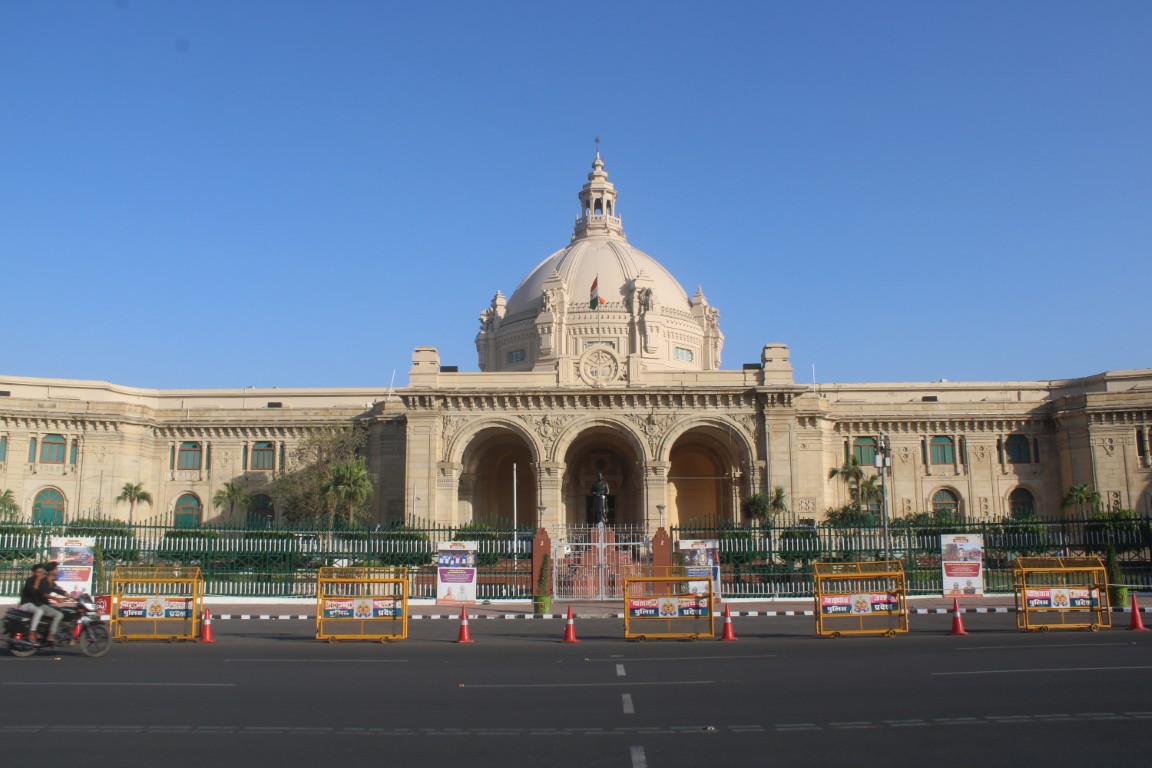
DAILY PHOTO: Uttar Pradesh Legislative Assembly

Image

PROMPT: Power

Daily writing prompt
If you had the power to change one law, what would it be and why?

That no individual would have the power to unilaterally change any law.

Because if we all had the power to change one law it would be chaos, like in “Bruce Almighty.”

FIVE WISE LINES [November 2024]

Inspiration enters at the border between hard work and laziness.

Lu juren in “Poets’ jade splinters” [Trans. by Barnstone and Ping in The ART Of Writing]

I will not own anything that will one day be a valuable antique.

Miyamoto musashi in “My way of walking alone” [Dokkōdō] (Trans. by Teruo machida)

A house full of gold and jade can’t be guarded.

Laozi in the DAo De jing [Ch. 9]

Writing is a struggle between presence and absence.

Lu ji in The ART of Writing [Trans. by Barnstone and ping]

The best leaders remain unknown; the next best are praised; the next best are feared, and the worst are mocked.

Laozi in dAo de Jing [Ch.17]

BOOKS: “Translation: A Very Short Introduction” by Matthew Reynolds

Translation: A Very Short Introduction (Very Short Introductions)Translation: A Very Short Introduction by Matthew Reynolds
My rating: 5 of 5 stars

Publisher’s Site

Language translation is one of those tasks that people take for granted is a straightforward endeavor — especially in the current era in which computers are starting to do a decent job of it. It turns out that translation isn’t at all straightforward, and a number of tradeoffs must be addressed through the act of translating — e.g. should one try to convey the original author’s meaning as closely as possible or should one make the writing as approachable and comprehensible to the readership as possible? This might seem like a false dichotomy, but because languages never map perfectly to each other and reflect differing worldviews, there is always some degree of trade-off necessary.

Reynolds addresses not only cases from literature, but also shows the role that translation (and mistranslation) can play in the legal, political, and business domains as well. I found this book to be interesting and useful in providing food-for-thought on the subject. It is particularly illuminating in its discussion of how translation is changing in an era of AI, and how profound an effect this will have on our future. (e.g. People worry about the death of languages with small followings, but if automated translation becomes cheap and ubiquitous, will the pressure to focus one’s efforts on one of the world’s major languages remain?)

If you are interested in issues of language translation, this is a fine book with which to begin one’s exploration.

View all my reviews

PROMPT: Elections

Do you vote in political elections?

Not as religiously as I did in my youth. Counter to the general trend of younger people hollering and protesting but not showing up to the polls, and thus not influencing change because politicians are cued into to the older crowd that tends to show up hell or high water.