BOOKS: A Double-Barreled Detective Story by Mark Twain

A Double Barrelled Detective StoryA Double Barrelled Detective Story by Mark Twain
My rating: 5 of 5 stars

Amazon.in Page

This novella is Mark Twain’s satirical jab at the whole Sherlock Holmes concept. In particular, it pokes fun at a detective who eschews everything supernatural in favor of cold rationality, but who produces results so impossible that they are themselves supernatural.

The story has two temporally disjointed parts that almost seem like independent stories until the very end when all is tied up. (Holmes only appears in the second part.) This works nicely for parody of Holmesian detective fiction as it’s an approach that was used by Sir Arthur Conan Doyle on occasion — e.g. in A Study in Scarlet. The first part tells the tale of a woman who is treated foully by Jacob Fuller, the husband she eloped with but who harbored resentment towards her father, a man Fuller believed felt wasn’t good enough for his daughter. The woman makes her son, named Archy Stillman, promise that he will track down Fuller and make the man’s life a living hell.

The second part revolves around a murder that seems to be independent of the case described above, the killing of a man named Flint Buckner. Here Sherlock Holmes, who happens to be in town visiting his nephew – Fetlock Jones, “solves” the case only to be shown to be entirely and humiliatingly wrong by Archy Stillman using only a superior sense of smell and basic observation of the facts (with no elaborated inductions.)

While I never had anything against the Sherlock Holmes stories — in fact, I enjoyed them all — I did find Twain’s satire amusing and compelling as a story. [And it’s true that Arthur Conan Doyle did regularly strain credulity — that’s what made Holmes an intriguing character.]

Well worth reading.

View all my reviews

BOOKS: Hadaka-Jime by Moshé Feldenkrais

Hadaka-Jime: The Core Technique for Practical Unarmed CombatHadaka-Jime: The Core Technique for Practical Unarmed Combat by Moshé Feldenkrais
My rating: 5 of 5 stars

Amazon.in Page

This is an interesting little book. I’m not sure how much stock I put in its utility, but the idea of it intrigues me. That idea is a system of self-defense built around a single technique, in this case hadaka-jime — i.e. the rear naked choke. (For non-martial artists, the “naked” is based on the fact that it works with or without a gi [coat] — i.e. it doesn’t require gripping the lapels or other cloth as many chokes in jiu-jitsu do. So, get your mind out of the gutter.) When I say “a single technique,” I’m talking about that technique being applied against a variety of unarmed, knife, and bayonet attacks — hence this being a book-length endeavor. Another way of looking at this central idea is an attempt to maximize muscle memory building efforts — i.e. by having a less extensive body of techniques one can more heavily drill a few basics rather than an elaborate set of complicated moves. As Bruce Lee said, “I fear not the man who has practiced 10,000 kicks once, but I fear the man who has practiced one kick 10,000 times.”

I should point out that the version of hadaka-jime that Feldenkrais uses isn’t the one that I was taught, and I suspect that will be true for most readers. If you learned to have the crook of the choking arm in line with the opponent’s windpipe and have that arm’s hand tucked into the crook of the opposite hand (forming a triangular choke,) then Feldenkrais’s variation will seem strange. Feldenkrais’s variation seems to be both more brutal (because it drives the bone of the forearm against the windpipe) and more vulnerable (because one’s hands aren’t as well tucked in and the structure isn’t as self-reinforcing as the triangular variant, which is quite difficult to contend with even for a recipient who is much stronger.) All that being said, one could easily apply the same set ups for the more popular variant, one just has to move a little deeper.

As I say, I have mixed feelings about this single technique approach. On the one hand, one can see successes like Ronda Rousey had while using juji-gatame (a cross-body ground-based armbar) repeatedly. On the other hand, everyone had to suspect the days of that success were numbered as other fighters knew exactly for what they needed to prepare.

It’s a short and simple book, the chapters arranged by types of attack. It has adequate pictures to get across what Feldenkrais is trying to convey. Those interested in martial arts and self-defense may want to check it out.

View all my reviews

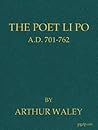
BOOKS: The Poet Li Po AD 701-762 Trans. & Ed. by Arthur Waley

The Poet Li Po       A.D. 701-762The Poet Li Po A.D. 701-762 by Arthur Waley
My rating: 5 of 5 stars

Available online at: Project Gutenberg – The Poet Li Po

Li Po, also Romanized “Li Bai,” is one of China’s most famous poets, the prolific Tang Dynasty poet wrote extensively at the nexus of intoxication and the beauty of the natural world. His well-loved and evocative poem, “Drinking Alone by Moonlight,” is a prime example [and is included in this selection.]

The selection consists of a small number of translations by [20th-century Orientalist] Arthur Waley. It’s only 20-some of the 1,000-ish extant poems of Li Bai, but it does offer variety in form and subject matter. It doesn’t include all of Li Bai’s most anthologized poems, which I consider a plus — i.e. Waley didn’t just assemble a greatest hits album.

The Waley translations aren’t as sparse as many that one will read. That offers the advantage of being clearer in meaning while losing some of the feel of the original. That said, I enjoyed this group of translations and didn’t feel they were too verbose – for the most part. It’s a selection well worth reading for those who enjoy poetry.

View all my reviews

BOOKS: The Creative Act by Rick Rubin

The Creative Act: A Way of BeingThe Creative Act: A Way of Being by Rick Rubin
My rating: 5 of 5 stars

Amazon.in Page

This book offers Rick Rubin’s philosophy of creativity and art. For those unfamiliar with Rubin, he’s a ZZ Top-looking music producer who contributed to a lot of successful albums, ranging from hip hop to the rock-n-roll of Tom Petty. He was a major player behind the Run DMC cover of Aerosmith’s “Walk This Way” that blew peoples’ minds in the 80’s. Interestingly, Rubin is neither a musician nor a technologist, and I heard him say in an interview that his great value-added was having an extremely high level of confidence in knowing what he liked. Rubin has a persona that is as much guru as music producer, and this book reflects this broad insight and wisdom.

In the book, Rubin lays out his view of the creative process and the mistakes people make with it, but along the way he offers insight into such interesting questions as why some artists only seem to have one major work in them. While Rubin’s experience is mostly with music (though he also worked with comedian Andrew Dice Clay on Clay’s albums,) his book is broadly targeted towards all artists, and he seems to use as many examples from literature and graphic arts as he does from music.

Rubin does sound a bit woo woo here and there, but I found that many statements — e.g. those that spoke of the universe’s role in artistry — could be interpreted in a way that wasn’t necessarily superstitious. While woo woo sounding statements often get on my nerves, I felt Rubin’s use was poetic and spoke to a broader truth.

I’d highly recommend this book for artists and creative types, regardless of field.

View all my reviews

Five Wise Lines from Fireflies by Rabindranath Tagore

In the drowsy dark caves of the mind / dreams build their nest with fragments / dropped from day’s caravan.

From the solemn gloom of the temple / children run out to sit in the dust, / God watches them play / and forgets the priest.

The wind tries to take the flame by storm / only to blow it out.

The same sun is newly born in new lands / in a ring of endless dawns.

When death comes and whispers to me, / “Thy days are ended.” / let me say to him, “I have lived in love / and not in mere time.” / He will ask, “Will thy songs remain?” / I shall say, “I know not, but this I know / that often when I sang I found my eternity.

Fireflies by Rabindranath Tagore is in the public domain and can be read at sites such as:

Fireflies is available at PoetryVerse

BOOKS: Kingdom of Fear by Hunter S. Thompson

Kingdom of Fear: Loathsome Secrets of a Star-crossed Child in the Final Days of the American CenturyKingdom of Fear: Loathsome Secrets of a Star-crossed Child in the Final Days of the American Century by Hunter S Thompson
My rating: 5 of 5 stars

Amazon.in Page

Kingdom of Fear is part memoir and part commentary on the state of America at the turn of the millennium. As a memoir, it explores Thompson’s bid for Sheriff, his arrest and judicial proceedings for drug and explosives charges that resulted from a “he said / she said” accusation that did not warrant charges in and of itself, a wild and wooly road-trip through Nevada, and Thompson’s position at the center of an investigation of a “threat” on the life of actor, Jack Nicholson.

As a commentary on the decline of America it discusses the battle for Grenada, a trip to Cuba, 9-11 and its aftermath, and the book revisits the ’68 Democratic Convention. It’s all written in Thompson’s drug-fueled Gonzo style, making it incredibly entertaining to read even as the hard walls between fact and fiction seem to dissolve. While the factualness might be at times in question, there is always a kind of truth that can only be received from those who’ve tossed off the shackles of societal convention and are willing to tell it as it is — even the embarrassing bits (especially the embarrassing bits.)

It’s not for those who take life and authority figures too seriously, but otherwise it’s a tremendously compelling and sometimes hilarious in its depiction of pre- and post-Y2K America.

View all my reviews

BOOK REVIEW: Wrath of the Dragon by John Little

Wrath of the Dragon: The Real Fights of Bruce LeeWrath of the Dragon: The Real Fights of Bruce Lee by John Little
My rating: 5 of 5 stars

Amazon.in Page

Release Date: September 5, 2023

There are many Bruce Lee biographies out there, from general bios (such as Matthew Polly’s Bruce Lee: A Life) to those that are much more narrowly focused (e.g. Rick Wing’s Showdown in Oakland about Lee’s fight with Wong Jack Man.) This book is somewhere in between in that it is theme-focused (Lee’s fights and matches,) but it does offer insights from Lee’s childhood through to his death as they pertain to these fights and sparring experiences. The book explores all of the known real-world scraps and matches, as well as some of the more telling sparring sessions. Fights range from Lee’s adolescent skirmishes as a punk kid through the challenge matches with extras on the set of Enter the Dragon as an astute (if still quick-tempered) master. When I say that the book includes sparring sessions, I’m not talking about every time Lee sparred, but rather those exchanges that offered particular insight into Lee’s prowess, such as his last ever sparring session with his old Wing Chun teacher, Wong Shun-Leung (a senior student of Ip Man’s) as well as those with athletes at the top of their respective combative sports.

The point of the book is to challenge a belief — widespread at times — that Lee was a blow-hard offering banal quasi-mystical Eastern philosophy and martial insights that were based only on a few Wing Chun lessons from Ip Man. In contrast, the book paints a picture of a broadly experienced fighter who was obsessive about his betterment as a martial artist. Lee was an innovator and trained with great endurance and intensity. The book portrays Lee as a martial artist of such speed and athleticism that even World Champion competitors were left in awe.

While reading, one does have to question how objectively the information is being presented. After all, Little is definitely a bit of a fanboy and he’s clearly taking a stance on Lee’s prowess. Furthermore, the fact that (at one point, I’m not sure about presently) Little was the only one with full access to Lee’s archived notes suggests his message was sufficiently on point for Lee’s family to feel comfortable with him. That said, I felt there was enough admission of Lee’s weaknesses and mistakes as well as a willingness to present competing statements when details were in question that I believe this is an honest attempt to get the details right (within the unavoidable constraints of memories of events being decades in the past and being seen from multiple perspectives — psychologically as well as geographically.)

I found this book to be fascinating from cover to cover, and well worth reading. In addition to the stories of the fights, the author discusses the lessons that Lee learned along the way. Even in winning, Lee was sometimes dissatisfied with his own performance, and this drove him to adapt and to develop new training methods. I’d highly recommend this book for those interested in the martial arts or who love a good biography.

View all my reviews

BOOK: Caged by Brandon Dean Lamson

Caged: A Teacher's Journey Through Rikers, or How I Beheaded the MinotaurCaged: A Teacher’s Journey Through Rikers, or How I Beheaded the Minotaur by Brandon Dean Lamson
My rating: 5 of 5 stars

Amazon.in Page

In Caged, Brandon Dean Lamson tells the story of his time teaching inmates on Rikers Island, finding himself in conflict both with students and with the guards. There is definitely a unique culture to the world of incarceration. I found myself thinking about the Stanford Prison Experiments in which ordinary people were randomly assigned to play either inmate or guard. The subjects’ behavior changed during the short period of the experiment, guards becoming more domineering and sadistic and inmates becoming more scheming and duplicitous than these people were in their regular lives. One sees evidence of this strange power dynamic and the resulting unusual behavior throughout the book. Lamson and the other teachers and staff involved with the school often saw the guards as vicious fascists, but – at the same time — they couldn’t trust the prisoners because learning was never an inmate’s top priority but rather was a combination of survival and maintenance of status.

As interesting as the story inside the wire is, it’s equally fascinating to learn what happens with Lamson outside his workday. The author is forthright about changes in his own psychology as he developed a need to work out his own violent tendencies as well as uncharacteristic sexual behavior. Lamson describes time spent in a boxing gym and S&M dungeon in service of these changes.

The book also offers some insight into what teaching methods worked or didn’t. Some of this pedagogical insight might be exclusively applicable to jails and prisons, but some would likely be of use to regular teachers, particularly in dealing with troubled or challenging kids. Lamson is also forthright about his own teaching missteps and failures, while offering the reader insight to what he learned from those teachers who seemed to be unusually effective.

I found this to be a fascinating book. It’s well-written and thought-provoking. I’d highly recommend it for readers of nonfiction.


View all my reviews

BOOK REVIEW: A Boy Named Rose by Gaëlle Geniller

A Boy Named RoseA Boy Named Rose by Gaëlle Geniller
My rating: 4 of 5 stars

Amazon.in Page

Release Date: July 18, 2023

This is the story of a preternaturally likeable and enthralling young cabaret dancer, the titular boy named Rose. Rose’s entire life has been lived in the cabaret that his mother runs, and much of the story revolves around his introduction to the broader world as his fame grows.

It is eye-catchingly illustrated in a way that creates and facilitates a unique feel for the story.

As stories go, it’s not particularly emotionally rousing. I suspect that is partly because, as is common with literary fiction, it’s more character-driven than story-driven, and this presents a challenge for the graphic novel format in which the reader has more direct exposure to the characters’ external happenings. One may see a character being pensive, but without insight into that individual’s mental world one doesn’t feel it as intensely as one would with a novel that allows one some internal insight.

That said, a world is presented that is so foreign to most of us, life inside a cabaret, that it generates interest in that sense.

Overall, it was an enjoyable, light-hearted read.

View all my reviews

Five Wise Lines from Chōmei’s Hōjōki

drawing by Kikuchi Yōsai

On flows the river ceaselessly, nor does its water ever stay the same.

 Kamo no Chōmei, Hōjōki

No one owns a splendid view, so nothing prevents the heart’s delight in it.

Kamo no Chōmei, Hōjōki

Knowing what the world holds and its ways, I desire nothing from it, nor chase after its prizes. My one craving is to be at peace; my one pleasure is to live free from troubles.

Kamo no Chōmei, Hōjōki

These days, I divide myself into two uses — these hands are my servants, these feet my transport.

Kamo no Chōmei, Hōjōki

When I chance to go down to the capital, I am ashamed of my lowly beggar status, but once back here again I pity those who chase after the sordid rewards of the world.

Kamo no Chōmei, Hōjōki

Reference: Saigyō Hōshi, Kamo no Chōmei, Yoshida Kenkō. 2021. Three Japanese Buddhist Monks. New York: Penguin Books. 112pp.

Available Here