AUSTRIA LIMERICK

There once was a man from Austria
prone to coffee house nausea.
“Our cafés are held dear,
but I can’t go near…”
said that lonely, skinny man of Austria.
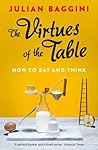
BOOK: “The Virtues of the Table” by Julian Baggini

The Virtues of the Table: How to Eat and ThinkThe Virtues of the Table: How to Eat and Think by Julian Baggini

My rating: 4 of 5 stars

Publisher Site – Granta

This book examines the nexus of food and philosophy, from the ethics of butchery to the virtue of authenticity to whether hedonism is a necessary component of eating philosophically. Much of the book challenges or debates conventional wisdoms such as whether local foods are inherently better, whether dining is always and everywhere a social activity (or should be,) and whether organic is always preferable. The book covers a wide variety of topics including: mindfulness, gratitude, skepticism, fasting, willpower, spontaneity, technology, etc.

The book offers many ideas for reflection though sometimes it felt like it rambled on for more than the issue in question necessitated.

Each chapter ends with a discussion of a particular food and its preparation as thought relevant by the author. This is a nice grounding mechanism for discussion that tends otherwise to be cerebral and philosophic.

I’d recommend this book for anyone interested in thinking more about food and its intersection with philosophy of life.

View all my reviews

Calabash Time [Kyōka]

bowl in the right
calabash in the left:
drunkard empties
& then fills his cup --
amid missing time.

PROMPT: Drink

What is your favorite drink?

If amount consumed is any indication, that would have to be water – with coffee as a second runner up. And the rest of the pack is a muddled mess in which no one stands out, judging from the fact that the aforementioned are the only beverages that I drink on a daily basis. (Gin or beer are at most once a week beverages and average less than that, if this was meant to imply alcoholic drinks.)

Certainly, water is the only one that I: a.) can’t do without, and b.) could live a comfortable and healthy life drinking exclusively.
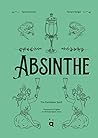
BOOKS: Absinthe by Tania Brasseur & Tamara Berger

Absinthe: The Forbidden Spirit: An Intoxicating History of the Green FairyAbsinthe: The Forbidden Spirit: An Intoxicating History of the Green Fairy by Tania Brasseur

My rating: 4 of 5 stars

Amazon.in Page

Release Date: February 27, 2024

The biography of a beverage might not seem exhilarating, but absinthe has no ordinary history. It rose from obscurity as a regional drink indigenous to parts of France and Switzerland to international celebrity by becoming popular with artistic geniuses of the era — e.g. Oscar Wilde. Some of whom credited the drink with more than just a pleasant tipsy sensation. Then it received its own prohibition while other alcoholic beverages remained perfectly legal. Of course, as with other prohibitions, Absinthe’s legend rose and taste for it didn’t disappear. Eventually, its prohibition ended, and absinthe was freed to have a second life.

This book is primarily a history of absinthe’s rollercoaster ride existence. However, it also discusses wormwood and other prominent ingredients, the distillation process, as well as the mythology that grew up around the beverage.

If you’re curious about the beverage and its mythos, I’d recommend you give this book a look.

View all my reviews

Green Fairy [Free Verse]

Bohemians
   gathered around 
   the absinthe bottles,
  the light hitting 
   the bottles shone
   a radioactive shade
   of green.

That green light
   threw blotches
  against walls &
 floors & people &
  anything else there
  was to illuminate.

The more they drank,
 the less green the mottling --
  not because the empty glass 
   was clear, &
 didn't refract, or spray green,
   but because the splotches
  turned every color --
   every color there is --
  and the colors danced
   around the increasingly 
  amorphous surfaces.

 Until, at last,
  everyone was asleep,
 and visions of Green Fairies
  danced in their dreams. 

BOOK REVIEW: Made in Chicago by Monica Eng & David Hammond

Made in Chicago: Stories Behind 30 Great Hometown BitesMade in Chicago: Stories Behind 30 Great Hometown Bites by Monica Eng
My rating: 5 of 5 stars

Amazon.in Page

Release Date: March 21, 2023

Chicago is a food city. Once famous for its stockyards and still a major transit point for the products of America’s breadbasket, the city is home to a diverse people, a gathering of migrants and immigrants who brought a wide variety of foods from their homelands and put the necessary twists on them to make them salable to Chicagoans while using available ingredients. This book features entries on thirty foods and beverages that are products of Chicago ingenuity, be they dishes that were wholly invented in the Windy City or one’s that have a distinctive Chicago-style variant. Foodies know exactly what is meant by Chicago-style hot dogs, pizza, or tamales.

If all you know about Chicago cuisine is that ketchup on a hot dog is considered a sin, you’ll learn about some colorfully named Chicago inventions such as: “the Jim Shoe,” “the Big Baby,” and “the Mother-in-Law,” as well as many others that are more prosaically named, if equally calorically dense. One also sees the mark of Chicago’s immigrant story in the Akutagawa, Flaming Saganaki, Gam Pong Chicken Wings, the Maxwell Street Polish, and Chicago Corn Roll Tamales.

Each chapter discusses the nature of the respective dish, its influences, the [often contentious] origin of each item, where one can obtain said dish, and (for most) includes a recipe for making one’s own home variant. So, it’s mostly food history, but with a bit of cookbook, as well. There are pictures throughout, of the foods and in some cases of the location that invented or popularized each dish.

Be forewarned, while Chicago is a city that loves food, it’s not a place that’s wild about nutrition or moderate serving sizes. In fact, I feel certain that many people attempting to consume every item in this book in, say, one month’s time would drop dead of a coronary shortly thereafter (if not during.) Most of these dishes are foods done fast and served with an allowance of fat, sugar, and / or meat suitable for a family (for several days.)

If you’re a traveler (or a Chicagoan) and want to know more about quintessential windy city foods and where you can sample them, you must read this book.


View all my reviews

BOOK REVIEW: Darjeeling by Jeff Koehler

Darjeeling: A History of the World's Greatest TeaDarjeeling: A History of the World’s Greatest Tea by Jeff Koehler
My rating: 5 of 5 stars

Amazon.in Page

As Bordeaux or Tokaj are to wine, Darjeeling is to tea, producing a quality beverage considered by many to be the best in the world. However, this isn’t merely the story of how this region of northern Bengal (or, alternatively, Gorkhaland) came to produce a unique kind of tea that would be sought-after around the world. It’s also a story of empire and how Britain’s insatiable demand for tea drove major developments in geopolitics. It’s yet further the story of recent troubled times of Darjeeling tea, from labor shortages to environmental degradation, and what tea estates have done to adapt – from management / organization changes to organic production techniques.

Lessons in the history and geography of tea may seem niche and uninteresting, but the story of tea is actually quite fascinating, involving Opium Wars, the Black Hole of Calcutta, and an industry shakeup resulting from India’s independence.

I found this book compelling, and thought it did a good job of zooming in and out between local and global (and past to present) to maintain the interest of a diverse readership. Whether the book is exploring attempts to transplant tea shrubs and expertise from China or the changing customer base for Darjeeling tea, it’s an engaging and thought-provoking story. If you’re interested in tea, world history, or agribusiness, you’ll likely find something in this book to hold your attention.


View all my reviews

BOOK REVIEW: Real Food Fermentation, Revised and Expanded by Alex Lewin

Real Food Fermentation, Revised and Expanded: Preserving Whole Fresh Food with Live Cultures in Your Home KitchenReal Food Fermentation, Revised and Expanded: Preserving Whole Fresh Food with Live Cultures in Your Home Kitchen by Alex Lewin
My rating: 5 of 5 stars

Amazon.in Page

Out: December 21, 2021

This is an expanded edition of a book that explores the process of fermenting a wide range of foods and beverages, including – new to this edition – sourdough bread. It’s a great book for a neophyte such as myself as it covers all the basics without getting too arcane (though it does include natto and some other regional foods that may not be widely familiar.) The book provides step-by-step instructions for making sauerkrauts (and variations such as Kimchi,) yoghurt & kefir, fermented fruit condiments, beverages (alcoholic and non-,) bases / starters (e.g. vinegar,) and sourdough products (including, but not limited to, bread.) It describes some of the challenges one may run up against as well as showing what equipment one will need. It also proposes some of the ways a curious person might experiment with variations.

Color photos are used to clarify the production processes as well as to show appetizing finished products that will whet one’s appetite.

If one is looking to get into a narrow domain of fermentation, e.g. making beer or other alcoholic beverages, one may want to look elsewhere for a more specialized and in-depth guide (of which there are many.) However, this book may introduce one to ideas for brewing adventures one wouldn’t have otherwise considered.

This book is an awesome choice for someone looking to get into or to expand their food fermentation activities. It’s well-organized, beautifully presented, and – as I mentioned – not overwhelming. With the mounting evidence of the benefits of fermented foods, this is a great guide to learn more about how one can best begin producing such foods at home.


View all my reviews

BOOK REVIEW: The Drunken Botanist by Amy Stewart

The Drunken Botanist: The Plants That Create the World's Great DrinksThe Drunken Botanist: The Plants That Create the World’s Great Drinks by Amy Stewart
My rating: 5 of 5 stars

Amazon page


This book is about how plants are used in the making of alcoholic beverages from vegetative matter that serves as the primary ingredient in fermentation to obscure herbs and berries used to lend subtle flavoring. The book covers a lot of ground, being at once a guide to the chemistry of fermentation and distillation, a mixologist’s recipe book, and a guide to growing the plants used to make booze.

I will admit, if I weren’t such a neophyte to both subjects at hand – botany and alcoholic beverages – I probably wouldn’t have rated this book so highly. For me, almost every page offered new fun facts about alcoholic beverages, some of which I’ve consumed and many of which I never have. So if you have a high degree of understanding about one or both of these subjects, you may not find the book as intensely satisfying. Also, at times the book comes off a bit pretentiously – hardcore drunks probably don’t want to be shackled with so many rules for optimal alcoholic consumption (e.g. what type of glass they should drink a given drink from, etc.), but hardcore drunks are probably not a huge readership demographic. (It should also be noted that the reader gets some knowledge to fight pretentiousness as well, such as against gin drinkers who say they would never drink vodka when, in fact, they are drinking juniper berry-flavored vodka.)

The book consists of three parts. The first part describes fermentation and distillation and then offers two sub-parts dealing with the most everyday bases for alcoholic drinks (e.g. corn, grapes, potato, and wheat) as well as some of the more obscure and unusual objects of fermentation, respectively.

The second part delves into the plants that are added for flavoring or the like, and these are organized by: 1.) herbs and spices, 2.) flowers, 3.) trees, 4.) fruit, and 5.) nuts and seeds.

The final part gives some guidance on how some of these plants can be grown. It should be noted that this section is a bit thinner because a lot of information on growing the plants is covered in side-bars in the earlier sections and also this isn’t the book’s main thrust. The third part is similarly divided up between herbs, flowers, trees, berries & vines, and fruits & vegetables.

There are quite a few graphics, mostly in the form of line drawings, throughout the book – some are purely aesthetic and others are informative (e.g. drawings of plants.) There is also a recommended reading section that proposes further books to expand one’s understanding at the nexus of booze and plants. The book presents a lot of material in text boxes that set the information aside. These boxes include recipes, but also insights into how to best grow these plants with particularly emphasis given to how the process is optimized for those growing for beverage production (e.g. sometimes the optimal variety isn’t the most common variety.)

I enjoyed this book. It was readable, full of fun bits of information, and written in a light-hearted style. If you’re looking for a book on plants and alcoholic beverages, this is a good starting point. It doesn’t get too deep in the weeds but yet offers some obscure but amusing factoids.

View all my reviews