


“Eyes Front, Jackass!“
Alternatively, “There’s a pit viper under your seat.”

“Eyes Front, Jackass!“
Alternatively, “There’s a pit viper under your seat.”

the lawn blossoms:
 attracting minds that never
  paid heed the grass.
What is the most important thing to carry with you all the time?
Awareness. It’s the only thing I take in the shower or through the metal detectors, or to every place I go – regardless of widely varying customs, rules, and etiquette.

Feel the breeze upon your face.
 Let it be all you know.

Don't ponder atmospheric lows.
 Just feel the breeze upon your face,
         and know:

There is a breeze.
         (Though it may not be
           what you think it is.)
 You have a face.
         (Though it may not be
           what you think it is.)
 Mindfulness in Wild Swimming: Meditations on Nature & Flow by Tessa Wardley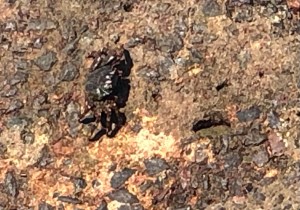
the crab that scurries
 when i come within ten feet,
  caught unaware by waves
 On Looking: Eleven Walks with Expert Eyes by Alexandra Horowitz
My rating: 5 of 5 stars
This is a field guide to getting the most out of walks in the city; though it’s presented through a series of essays. City-centeredness is the book’s niche. There are tons of books that teach one how to get more out of the subtle signs and signals seen in nature, but we tend to miss the nature (and a good deal of the culture) in our city walks because we view them in a utilitarian fashion and because there is so much shouting for our attention that it’s easy to miss nature’s subtle cues.
The book consists of 12 chapters—each of which is organized around a city walk. Eleven of these walks are with experts who offer the author (and her readers) greater insight into some dimension of the city walk experience that is often lost to the limits of our attention. When I use the word “expert,” I use it broadly. The reader may find some of these individuals more worthy of the title “expert” than others—e.g. two among them are the author’s 19 month old son and her dog—but they all offer a unique insight. [You may recognize the author’s name from a popular book she wrote on dog behavior, and that’s a particular area of interest for her.] Others are the kind of experts that might testify in court or be asked to give a consultation at a corporation. Along the way, Horowitz inserts more general information on the psychology and science of human attention–and its limits—as is relevant to the larger discussion.
The twelve chapters are organized into three parts. The first part deals with the inanimate dimension of the city. Its four chapters deal with the things that children notice owing to either their height or their unjadedness, the natural materials of the city (rocks and biomass), fonts and signage, and the under-appreciated ordinary.
The second part explores the animate part of the city, including insects, animals, and humans. The reader will learn that–despite the fact that they may only see the occasional bird or squirrel—the city is teeming with non-human fauna. The two chapters that deal with humans take quite different perspectives. One is with the Director of the Project on Public Spaces, an expert on how cities are organized (by planning, organically, and by default) and the effect that this has on people and their movement through cities. The last chapter in this part is by a doctor whose expertise is making diagnoses in the style of Sherlock Holmes by means of close observation of the minutiae of a person’s appearance and posture.
The final part is about the sensory experience of a city walk. The first chapter in this section details a walk with a blind woman who is attuned to moving about the city using her other senses. There’s a chapter with an expert on sound, and the walk she takes with her dog—whose experience is largely informed by its olfactory sense. The last chapter is a short summation of what the author has learned and begun to apply in her own solo walks.
The book has few graphics, e.g. depictions of relevant art. There are source citations arranged by chapter in end-note form.
I found this book to be intriguing and beneficial. I think we could all benefit from city walkers who were more tuned in to what was going on around them. (Sadly, the trend seems to be going the other way.) I’d recommend this book for anyone who likes to take a walk, and nature lovers may find it unexpectedly fascinating.
 Mastermind: How to Think Like Sherlock Holmes by Maria Konnikova
My rating: 4 of 5 stars
This is a book about how to be more observant while avoiding the pitfalls of drawing faulty conclusions based on unsound reasoning, tainted memory, or faulty assumptions. Examples from the canon of Sherlock Holmes (i.e. the 4 novels and 56 short stories written by Sir Arthur Conan Doyle) are prevalent throughout the book, but Konnikova also discusses Doyle’s limited real life investigations as well as those of the men who influenced the writer. Doyle lived at time when science and reason were making great strides in overcoming superstitious and spurious ways of thinking, and so the Sherlock Holmes works were cutting edge for their time.
The book is neatly organized into four parts with two chapters each. The first part is entitled “Understanding Yourself” and it unpacks what we have to work with in the human brain. One learns how one’s brain works and how it sometimes leads one astray. It also introduces how the scientific method can provide a framework to harness the brain’s strengths and avoid the hazards of its weaknesses.
Part II investigates how one can become more skilled at investigation, as well as the role played by creativity and imagination. We learn how our attention is much more limited than we feel it to be.
The third part reflects upon the building one’s powers of reasoning as well as the importance of knowledge-building in the process. Konnikova describes “deductive reasoning” using Holmes’s favorite term. [She doesn’t really get into the whole muddle of—as many have pointed out—the fact that Holmes more often uses induction than deduction, i.e. going from very specific observations to draw broader conclusions.] The second chapter considers the importance of being knowledgeable and broadly educated. Holmes’s conclusions often hinge on fairly arcane knowledge about a range of issues: animal, vegetable, and mineral. However, a large part of the discussion is about the idea of degree of confidence. It’s also pointed out that knowledge can be double-edged sword—an impediment as well as a tool. Extraneous knowledge may lead one down the wrong path.
The final part suitably closes the book with one chapter on practical advice for how to put all of the knowledge discussed in the book to work and another on the recognition that even the best minds can go astray. The first chapter summarizes as it offers pragmatic advice. The second of these chapters discusses a fascinating investigation of a supernatural phenomenon (i.e. the existence of fairies from photographic evidence) upon which even Sir Arthur Conan Doyle’s mind led him astray.
The use of the Sherlock Holmes character is beneficial as many readers have consumed the entire Holmsian canon, or will do so, because it’s short and readable even today. Even those who haven’t read it will at least be familiar with the lead character and his proclivities as well as the other essential characters, such as Dr. Watson, Professor Moriarty, and Irene Adler. There are too many television shows, movies, and pop culture references to not be aware of these characters. One needn’t have read all Doyle’s Holmes to benefit, as Konnikova offers the essential background. However, one might find it a bit more intriguing if one has read the canon. At the end of each chapter, Konnikova offers a set of references that point to the sections in the Sherlock Holmes canon relating to that chapter’s discussion. Konnikova uses quotes and stories that aren’t attributable to Doyle to good effect throughout this book as well.
Graphics are used sparsely and only as absolutely necessary. There is a “Further Reading” section at the end of the book in addition to the end of chapter pointers. Besides a list of the Sherlock Holmes books, there are chapter-by-chapter prose suggestions of relevant key readings.
I found this book interesting and informative. While it may be most useful for someone who wants to become more attentive, less prone to biases, and more effective in drawing conclusions, it could also be enjoyed by Sherlock Holmes fans as a way to drill down into stories a bit further.








 Tiger Riding for Beginners