BOOK REVIEW: Outlandish by Nick Hunt

Outlandish: Walking Europe's Unlikely LandscapesOutlandish: Walking Europe’s Unlikely Landscapes by Nick Hunt
My rating: 5 of 5 stars

Amazon.in Page

There are many beautiful and wonderous sights that come to mind when one thinks of Europe: forests, meadows, alpine vistas, or cities of stunning architecture. However, there are other sights that one wouldn’t expect at all: tundra, jungle, desert, or steppe, but those are the unexpected destinations that Hunt takes his reader. In some cases, a destination under discussion doesn’t meet the technical definitions for said ecosystem, but they’re the closest that Europe has to offer, and that’s enough to make them outlandish.

The book takes the reader on a tour of four uncharacteristic ecosystems of Europe: Cairngorms arctic tundra in northern Scotland, Poland’s “jungle” – the forest primeval of Bialowieza, Spain’s Tabernas desert, and the Hungarian Puszta (i.e. the Pannonian Steppe.) For each of these places, the reader is treated not only to vivid description of the locale and its flora and fauna, but also some fascinating folklore, cultural peculiarities, and indigenous mysteries. In Scotland, this involves inexplicable reindeer and the legend of the Big Grey Man. In Poland and Belarus, we learn about legendary forest folk deities and about the last Soviet standing. In Spain, one gets a lesson in Spaghetti Westerns. In Hungary we see birders, neo-Nazis, and Central Asian immigrants all traipsing the same ground.

I found this book to be an engaging read. It helps raise consciousness about climate change without collapsing into a gloomy doom-fest. This discussion is most notable in the most extreme ecosystems, Cairngorms and Tabernas, but most of the intense discussion is saved for a brief epilogue entitled “The Last Snow.” The book offers rudimentary maps, but relies entirely on text to paint a picture, but I felt the author did a great job of bringing the places to life through words.

If you’re interested in learning more about a few of the globe’s lesser-known natural settings, I’d highly recommend this book.

View all my reviews
Debrecen Limerick

An old organist from Debrecen
couldn't decide which organ to play when.
The big church had two -
one old and one new,
and they sat them at opposite ends.

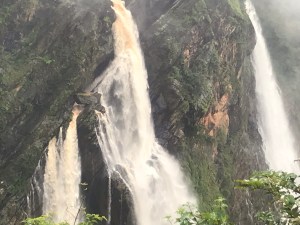
DAILY PHOTO: The Crowd at Jog Falls

Taken at Jog Falls on July 24, 2021

BOOK REVIEW: Philosophy of Biology: A Very Short Introduction by Samir Okasha

Philosophy of Biology: A Very Short IntroductionPhilosophy of Biology: A Very Short Introduction by Samir Okasha
My rating: 4 of 5 stars

Amazon.in Page

Excepting the final chapter, this wasn’t the book I expected, but it did raise some compelling questions. The book did devote more space to semantic and categorical questions than I found useful or interesting. These are the kinds of questions which philosophers may find joy in catching peers in paradoxes, but which are pure navel-gazing, offering no insights on how to achieve the well-lived life or to better understand the grand questions of the universe.

The book looks at the metaphysical and epistemological ramifications of evolution, species classification, genetic and memetic transmission, and the degree to which humans are or aren’t constrained by our evolutionary history. Among the questions I found most interesting were: Is it useful to speak in terms of “function” (i.e. “what a thing is for”) when discussing biological entities, given that those words seem to imply an intended purpose inconsistent with evolution? Does selection occur at the level of the individual, the group, or both? How does one reconcile the Mendelian notion of a “gene” with that of molecular biology? Lest one think Mendel’s ideas were partially formed and are now supplanted, they do internally explain dominance and recessivity, a thing molecular biology can’t yet do. Is it reasonable to apply the logic of evolution and heritability to the cultural domain?

I got a lot out of this tiny guide. It may have spent more time on semantics and categorization than I would have liked (as well as more time reviewing basic biological science,) but it did raise some intriguing questions that I didn’t anticipate as well as illuminating new dimensions of those I did. Your patience with the insubstantial questions will be a major factor in how much you get out of this book.

View all my reviews

Boxing Day Blues [Poem]

the clash of colors and thunderous noise
the box, the paper, the Christmas day toys

the scree of excitement lies, toppled down
and all that's left is our cold, silent town

DAILY PHOTO: Bull Oversees the Line at Soylent Green Production Facility

Taken on July 24, 2021 in Sigandur, KA, India

DAILY PHOTO: Sparkling Ferry

Taken on July 24, 2021 on Linganamakki Reservoir

BOOK REVIEW: The End of Trauma by George A. Bonanno

The End of Trauma: How the New Science of Resilience Is Changing How We Think About PTSDThe End of Trauma: How the New Science of Resilience Is Changing How We Think About PTSD by George A. Bonanno
My rating: 5 of 5 stars

Amazon.in Page

Out: September 7, 2021

The central idea of this book is that not everyone who’s exposed to traumatic events has long-term mental health effects. On average, two-thirds of those who suffer traumas show resilience. Bonanno’s experience working in the mental healthcare sector in New York City in the aftermath 9/11 impressed this truth upon him. The anticipated mental health tsunami never came; most people recovered and moved on with their lives.

It is hard to predict who that one-third is who will suffer long-term mental trauma. While there are some traits that correlate more to resilience and others to a proclivity to be traumatized, the fact that humans are complex and there are many confounding variables makes it immensely difficult to anticipate the impact of a trauma.

Given this difficulty, it’s beneficial to figure out how one can increase any victim’s resilience, and that’s the task the book engages. Bonanno discusses an optimal mindset for resilience that he calls the “flexibility mindset,” and he details a corresponding sequence (i.e. the “flexibility sequence”) that he suggests is the best known approach to reducing the adverse effects of trauma. As the key word, “flexible,” suggests, this approach requires adaptability. It’s not a one-size fits all approach, but rather hinges upon determining what coping strategies a person has access to, and then evaluating the degree to which they are working.

If found this book to be full of food-for-thought. I thought there could have been more elaboration of the dangers and limitations of distraction as a coping mechanism. To be fair, there is a discussion of this as he presents another therapist’s experience with, and thoughts upon, the “flexibility” approach, but that’s a bit late in the book. That said, I learned a great deal in reading this book, and thought it offered some excellent insights.

View all my reviews