BOOK REVIEW: Escape from North Korea by Melanie Kirkpatrick

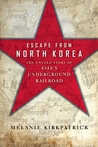
Escape from North Korea: The Untold Story of Asia's Underground RailroadEscape from North Korea: The Untold Story of Asia’s Underground Railroad by Melanie Kirkpatrick

My rating: 5 of 5 stars

Amazon page

Escape from North Korea is the most intriguing non-fiction book I’ve read in recent months. Kirkpatrick offers a glimpse into the operations of a modern-day underground railroad, one whose stories—sadly—are often no less chilling than those associated with its US Civil War namesake from 150 years ago.

The 17 chapters of this book are arranged into six parts. The organizational logic of the book takes the reader from the germ of an idea to flee all the way to settling into life in a free country, with all the trials and tribulations that are experienced in between. It begins as a story of one person who decides to escape, and who must virtually always get across the border into China on his or her own. Once across the border, there is help to be had if the refugee can find it before he or she gets caught by the Chinese and repatriated or is exploited by nefarious individuals. Danger is ever-present, occasionally even once the individual gets to South Korea.

Chapters 3 through 7 were particularly interesting because they looked at various classes of escapee, some of which one might not realize existed. It starts with the classic defectors, similar to those one might associate with the USSR—political, military, sporting, and artistic figures. This was the main class of refugee until people began starving in the 1990’s due to nation-wide famine.

Next is a chapter on brides for sale. Many North Korean women end up forced into slave marriages. China has a dearth of eligible women due a bias against female children, particularly combined with its one-child policy. Some women are lured across the border under false pretenses, but others, finding themselves fugitives in China, end up being exploited due to their vulnerability. Each bride fetches about $1,200 to $1,500 ($500 to $800 from the wholesaler to the retailer.) There’s also a chapter devoted to the children of such marriages, and particularly the cases in which the mother is repatriated and the child ends up orphaned because children born in China will not be taken by the North Koreans and frequently the fathers want nothing to do with the children. Pregnant women repatriated to North Korea are often forced to abort pregnancies involving Chinese fathers.

One of the most intriguing chapters was on the North Korean lumberjacks residing in Siberia. This profit-sharing deal goes back to the Soviet days. When the Soviet Union imploded, however, the arrangement was kept with some worker rights installed on paper to appease Russia’s newly developed human rights watchdogs. One might wonder how the Kims—fearful of dissidents as they are—would let a group live outside the country on a remote site that’s hard to guard. The answer is that all the lumberjacks had to have both wives and children at home to serve as hostages. Still, some decide to make the break.

There is also a chapter about the Prisoners of War from the Korean War who were trapped on the wrong side of the border.

I’m fairly well-read on the subject of North Korea, but, like most Americans, the bulk of this has to do with Pyongyang’s nuclear program. I, therefore, found some of the stories of the regime’s depravity to be beyond the pale. A sampling of such stories includes:
-guards severely beating a prisoner and then having other prisoners bury the victim alive

-the warden in a state-run orphanage having orphans fight each other for bigger food servings

-a family that killed themselves rather than be repatriated to North Korea

-individuals, such as Ri Hyok-ok, who were executed for distributing bibles

-North Korea’s provision of family information on trans-border family members as a profit-making scheme

-Kim Jong Il pulling a Pol Pot and shutting down the universities and colleges and sending students to work on farms and in factories for months in 2011 because he was afraid that the Arab Spring might be infectious

-Kidnapping foreigners on foreign soil, which North Korea has even admitted to openly.

Sadly, the woeful tales aren’t limited to the North Koreans. Kirkpatrick devotes a considerable amount of space to chastising the Chinese for repatriating North Koreans. Under international law, which China ratified, refugees shouldn’t be sent back to their country of origin if it’s likely they will be punished. China claims that individuals are economic migrants and not political refugees, and it compares them to Mexicans crossing onto American soil—without addressing the fact that Mexicans are not sentenced to hard labor or killed when they are returned to Mexico. The Chinese might also point to Hwang Jang-yop, the author of the North Korean Juche (self-reliance) policy, as an example of a “true” political refugee that they didn’t repatriate, but allowed to migrate to South Korea (where the North Koreans tried to assassinate him in Seoul several times.)

There’s even some disappointing behavior on the side of the US. In 2006, an American consulate employee in China not only turned away several North Korea refugees, but–by speaking openly over an unsecured line–got a conductor on the Underground Railroad arrested.

The end of the book contains an interesting description of how the Kims are beginning to lose the war on keeping the information age out of North Korea. From balloon drops to radio broadcasts, North Koreans are beginning to get true information about both the outside world and their own leadership. Lest one think that no one could possibly believe the propaganda out of Pyongyang, even in the absence of information inflows, there’s a story about an immigrant to America who had a hard time coaxing his family out because they believed that America was out to kill North Koreans. This father’s story of the good life in sunny Florida didn’t entirely convince them, and ultimately they had to be coaxed to their new home in stages. It’s telling that the cellphone was only introduced in North Korea in 2008. While cellphones aren’t that useful for the railroad because they can’t call outside the country, they do allow for some spread of information inside.

One might think that once a North Korean gets to freedom, everything is hunky-dory, but Kirkpatrick discusses the problems that most North Koreans have adjusting to life in South Korea. As workers, North Koreans tend to lack initiative. They just want to be told what to do, and will do no more. It’s not that they’re inherently lazy; they come from a world in which initiative is not rewarded but is often punished.

While it may be hard to believe, most of the emigrants have trouble coping with the massive amount of choice available in their new homelands. Having an entire aisle of the market devoted to laundry detergent overwhelms them. Apparently, a few—very few—have even snuck themselves back into North Korea where all they have to do is do what they’re told, eat what they can, and maybe starve to death.

I think this is an important book that should be read by anyone interested in world affairs. North Korea is truly unique in the world. One telling line from the book was, “Even during the Communist era, Russia was more liberal and prosperous than North Korea.” The continuance of the Kim Dynasty is an unstable proposition, and it’s impossible to know when it will fall and what damage will be done internationally when it does.

View all my reviews

BOOK REVIEW: Top 10 Phuket by DK Publishing

Top 10 Phuket (EYEWITNESS TOP 10 TRAVEL GUIDE)Top 10 Phuket by DK Publishing

My rating: 3 of 5 stars

Amazon page

I bought this book in Kindle format both because Amazon was having a sale on the series and because I will be traveling to Phuket soon. The sale included many—if not all—of the books in the series, not just the one on Phuket.

I’m pleased with the book given the sale price that I paid, which was substantially less than Amazon’s usual price and vastly less than list. I don’t think I would be pleased with the book at all had I paid list price, however.

As you may have realized by the title, this book contains a series of lists. The publisher tells one what they believe are the top 10 beaches, temples, bars, travel tips, etc. These lists are arranged in three sections: geographical (best of Phuket Town, best of Patong, etc.), topical (best entertainment venues, best outdoor activities, etc.) and practical (best transportation advice, best money advice, etc.)

The strengths of this book lie in its organization. It’s easy to find what one is looking for. First one finds the list one needs, and then skims the brief text of the particular enumerated items for what one wants to see. This is facilitated by hyperlinking of the table of contents and the index. There are also maps in the back that are connected by hyperlink to the text. I found the maps to be of limited use due to their small size, but I have the baseline model of Kindle, so your results may vary. The maps do put the numbers in large type, so it’s easy to find where a site is in a general sense and relative to other sites.

The weaknesses of this book have to do with lack of information and redundancy. One isn’t going to get more or better information on a given subject from this book than one would from the free tourist information one picks up at the tourism office, from a hotel rack, or online. If you’re expecting any depth or insight, and you would be if you paid the list price of $14, you’ll be sorely disappointed.

The book is only 128 pages, but, on top of that, there’s a great deal of redundancy. Because of the way the book is arranged, one will find out about the same subjects in more than one section. For example, one will read about the Phuket Vegetarian Festival in both the Phuket Town and the Festivals chapters.

A more nit-picky complaint has to do with the arbitrary limitations of the 10-list format. I suspect that some of these subjects could have benefited from longer lists, while others could have been shortened without doing harm.

My bottom line is if you can get this book on sale, like I did, you’ll probably be satisfied. If you pay list, you’ll likely be displeased. Of course, DK Books are largely about the graphics, and my black-and-white, small-format Kindle doesn’t support pictures well—so, again, your experience my vary.

Given the consistency of DK Books, I imagine the same could be said for the other books in the series.

View all my reviews

BOOK REVIEW: The Einstein Theory of Relativity by H.A. Lorentz

The Einstein Theory Of RelativityThe Einstein Theory Of Relativity by Hendrik Antoon Lorentz

My rating: 3 of 5 stars

Amazon page

It’s hard to complain about this book because: a.) it’s a free kindle book, b.) the author was brilliant, a Nobel Laureate, and a man whose work contributed to the discoveries of Einstein, and c.) it’s a very short book, clocking in at about 60 pages, and so it’s not a huge time investment–though for most it will be a bigger time investment than its page count would suggest.

All that being said, I’ll be upfront and tell you that his work is the product of a different era and doesn’t establish its audience clearly.

Science writing, particularly on subjects as arcane as relativity, is a challenge. One has to pick an audience and carefully write for that audience. If ones audience is broad (i.e. not well-trained in science), this means one has to accept a lot less precision in exchange for clarity. In other words, one has to write like Brian Greene or Michio Kaku do in their popular works. On the other hand, if you want to write for technical people, you should probably feel free to show your math and sling the technical jargon.

This book tries to walk a middle ground. It doesn’t lay the subject out in clear, simple, and entertaining analogies. (With the exception of a moving car analogy early on that gets bogged down.) However, there’re no equations or highly technical and jargon-suffused discussions. (Though the section on deflection of light does get into measurements and is bit technical.)

So the question the reader needs to ask themselves–provided they haven’t had physics since high school or their freshman year of college–is whether they are willing and able to grind through reading that will require them to think hard the whole way. One doesn’t need a big science vocabulary, and you aren’t asked to ponder any equations, but you do have to noodle out what the author is saying to get value out of the reading. As I implied earlier, this book (pamphlet) took me considerably longer to read than 60 pages normally would–and I read a fair amount of popular science works.

Of course, given that it’s free, it’s worth a try if you have a Kindle. If nothing else, you should come away with some basics– such as what differentiates special from general relativity. If you don’t like the book you can always buy a Greene or Kaku book to explain the subject in a more palatable fashion.

View all my reviews

BOOK REVIEW: The Warrior’s Path James Sidney (ed.)

The Warrior's Path: Wisdom from Contemporary Martial Arts MastersThe Warrior’s Path: Wisdom from Contemporary Martial Arts Masters by James Sidney

My rating: 5 of 5 stars

Amazon page

My upfront apology: Having drafted this review, I noticed that the book comes off sounding like a bunch of old folks being curmudgeonly about the current generation. As I read this book, that wasn’t the feeling I got. Therefore, it may be a matter of the points that resonated with me, and be more reflective of myself than the martial arts sensei (teachers) who have chapters in the book. [That being said, young readers be forewarned that your generation does get blasted upon not only in this review, but by the sensei in question.]

Fifteen prominent martial arts teachers offer their insights in this book. The group is in many ways homogenous. All fifteen teachers are practitioners of Japanese gendai budō (the modern-day martial arts that developed after the Meiji Restoration [1868]; as contrasted with kobudō or koryū bujutsu, i.e. old school martial arts). All of these martial artists were born in the 1910’s and 20’s and began their study of martial arts in first half of the 20th century.

These teachers are a bridge between the founders of these arts and the arts as we know them today. In a few cases, they are also bridges between kobudō and modern martial arts. For example, Hiroshi Tada was a student of Morihei Ueshiba, the founder of aikido. While we think of O-sensei (Ueshiba) as a gendai budō practitioner because he founded a modern school, he was brought up on kobudō. Furthermore, students of Gichin Funakoshi (the Shotokan karate founder), Jigorō Kanō (the Kodokan judō founder), Hironori Ōtsuka (the Wadō-ryū karate founder), and Dōshin Sō (the founder of Shōrinji Kempō) are represented.

This book is particularly important in that several of the teachers in it have passed away since the book was published. Time is receding for this generation’s thoughts to be saved for posterity. A cursory google search revealed that at least four of these teachers have passed away: Hidetaka Nishiyama (2008), Tatsuo Suzuki (2011), Keiko Fukuda (2013), and Ron Nobuto Omoto (2013.) However, some were more well-known internationally than others, so there may be a few others that passed on without attracting the attention of English-language websites. However, the youngest of them is 84 (the oldest believed living is 97), and so it’s safe to say there may not be many more chances to hear these people’s wisdom.

I’ve pointed out the homogeneity of this group, but there’s also a diversity about them. Practitioners of karate, judō, aikidō, shōrinji kempō, kendō, kyūdō, and Atarashii Naginata are represented. Despite the notoriously male-dominated nature of Japanese martial arts, at least there are two women’s voices in the mix. While all of the artists are of Japanese ancestry, they’re not all Japanese by citizenry. There are two Americans and two Canadians among the bunch, and one individual who was born in China. There are also individuals who were born in Japan but moved abroad to places like France and Brazil to spread their art.

There are a few themes common across multiple of the commentaries. It might be tempting to dismiss some of these points as the “back-in-my-day” sentimentality of the aged, but their experiences are sometimes too similar to lack veracity.

First, several of the teachers said there was much less doggedness in recent generations than in their era. People come into the dōjō (a martial arts school), dabble a little, and–if they’re not constantly entertained by new and fancy techniques–they quit. As a result, there are many practitioners who possess a vast repertoire of technique, but they aren’t skilled in any of it—and even more who get nowhere. The theme was that there is no fast-track to success in budō, one has to work at it day in and day out. It should be noted that all of these individuals were born before 1930, and yet were still teaching / training in 2003 when the book was published.
Second, this generation devoted considerable effort to developing the mind as well as the body. With the availability of better nutrition, training equipment, and sport science, young martial artists may be physically fitter than ever on average (I’m talking about competitors not those using martial arts as a fat camp), but they are also mentally weaker than ever—with limited attention spans and emotional control. Present-day martial arts students often give little credence to the value of training the mind or carrying a martial arts mindset outside the dōjō. Several of the teachers in this book mentioned practicing Zen or some other form of mental exercise, and some emphasized the importance of carrying the clarity and intention of the dōjō about everyday life.

The problem with this is that the martial arts become a young man’s game, and there becomes a lack of experience. A student does a martial art for a few years and then abandons it because his or her physical athleticism isn’t going to increase. This decreasing physical capacity translates into becoming a weaker martial artist. The only way to grow in the long-run is to become mentally stronger, more self-confident, and having better emotional control.

The problem is that this mental strength and confidence often becomes confused with arrogance or cockiness. But as Nobuyuki Kamogawa (kyūdō) points out, the problem with arrogance is that one can’t see one’s weaknesses—and, thus, can’t grow. While Japanese arts may seem overly-formal (and there can be truth to that), it shouldn’t be forgotten that part of what this formality does is (potentially) build mental discipline and humility.

I think Toshiro Daigo best summed up the problem of not living the art. He said, “But to young Japanese people, judō becomes judō when you put on your judō costume. So without the costume, judō doesn’t exist.”

Third, judō, karate, and kendō teachers bemoaned a shift away from the pursuit of victory by decisive technique (e.g. the the ippon.) Over time, there has been an increased reliance on building up a win by minor points. In judō this may mean trips instead of throws; in kendō it means going for the forearm rather than the head. In other words, competitors have become more risk-averse and less bold. Concern about this is two-fold. For one thing, there’s a worry about the dilution of these arts, but there’s also concern about the sport becoming less interesting to watch and thus losing its following.

Related to the previous two criticisms is a concern about training to build champions, while forgetting to forge good students. This was emphasized not only by some of the sport-oriented art teachers, but also by Hiroshi Tada. Tada, as an aikidō practitioner, is in the unique position being the only one of the teachers to practice a non-sport martial arts system.

Fourth, several sensei suggested the importance of learning for oneself. One of the teachers, Rod Nobuto Omoto, was an uchi deshi (live-in student), and he—as in the old days—spent a lot of time doing chores while getting little to no training. The point is not so much to criticize the younger generation, but to inform them that they must take the reins of their martial arts practice. This may come to a surprise because the educational experiences they are most used to is having information handed to them in as learnable a form as possible.

Fifth, there was a general disdain for the idea of thinking of one’s art as being inherently superior to all others. Masao Takahashi (judō) and Mitsusuke Harada (karate) both made this point. Harada proposed that abject faith in the superiority of one’s art encourages the development of martial artists who cannot defend themselves. If you think your system is inherently best, you may begin to rely on that illusion of superiority rather than on the advancement of your own skill.

Sixth, the importance of mutual benefit was emphasized throughout. Of course, for the judo practitioners, the idea of jita kyoei (self-perfection, mutual benefit) is one of the two Kodokan budōkun (martial arts maxims.) [The other being seiryoku zenyo, or maximum efficiency.] Shigeru Uchiyama said that the belief in Shōrinji Kempō (whose practitioners are also Kongo Zen pupils) is that of “…living half of your life for yourself and half for others.”

A couple of other points that caught my attention were brought up by individual teachers.
Keiko Fukuda expressed concern about women being trained in the same manner as men, and, thus, using too much strength. The 9th dan was concerned about injuries resulting from this over-reliance on strength. This is an interesting point which I hadn’t given much thought. No doubt it’s a controversial point as well. It’s hard for me to comment about whether Fukuda is just old-fashioned and a product of her time and culture (which is, I’m afraid, highly misogynistic) or whether her point is valid. However, I’d be willing to give her the benefit of the doubt as she was an extremely impressive woman.

Lest one think that these are all just traditionalists trying to keep the traditions alive, consider a quote by Yoshimitsu Takeyasu that speaks otherwise. “Not all traditions are good but we have to identify the ones that should be kept.” Rod Nobuto Omoto said simply, “Tradition is not important.” However, I think Omoto’s point is more nuanced than it seems (and perhaps more Taoist) in that what he seems to be saying is that if you make the tradition important it becomes about the tradition and not the what lies beneath the tradition (e.g. values, etc.)

Omoto also offered a great deal of thought-provoking insight into death. It was clearly a topic that he’d reflected on not only as someone coming to the end of his life, but also as one who practices budō.

I think this is an important book for martial artists of all stripes. However, I think that even non-martial artists might learn a thing or two from the insights of these old masters.

View all my reviews

BOOK REVIEW: Heart of Darkness by Joseph Conrad

Heart of Darkness Heart of Darkness by Joseph Conrad

My rating: 4 of 5 stars

Amazon page

Heart of Darkness is a story within a story (i.e. a frame narrative) in which the protagonist, Marlow, tells a group of men on a ship on the Thames about his adventures captaining a boat on the Congo River. The use of a frame narrative both gives this novella/ novel a confessional feel, but also imagines Marlow’s audience feeling his tale particularly viscerally as some of them might be caught up in similar intrigues themselves.

Marlow’s job in the Congo is transporting ivory. However, the core of the story revolves around a trip to extract an agent of the ivory trade named Kurtz, and to transport the ill man to medical care. Kurtz is an intriguing character. This isn’t a man one can feel indifferently towards. Some love his intellect, charisma, or even his ruthlessness. Others despise him as the face of villainy. Kurtz represents imperialism at its most vile. Some natives are at war with him. Others respect and fear him. However, he’s willing to destroy them all on a whim to make the flow of ivory come more swiftly.

Marlow isn’t a member of Kurtz’s fan club initially and thinks the agent is completely insane, but he becomes intrigued with him as their journey progresses. In a way, Marlow is the moderate face of Imperialism. He doesn’t like the way the natives are treated, or the power plays and bureaucracy of the trade. However, he’s an active and willing participant, and, ultimately, when given a choice to work against the system or in support of it he chooses the latter. He hands over Kurtz’s report on the “Suppression of Savage Customs.” He also shows his sympathy towards Kurtz through his interaction with the dead man’s fiance.

This is definitely 19th century literature. While the book is very short, it’s readability isn’t high by today’s standards. It’s organized into just three parts or chapters, and the prose isn’t built for speed. Also, while it turns out to be a gripping tale, it’s slow off the blocks. It must also be put in the context of 19th century literature because the themes of imperialism and suppression of “savagery” have long since been settled. Viewed through today’s lens, the story might not ring true. Though I suppose there’s still a heart of darkness in urban environments today, behind walls rather than across seas.

What are the book’s strengths? While it may seem silly, the title is pure-D awesomeness. Also, while it’s not organized or written for readability by today’s standards, by 19th century standards it’s a page-turner. It’s certainly a compact tale. As I indicated, I’m not sure whether to call it a novel or a novella. Reading this book isn’t a major time investment, and it does pay off. Conrad’s use of descriptive language is often beautiful. Conrad’s characters all ring true and serve to sit one in a world of darkness beyond the imaginings of the London elite, where sad and terrible things happen to make their world possible.

Lastly, the book makes one think. Like Kurtz, one is likely to love it or hate it.

View all my reviews

BOOK REVIEW: Rashōmon and Other Stories by Ryūnosuke Akutagawa

Rashomon and Other Stories (Tuttle Classics)Rashomon and Other Stories by Ryūnosuke Akutagawa

My rating: 5 of 5 stars

Amazon page

Six stories make up this brief collection. All six are intriguing, well-written, and shine a light onto the dark side of mankind. The works of Akutagawa collected herein are all morality tales, but aren’t written in a moralistic tone. In fact, it’s not clear that the author wishes to convey lessons on virtue and vice as he’s intrigued with the instant at which an ordinary person turns bad. That instant, and the inflamed passions that often inspire it, is a prevailing theme throughout most of this small anthology. Akutagawa beats AMC by the better part of a century in showing us how bad breaks.

The first story is entitled In a Grove. This is a murder mystery in which we are given conflicting accounts of a man’s murder through the process of the investigation of the act. The final account that we are offered is that of the victim himself–as presented by a psychic medium. [Only two of these stories contain supernatural elements–this one and the last. Most of the collection involves realist premises. One must remember that Akutagawa was writing in the early part of the 20th century, and scientific rationality hadn’t yet gotten as strong a hold as it does today.] In this case, the use of a psychic is really just a plot device to give the reader insight into a truth which couldn’t otherwise be revealed. Having heard the perspectives of the murder and the dead man’s wife, one is left with questions owing to the self-serving nature of those statements. Of course, the final section reveals a twist–that I won’t spoil.

The second story is the title story, Rashōmon. The title is the name of a gate in Kyōto, the largest gate of Kyōto, in fact. However, Kyōto has fallen on hard times, and our protagonist is a newly masterless samurai who has sought the gate’s shelter from the rain. There, he contemplates whether he should take up a life of crime, which seems to be his only means of survival in the current economy given his skill set. The gate has become a repository for the corpses that are amassing as victims of the hard times accumulate. Within the gate, he finds an old hag who loots bodies for a living. His interaction with the old woman helps him to decide his own destiny.

The third story is called Yam Gruel. While “yam gruel” (or anything with the word gruel in it) might not sound appealing given today’s usage, a fact one must know is that during the time of the story it was a highly-prized and rare dish. The story follows a milquetoast administrator who leads a rather pathetic life in which he has but one ambition, to eat his fill of yam gruel. As a member of the samurai class, he’s invited to an Imperial banquet each year. However, because of his low status and the high-value of yam gruel, he never gets more than a taste. One year he openly bemoans the fact that he never gets his fill. A powerful samurai overhears this complaint, and it puts a seed of mischief in his mind. While this tale isn’t about breaking bad, it is about inflamed passions.

The fourth story sticks out as different from the others. While the bulk of the stories center on that moment at which a more-or-less good person goes bad, The Martyr tells us about a protagonist that never goes bad, despite having every right to. This might seem like a sea change in theme, but in reality it’s just another way of shining a light on the dark seed that resides in people. Only this time it does it by way of contrast. All of the other characters are deeply flawed, and we see that most vividly when contrasted against the one who always behaves virtuously. In this case, that virtuous character is Lorenzo, a novice monk who is accused of a severe breach of good conduct. Lorenzo becomes an outcast and a vagrant due to these allegations. Yet, despite all this, he acts heroically–even to assist those who’ve betrayed him.

In the fifth story we revisit the theme of breaking bad. In Kesa and Morito we are presented with two regret-filled accounts of the instant at which an adulterous couple decides to kill the husband of the woman involved in the affair. Each member of the cheating couple thinks that the other desperately wants the killing to go forward. In reality, both consider it a foolish decision driven by a brief moment of passion. This is another tale about letting one’s passions get out of control.

The final work is a retelling of the story of a monk named Hanazō who decides to prank his fellow monks because they chide him about his huge nose. Hanazō sets up a sign that says a dragon will appear from the local lake at a certain time and day to fly up into the heavens. The joke doesn’t turn out at all as the monk intended. I won’t go into the moral of the story to avoid giving too much away, but suffice it to say there is a moral.

I highly recommend this collection. As I’ve suggested, the collection isn’t just a disparate collection of tales, but has an integrating theme. Akutagawa was truly one of the masters of the short story. He wrote 150 stories before dying at the age of 35 in a suicidal drug overdose.

For those who like to see how literature is portrayed in, below one can watch the film version of Rashōmon.

View all my reviews

BOOK REVIEW: The Color of Magic by Terry Prachett

The Color of Magic (Discworld, #1)The Color of Magic by Terry Pratchett

My rating: 3 of 5 stars

Amazon page
The Color of Magic is a hero’s journey tale done in comedic fashion. It’s the first book in Prachett’s disc world series. An incompetent wizard, Rincewind, becomes the guide to a goofy but wealthy tourist named Twoflower. However, as it happens the events that confront these two on their journey are part of a game being played between gods. I loved the humor, liked the story, but wasn’t a fan of the organization of the book.

I should admit up front that fantasy is–hands down–my least favorite genre, and I can’t say that view didn’t jaundice my perception of this book. However, it’s a testament to Pratchett’s humor and readability that I continued reading it.

What is my beef with fantasy in general? First, once one introduces magic, how does one maintain tension in an environment in which anything can happen effortlessly? Obviously, fantasy fans find plenty of tension to keep them reading, but I just don’t get it personally. I know that one retort is that the same could be said of other speculative fiction genres. To the degree that is true, I also don’t care for those other genres so much either. However, sci-fi (for example) has a basis for constraints that can be widely agreed upon. Second, the appeal of feudal society for setting perplexes me. I guess there is a certain romance to these periods for fans (perhaps because they imagine themselves in the statistically-unlikely role of king or knight as opposed to the much more likely position of serfdom, but whatever), but I see this type of society as backward and unsustainable (a ten millennia old kingdom maybe possible in a world of magic, but not in a world as we know it.)

I know fantasy fans will be able to come up with examples of how their favorite authors avoid both of the pet peeves mentioned. In truth, Pratchett does a good job of negating these pitfalls. With respect to the magic problem, he makes the protagonist wizard really inept and, therefore, easily in situations over his head. Simply put, he makes his lead weak relative to those confronting him. With respect to the setting issue, Pratchett creates an entirely different kind of world, the disc world. This is not Charlemagne’s Europe with wizards.

Prachett is often compared to Douglas Adams. In fact, if you Google “the Douglas Adams of fantasy,” you are sure to pull sites pertaining to Pratchett. One can see the same type of absurdist humor in Prachett’s work. Here’s a compilation of a few of my favorite lines:

“Being Ymor’s right-hand man was like being gently flogged to death with scented bootlaces.”

“No, what he didn’t like about heroes was that they were usually suicidally gloomy when sober and homicidally insane when drunk.”

“Yah. I outnumber you one to two.”

“He wondered what kind of life it would be, having to keep swimming all the time to stay exactly in the same place. Pretty similar to his own, he decided.”

“But the captain had long ago decided that he would, on the whole, prefer to achieve immortality by not dying.”

“Your affected air of craven cowardness does not fool me.”

Pratchett appeals to the downtrodden in all of us. This can best be gleaned from the tale of Goldeneyes Silverhand Dactylos. Dactylos is a superb craftsman who is blinded, has his hand cut off, and suffers ever greater indignities because the Emir wants him to never again produce anything as lovely. It’s like the myth about Shah Jahan having the hands cut off Taj Mahal craftsman, except Pratchett’s Emir keeps asking the same man of increasing handicaps back to construct ever greater marvels of engineering.

The book is arranged in just four chapters. This is a bit of an oddity for commercial fiction, and I don’t really care for the sparse employment of breaking points in this book. Again, if I was enough of a fan of fantasy to read this in a single sitting (or even a few sittings) I would likely not find this to be an issue. However, I read it over time and interspersed with many other books (a lot of which were more captivating to me personally.) This might seem like a ridiculously nit-picky point, but for those of us who have a lot of reading up in the air at once, being able to readily put a book down and pick it up seamlessly later without losing the story is of great benefit.

If you like humor, this book will appeal to you. If you like fantasy, I suspect you’ll doubly like it–as long as you have a sense of humor. If you don’t like either, this book will not be for you.

View all my reviews

BOOK REVIEW: The Book of Tea by Kakuzo Okakura

The Book of TeaThe Book of Tea by Kakuzō Okakura

My rating: 4 of 5 stars

Amazon page

This book is neither about tea the drink nor tea the plant; it’s about tea the experience. It’s about what the author refers to as “Teaism,” which is akin to Taoism and Zen and which extols the virtues of simplicity, purity, and humility. Teaism is a philosophy that exists around–and in conjunction with–so many familiar philosophies, but is not subsumed by any of them.

The book is divided into seven parts: I.) The Cup of Humanity; II.) Schools of Tea; III.) Taoism and Zennism; IV.) The Tea Room; V.) The Art of Appreciation; VI.) Flowers; and VII.) Tea Masters.

Part I gives us an overview of what Teaism is. One may get a better feel for the author’s view of Teaism through a few choice quotes than from my rambling description. (I’ll take advantage of the book’s 1906 birth date–and, hence, public domain status–to quote heavily from it.)

“Those who cannot feel the littleness of great things in themselves are apt to overlook the greatness of little things in others.”

“It’s [The Tea cult’s] very spirit of politeness exacts that you say what you are expected to say, and no more.”

“For Teaism is the art of concealing beauty that you may discover it, of suggesting what you dare not reveal.”

“Let us dream evanescence, and linger in the beautiful foolishness of things.”

The first part also devotes considerable space to contrasting East and West. The author defends the Eastern ways, which include an exacting and meticulous approach to tea, as not being backwards–as suggested by some in the West.

It should be noted that her commentary, while sometimes sharp in tone, isn’t an attack on the West so much as a defense of the East. It’s interesting to me that there was such conflict as Teaism sprang from Taoism, which is the individualistic strain of Southern China. There is much in common between the values of Taoism and Western liberal thinking. Both share irreverence for tyranny and authoritarianism, and a dislike of that which is forced on one by dictate.

The second part gives a mini-history of the development of tea, but soon sows more of the philosophy of tea in what becomes a lead-in to the following chapter. A couple more choice quotes:

“Perhaps we reveal ourselves too much in small things because we have so little of the great to conceal.”

“Teaism was Taoism in disguise.”

The third part is the core chapter. It discusses the like mind of Taoism and Zen, and how these systems made fertile soil for the growth of Teaism. It is the heart of the book, as it reveals most vividly what Teaism is by explaining the concepts of nothingness and duality.

“One who could make himself a vacuum into which others might freely enter would become a master of all situations.”

“In jujutsu one seeks to draw out and exhaust the enemy’s strength by non-resistance, while conserving one’s own strength for victory in the final struggle.”

“Truth can be revealed only through the comprehension of opposites.”

“The followers of Zen aimed at direct communion with the inner nature of things, regarding their outward accessories only as impediments to a clear perception of truth.”

Part IV describes the place in which the tea ceremony takes place. The key points are: The tea room should be small and simple, and emulate a Zen monastery. The entryway should be less than three feet high, so that all–Shogun or shepherd alike–can be reminded of the need for humility. The first requisite of being a tea master is the ability to sweep and clean. Earlier, Okakura mentions how the most senior monks in a Zen monastery do the most arduous tasks, rather than the novices. This point translates to Teaism. By becoming a master, one doesn’t escape the requisites of modest tasks, but must carry them out all the more skillfully.

Part V, on the art of appreciation, was summed up for me by the quote, “We classify too much and enjoy too little.”

Part VI is where the author goes a little astray in my opinion. She seeks to address the co-development of flower arranging with tea ceremony. She begins by bemoaning the waste of so many flowers–even more-so in the West than the East. “Why were the flowers born so beautiful and yet so hapless.”

Interestingly, she never bemoans the plucking of tea. She anthropomorphizes flowers–not, apparently, because they are living–but because they are beautiful. She imagines that they must feel the excruciating pain of being wrenched from a stem in a way that a rather lackluster looking tea-bud cannot. It’s her deference to the consensus of beauty as represented by the flower as opposed to the simple tea-bud in which she performs the greatest sin against her own philosophy.

Furthermore, she says, “The man of the pot is far more humane than the man of the scissors.” Failing to recognize that the flower planter and the flower harvester are, in most cases, one in the same person.

She eventually explains how those whose philosophy so despised the destruction of life and beauty came to engage in flower arranging. “We shall atone for the deed by consecrating ourselves to purity and simplicity.”

The final part tells us about the nature of the tea master–a monk of leaf and beverage, if you will.

“The tea-masters held that real appreciation of art is only possible to those who make of it a living influence.”

“He only who has lived with the beautiful can die beautifully.”

I recommend giving this thin book a read. I packs a lot of food for thought into a small package. The language is excellent. (The book was originally written in English, and directed toward a Western audience. Hence the extensive defense of Eastern thinking up front.Therefore, there is no worry about getting a particular translation.)

View all my reviews

BOOK REVIEW: Living Your Yoga by Judith Hanson Lasater

Living Your Yoga: Finding the Spiritual in Everyday LifeLiving Your Yoga: Finding the Spiritual in Everyday Life by Judith Hanson Lasater

My rating: 4 of 5 stars

Amazon page

If you’re the average joe, you probably think of yoga as a series of stretchy postures–many or most of which seem physically impossible for a run-of-the-mill human. If you’re a little more sophisticated on the subject–perhaps you’ve even done a few yoga classes–you realize that breathing exercises (pranayama) and meditation (dhyana) are also an essential part of the practice. However, if you’re hardcore, you realize that there is an entire moral, ethical, spiritual, and philosophical approach to life embodied in yoga.

Lasater’s book is aimed at the latter group or people who plan to one day be in that group. You will not find out how to do a single posture (asana), and you won’t learn how to do breathing exercises or meditation. So, the book might sound like one of those navel-gazing, pie-in-the-sky, philosophical tomes. But it’s not. On the contrary, the chapters are short and readable, and each one ends with exercises to put that chapter’s lesson into practice. Now, it probably sounds more like a how-to workbook. It is, but the exercises can only be carried out in everyday life.

Admittedly, I don’t know that much about yoga, but I suspect such a book is much-needed. I do know that in the martial arts there is also a rich and well-defined moral, philosophical, and–for lack of a better term–spiritual component, and that it gets lost much of the time by a large percentage of students as soon as they step out the door of the dōjō. I suspect this is true of yoga practitioners as well. I imagine that as yoga has spread globally many of the less visible and tangible aspects of the system get left behind. I know this happens in the realm of martial arts–sometimes these elements even get lost in the homeland. It’s a natural side-effect of busy lives; people take on what they can grasp and don’t go looking for the rest.

Living Your Yoga is divided into three parts of seven chapters each (21 chapters in total.) The social circle widens as one goes through the parts. Part I deals with the yoga practitioner as an individual. Part II considers the practitioner’s relationships with others in their immediate domain–family, friends, co-workers, etc. The final part looks at the practitioner in the global context.

Each chapter focuses on a particular virtue or vice and how to cultivate it or mitigate against it, respectively. All of the chapters begin with a quote, most from the Yoga Sutras of Patanjali or the Bhagavad Gita, then there is the body of the chapter, followed by a practice on that particular theme, supplementary practices, and a few mantras.

The chapters in the first part are: spiritual seeking, discipline, letting go, self-judgment, faith, perspective, and courage. The second part deals with compassion, control, fear, patience, attachment / aversion, suffering, and impermanence. And the final part considers greed, service, connection, truth, success, nonviolence, and love.

While I suggested this book is for the hardcore yogi/yogini, it has value for a more general readership than that. It’s really for anybody interested in working on self-improvement on a daily basis, as opposed to those who restrict their development pursuits to inside the yoga studio (or dōjō or ashram.) The advice is sound, regardless of whether one ever practices an asana or not.

View all my reviews

BOOK REVIEW: The Book of Massage by Lucinda Lidell

The Book of Massage: The Complete Step-By-Step Guide to Eastern and Western TechniquesThe Book of Massage: The Complete Step-By-Step Guide to Eastern and Western Techniques by Lucy Lidell

My rating: 4 of 5 stars

Amazon page

I picked up this book because I recently began studying Thai Yoga Bodywork (TYB.) While The Book of Massage doesn’t specifically deal with Thai massage, as a neophyte, I figured some general reading was in order, and there aren’t a lot of widely available books that deal with Thai massage specifically (at least not where I currently reside.)My first testimonial of this book is that I looked through over a dozen books on massage at my local bookstore, and this is the one with which I walked home.

I found Lidell’s book to be a valuable resource. The book covers three approaches to massage: oil massage, shiatsu, and reflexology. As the subtitle suggests, this book addresses both Eastern and Western approaches to massage. The section labeled simply “Massage” is one that deals largely in the Western approach, as it’s suggestive of the Swedish style of massage. This involves oil, no / few clothes on the recipient, and a variety of strokes that are delivered over relatively broad areas (as opposed to the deeper acupressure approach of the latter methods.) The oil massage chapter begins with an overview including what type of oil to use and the basic strokes, and then provides a sequence before delving into specific techniques for various body parts or groups of body parts.

Shiatsu is a Japanese form of massage that is based on the concepts of Traditional Chinese Medicine (TCM.) I found this style to be much closer to what I’ve learned in TYB. Like TYB, both patient and recipient are clothed, there is no oil, acupressure is the norm, it requires no table, and there is a match up between what are called “energy lines” in TYB and “meridians” in Shiatsu. Shiatsu even employs similar stretching techniques to those that are the hallmark of TYB. I can imagine these systems having a common ancestral art.

The order of the shiatsu chapter is basically the same as the chapter on Massage. First, there’s necessary background information. This consists of a couple of pages on the basic Taoist concepts on which TCM is based (e.g. Chi, Yin & Yang, and the five elements) and related vocabulary like “tsubo” (pressure points) and meridians. The section then goes on to address basics of posture and bodily tools (palms, thumbs, elbows, knees, etc.), the sequence of the massage, and then the specifics of various body parts.

Reflexology massages only the feet and hands in the belief that points on these appendages map to other parts of the body. In other words, practitioners believe one can increase wellness throughout the body by working points on only the feet or hands. It’s said that the roots of reflexology may be ancient and that it may have been practiced in Egypt in 2300BC, but the modern school was developed by an American physician in the early 20th century. TYB does borrow from reflexology (though not necessarily the modern form of it), so some of this was also similar to what I learned in TYB. Again, the order of this section went from the generic information one needs toward the specifics of how to apply a given technique on a particular part of the foot or hand.

In addition to the three core sections, there were chapters before and after that provide the reader with useful information. Some of this was banal but obligatory (e.g. a brief history of massage and a discussion of the importance of touch among the human species), but some of it was essential practical information such as how to create the proper environment and how to center oneself before delivering a massage. There was also information that will be useful for some about massages involving babies, expectant mothers, the elderly, athletes, and oneself.

Perhaps the most beneficial of the “supplementary” chapters was one that dealt with the subject of how to read bodies. This may seem like an odd topic. However, it’s useful to be able to recognize where an individual holds his tension or where her posture is off–a problem that can create many muscular difficulties. There’s a short overview of anatomy, which I found useful, and a shorter overview of “chakras and auras,” which I personally didn’t find useful but can see where others might.

There are several strengths and relatively few weaknesses to this book. I found the organization to be logical. The graphics are a combination of photos and line drawings, and they work well together. I thought it was great that the author explained that Shiatsu is to be done in comfortable, loose-fitting clothing and that the only reason the graphics display the masseuse in a skin-tight body suit was so that the baggy clothing wouldn’t inhibit the reader’s view. Also, I found the written descriptions worked well with the graphics. One often needs a written cue as to where to find a certain point or line, and just showing it in a picture can be misleading given the wide variety of body types as well as the granularity of the graphic in contrast to the specificity of a point one may need to hit.

I suppose I should warn the easily mortified and / or very religious that there are full and partial frontal nude photographs in the section on oil massage. [I doubt such people are a major demographic for giving or receiving massage, but one never knows.]

I don’t have a lot of complaints. As it’s set up like a workbook, a spiral binding might have been nice, but I recognize the huge challenges of that. Plus, I’m not certain that one can or should learn massage from a book. Rather one should look at it as information to support study with a skilled teacher–or to experiment with once one has already developed some skill. The sections early and late in the book that talk about the importance of human touch didn’t add much, but they were also brief.

If you’re looking for a book on massage that covers a broad set of bases, but yet gives adequate detail for learning, I think this book is a good choice. I’d say it piqued my interest in learning Shiatsu.

View all my reviews