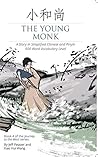
BOOK: “The Young Monk” [Vol. 4 of the “Journey to the West” Series] ed. by Jeff Pepper / trans. by Xiao Hui Wang

The Young Monk: A Story in Simplified Chinese and Pinyin, 600 Word Vocabulary (Journey to the West Book 4)The Young Monk: A Story in Simplified Chinese and Pinyin, 600 Word Vocabulary by Jeff Pepper
My rating: 5 of 5 stars

Publisher Site — Imagin8

This book, Volume 4 of the Journey to the West series, takes a turn from the books thus far. While the first three volumes (Ch. 1-7) focus on Sun Wukong, the Monkey King, this volume leaves him under the mountain where the last volume left him, and — instead — focuses on the origin story of Xuanzang — the monk who is sent by the Buddha to India to get scriptures in the original book — based on the real-world monk who did travel to India to complete the selection of Buddhist scriptures available to Chinese Buddhists.

The monk’s story might not sound like it would be as thrilling as that of the superpowered immortal monkey, but it’s a gripping tale. The story begins before Xuanzang is born and ends in his eighteenth year. So, before he is assigned to travel West to get scriptures.

As I’ve said in earlier reviews, I really like the approach of this series. It has Simplified Chinese script, pinyin, an English translation, and a full glossary of terms used, and it’s organized so as to facilitate reading by a language learner.

I continue to recommend this series for language learners who need a linguistically simplified text to be able to read.

View all my reviews

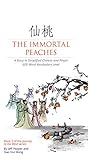
BOOK: “The Immortal Peaches” [Vol. 3 of “Journey to the West”] Ed. by Jeff Pepper / Trans. by Xiao Hui Wang

The Immortal Peaches: A Story in Simplified Chinese and Pinyin, 600 Word Vocabulary (Journey to the West Book 3)The Immortal Peaches: A Story in Simplified Chinese and Pinyin, 600 Word Vocabulary by Jeff Pepper
My rating: 5 of 5 stars

Publisher Site – Imagin8

This is the third volume in this Journey to the West series aimed at language learners. It covers Chapters 5, 6, and 7 of the book, which includes events from Sun Wukong’s return to heaven acknowledged with the title “Great Sage Equal to Heaven” through the conflicts that result from his lack of control and decorum to Buddha’s bet with Monkey King.

I’ve enjoyed this series. The pinyin is interspersed with an abridged and linguistically simplified Chinese telling of the story on a paragraph basis, and the English translation is at the end. This allows one relatively quick access to the pinyin without continually cheating by stray glance. Also, one can determine whether one wants to read the English translation before or after reading the Chinese, as is appropriate to one’s level and language learning strategy. The book also has a glossary of all the Chinese words it uses, and the words beyond the most basic (beyond HSK3, or so) are footnoted. (I read on kindle, so looking up translations of any words is as quick as highlighting them.)

This is a great language learning tool, featuring one of Chinese literature’s most engrossing stories. I’d highly recommend it for those learning Mandarin Chinese with Simplified script.

View all my reviews

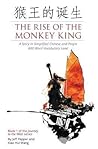
BOOKS: “Rise of the Monkey King” ed. / trans. Jeff Pepper & Xiao Hui Wang

The Rise of the Monkey King: A Story in Simplified Chinese and Pinyin, 600 Word Vocabulary Level (Chinese Edition)The Rise of the Monkey King: A Story in Simplified Chinese and Pinyin, 600 Word Vocabulary Level by Jeff Pepper
My rating: 5 of 5 stars

Publisher Site – Imagin8

This is an abridged and linguistically simplified telling of the first two chapters of Journey to the West. It contains the birth story of Sun Wukong (i.e. the Monkey King) and describes his studies with a sage in an attempt to become immortal.

As someone learning Chinese but at a point where I can only read grammatically and lexically simple content, it’s not easy to find reading material that is both fun to read and readable. The discovery of this series was a godsend. It’s hard to get more thrilling than the story of the Monkey King, and it helps that I’ve already read translations – and so have a bit of context to piece together challenging sentences and to avoid the misunderstandings that can arise when reading a new language. It’s much easier to be a disciplined reader when reading something that is neither a children’s book nor the life story of a preternaturally typical person [which is the usual adult equivalent of a beginner level reader.]

I was pleased by how this book was laid out. Often reading material for learners puts the Chinese characters (hanzi,) the Romanized phonetics (pinyin,) and the English translation all in adjacent rows. While this has its advantages, it also makes it too easy to cheat by eye saccade and not be reading as well as one thinks one is. This book does have all three elements, but it alternates paragraphs of hanzi and pinyin but then puts the translation in an unbroken format after the Mandarin. The book also has a glossary of the book’s vocabulary.

Whether you’ve already read Journey to the West or not, if you’re just learning to read Simplified Chinese, I’d highly recommend this book.

View all my reviews

PROMPT: Character

Daily writing prompt
If you could be a character from a book or film, who would you be? Why?

Wu Song (武松) from Water Margin (水浒传.)

Because he’s a traveler with zero f#&ks to give. There is no more freedom to be had than that.

BOOKS: “Water Margin” by Shi Nai’an

Outlaws of the marsh (the Water Margin)Outlaws of the marsh by Shi Nai’an
My rating: 5 of 5 stars

Amazon.in Page

Water Margin is one of the four classic Chinese novels. The English language translations of the novel go by many names, but in Chinese it’s called Shui Hu Zhuan (i.e. 水滸傳.) The book tells a tale of war and brotherhood in a world in which a person’s virtue and his station in life are often topsy-turvy. It’s one of the most engaging pieces of fiction I’ve read in some time. While it’s a sprawling epic (close to a thousand pages in the unabridged translation,) it draws the reader in and keeps one reading by way of clever plotting and intense intrigues.

The story revolves around 108 individuals of varied checkered pasts who end up together as a band of outlaws in the Liangshan Marsh (hence, one of the most common translated titles is “Outlaws of the Marsh.”) Under the leadership of an exceptionally virtuous and beloved leader, Song Jiang, these outlaws are united into, first, a band of outlaws and, later, (having been pardoned by the emperor) as an incomparable military force that quells threats to the nation.

About the first half of the book consists of the individual stories of the most central of the 108 outlaw chieftains. The next quarter of the book describes their time together as outlaws and, particularly, how they repeatedly defeated government attempts to crush their band. The final quarter of the book is about the band’s Imperial service: first in defeating Tartar invaders from the North and then in crushing a kingdom that arose in the south by uprising of a self-declared king.

If the reader is thinking that 108 primary characters is too many to contend with, I would say that: a.) there are a small set of characters that are so substantially discussed and developed that you’ll be able to always keep them straight; b.) not all of the 108 are crucial to keep straight to follow the flow of the story, but c.) yes, it is not easy to keep them all straight — particularly for a non-Chinese reader who will find a number of the names quite similar (e.g. Wu Yong and Wu Song.)

I should note that the book can be extremely visceral, too much so for some readers. This intensity largely has to do with the stories involving one of the chieftains, Li Kui. Li Kui is the worst. He has a horrific temper, a blood lust, is completely out of control, and almost always turns anything he touches into a bloody mess. His only saving grace is that he recognizes in Song Jiang’s virtue something that must be followed, such that he does his level best to do anything Song Jiang tells him to and (often more importantly) not do whatever he is told not to do. Many readers will hate Li Kui, finding him completely despicable. However, there is a good chance that thinking about why Li Kui is kept around and tolerated after constantly fouling things up will be a productive thought exercise for those who can get through the gore. One may want to consider that question in relationship to the fascinating fact that Song Jiang, the undisputed leader who all the men insist take the position of head chieftain, is the only member of the band who has no kung fu. The other 107 chieftains are all martial arts masters-extraordinaire, most with specialties in particular weapons or tactics.

I won’t say there aren’t clunky plot devices and repetitive elements, but they didn’t bother me much for a few of reasons. Firstly, this novel is from the fourteenth century, and — given that — the readability and emotional resonance of the book is phenomenal. Secondly, I have no way of knowing how much the cheapening plot devices are a product of the original versus of the translation. Finally, those elements are more than made up for by skilled story crafting.

I’d highly recommend this book for all readers who can feasibly get through an 850-page novel with hundreds of characters. Martial artists and travelers may find it of particular value.


View all my reviews

Of Samurai & Cats: Issai Chozan’s Neko no Myōjutsu

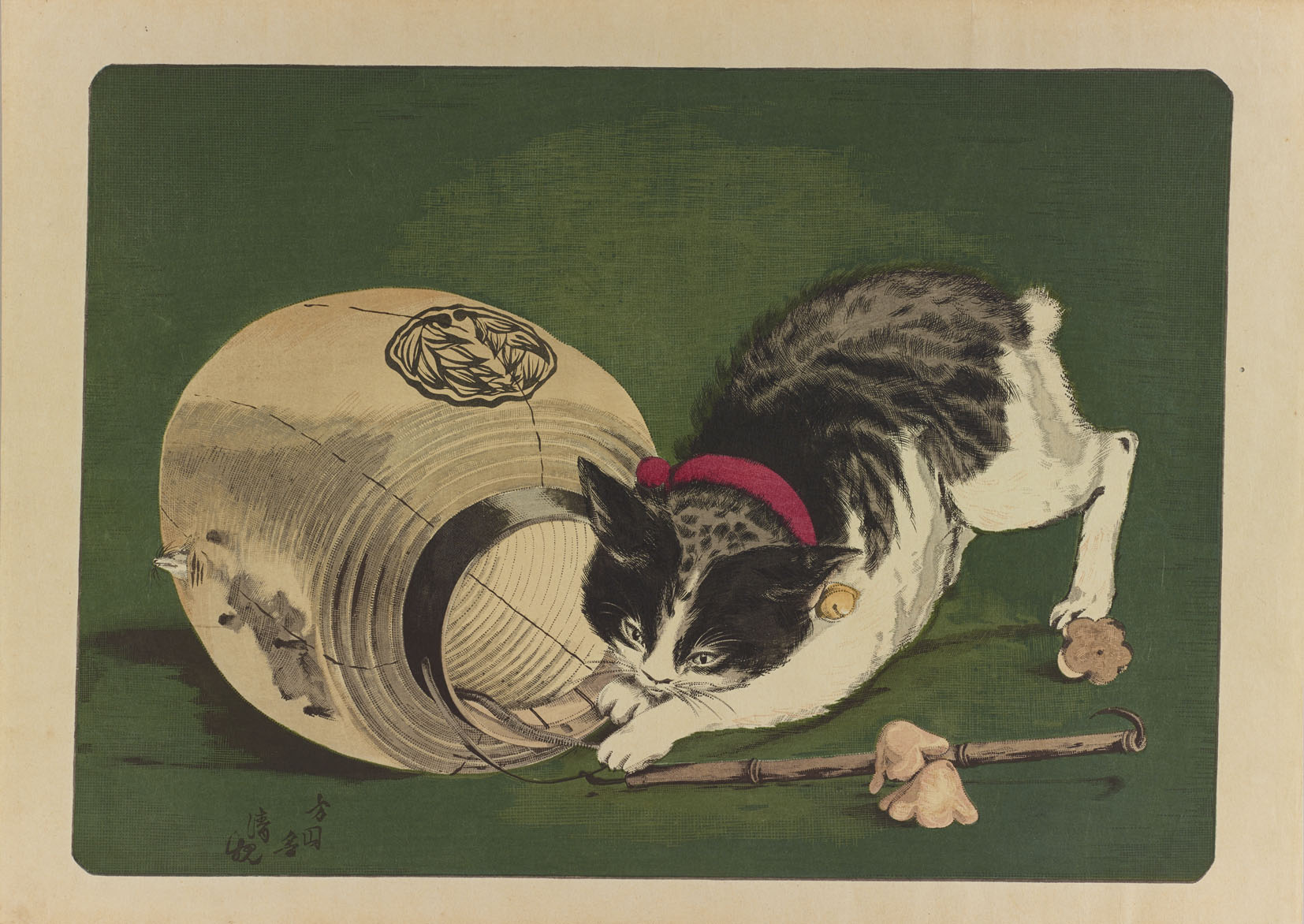
Cat & Lantern (1877) by Kiyochika Kobayashi

BACKGROUND: Issai Chozan’s Neko no Myōjutsu (“Eerie skills of the Cat”) was published in the book Inaka Sōji in 1727. It’s an example of dangibon, a light-hearted form of instructional short story, a form for which Issai Chozan is said to have been one of the originators. On the surface a story of rat-catching cats, in reality it’s a lesson in strategy and philosophy of combat.

SYNOPSIS: I’ll include citations and links below, so you can read the story in its entirety, should you choose to do so. But for now, a brief synopsis: A samurai, Shoken, has a rat in his house, and it’s driving him crazy. Shoken’s housecat is terrorized by the rat. The samurai brings in the best rat-catching cats from the neighborhood, and each is soundly defeated by the rat. Shoken decides to take matters into his own hands, chasing after the rat with a wooden sword (bokken,) but the rat evades each attempted strike and, ultimately, bites the samurai on the face. Finally, Shoken brings in a legendary elder cat from across the city, a cat who doesn’t look like much, but who effortlessly evicts the rat from Shoken’s house. The balance of the story is a conversation between the successful old cat and three of the skillful younger cats who’d failed to catch the rat (as well as with Shoken.) Each of the three explains its approach to achieving victory, and in turn the master cat explains the limitations of each one’s approach. The old master goes on to explain how when he was younger, he’d met a tomcat who slept all day, and yet no rat would come within miles of it. He asked how the tomcat achieved this, but the tomcat was unable to explain it.

THE LESSON: The first cat, a young black cat, explained that it was a master of technique. The black cat was agile and strong in movement of all kinds and practiced diligently to streamline and perfect all of its techniques. The old cat pointed out that focus on technique still left the black cat with too active a mind, thinking too much about how it would defeat its opponent. The master went on to say that there is value in technique, but it can’t be allowed to be the extent of one’s abilities. He emphasized that one’s clever actions must be in accord with the Way.

The second cat, a tabby, proudly proclaimed that all of its effort went into building its energy or spirit (ki, also called chi,) and that it could defeat most rats with a gaze (though not the one in question.) The old master explained that spirit is a fine thing but being too conscious of it hurt the second cat’s ability. The master went on to say that one can never be sure that the opponent won’t have more spirit than one, and so complete reliance on ki can lead one to a defeat.

The third cat, a gray one, said that its philosophy relied on yielding and never forcing a fight. The old master explained that this was a misunderstanding of the principle of harmony, and that this kind of yielding was a man-made contrivance that was not in accord with nature and often led to muddiness of the mind. While the old cat goes on to say that none of these elements (technique, ki energy, or yielding) is without value, it’s clear as he continues that the answer isn’t as simple as being a combination of them, but rather requires a completely new way of being, of experiencing and perceiving the world.

To Shoken, the old cat explained the importance of not thinking of swordsmanship as a means to defeat an enemy but, rather, a means of understanding life and death. The old cat went on to discuss mushin (i.e. “no mind,”) a serene state of mind that allows one to be flexible to whatever comes along. The old cat emphasized the importance of eliminating distinctions of object and subject through a process of self-realization and explained that the process of seeing into one’s being one can trigger satori (sudden enlightenment.)

CITATIONS:

Matheson Trust for Comparative Religion translation, available online at: https://terebess.hu/zen/neko.pdf

Ozawa, Hiroshi. 2005. The Cat’s Eerie Skill. Essence of Training in Japanese Culture: Technique Acquirement and Secret of Kendo. Online at: https://tenproxy.typepad.jp/recent_engagement/files/essence_of_training_in_japanese_culturee.pdf

Suzuki, D.T. 1959. The Swordsman and the Cat. Zen and Japanese Culture. New York: Pantheon Books. pp. 428-435

Wilson, William Scott. 2006. The Mysterious Technique of the Cat. The Demon’s Sermon on the Martial Arts. Tokyo: Kodansha International

BOOK REVIEW: Shang-Chi, Vol. 1: Brothers & Sisters by Gene Luen Yang

Shang-Chi by Gene Luen Yang, Vol. 1: Brothers & SistersShang-Chi by Gene Luen Yang, Vol. 1: Brothers & Sisters by Gene Luen Yang
My rating: 4 of 5 stars

Amazon.in Page

This five-issue story arc tells the tale of an intra-family battle for control of the Five Weapons Society, a kung fu dynasty that dates back at least to the Boxer Rebellion. With the patriarch deceased, sides form behind Shang-Chi, on the one hand, and Sister Hammer, on the other. While close as young children, Shang-Chi and Sister Hammer grew up separated, and could not have turned out more differently. Shang-Chi (aka. Brother Hand) has been reluctantly drawn into the conflict by virtue of his being the “chosen one,” and by having the support of Brother Sabre and (to a lesser degree) Sister Dagger. Sister Hammer has raised an army and is bent on taking over the dynasty by whatever means necessary.

So, this is one of those stories that’s not about a purely good hero against a purely evil villain, the latter needing to be completely destroyed, but rather it’s about the need for catharsis and reconciliation. But that doesn’t keep the comic from being loaded with action. We also see a protagonist who experiences a change, which is a story convention that is often jettisoned in the action genre. Shang-Chi must move past his reluctance, and embrace his role in the family.

I found this comic to be compelling and worth reading.


View all my reviews

BOOK REVIEW: Marvel-Verse: Shang-Chi by Fred Van Lente, et. al.

Marvel-Verse: Shang-ChiMarvel-Verse: Shang-Chi by Fred Van Lente
My rating: 4 of 5 stars

Amazon.in Page

This is a collection of issues involving Shang-Chi. The early issues present the “Master of Kung Fu” in cameo / secondary roles within headliner characters’ comics – notably Wolverine and Spiderman. In those early issues, Shang-Chi mostly serves as the invincible master showing quippy superheroes that their kung fu lacks vigor and precision. In the later issues, those in which Shang-Chi is the lead, he becomes more well-rounded leading man material and less of a stoic, exotic Yoda-figure. In those issues, Shang-Chi combats the elusive ninja organization called “The Hand,” as well as “Lady Deathstrike.”


There is one issue, “Shang-Chi’s Day Off,” which is written as one-liner laden low comedy. Its tone stands out as distinct from the rest of the volume, but it has a few genuinely amusing lines, and so it’s not so bad. Those who take their superheroes somewhat seriously will hate it.


This collection isn’t a bad way to gain insight into the character and his evolution over time. Don’t be thrown off by the campy and stereotyped way he’s portrayed in his 70’s Kung fu cinema iteration, it gets more balanced and sophisticated later in the volume. I read found it on Amazon Prime.


View all my reviews

BOOK REVIEW: False Guard by Merwan

Fausse Garde - NE (Hors Collection)Fausse Garde – NE by Merwan
My rating: 4 of 5 stars

Amazon.in Page

Out: November 30, 2021

This graphic novel is set in a fantastical world that combines the culture of a Southeast Asian live-in gym, a setting suggestive of “One Thousand and One Nights” supersized to mega-city scale, and some novel creative elements of the author-artist’s imagination. The protagonist, Mane, is a fighter who dreams of making it big in the big city. On the bright side, despite the prejudices against him as an outsider, Mane has the drive and talent to be a champion. However, in a universe of single-minded people (professional fighters,) his energies are split between the gym and his desire to fight for social justice. It turns out that the man leading him into a guerrilla battle against the societal elite, Fessat, is an old intra-gym rival of the gym-owner / coach, Eiam, for whom Mane is fighting.


The story is largely about Mane’s attempts to reconcile these two aspects of himself, and the travails of the bifurcated mentorship he receives from Fessat and Eiam. The fictional martial art of Pankat bears resemblance to Muay Thai / Lethwei / Pradal Serey Southeast Asian style kick-boxing, with a combination of MMA elements to appeal to the present-day reader and some creative details to make it feel more exotic.


For the most part, I found the story and character development compelling. There were some points at which it felt like there was a disjoint between the emotional displays being made and the events at hand. It’s hard to put a finger on what was off, it just felt a bit overwrought at times. Besides a desire to create a visceral story, this is probably meant to reflect Mane’s stress level, but it felt forced at times. It’s also true that Mane is a complex character – at times sympathetic and at other times an impetuous jerk.


If found this book to be enjoyable and engaging.


View all my reviews

BOOK REVIEW: The Breaker Omnibus, Vol. 1 by Jeon Geuk-Jin

The Breaker Omnibus Vol 1The Breaker Omnibus Vol 1 by Jeon Geuk-Jin
My rating: 4 of 5 stars

Amazon.in Page

Out: July 13, 2021

This manga combines the motifs of traditional martial arts stories with a modern-day setting. A bullied high school student, Shiwoon Yi, discovers that his colorful (if abrasive) substitute teacher, Chunwoo Han, is a martial arts master, and employs numerous tactics to get the teacher to instruct him in the martial arts. However, Chunwoo Han is not interested, his priorities as a womanizing playboy caught up in a martial arts clan war are far removed from helping a student one iota more than he needs to in order to maintain his cover and employment.

Shiwoon Yi grows over the course of the book, learning to be more tenacious and to not give in to fear so readily. However, this growth does not come about from the teachings of Chunwoo Han, he remains unwilling to teach, even when he is begrudgingly coerced into agreeing to it. However, Chunwoo Han does assign the boy a task as a precursor to lessons, a task that – despite nearly killing the boy – forces him to be more disciplined. However, the most effective lesson results from Shiwoon Yi’s shame at almost betraying the only person who is nice to him, a girl in his class whom he is too beleaguered by bullies and low self-esteem to acknowledge.

Chunwoo Han doesn’t really grow throughout the course of the story (action heroes rarely do,) but he does soften his view towards Shiwoon Yi – presumably as a result of a new found respect. While Shiwoon Yi is quite a wimp, he does show a willingness to make the ultimate sacrifice in pursuit of learning martial arts, and that earns him some begrudging regard.

Generally, I found the story to be entertaining. It uses a lot of the familiar martial arts story motifs (e.g. superpowered chi, elaborately named techniques, and the “you kill my master” motive.) These motifs ground it in a genre, even if it results in some trite elements. I wish Shiwoon Yi would have played a greater role in the story’s climax and conclusion. Shiwoon Yi is ostensibly the protagonist, though Chunwoo Han makes a more appealing action star. The ending felt a little gratuitous because it basically jettisoned Shiwoon Yi in favor of making a straightforward concluding battle scene.

The book is presented in manga style, including right-to-left read panels and monochrome art. The art is well drawn, though (oddly) everyone looks like a supermodel – except Chunwoo Han when he is having a meltdown of one kind or another.

It’s a straightforward story, rooted in familiar themes and plot mechanisms. If you enjoy martial arts manga and aren’t expecting complex twists and subversion of expectations, you’ll find it to be an entertaining action-centric story with a good sense of humor.


View all my reviews