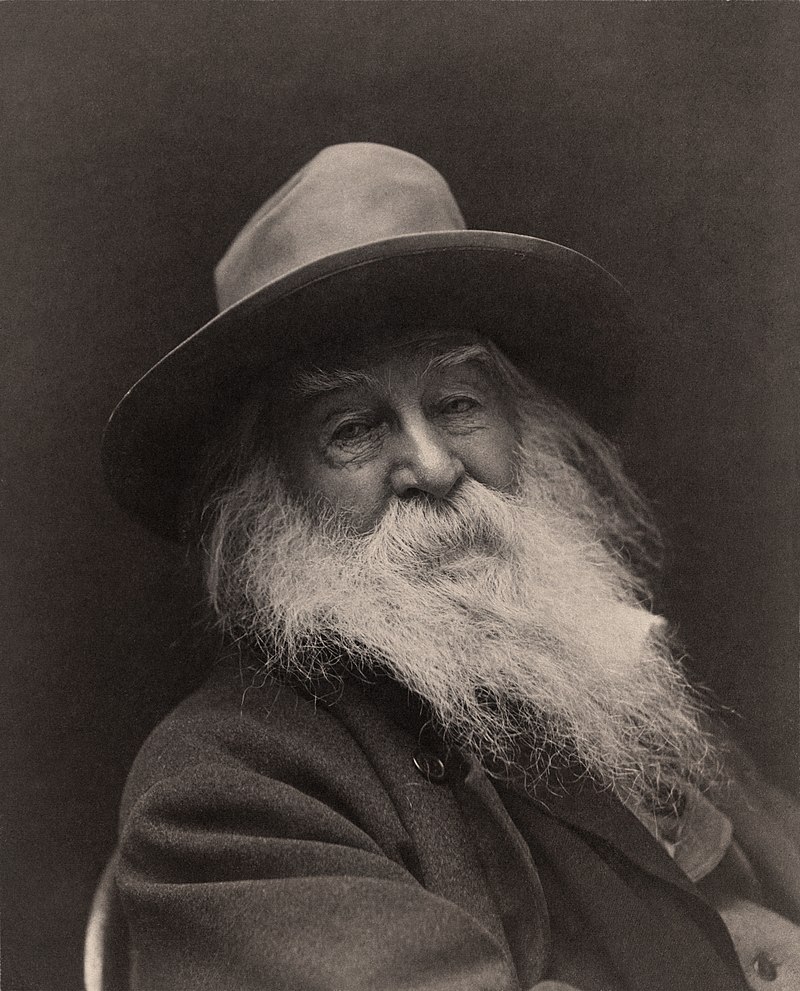
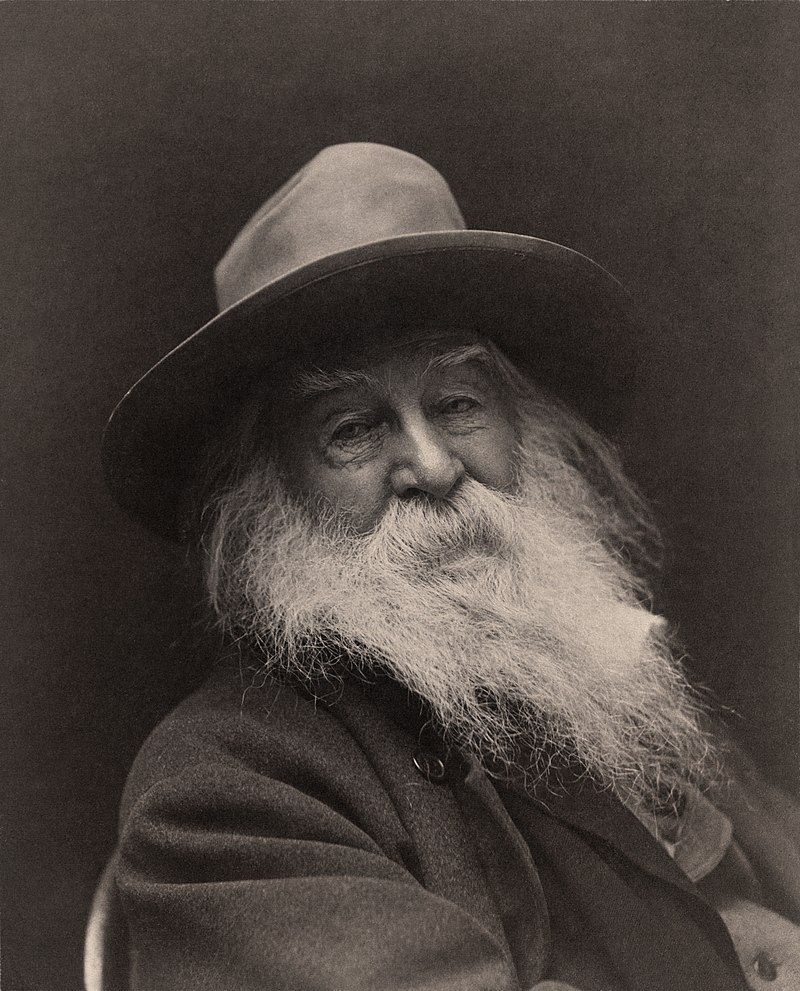
O Captain! My Captain by Walt Whitman [w/ Audio]

O Captain! my Captain! our fearful trip is done,
 The ship has weather'd every rack, the prize we sought is won,
 The port is near, the bells I hear, the people all exulting,
 While follow eyes the steady keel, the vessel grim and daring;
       But O heart! heart! heart!
          O the bleeding drops of red!
             Where on the deck my Captain lies,
                Fallen cold and dead.

O Captain! my Captain! rise up and hear the bells;
 Rise up -- for you the flag is flung -- for you the bugle trills,
 For you bouquets and ribbon'd wreaths -- for you the shores a-crowding,
 For you they call, the swaying mass, their eager faces turning;
       Here, Captain! dear father!
          This arm beneath your head!
              It is some dream that one the deck
                 You've fallen cold and dead.

My Captain does not answer, his lips are pale and still,
 My father does not feel my arm, he has no pulse nor will;
 The ship is anchor'd safe and sound, its voyage closed and done,
 From fearful trip the victor ship comes in with object won;
       Exult, O shores! and sing, O bells!
          But I, with mournful tread,
             Walk the deck my Captain lies, 
                 Fallen cold and dead. 

Stopping by Woods on a Snowy Evening by Robert Frost [w/ Audio]

Whose woods these are I think I know.
 His house is in the village though;
  He will not see me stopping here
 To watch his woods fill up with snow. 

My little horse must think it queer
 To stop without a farmhouse near
   Between the woods and frozen lake
 The darkest evening of the year. 

He gives his harness bells a shake
 To ask if there is some mistake.
  The only other sound's the sweep
 Of easy wind and downy flake.

The woods are lovely, dark and deep.
 But I have promises to keep,
  And miles to go before I sleep,
 And miles to go before I sleep. 

BOOKS: A Double-Barreled Detective Story by Mark Twain

A Double Barrelled Detective StoryA Double Barrelled Detective Story by Mark Twain
My rating: 5 of 5 stars

Amazon.in Page

This novella is Mark Twain’s satirical jab at the whole Sherlock Holmes concept. In particular, it pokes fun at a detective who eschews everything supernatural in favor of cold rationality, but who produces results so impossible that they are themselves supernatural.

The story has two temporally disjointed parts that almost seem like independent stories until the very end when all is tied up. (Holmes only appears in the second part.) This works nicely for parody of Holmesian detective fiction as it’s an approach that was used by Sir Arthur Conan Doyle on occasion — e.g. in A Study in Scarlet. The first part tells the tale of a woman who is treated foully by Jacob Fuller, the husband she eloped with but who harbored resentment towards her father, a man Fuller believed felt wasn’t good enough for his daughter. The woman makes her son, named Archy Stillman, promise that he will track down Fuller and make the man’s life a living hell.

The second part revolves around a murder that seems to be independent of the case described above, the killing of a man named Flint Buckner. Here Sherlock Holmes, who happens to be in town visiting his nephew – Fetlock Jones, “solves” the case only to be shown to be entirely and humiliatingly wrong by Archy Stillman using only a superior sense of smell and basic observation of the facts (with no elaborated inductions.)

While I never had anything against the Sherlock Holmes stories — in fact, I enjoyed them all — I did find Twain’s satire amusing and compelling as a story. [And it’s true that Arthur Conan Doyle did regularly strain credulity — that’s what made Holmes an intriguing character.]

Well worth reading.

View all my reviews

Rickety Gibberish [Free Verse]

A long time ago,
 I listened to the audiobook of
    Kerouac's "On the Road."

In that format, 
   I became aware of how often
     Kerouac used the word
       "rickety." 

Almost as aware as I became
   of how often Twain uses
      the N-word in Huck Finn
      when I unwisely listened to 
      that audiobook while driving
      through downtown Atlanta
      with my windows rolled down. 

I'm now reading Hunter Thompson's
   "Kingdom of Fear," and I've become
      aware that Thompson had a love
      of the word "gibberish" almost on par
      with Kerouac's love of "rickety."

And I think about how much beautiful
   rickety gibberish I've read from those
      authors, and what a fine 
      thing it is if one can write 
      rickety gibberish that stands up 
      under its own weight. 

Whitman’s Eye [Free Verse]

Walt Whitman saw the world 
   with its ubiquitous beauty
     laid bare.

He saw it in dock workers
    & painted ladies &
    swimmers & walkers &
    Presidents & paupers. 

He saw it in every hue &
    sinew, and danced it into hymns.

BOOKS: Echo & Critique by Florian Gargaillo

Echo and Critique: Poetry and the Clichés of Public SpeechEcho and Critique: Poetry and the Clichés of Public Speech by Florian Gargaillo
My rating: 4 of 5 stars

Amazon.in Page

Out Now (May 10, 2023)

This book examines seven poets’ attempts to halt the proliferation of clichés, euphemisms, doublespeak, etc., words and phrases that not only corrupt the language but are often used to disguise bad behavior or to camouflage dismaying truths. It focuses on a technique, echo and critique, in which the poet employs one or more of these disconcerting words or phrases (or clever variants of them,) but does so in a way that reveals the chicanery within them.

The poets whose work is discussed are: Auden, Randall Jarrell, Langston Hughes, Claude McKay, Robert Lowell, Josephine Miles, and Seamus Heaney. These poets go head-to-head with cliché and doublespeak in the form of bureaucratese, propaganda, political speak, and business talk — with particular emphasis on war, race, and politics.

The book makes some interesting points. There are more readable discussions of the subject of corruption and manipulation of the English language, though none that I’m aware of on this particular approach to combating it. This volume is largely aimed at scholars, and not so much the popular readers. That said, I found it well worth reading.

View all my reviews

Five Great Yarns from Kahlil Gibran’s The Madman

The MadmanThe Madman by Kahlil Gibran
My rating: 5 of 5 stars

Project Gutenberg Page

The Madman is a collection of poems and short fiction (often micro-fiction) of a philosophical nature. The protagonist claims he became a madman when a thief broke into his house and stole his masks, the masks that people wear to fit into society and appear “normal.” Beyond the thread created by this mad character, the entries meander along, each with its own moral and with little discernible overarching plot.

There are many clever stories in this collection, offering food-for-thought on religion, philosophy, and psychology. I’ll discuss five of my favorites:

“The Sleepwalkers” A mother and daughter are both sleepwalkers. When they are somnambulating, they speak to each other in horribly cruel terms, but when they wake up, they display (at least a veneer of) love and affection. Besides demonstrating the nature of the aforementioned masks, the loss of which gets one designated “crazy,” this story encourages the reader to discern the differences between conscious and subconscious mental activity.

“War” This one presents an analogy for war in which a thief breaks into the wrong building, walks into a machine, pokes his own eye out, and then takes the building owner to court seeking “justice” for his lost eye. The craftsman / shop-owner says he can’t lose an eye because he won’t be able to do his work, but he knows a neighboring craftsman who could have his eye removed without great loss of productivity. This story builds upon the well-known “An eye for an eye…” Bible verse with the added absurdity of violence being doled out randomly and without concern for whether the victim had anything to do with the events in question.

“The Wise King” A disgruntled witch poisons a city well with a substance that makes drinkers insane. The King avoids the well water and is spared insanity. However, the townspeople begin to plot against the king because, in their insanity, they believe him (as one who acts differently) to be insane. The king eventually drinks the well water in order to come back into synch with his subjects. This entry speaks to the arbitrary nature of classification of sane and insane, an idea that has been discussed in modern times by mental health experts such as R.D. Laing.

“The Two Cages” A bird is caged next to a lion. The bird’s confidence provides the central lesson, knowing they’re both imprisoned separately, the bird refers to the lion as “fellow prisoner.” The power dynamic has changed from that of the jungle. Perhaps, the bird has even happily exchanged its freedom — either for safety or to tear the lion down a little.

“The Eye” In this story, the other sense organs mock the eye after it comments upon how grand a mountain is. The ear can’t hear the mountain and the skin can’t feel the mountain. Therefore, the other senses assume that the eye is either lying or is delusional. This tale speaks to the risk of denying something based on one’s own limited perception.

This book was originally published in 1918 and is in the public domain (most places.) It’s definitely worth the short time investment required to read it.

View all my reviews

BOOK REVIEW: Braided Creek by Ted Kooser & Jim Harrison

Braided Creek: A Conversation in Poetry: Expanded Anniversary EditionBraided Creek: A Conversation in Poetry: Expanded Anniversary Edition by Jim Harrison
My rating: 5 of 5 stars

20th Anniversary Edition Release Date: August 15, 2023

This is a twentieth anniversary re-release of a collection of short poems — on the scale of haiku or tanka — exchanged between Ted Kooser and Jim Harrison over many years. The poems are unattributed and, famously, literary critics who boldly proclaimed they knew which poems were written by which poet have been proven wrong.

While the length of the poems is similar to that of haiku and tanka, if one were going to categorize them in terms of Japanese verse, most would be more like senryū or kyōka (the poetic genres that match haiku and tanka [respectively] in form, but allow for humor, humanism, abstract metaphors, and freedom to deviate from juxtaposition of natural imagery.) But even that categorization would be deceptive because these poems tend toward a uniquely American voice.

That said, there are a few that fit the Japanese style well, e.g.:

In the morning light, / the doorknob, cold with dew.
Or,
The cups of the tulips / tip forward, spilling their snow.

There are also a few that are more like ko-an than like poems. (A ko-an is a Zen “riddle” designed to help practitioners break the hold of logic and reason on the mind. Typically, the ko-an looks like a question, but it can’t be thought out to an intellectually satisfying answer as most questions can.)

Is this poem a pebble, / or a raindrop coated with dust?
Or,
My wife’s lovely dog, Mary, kills butterflies. They’re easier than birds. I wonder if Buddha had dog nature.

But one hears an American voice in such examples as:

On my desk two / indisputably great creations: duct tape and saltine crackers.
Or,
Rowing across the lake / all the dragonflies are screwing. Stop it. It’s Sunday.

There are philosophical pieces, such as:

Only today / I heard / the river / within the river.
Or,
How tall would I be without my enemies to measure me?

This anniversary edition has a beautiful introduction by Naomi Shihab Nye and a brief epilogue by Kooser, but is otherwise the same.

If you like light and whimsical poetry that can make you laugh, or – sometimes – make you think, you should check out this collection.


View all my reviews

Five Wise Lines from Leaves of Grass

Why, who makes much of a miracle? As to me I know of nothing else but miracles.

Walt Whitman, “miracles”

The American contempt for statues and ceremonies, the boundless impatience for restraint…

Walt whitman, “Song of the Broad-axe”

I exist as I am, that is enough. If no other in the world would be aware I sit content. And if each and all be aware I sit content.

walt whitman, “Song of myself”

I am not the poet of goodness only, I do not decline to be the poet of wickedness also.

walt whitman, “song of myself”

If any thing is sacred the human body is sacred.

Walt whitman, “i sing the body electric”

NOTES: Numerous editions exist between the 1855 and 1892 (deathbed) edition. It’s available for free on Project Gutenberg at: https://www.gutenberg.org/ebooks/1322

In Homage to Leaves of Grass

You're my Analects,
           my Gita,
           my Dao De Jing,
           my sutras,
           my Meditations,
           and my Republic
 all rolled into one.

You are the scripture by which I live.

You present a path to that rare place:
            extreme confidence
            which tears no one down,

            but, rather, lifts all.

You achieve this by crushing 
            the ordinary.

Nothing is common.

Everything is a miracle. 
            (Even those leaves of grass
                      you repeatedly reference.)

No one is so rough
             or promiscuous
             or simple
as to be lowly.

Your author's unbridled enthusiasm 
             glowed with the insane confidence
             of an adolescent boy,
but his awesomeness was never gained
             by subtracting from others.
Rather by seeing the bright, beautiful spark 
             in each body,
             mind,
             pair of hands,
             & burdened shoulder. 

You are America,
             the America we want to be.

The America that labors,
             but which takes time to see
             its natural wonders. 

The America that heard what Jesus said,
             and became less excelled at stone-throwing,
             and more at cheek-turning.

The America that could see beyond dogma
             and hard-edged tribalism,
             and could learn from all the 
             grand & glorious people 
             who reached its shores --

So that we could be the best version of ourselves
            through the strengths of all of us,
            and not be stymied by missing 
            the great beauty & knowledge
           among us. 

You pair away the extraneous burdens
            which tax the mind,
and show us what the world looks like
             unfiltered. 

You teach one to see a beauty
            that is so well hidden 
            that its own possessor doesn't 
                      recognize it.

You are the song of a life well lived.