POEM: Building Mythical Beasties

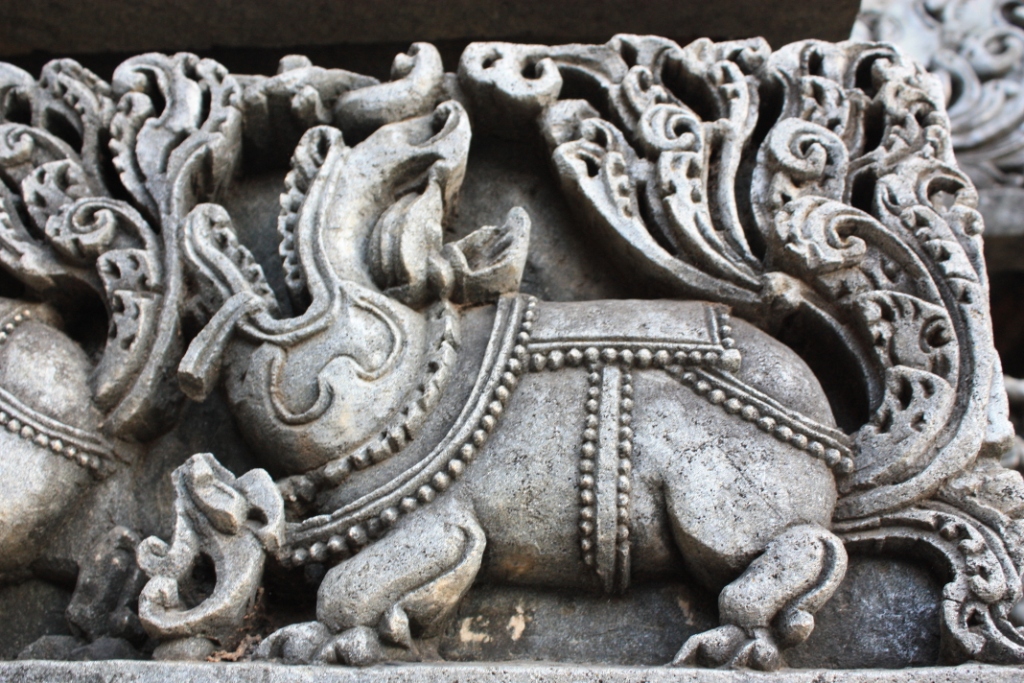
IMG_1651
Hands of a surgeon,
Fins of a sturgeon…

Wait, no… that’s not right.

Let me admit that I have no gift
for mythical fliers that get lift.
One can’t just throw wings on a rat.

Of course you can, we call it a bat!

Alright, bad example…

One can’t draw wings on a whale,
and through the sky expect it sail.

Much better.

How did the likes of primitive man
create the myth of a flying orangutan?

They did no such thing.

Fair enough, then answer me this:

Who came up with ogres that eat babies?
Does a crescent-moon werewolf give you rabies?
Who first saw a spiraling dragon,
and how many drops remained in his flagon?
From whence came the fearless griffin
body of a lion and the head of a… chicken?
If by her shrill scream you know a banshee,
how’d you know it’s not any old woman she?
In how many beds are succubi layin’
in which the occupant ain’t already strayin’?
Leprechaun stories come from notorious drinkers,
and Gorgons and Sirens from a culture of thinkers.
My deficit, it seems, is as aligns with my fears.
Quick, get me a stack of books and a case of beers.

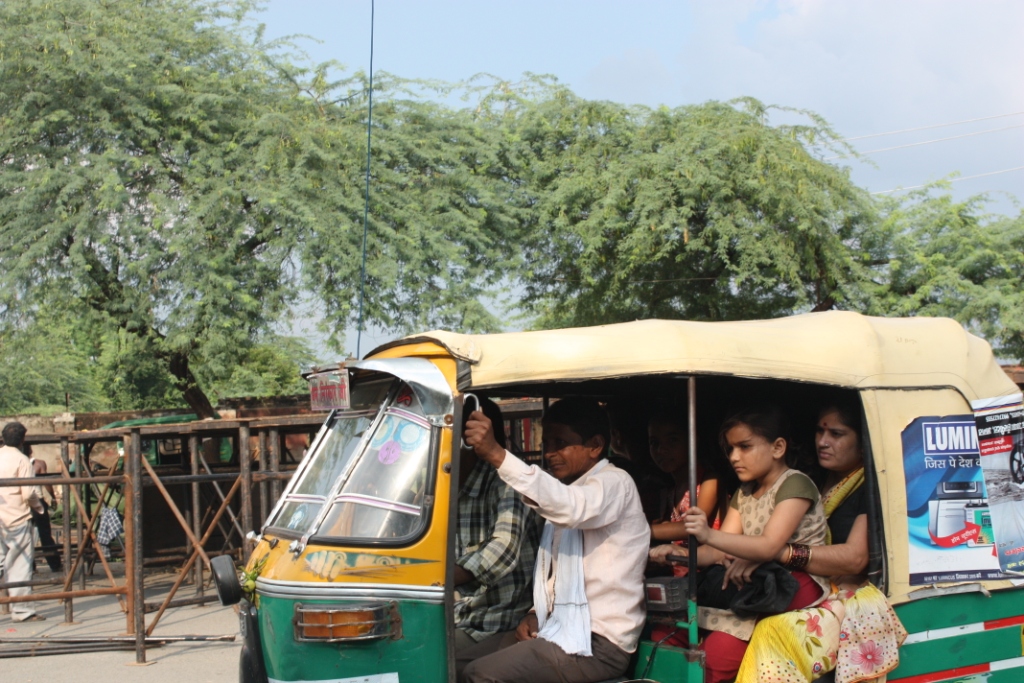
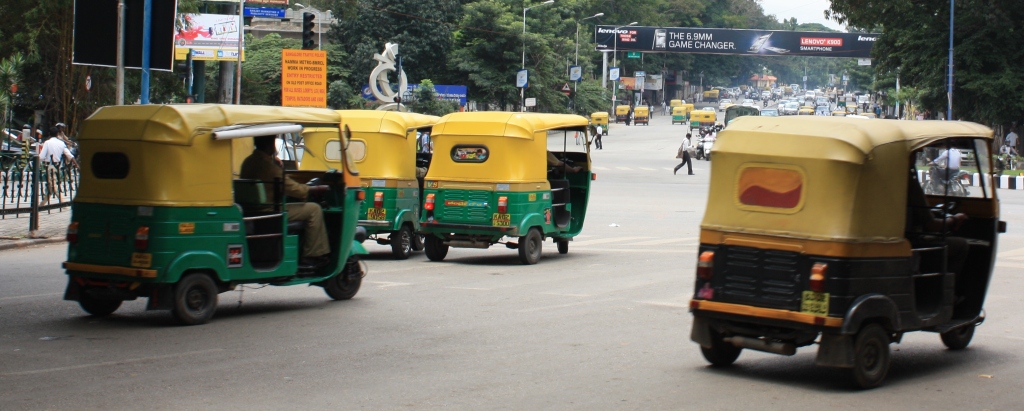
DAILY PHOTO: How Many People Fit in an Auto-Rickshaw?

Taken October 12, 2013 in Agra, India

Taken October 12, 2013 in Agra, India

It’s a question that has been debated since the dawn of the Tuk-tuk. Like the question of how many licks it takes to get to the center of a Tootsie-Roll Tootsie-Pop, attempts to definitively answer the question have resulted only in controversy. The question?

HOW MANY PEOPLE FIT IN AN AUTORICKSHAW?

In the highfalutin cities, people think that nobody is supposed to ride upfront with the driver, but elsewhere they’ve figured out that you can put at least one man on either side of the driver (as long as the weight of each man is fairly evenly matched–there’s only one tiny front wheel after all.) How many one can fit in the back is influenced by the average yoga skill level of the riders and whether one has any Twister (TM) grand-champions on board. 

There are myths of tuk-tuks containing entire villages tooling down the back-roads. Theoretical physicists tell us that you can pack them in until their density forms a self-sustaining black-hole, and then everybody out to the event horizon is drawn in… ya-da-ya-da-ya-da.

The answer is: “a lot.”


POEM: Scared Little Chipmunk

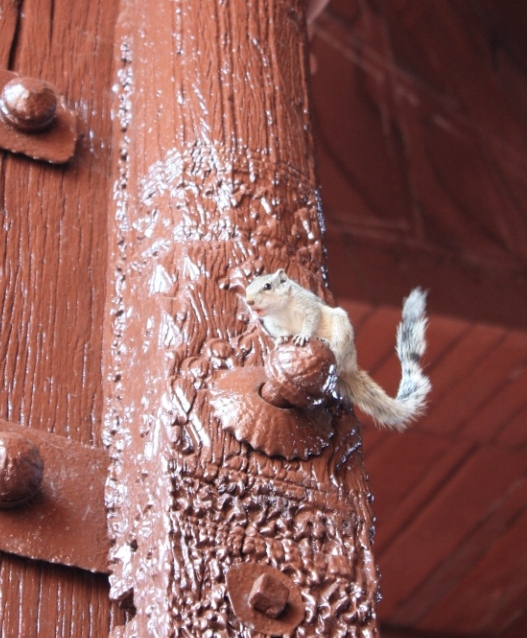
Taken at Fatehpur Sikri

Taken at Fatehpur Sikri

Poor little rodent, run up a door.

Chattering and chattering, frantic, he swore.

Babel Fish Rodentia translated his words:

“It’s not bad enough, the cats and the birds,

hectic humans and their frantic pace,

always running about like they’re in a race.

Stuck on this peg for nigh half a day.

‘A break in the traffic’, I fervently pray.

Pfff! Bipedal humans with their gigantic feet

designed to crush chipmunks right in the street.”

POEM: Human Farm of Underachieving Aliens

IMG_2485

What if the world that we know

is just a two-bit reality show

or some high-def video game?

Wouldn’t it be terrible lame,

if we were the toys of an alien race

of underachievers from deep outer space?

What if our planet currently resided

on a beat-up, old card-table–lopsided,

in the basement of a strung-out dude

who sat around in a cloud in the nude?

What if all of the wonder and foreboding

is just the result of some skillful encoding?

POEM: Lion Eyes (or Lionize or Lyin’ Eyes)

Taken Nov 10, 2013 at Bannerghatta National Park

Taken Nov 10, 2013 at Bannerghatta National Park

The lion is  a kingly beast

Whose eyes no lies can abide

If you don’t wish to be his feast

Please act with tact and don’t chide

He doesn’t take to teasing well

He’s still but to kill is in his blood

His placid face may look swell

But a strong heart pounds THUD-THUD…

THUD-THUD

&

another thing

He may look like a big plush toy

But he’s no fun for a girl or boy

Don’t get your kid a big feline

Unless your exit is a swift beeline

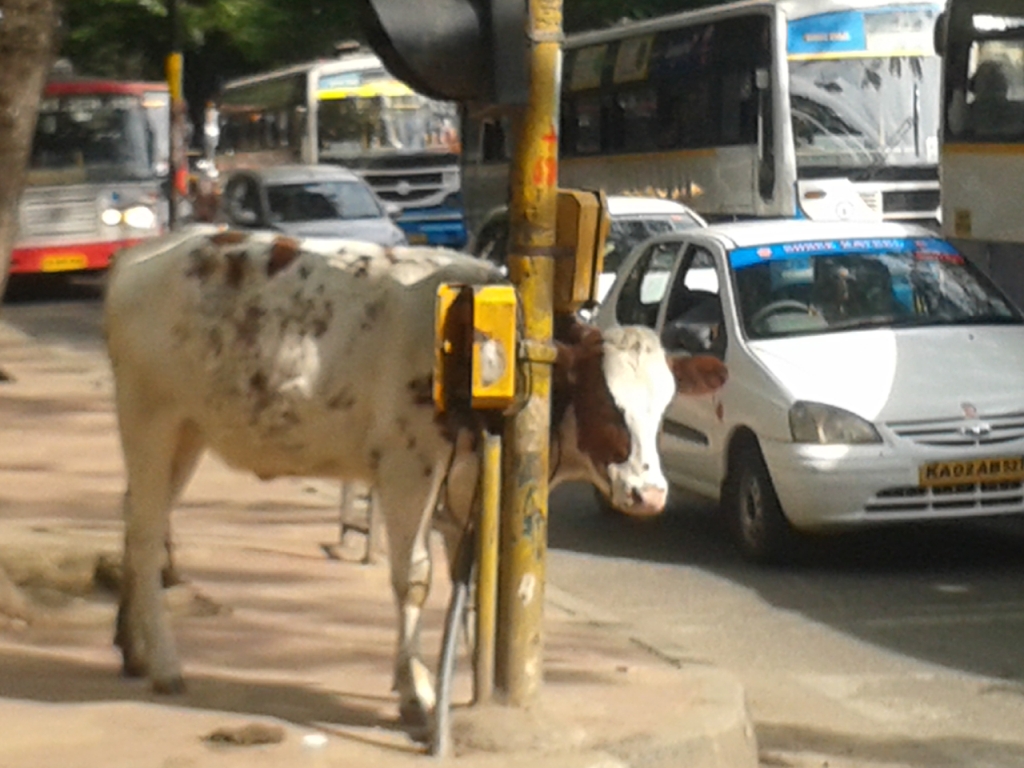
DAILY PHOTO: Cow Waiting for the Light to Turn

Taken October 8, 2013 in Bangalore.

Taken October 8, 2013 in Bangalore.

I just missed the perfect picture of this cow using its hoof to push the button for the pedestrian crosswalk light. I’m kidding of course, Bangalore doesn’t have functioning buttons for the pedestrian crosswalks and the cows damn sure know it.

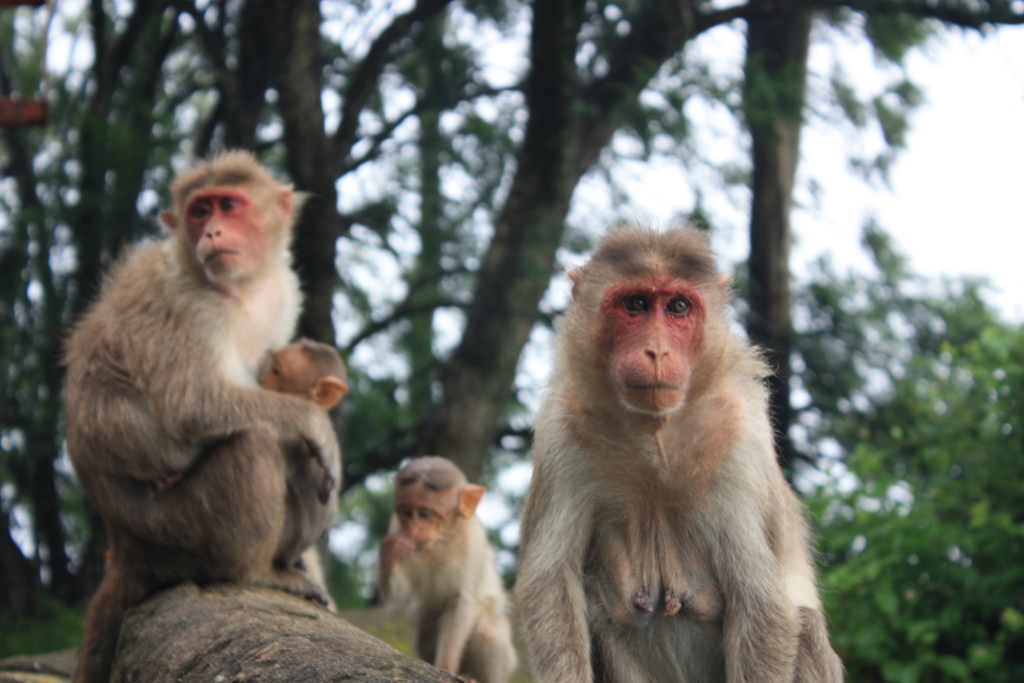
POEM: Monkeys Make Me Smile

Monkeys always make me smile

Some have hair in human styles

Oh the vanity  their locks betray

Can you spot the one with a toupee?

IMG_0507

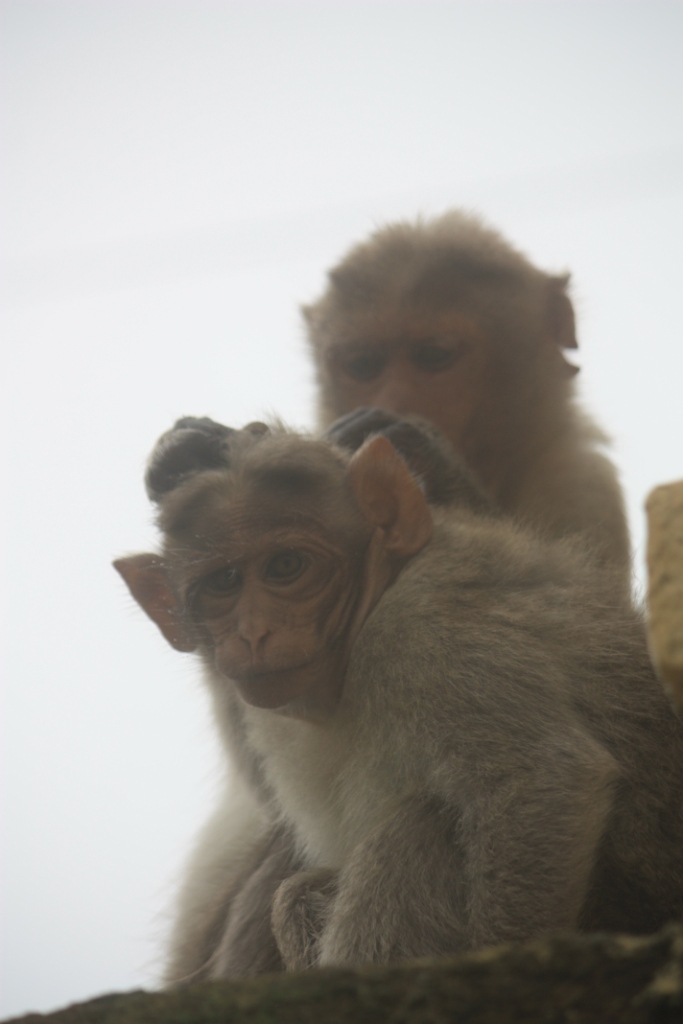
Faces so reminiscent of our kind

Eyes suggesting intelligent minds

Into their faces they’ll one day grow

but the youngsters all look like H. Ross Perot

IMG_0389

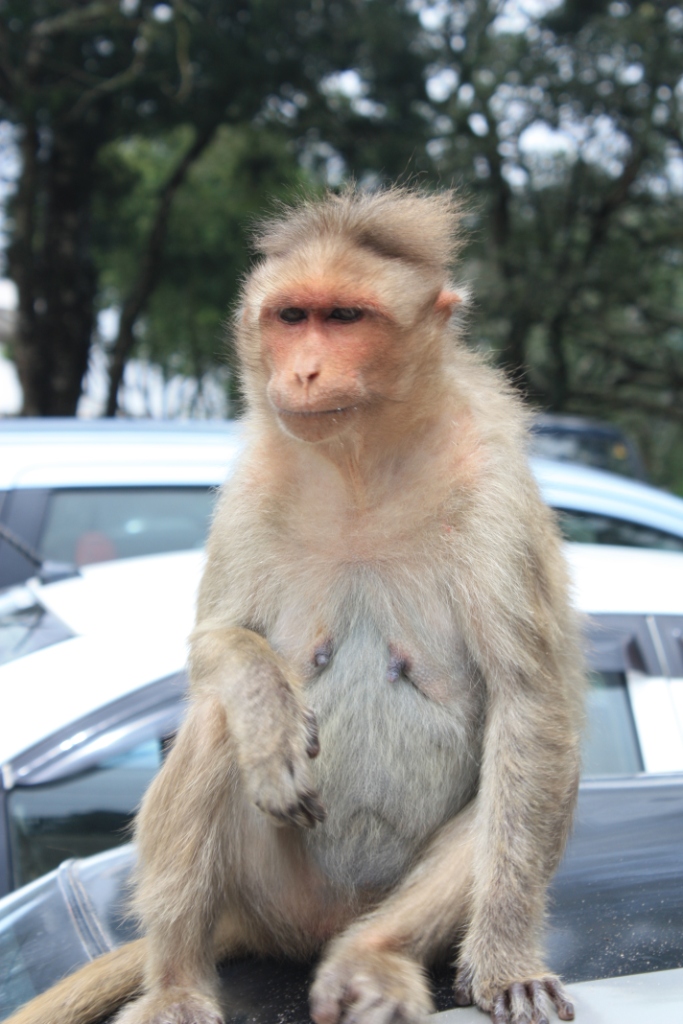
They’ll sit on your car like they just don’t care

And screw the haters who stop and stare

Have you the courage to leave your mark

on the windshield of one who double parks

IMG_0734

It amuses us that they sling their poo

So we banish them to the city zoo

But what of our words so vitriolic

We’re evolved to sling poo symbolic

Picture Your Unhappiness in its Underwear

I was writing some six-words on Smith Magazine the other day. I do this now and again as an exercise to get the creative juices flowing. There are a series of themes, and I try to write in as many of them as I can in less than 20 minutes, writing in a free form, stream of consciousness style.

When I got to the category HAPPINESS the first six-word to jump to mind was: “Picture your unhappiness in its underwear.” This one drew a nice response, which began me thinking about whether this advice might have actual merit–as opposed to being a non-nonsensical statement that might at best function as a Zen koan.

As I thought about it, three legs of the stool came to mind.

1.) Have a sense of humor. Anger and sadness have a hard time taking hold if one can manage a good laugh. I’ve found that being able to dance personal tragedy into comedy has been a great coping mechanism. One does have to be conscientious about not becoming a snarky person. One risks beginning to see the world through a crap-colored lens just as a means to comic fodder (or from a martyrdom complex.)

Perhaps even if one can’t formulate humor, one can still use laughter. There’s a system called laughter yoga that is based on the belief that you can create the same range of physiological responses from “forced” laughter as one does from spontaneous laughter. It’s a sort of chuckle pranayama (breathing exercises.)  While I don’t know much about the system, I can believe that it has merit based on what I’ve read about human emotions.

2.) Lay the source of your unhappiness bare. This sounds simple enough. One must know what is making one unhappy in order to turn that frown up-side-down.

That being said, human beings have an astounding ability to attribute all negative happenings in their lives to external factors. Like politicians, we like to take responsibility for what is going right (regardless of whether we are responsible or not), and we love to place the blame for failure firmly elsewhere (even it it’s mostly our fault.) This may be an evolutionarily-hardwired coping mechanism, but it can keep one in the doldrums.  If one continually says, “He makes me so mad” or even, “His actions make me so mad,” then you’re forfeiting control over your emotional state. Jerks and bitches might be an intermediary cause of unhappiness, but ultimately one’s own perceptions and responses lead to the negative emotional state.

This is where the hard work of mind training comes into play. Instead of being swamped by negative thoughts, one has to recognize them early, find the root cause, and recognize that our desire to for things to be a certain way is ultimately what makes us unhappy. We may want people to think we are smart or beautiful, and intimations to the contrary (whether intended or not) make us fume.

Don't be an angry monkey!

Don’t be an angry monkey!

One of the few things I remember explicitly learning in high school was about what our psychology teacher called a “gestalt of expectations.” Like most ideas one remembers though only taught once, I remember it because it had a memorable story attached to it. The story goes like this: “A man is driving through the desert in the American southwest. Now, out in the southwest, gas stations can be few and far between. So the man runs out of gas, and realizes that the station he passed 20 miles back is his safest bet because–contrary to what he had thought– the next one going forward might be another 50 miles.  So he starts walking. It’s hot. He’s hungry. He’s thirsty, and only has some lukewarm water that’s getting hotter by the minute. The backs of his hands and his face are getting sunburned. He starts thinking about how the little two-pump gas station is going to gouge him. He realizes he’s desperate, and so he figures the attendant is probably going to sell him gas at $6 a gallon, a bottle of cold water for $8, and don’t forget the jerrycan at $20.  These thoughts and the heat keep making him madder and madder. Finally, he gets to the station, and the attendant comes out and say, ‘Oh my, Mister, you must have had a horrible time.’ And so the man on the verge of heat-stroke punches out the attendant, a kid who only wanted to help him out.” Once one starts attributing one’s unhappiness to external sources, one can easily mis-attribute unhappiness because one thinks one knows what is in the minds of others, when really one doesn’t.

3.) Unhappiness, like standing around in one’s underwear, is–at most–a temporary state. As Taoists have been known to suggest, one’s darkest hour is a time to rejoice, for surely it will  get better from there. The only way one can remain in a perpetually unhappy state is to carry it with one long past its time. Just like the only way that can always be rained on is if one carries around a complicated mechanism with a showerhead and tank and keeps refilling that tank so that the shower never runs out. Otherwise, the dry season will come eventually.

The Deferential Calculus of Being an American in India

Every time I come home, the security man at the desk at our apartment building jumps to his feet and proceeds to stand at attention until I pass. This makes me uncomfortable, as do the many other ingrained acts of deference that occasionally border on obsequiousness. I’ve considered stopping to tell him he can be permanently “at ease” with me, but given the language barrier I’m afraid I’d just confuse the issue–plus have him standing at attention that much more longer. So, when in Rome…

If you’re an American, but not, say… General Pershing, you’d probably find this makes you uneasy as well. I think one of the reasons that Americans have historically excelled at technological development  is that we were in a hurry to have machines do our laundry, wash our dishes, or trim our nose hairs so that we wouldn’t have to have some other human apparently kowtowing to us. (This may be why the 19th century North was considerably more technologically advanced than its Southern counterpart, which had successfully rationalized a subclass of human being.)

There’s a guy who stands at the end of the lane and lifts a swing arm up and down every time a car (or, oddly, a pedestrian such as myself) comes down the lane. The first couple times I walked around the end in hopes of indicating to him that, “Hey, see you don’t really need to swing that thing up, I can just walk right around it, easy as pie.” I think I hurt his feelings, or–perhaps worse–undermined his reason for getting up in the morning. My point is that operating a swing-arm barrier is a perfect example of the type of job that has been completely mechanized in America.

I’m sure that cultural differences are the root of my discomfort. India is coming from the caste system, whereby who you were born to determined your status in a rigidly hierarchical structure. While Indians may have dropped the caste system, the underlying thought process dies hard. I, on the other hand, come from a culture which believes that on a fundamental level we are all equal. Americans are often stymied as to why we are viewed as being arrogant by other cultures. This may be a failure to see things in the same light. It’s not so much that we project that we are better than the average Joe, it’s that we don’t accept that the kings and holy men those cultures hold dear are above us. This is true. I don’t think I’m better than the door man, but I also don’t think the King of [Fill in the blank] is better than me. [OK, the perception of arrogance is also partly that we’re loud and expect a ubiquity of comfort that is simply not available in much of the world. There is that. And the fact that our leaders often think they can fix every problem everywhere, and–given this is not actually true–we have left a lot of chaos in the our wake since our rise to hegemony.]

So the whole culture thing is part of it. However, I also worry that the man who brings my food with a warm smile and a bow is spitting in it. I wonder if the lady who launders my clothes, and then goes the extra mile by ironing them (though they mostly consist of T-shirts and jeans), might be preparing an itching powder attack. I wonder if the security guy standing at attention is just waiting for me to lock myself out of my apartment so that he can exercise some passive aggressive payback. [I suspect this is why Indian bureaucracy is notoriously slow and prickly. It’s a desire to exercise the leg up on has while one is in other ways part of an underclass.] I heard a comedienne of Indian origin say that her mother always flew British Airways just for the delight of bossing a Brit around. All of this consternation is because I worry that they think that I think I’m superior to them, which I don’t.

Yesterday I was eating at an Indian fast food joint called Kaati Zone. It’s one of those places that you order at the counter, get your food at the counter, and take it to one’s table. (FYI- this set up is much less common here except for little holes in the wall where one stands to eat.) When I was done, I pitched my trash in the trash can and put my tray on top, just like one would at a Wendy’s. When I turned around there was a young woman with her jaw agape and eyes wide looking right at me. My first thought was that I had pitched my wallet or my journal in the trash. I did a pat down and found I was alright. As I left, it dawned on me that her surprise may have had something to do with my handling of my own garbage.

Lies My Tuk-Tuk Driver Told Me

Taken Sept 5, 2013 in Bangalore, India

Taken Sept 5, 2013 in Bangalore, India

Tuk-tuks or Autorickshaws  are the ubiquitous three-wheeled vehicles-for-hire seen throughout South and Southeast Asia. (Note: Owing to their evolution from walking or pedal rickshaws, they’re sometimes just called “rickshaw” for short, or even “pedicab” or “petty cab”–the latter likely a corruption of the former.) They’re an essential way to get around in the big cities of Mega-Asia, but almost everyone has a bad experience with one at some point.

Let me point out that I’m not suggesting that most tuk-tuk drivers are amoral liars, but as a tourist (or someone who looks like one) the drivers that approach you probably will be. The vast majority of drivers are honest, hard-working men (and the elusive woman) just trying to put food on the table. That’s why my key advice to people on the subject is, “Pick your driver, and don’t ride with the ones who pick you. Then always negotiate your fare–or make sure they will use the meter– before you get in.” The drivers who pick you often have rationalized that it’s alright to treat foreigners like crap. And I’m not so much talking about charging you a little more money (which I personally don’t mind), but more that it’s alright to waste your time or take you places you didn’t ask to go [and potentially much worse.]

Well, without further ado, I’ll share some of my interactions with drivers. This is inspired by a whooper I was told yesterday.

1.) Driver: “The Temple is closed.”
Me: “But there’s a line of Caucasians and Japanese people with cameras going into the place right this moment. I can see them as we speak.”
Driver: “Uhh, monks and nuns.”

2.) Driver: “That road closed. Big protests. Throwing stones. Very dangerous!”
Me: “But I can see all the way to the corner where we need to turn, there’s nobody there.”
Driver: “They hide. [Pantomiming popping up over a wall] Throw rocks.”

3.) Driver: “Meter[ed fare is] 200 Rupee, but I’ll take– only 150 Rupee.”
Me: “I just took a trip yesterday that was 50% farther and took twice as long, and the metered fare was 50 Rupee.”

4.) Driver: “But traffic very bad, VERY BAD. Premium rate time.”
Me: “But it’s Sunday morning at 8:00am. I haven’t heard a horn for half an hour, and I happen to know that there’s no such thing as ‘premium rate time.'”
Driver: “It’s new.”

5.) Driver: “You can’t get from here to there, except go past travel office.”
Me: “Sure you can. It’s one block over and then a straight shot of five kilometers. The travel office is four kilometers out-of-the-way.”
Driver: See lie #2