Rivers of the Dead [Free Verse]

So many cultures
make their dead
cross a river.

The Greeks' Styx.
The Hindus' Vaitarna.
The Norse Gjȍll.
The Gnostic's Hiṭpon.
The Japanese Sanzu-no-Kawa.
The Mesopotamians' Hubur.
Taoists cross Naihe Bridge --
over what (I'm not sure,
but) is probably a river.

No rest for the dead?
It seems kind of rude.

PROMPT: Cultural Heritage

Daily writing prompt
What aspects of your cultural heritage are you most proud of or interested in?

It’s not something that I’ve thought of much. In my youth, I was attracted to most every culture but that of my own ancestry. In my late teens and early twenties, I visited Liverpool two or three times (just across the Irish Sea from my ancestral homeland,) but (sadly) never made it to Ireland. I’ve been to over 40 countries, but not yet my ancestral homeland. I think that’s not so uncommon to come around to an interest in such things later in life.

But the answer to the question is certainly to be found in the literature. Yeats is among my favorite twentieth century poets (if not my favorite,) and Seamus Heaney is certainly in the running. Of late, I’ve gotten on an Oscar Wilde kick, and his work definitely appeals to my ornery yet thoughtful nature. Even Joyce, who I had trouble getting into in his role as novelist, is a writer whose use of language I love.

PROMPT: Comfort Foods

What’s your go-to comfort food?

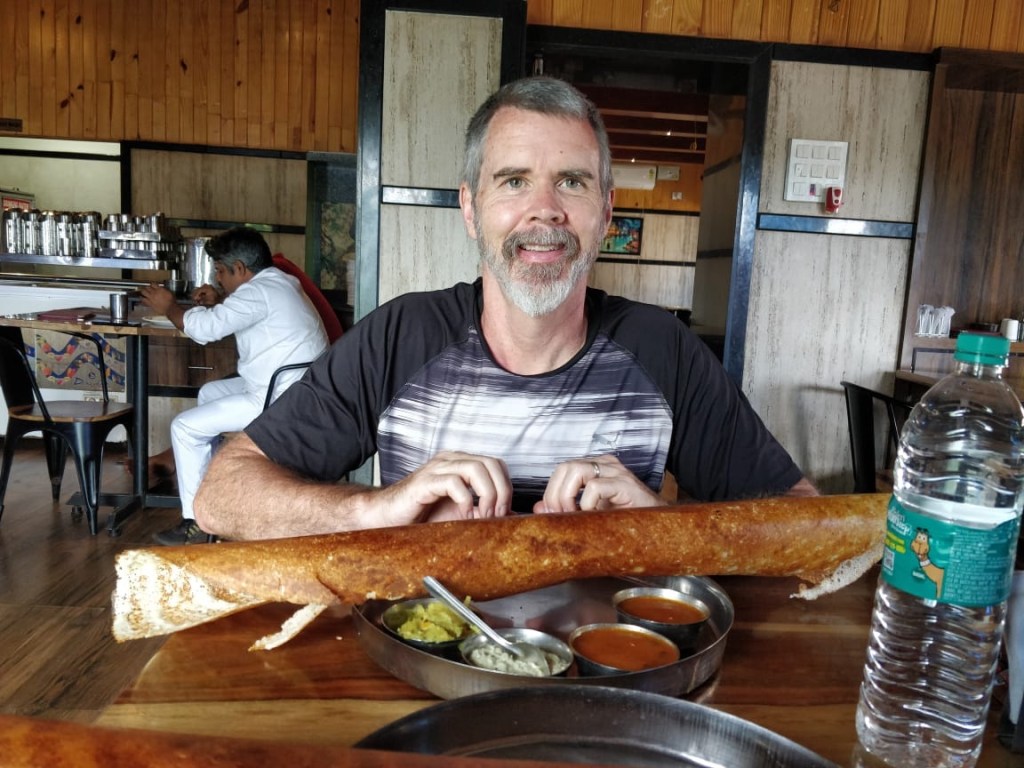
Completely depends on where I am at the moment. Here, in South India, it’s a paper masala dosa.

But [for example] in Budapest it’s túrós csusza, in Bangkok it’s pad thai, in Bombay it’s vada pav, and in Vajrayana Buddhist areas it’s momo.

BOOK REVIEW: Identity: A Very Short Introduction by Florian Coulmas

Identity: A Very Short IntroductionIdentity: A Very Short Introduction by Florian Coulmas
My rating: 5 of 5 stars

Amazon.in Page

This book explores the slippery metaphysical concept of identity — not only as it’s presented in philosophy, but also in psychology, law, politics, anthropology, and literature. It begins with individual identity and expands outward to encompass gender, political, socio-economic, and linguistic identities. The aforementioned slipperiness of identity stems from the fact that we all have an intuitive grasp of identity that could be leading us astray. It tends to make us believe that aspects of identity are inherent features of the universe, when – in fact – they may be arbitrary designations – in which case, a given criterion or classification of identity may be chopped up in different ways than a given culture happened to glom onto.

I learned a great deal from this Introduction, and feel it was well organized and presented. How we see various dimensions of group identity (as well as how we weight them) has a lot to do with our social tensions and strife, and the issues around identity are worth dissecting — despite the fact that it might seem like a dry academic topic at first blush.

If you’re interested in learning more about identity, selfhood, and how various group identities feature in an individual’s overall identity, this book is worth investigating.


View all my reviews

BOOK REVIEW: Social and Cultural Anthropology [VSI] by John Monaghan & Peter Just

Social and Cultural Anthropology: A Very Short IntroductionSocial and Cultural Anthropology: A Very Short Introduction by John Monaghan
My rating: 5 of 5 stars

Amazon.in Page

Get Speechify to make any book an audiobook

This was one of the most interesting “Very Short Introduction” books — of the many titles in the series that I’ve read. The authors use stories and examples to convey the basics of the subject in way that’s not mind-numbingly dry (i.e. the scholarly norm) – in fact, there’s a fair amount of humor laced throughout the book.

Most of the examples come from the two tribes that these two authors study – i.e. one in Mexico and the other in Indonesia. However, those two groups provide a rich arena of interesting anecdotes, and the authors do use social groups outside their research focus when necessary.

In addition to learning about the nature of ethnographic fieldwork and what anthropologists do, there’s an exploration of culture, the various ways in which people are socially organized (i.e. kinship, castes, societies, etc.,) and how different societies view religious belief, economic activity, and selfhood.

If you’re starting from zero and are seeking an introduction to anthropology, I’d highly recommend this one.

View all my reviews

BOOK REVIEW: Introducing Cultural Studies: A Graphic Guide by Ziauddin Sardar

Introducing Cultural Studies: A Graphic GuideIntroducing Cultural Studies: A Graphic Guide by Ziauddin Sardar
My rating: 4 of 5 stars

Amazon.in Page

Get Speechify to make any book an audiobook

Culture is a deep and fascinating topic, but a dirty little secret of academia is that there are two words used to signal subjects and courses for the not-so-bright kids: one is “Studies” and the other is “for.” (As in “Math FOR Economists,” a course that I once took that was – I’m sure of it – greatly dumbed down from what Math majors learned. “Economics FOR Business Majors” is a more widely known example; it’s Economics for people who are afraid of equations and who can’t figure out which way is up on a supply and demand curve.) So, I wasn’t sure what to expect from a guide to “Cultural Studies,” as opposed to a book about, say, Cultural Anthropology, which I believe is the big-boy pants version of the discipline under discussion.

The author is forthright that cultural studies is a bit amorphous and that it struggles to find its place amid the established disciplines that touch upon culture from varying perspectives (i.e. psychology, philosophy, anthropology, etc.) The book begins before there was a “Cultural Studies,” per se, discussing competing definitions of culture and related precursor disciplines, e.g. semiotics. It then describes the evolution of the subject and its varied points of focus and ideas across its major epicenters: Europe, North America, Australia, and South Asia. It investigates colonization and its influence on indigenous cultures, and it looks at how a range of concepts intersect with culture, including: science, technology, race, gender, sexuality, and media. It concludes by reflecting on globalization and the discontents who wish to end or replace this homogenizing force.

I did learn quite a few new things from this book, and if you’re looking to understand culture as a landscape of academic study, it’s worth having a look at it.


View all my reviews

BOOK REVIEW: The Beats: A Very Short Introduction by David Sterritt

The Beats: A Very Short IntroductionThe Beats: A Very Short Introduction by David Sterritt
My rating: 5 of 5 stars

Amazon.in Page

This is the most fascinating book I’ve read in the VSI (Very Short Introductions) series, and I read a lot of these books as a means to mainline the gist of various academic subjects. I should point out that the subject matter is more colorful than the average scholarly topic. The Beats were a 1950’s American countercultural literary movement that some may confuse with the hippies of the 60’s, but which was different in many ways. As is emphasized in the book, the Beats were more about revolutions from within than they were about upending society. In that sense, they might have more in common with the Transcendentalists (i.e. Emerson, Thoreau, etc.) than the hippies. That said, some Beats did flow pretty smoothly from one movement to the next, and were both interested in revolution from within and without – most notably, Allen Ginsberg.

The first thing that one finds compelling is the biographical sketches of key Beat figures (i.e. chapters 3 and 4 on Beat novelists and poets, respectively.) A disturbing number of Beats lived tragically short lives, owing to drugs, alcohol (e.g. Kerouac,) and sometimes just being around a violent contrarian. Even the Beats who lived long lives had their share of outlandishness, such as William Burroughs killing his wife, Joan Vollmer, in an ill-fate William Tell imitation. (Those who know Burroughs from later in his career may wonder why he even had a wife, being gay and all. That’s just one of the ways that hidden, latent, and repressed homosexuality plays out as tragedy in the Beat story of the socially conservative 1950’s.)

The second thing I found absorbing was the discussion of how these writers and poets made art. Like the aforementioned Transcendentalists, the Beats drew heavily on Eastern philosophies and psychologies – most notably Buddhism, and Zen, in particular. Beat authors not only looked to the East for subject matter and aesthetics, but also to help them achieve the spontaneity and nowness associated with Zen. However, this wasn’t wholesale conversion to Buddhism, it remained a uniquely American strain, and also sought to draw inspiration from that most American of arts, Jazz.

If you’re interested in the Beats or their approach to writing, I’d highly recommend reading this book.


View all my reviews

BOOK REVIEW: Iranian Love Stories by Jane Deuxard & Deloupy

Iranian Love StoriesIranian Love Stories by Jane Deuxard
My rating: 5 of 5 stars

Amazon.in Page

Out: December 14, 2021

This graphic novel shows what life is like in Iran. A French couple engaged in immersion journalism converses with Iranian men, women, and couples. As the title suggests, the theme of the book is intimate relationships (and marriage, when it – sadly – doesn’t fall into that category,) and the trials of love under an ultra-conservative theocratic regime. The book offers insight into how singles sneak love, how arranged marriages work (or don’t,) and how the bizarre in-law dynamics of arranged marriage are navigated. One also learns about non-amorous elements of Iranian life – i.e. the illicit nature of dog owning, workplace dynamics, etc.

The people Deuxard talked to were overwhelmingly wealthy, educated, and unhappy with the regime. That said, there’s a range of views presented. There were a few who were mostly happy – e.g. one young woman complained about the impossibility of openly dating, but said she was ultimately happy not to live in the West where she would probably have to work and / or take on other responsibilities she was freed of as an Iranian housewife. Additionally, one girl said that a relationship in Europe would offer no thrill because, you know, no one will murder you for smooching your boyfriend in Denmark. There were also many who desperately wanted out of the country, some of whom felt trapped and others who were working toward getting away (there are measures in place to make this difficult for many – e.g. if you have an Iranian degree, you have to pay it off before you’re granted an exit visa.) Some were hopeful that the theocracy would be overthrown, but most were resigned to a tormented life.

As a traveler, I’m fascinated by how people live at various places around the world, and so I found this book intriguing and thought-provoking. However, I can see how those who aren’t interested in such questions might find it a bit dull. It’s essentially documentary-style interviews in graphic novel format. That said, I thought the artist and writer did a good job of conveying mood. If you want to know what life is like in Iran, check it out.

View all my reviews

BOOK REVIEW: The Geography of Bliss by Eric Weiner

The Geography of Bliss: One Grump's Search for the Happiest Places in the WorldThe Geography of Bliss: One Grump’s Search for the Happiest Places in the World by Eric Weiner
My rating: 5 of 5 stars

Amazon page


This book combines travel writing with pop science discussion of what makes people happy (or unhappy.) Weiner travels to ten countries in pursuit of happiness, and reflects upon the cultural components of bliss.

Some of the countries, like Switzerland and Iceland, rank among the world’s happiest in international surveys. Some of the countries, such as Qatar and America, have every reason to be happy, but aren’t necessarily as blissful as the rest of the world would expect. Some of them, like India and Thailand, have good reason to be unhappy, and yet they manage to be global exemplars of happiness [at least within certain domains.]

Then there are a few nations that have unique relationships to happiness. Bhutan has a national policy on happiness [plus it’s a Buddhist country, and Buddhism probably offers the most skillful explanation of what it takes to be happy of any world religion.] Moldova provides a counterweight as it’s one of the least happy countries in the world. Weiner visits the Netherlands in part because one of the biggest academic centers studying happiness is located in Rotterdam, but it also offers an opportunity to study whether the country’s unbridled hedonism (drugs and prostitution are legal) correlates to happiness. That leaves Great Britain, a country known for wearing the same happy face as its sad, terrified, and enraged faces.

I’ve been to half of the countries on Weiner’s itinerary, and—of the others—I’ve been to countries that share some—though not all—of the cultural constituents of happiness. (e.g. I haven’t been to Qatar, but I’ve been to the UAE. I haven’t been to Moldova, but I’ve seen somewhat less grim Eastern European states. I haven’t been to Switzerland or Iceland but I’ve been to cold countries in Western Europe. I haven’t been to Bhutan, but I’ve been in areas where Tibetan Buddhism was the dominant cultural feature.) This allowed me to compare my experiences with the author’s, as well as to learn about some of the cultural proclivities that I didn’t understand during my travels. And I did find a lot of common ground with the author, as well as learned a lot.

I found this book to be interesting, readable, and funny. Weiner has a wacky sense of humor that contributes to the light-hearted tone of the book—perfect for the subject. That said, some people may be offended because the author doesn’t pull punches in the effort to build a punchline, and this sometimes comes off as mocking cultures. However, in all cases—even that of Moldova—Weiner does try to show the silver lining within each culture.

The paperback edition I read had no graphics or ancillary matter. There are no citations or referred works (except in text), and the chapters are presented as journalistic essays. The chapters largely stand alone, and so one could read just particular countries of interest. He does refer back to events that happened in earlier chapter or research that related to another country’s cultural proclivities, but not often. The first chapter, on the Netherlands, would be a good one to read first because he describes many of the scientific findings on happiness in that one.

I would recommend this book for anyone interested in what makes some places happier (or sadder) than others.

View all my reviews

DAILY PHOTO: Fire Handler

Taken in May of 2015 in Kandy

Taken in May of 2015 in Kandy

IMG_0474