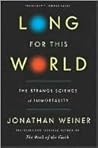
BOOK: “Long for this World” by Jonathan Weiner

Long For This World: The Strange Science of ImmortalityLong For This World: The Strange Science of Immortality by Jonathan Weiner
My rating: 4 of 5 stars

Author’s book site

This book considers the science around the question: will there come a day when human beings live forever (or at least considerably longer than we’ve achieved to date? — i.e. hundreds or thousands of years.) A secondary question, explored in the last of the book’s three parts, is should we want to?

It was a courageous decision to write this book because it focuses heavily on the ideas of one particularly controversial figure, Aubrey de Grey. And by “controversial” I don’t mean to the general public, a public which has limited understanding of the science involved, but rather a man who is controversial to many (perhaps, most) of his peers. Of course, with a Pulitzer under one’s belt, one can afford to take a few chances. (Weiner won in 1997 for The Beak of the Finch, a popular science work on evolutionary biology.) To be fair, Weiner does not present Grey’s ideas from the perspective of an acolyte. On the contrary, he is clearly skeptical and not shy about presenting the countervailing arguments put out by others in the gerontological field.

I can see several reasons why Weiner chose to focus on Aubrey de Grey. First, De Grey is an eccentric figure, and that makes for more interesting reading. Second, De Grey also takes the boldest possible stance on the topic (i.e. that there is no reason humanity won’t be able to overcome aging and death, given sufficient time and effort.) Finally, De Grey has a readily digestible roadmap for eliminating aging. De Grey identifies seven problems that must be solved, arguing that the last — i.e. defeating cancer — is the only one that will present a true challenge in the long run.

While I wasn’t converted to a belief that immortality is inevitable (and that wasn’t the book’s objective, though it may be de Gray’s,) the book does offer interesting food-for-thought, both on the scientific question of what it would take and on the philosophical question of whether we should want to.

If you’re interested in aging and mortality, I’d recommend reading this book.

View all my reviews

BOOK: “The Mind Electric” by Pria Anand

The Mind Electric: A Neurologist on the Strangeness and Wonder of Our BrainsThe Mind Electric: A Neurologist on the Strangeness and Wonder of Our Brains by Pria Anand
My rating: 5 of 5 stars

Publisher Site — Simon & Schuster

There are A LOT of pop neuroscience books out there that reflect upon what we know about the brain from what goes wrong with it. I thought I was done reading such books because, while the first few are fascinating, they tend to retell the same stories.

That said, I’m glad I read this one, and what made it worth reading was that the science was explored in a very personal way, and I don’t just mean that the author recited her own personal experiences or those of her patients (though she does both,) but rather that the whole book is imbued with her worldview. She relates maladies of the mind to works of literature, of Greek and Hindu mythology, and to other aspects of culture in a relatable manner.

Another factor that sets this book apart is that its author shows a passion for language. In that sense, it reminded me of the works of Oliver Sacks (who she references a number of times,) rather than your average — articulate but linguistically conservative — neuroscientist.

I’d recommend this book for any readers interested in neuroscience, particularly anyone looking for a book that sets itself apart from the crowd. (I don’t recall it even mentioning Phineas Gage, which I thought was a requirement of all such books.)

View all my reviews

PROMPT: Nickname

Daily writing prompt
What’s the story behind your nickname?

It’s a shortened version of my proper name. I was born before “Weekend at Bernie’s” and before legendary comedian Bernie Mac became a comedian (at least before he became a celebrity,) and so – contrary to popular stock responses upon mention of my name – it derives from neither.

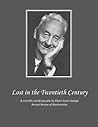
BOOKS: “Lost in the Twentieth Century” by Albert Szent-Györgyi

Lost in the Twentieth Century (Annual Review of Biochemistry Book 32)Lost in the Twentieth Century by Albert Szent-Györgyi
My rating: 5 of 5 stars

Available Online – NIH National Library of Medicine

This is the very brief autobiography of a fascinating man. Szent-Györgyi is most famous for work in biochemistry involving Vitamin C, work that won him a Nobel Prize. However, his life is not only notable for science before and after the Nobel (after he worked on the physiology of muscular activity, on electron activity in physiology, and on cancer.) He also performed important works outside the laboratory, notably he conducted an espionage / diplomatic mission during the Second World War (“Espionage” in that he traveled to Turkey under false pretenses, under cover of giving a lecture at a university, “diplomatic” in that the trip’s true objective was to negotiate with the Allied powers.)

Szent-Györgyi has some interesting quips and insights that make it worth reading this pamphlet-scale book, even though his Wikipedia page probably contains as much information. He had an interesting way of thinking about matters, both scientific and not, and was politically and socially engaged in the world.

If you’re curious about Szent-Györgyi or enjoy biographies, in general, I’d highly recommend reading this one.

View all my reviews

Evolution [Free Verse]

Anywhere copies are made, 
but copies aren't exact,
selection will take place.

Some erroneous copies will
be more beloved than others.
Some errors will propagate.
Some errors will die out.

Thus is language,
thus is chemistry,
and thus is life.

Lion-tailed Macaque [Lyric Poem]

I came upon a Lion-tailed Macaque,
And was instantly taken aback.
Sure, its tail was lion-like, but what's weird
Is that namers didn't call upon that beard!

BOOK REVIEW: A Gardener’s Guide to Botany by Scott Zona

A Gardener's Guide to Botany: The biology behind the plants you love, how they grow, and what they needA Gardener’s Guide to Botany: The biology behind the plants you love, how they grow, and what they need by Scott Zona
My rating: 5 of 5 stars

Amazon.in Page

Release Date: December 6, 2022

This beginner’s guide to botany is well conceived and executed. The photographs are beautiful and well-chosen to help the reader understand the complexities discussed in the text. The text gets definitionally dense in places, but also presents fascinating ideas in plain English. I learned a lot from the book, particularly where it was less steeped in technical terminology and details and offered intriguing ideas and examples.

While the book’s eight chapters aren’t formally divvied up, I would place them into three groups. Chapters one and two are about what plants are and how they are organized to do what they do. Chapters three through five are about what plants need to survive (water, light, and nutrients, respectively) and why. The last three chapters explore the main activities plants engage in (i.e. defense, reproduction, and seed dispersal.)

I found this book to be informative and readable, and if you’re looking for a basic guide to botany that skillfully employs photographs, I’d have a look at this one.


View all my reviews

BOOK REVIEW: Body Am I by Moheb Costandi

Body Am I: The New Science of Self-ConsciousnessBody Am I: The New Science of Self-Consciousness by Moheb Costandi
My rating: 5 of 5 stars

Amazon.in Page

In this book you’ll learn about: a man who wanted a perfectly healthy leg amputated, a fisherman who felt like his hands were crab claws, a woman who felt she wasn’t responsible for the actions of her hand, various people who’ve experienced “Alice in Wonderland Syndrome” [i.e. feeling one has shrunk or stretched,] and about many other issues stemming from the body’s sensory and motor integration with what we think of as the mind. For most of us, the most powerful take-away to be gained from this book is just how wonderful and awe-worthy it is that we have bodies that are so well integrated and coordinated that we can go about life engaging in all sorts of fascinating and productive activities.

While this isn’t the only book that addresses this subject, I think it’s a topic worth learning more about and reflecting upon in depth. We can get so out of touch with the fact that our body is integrated with our mental and sensory experiences that we take “brain in a vat” scenarios as a given for the near future, as if one is the sum of one’s neuronal connections. This book will disabuse one this notion. In fact, the final chapter (Ch. 10) questions the proposition that copying consciousness is a matter of mastering such neuronal mapping. It’s easy to miss how much of our emotional experience is rooted in what’s happening in our guts and heart, and how much all the non-central nervous system parts of the body play in our conscious experience of the world.

I learned a great deal from this book and would highly recommend it.

View all my reviews

BOOK REVIEW: Introducing Epigenetics by Cath Ennis

Introducing Epigenetics: A Graphic Guide (Introducing...)Introducing Epigenetics: A Graphic Guide by Cath Ennis
My rating: 4 of 5 stars

Amazon.in Page

Get Speechify to make any book an audiobook

I’m old enough to remember when the human gene sequence was first being decoded, and there was a widespread belief that it was going to end genetic diseases in one fell swoop. It didn’t do that, and – in fact – seemed to result in whole new levels of confusion. It’s fascinating to me that now Epigenetics, a subject that grew out of that confusion, is also being seen as the ticket to ending disease. Epigenetics investigates what traits are expressed and why, given that a specific gene sequence has a vast array of potential for various traits to be (or not to be) expressed.

For those familiar with this series (the “A Graphic Guide” series,) this book is more difficult to digest than most titles, certainly than any of the several others that I’ve read. To be fair, the subject matter is more technical than most, leading to it being more jargon- and acronym-intensive. In addition, the subject isn’t cut up into as small of pieces as most of the books. This one has far fewer and longer chapters than the others that I’ve read.

That said, while it reads technically for the general reader, there are a few concepts (methylation, demethylation, and histone modification) that are frequently revisited throughout the book, and so one can get a basic grasp of those concepts. The book also explores some issues that are more readily understood by the lay reader, such as: nature v. nurture in gene expression, the role of twin studies, and how pseudo-scientific individuals and organizations have made fraudulent claims involving Epigenetics.

If you want to learn about the fundamentals of Epigenetics, you may want to look into this book — but keep in mind that it’s not a smooth read.

View all my reviews

BOOK REVIEW: The Exquisite Machine by Sian E. Harding

The Exquisite Machine: The New Science of the HeartThe Exquisite Machine: The New Science of the Heart by Sian E. Harding
My rating: 5 of 5 stars

Amazon.in Page

Release date: September 20, 2022

Get Speechify to make any book an audiobook

In this book, a renowned heart researcher presents an overview of what we know (and don’t know) about the human heart: i.e. what can go wrong with it and why, how [and to what degree] it fixes itself, and what modern medicine can do to treat or replace a damaged heart. I learned the most from the middle of the book – i.e. chapters five through seven. Chapter five explores plasticity in the heart, plasticity is a concept that most people associate with the brain and its ability to rewire itself to contend with damage or changing needs. The other two chapters look at how the heart can be damaged, specifically as a result of emotional experience. A “broken heart” isn’t necessarily a misnomer.

Chapter four is also intriguing but takes the win for “which one of these things is not like the others.” It deals with big data, though not in a general sense but rather as it applies to gaining a better understanding of the heart. This chapter discusses a common challenge of medical research: that it’s hard to come up with large enough study groups of patients with close enough to the same problem to draw solid conclusions. Four also discusses the potential of the vast amount of data that exists, e.g. Fitbit heart rate figures.

The last couple chapters deal largely with the future of heart repair through genetic / biological means (as opposed to via mechanical hearts and technologies, which are dealt with in Chapter nine.) This is where the book gets to be a challenging read for a readership of non-experts. It gets technical and jargon- / acronym-heavy.

The heart is an astounding entity, relentlessly at work, rarely giving up despite regularly being subjected to intense shocks, an organ tied to our whole being in a way that humans have always felt – if only just begun to understand. If you’re interested in learning more about this magnificent organ, check this book out.

View all my reviews