
Glories Past
Sitting off the Coney Island boardwalk, the old Child’s restaurant–like so many structures at Coney Island–embodies glory days past.
Can you see it in its heyday?

Glories Past
Sitting off the Coney Island boardwalk, the old Child’s restaurant–like so many structures at Coney Island–embodies glory days past.
Can you see it in its heyday?
The one Oscar winner I saw
I only watched part of the Oscars last night. At some point I realized it wasn’t worth continuing. I see about three movies in the theater per year, and rarely are any of them Oscar material. At 10:00 pm all I had to show for watching was the chorus of the ditty “We Saw Your Boobs” echoing through my brain. (Damn you, Seth MacFarlane, for that catchy, clever, melodic jingle that still runs like a gerbil in the rodent-wheel of my mind.)
The three movies I saw in the theaters last year were: The Avengers, Dark Knight Rises, and This is 40. The first two will no doubt convince you that I am a 12-year-old boy trapped in a middle-aged man’s body, and the last will convince you that I have poor judgement. (This is 40 had its humorous moments, but there was far too much screaming for my taste, although we did see Leslie Mann’s boobs– damn you, again, Seth MacFarlane.) I saw another half-dozen 2012 films on long Korean Air flights, but these were equally lowbrow titles (Men in Black 3, Prometheus, and Brave– the latter at least won an Oscar during the hour and a half I was watching, I think it was for Best Animated Makeup Artistry.)
I’m not altogether lowbrow. I will see most of the big winners eventually, when they finally make it to basic cable. For example, I watched The Hurt Locker on Saturday, just one day before the Oscars. So I am only three or four or five years out of synch. The Hurt Locker is a particularly fine example of going the other way because I understand its distinction is being the lowest grossing Best Picture winner ever.
This year’s Best Picture Argo is definitely a film that I will see in the next five years–barring Zombies, the apocalypse, or a Zombie Pandemic Apocalypse. So there’s a 60% chance that I’ll see it. The Iranian hostage crisis is one of the first historical events that I remember seeing on the news first-hand. Had I been in the country when Argo came out–I might have seen it in the theaters, but probably not.
Part of me thinks that I should grow up and start watching the “right” movies. However, part of me says, “wait, there’s this one day a year when everybody is talking about these movies, and the other 364 days they are talking about Dark Knight Rises and The Avengers“ So in some sense, I already am watching the “right” movies.
My rating: 3 of 5 stars
Humorist George Mikes’ main premise in this book is that humans created God in their image. The book is a series of essays designed to instruct God, if he or she exists, in being a more reasonable facsimile of the ideal human–dear old mom.
Actually, the micro-essays that make up the chapters of this book cover a wide range of subjects. Some of them stay on topic more closely than others. A few of the chapters seem to be stories that the author found interesting (and they are), but which didn’t have a lot to do with supporting his argument. For example, he discusses the two good deeds he has done in life, and he has a chapter on episodes of coincidence. The former may be a tongue-in-cheek support for the argument that even the worst of us are good sometimes. The latter may have been an attempt to bolster a more general argument for atheism by stating that coincidences are not miracles. However, if that is his point, while true, he doesn’t explicitly close that loop in any but the most gratuitous way. At barely over 100 pages, it felt like some of the material, while entertaining, was in the book not to address the topic but to hit the lower bound on a page range.
Mikes weaves together amusing anecdotes with shock-essayist statements that are not so much humorous as gratuitously provocative. With respect to the latter, I’m thinking of his discussion of Hitler and Stalin as basically good guys–if at least in their own minds.
The book is a mixed bag. It’s sometimes though-provoking and humorous, but other times it drifts into shock and awe gratuitous assertions. I suspect he could have hit his page mark by supporting his arguments better and still maintained the humor (realizing that exposition can be death in humor writing.)
A prime example of the book at its best is a story about a woman meeting with her doctor [paraphrased herein.] This is in a section about mini-gods, i.e. those people that we quasi-deify–such as judges and medical doctors. The doctor is trying to convince the woman to have surgery, but the woman refuses.
The doctor asked, “how did you get here today?”
The lady replied, “I took the bus.”
“And you trusted the driver, a complete stranger, with your life. But you won’t trust me–an expert in my field?”
“Yes, of course, the difference is vast.”
“How so?”
“The driver was on the same bus.”
If you find a copy, this book is worth a read. It’s not much of a time investment. It’s an illustrated 105 page book. If your attitude is, “Sacred cow? it’s what’s for dinner,” you’ll probably like it overall. If you are pious, you’ll probably hate it. If you are neither, you’ll probably find that it has its moments.

Budapest’s south side
Gellért Hill is a prominent overlook in Budapest; it’s topped by the Citadel. The hill offers splendid views both north and south down the Danube River. I show the view to the South to be contrary (pictures to the north, dominated by the sprawling neo-gothic Parliament building, are ubiquitous–and are commonly the subject of postcards.) If you want some exercise, you can walk up to the top. The stairs are adjacent to the roundabout at the foot of the Buda-side of the Erzsébet bridge.

Killer duck jumps out of the water.
 The Lone Samurai: The Life of Miyamoto Musashi by William Scott Wilson
My rating: 4 of 5 stars
[Note: this was previously posted in my martial arts blog, Jissen Budōka.]
This is a concise and well-researched biography of one of Japan’s most famous swordsmen. Miyamoto Musashi, however, wasn’t just a swordsman, he was also a writer, a painter, a sculptor, a Zen Buddhist, a poet, a philosopher, and a strategist. In short, he was a renaissance man. While The Lone Samurai focuses heavily on Musashi’s many duels as a traveling warrior, it also describes his artwork as it paints a portrait of a complex and beguiling character.
Musashi holds a curious allure among figures in Japanese history. The Japanese tend to be strictly bound by societal conventions, and being respectful and well-mannered is valued above all else. Musashi flouted convention whenever it served him. He used irreverence for strategic advantage. He was an astute reader of men. He often showed disrespect in order to get into his opponent’s head. This is most famously exemplified in his Ganryu Island duel with Sasaki Kojiro.
Musashi adopted a life of musha shugyo, or warrior errantry, though he could have been much wealthier and more comfortable had he chosen to be. He enjoyed simplicity, and only owned a few possessions. In his travels, he engaged in over 60 duels, and is usually credited with being undefeated [Note: I’ve heard some dispute the outcome of his second duel with Muso Gonnosuke. Wilson calls it a draw, but I’ve heard it called Musashi’s only defeat as well.] He fought as a samurai in battle at Sekigahara as well, but his adulthood was a relatively peaceful time.
One fascinating, but controversial, claim is that Musashi had no teachers–neither in swordsmanship nor in any of the fine arts he practiced. Musashi said this himself, but some historians dispute it. If true, it really takes being an extraordinary person up a notch. It should be noted that Musashi was only 13 when he had his first duel.
There is much about Musashi that is lost to the ages, but this book does a great job of pulling together what is known and weaving it into a portrait of the man.
There is an extensive series of appendices providing background information, notes, a glossary, and even a collection of pop culture (e.g. movie and novel) depictions of Musashi.
It’s well worth the read if you’re interested in strategy, history, or the biographies of incredible people.
 Secret Weapons by Cheryl Hersha
My rating: 3 of 5 stars
Secret Weapons is about two sisters who are trained in an MKULTRA-style behavior modification program to become femme fatales. This book was a rare find. I hadn’t heard of it before or seen it in my local bookstores, but I came across a copy at the Strand bookstore in New York (the “miles of books” place) on a trip several years ago.
Like Whitley Strieber’s Communion, this book leaves one engrossed but wondering what exactly one is reading. It is written as non-fiction, and not creative non-fiction that admits to blending elements of fiction into the fact. The writers are eager to convince the reader that this is not a hoax. About a quarter of the book is supporting documents to lend the book credibility. However, while I’m well aware of the “mind control” programs sponsored by the American government, this story doesn’t ring true to me. (In large part this is because we know the programs that operated were not nearly so successful as the one in Secret Weapons would have had to have been.) [I wrote a post about such programs that is available here. If you’d like to read some primary documents on the subject, this page at the National Security Archives has many of them.]
One might think that there are two possibilities: either it’s a true story or it’s a hoax. However, it’s a third possibility that makes this book so thought-provoking. What if the two sisters believe that the story is absolutely true, when–in fact–it wasn’t? How could this be? Their father is presented as an unsavory character. One possibility is that the father abused these girls and they created an elaborate backstory in their minds to cope with the fact that the one man who should have loved them, that they should have been able to trust, neither loved them nor was worthy of their trust.
Of course, another possibility is that it’s all true. While a lot of information did come out about Projects ARTICHOKE, BLUEBIRD, and MKULTRA, a lot was also shredded. The person working the shredder might have gone after the documentation of activities involving pedophilia first. If there is any activity that would have rightfully taken the situation from one of CIA employees being sent to country club federal prisons to them being strung up on the Capitol steps, it’s what’s depicted in this book.
Of course, it could all be a hoax as well. A story like this, if believed, elicits the publicity of the news media. That’s a powerful way to sell books.
I’ll leave the reader to decide which of the three possibilities they believe is most likely.
If you haven’t concluded this already, let me be explicit: This book contains disturbing descriptions (and even sketches.) It isn’t gratuitous to the story they are trying to convey, but if you have a weak stomach for such matters, I’d recommend you steer clear.

On the grounds of the Grand Palace
This was taken at the Grand Palace in October 2012 as some foul weather was arriving.
A few things to keep in mind:
1.) The Palace is open all day almost everyday but tuk-tuk drivers tell bald-faced lies, saying that it’s closed for an hour or two. They do this so they can get a fare. The loudspeakers blaring an announcement to not listen to anyone who attempts to divert you, doesn’t dissuade them. They will say that there is some special event involving the King or Queen that has shut the complex down. Don’t believe it.
2.) Cover your thighs. While there are lots of places (temples and so forth) that say they require such modesty, this is one of the few places that seems to strictly enforce it. If you don’t want to end up wearing a communal sarong, leave the daisy dukes in your hotel room and wear some bigboy/biggirl pants (or at least long shorts.) I wore walking shorts that went to the top of my knee, and was fine.
Let me begin by being forthright; I know almost nothing about art. If you’re thinking this post might offer you insight into what makes for a good painting, you’re in the wrong place. A few years back, I did get a couple books on “art for philistines” (…isms: Understanding Art and 50 Artists You Should Know) Being fascinated by just about everything, I immensely enjoyed both books. However, my objective wasn’t to develop any great expertise, but simply to not be a clod. I wanted to be able to tell Monets from Manets from mayonnaise. And I did learn some nifty lessons, mostly about what art wasn’t. Did you know that Neo-impressionist art is NOT art that makes a new impression on one, as contrasted with paleo-impressionist art that makes one feel their inner-caveman. Secessionism was NOT the art of the Confederate States. Neither sensationalism nor naturalism necessarily involve nudity, darn. One the other hand, Pointillism is exactly what it sounds like, paintings made of little pointills.
As a writer, the story that I see in a painting has a lot to do with its appeal to me. That’s why there aren’t any Jackson Pollack’s or Mark Rothko’s on my list. I’m sure their work is aces in aesthetics, but I don’t get much out of it.
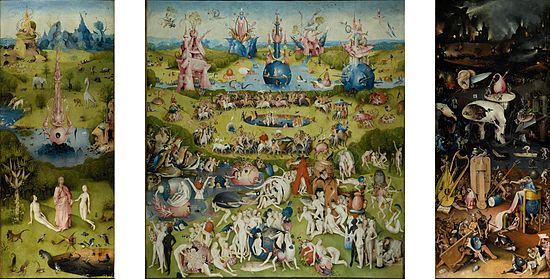
The Garden of Earthly Delights by Hieronymus Bosch, 1510
I usually don’t care for paintings that are as busy as The Garden of Earthly Delights, but I find it fascinating that an early 16th century artist could produce so much wild surrealism. I didn’t even know they had LSD in the Netherlands back then. Today we have decades of monster movies to help us think up weird and bizarre images, but Bosch had only his imagination.
There are an infinite number of stories packed into this tri-sectional painting. A question being the root of a story, a world in which some people have flowers and berries blossoming from their heinies, makes for a lot of fodder. However, the first thing that strikes the eye is that God is the only one wearing clothing. (Lets avoid a tautology. One could say that the only reason I know that that’s God is that he’s wearing clothing. If he were naked too, the viewer would just assume that he was a perv trying to horn into a menage a trois. I would say the world’s first threesome, but if you look in the middle section, you can see that about everyone is getting their freak on.) So why is God wearing robes? We can assume that it’s not that he has shame. He’s God, you can be sure he’s sporting the perfect specimen of masculinity (if he cares about such things.) Is it drafty in heaven? If so, doesn’t his omnipotence extend to the heavenly thermostat, or is it that the Holy Ghost likes to crank the AC? I see tension, and tension is the root of a story. (I realize that I said that a question was the root of a story. Live in the moment.)

The Sea of Ice by Caspar David Friedrich, 1823
Sea of Ice, also called The Wreck of Hope, at first looks like just a landscape. However, if one directs one’s glance to the right hand side, one can see the stern of an old sailing ship. As the alternate title suggests, it’s about a shipwreck. A shipwreck in the sailing age in the Arctic Ocean makes an outstanding setting for a story. Those men are all going to die, but not with the suddenness of drowning. They will freeze to death over the course of hours. If they can start a fire, they may have many hours, but they are not going to be rescued and they cannot walk to home. The tension between wanting to survive and knowing you are just extending your misery is good stuff for story-telling. If this image doesn’t send a shiver down your spine, nothing will.
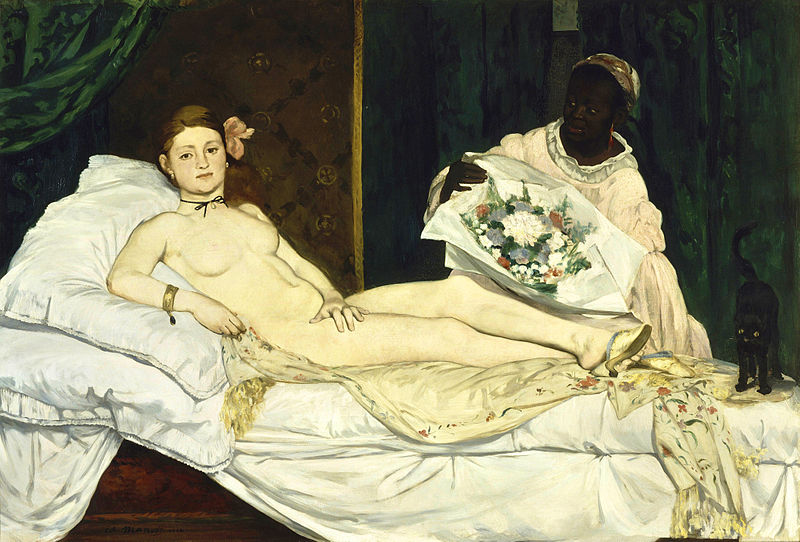
Olympia by Édouard Manet, 1863
Olympia was a scandalous painting when Manet first revealed it. Nudity has been around for ever in paintings, right? Certainly, but it’s the context that enraged people. Society was used to characters of classical mythology being nude, e.g. Venus. They were also used to Biblical nudity (see Garden of Earthly Delights above.) However, Olympia made them think of the Parisian prostitutes that they didn’t visit, but somehow knew exactly what they looked like. There are several stories to be told here. The one that springs to mind is why the servant is about to try to suffocate Olympia with a pillow. Will she, or won’t she, go through with it? If she does, will she prevail? Olympia looks like a fighter. If she doesn’t, will the cat?

Impression: Sunrise by Claude Monet, 1872
In Impression: Sunrise two boats are out on the water, even though the sun has broken over the horizon. They are rivals. The early bird got the worm, and the other will have to fish with fake lures.

Lighthouse Hill by Edward Hopper, 1927
Lighthouses make good settings for tragedy. They are remote. Ships depend upon them to avoid the rocky shoals. This lighthouse keeper’s family left because they didn’t like living in the middle of nowhere with a drunk. Now it’s just a man living in a big house alone. He runs out of Jack Daniels, and drives off to town at dusk. Being on the other side of the hill, he can’t see the lighthouse when he briefly glances into his rear-view mirror and wonders, “Did I turn the beacon on?”

The Persistence of Memory by Salvador Dalí, 1931
The Persistence of Memory, a.k.a. Melting Time, is a dream state. It makes no sense. Nature is ordered into square edges. Watches are the only evidence of humanity’s existence. There is one creature living, or once living, that looks like the Thalidomide abortion of a three-way mating between a donkey, a Portuguese man of war, and Dalí himself. The story is about being trapped in a dreamscape where time has become stuck. Our protagonist must seek the wisdom of the Portuguese man-o-Dalí.
 Life, the Universe and Everything by Douglas Adams
My rating: 4 of 5 stars
My review of: Hitchhiker’s Guide to the Galaxy
My review of: Restaurant at the End of the Universe
Arthur Dent and company are back for a third volume, and this time they must save the universe. This installment in the Hitchhiker’s Guide to the Galaxy (H2G2) series leaves off where the second stopped.
Readers will recall that at the end of the second volume,Restaurant at the End of the Universe, Arthur and Ford Prefect were marooned on the Earth two million years before their time (i.e. before the Earth was destroyed for a hyperspace bypass.) The two are reunited after Ford spent some time in solitude experimenting with being insane. They catch a ride forward in time on a piece of couch-shaped jetsam caught in an eddy in the space-time continuum.
Arthur and Ford are then picked by Slartibartfast, designer of fjords, who convinces them that they must go on a mission to save the universe from the inhabitants of the planet Krikkit. Actually, he can’t convince Ford of that, but he does convince him to go to the longest running party in the universe. Unknown to Ford, Slartibartfast wants to prevent the Krikkiters from attaining a requisite part that happens to be located at the party.
Arthur plays a particularly important part in this volume. After a run-in with a creature that he has killed numerous times in various bodies, the H2G2 straight man develops the knack for not hitting the ground after throwing himself downward (i.e. he can fly.) This new skill plays an important role in ultimately winning the day.
Arriving at Krikkit, the group finds that the locals aren’t much interested in destroying the universe anymore.This leads the band them to uncover a plot of intrigue and hilarity.
Given that there are two more books, you probably believe that the universe wasn’t destroyed, but I’ll avoid spoilers.
As always, Adams is the master of absurdist science fiction. Sure he gets his characters out of jams by flukes of the infinite impossibility drive or, in this book’s case, randomly appearing and disappearing couches, but it’s the wackiness that we enjoy and not the tautness or logical consistency of the tale.


