Unknown's avatar

About B Gourley

Bernie Gourley is a writer living in Bangalore, India. His poetry collection, Poems of the Introverted Yogi is now available on Amazon. He teaches yoga, with a specialization in pranayama, and holds a RYT500 certification. For most of his adult life, he practiced martial arts, including: Kobudo, Muay Thai, Kalaripayattu, and Taiji. He is a world traveler, having visited more than 40 countries around the globe.

BOOK REVIEW: The Bridge at Andau by James Michener

The Bridge at AndauThe Bridge at Andau by James A. Michener

My rating: 5 of 5 stars

In the fall of 1956, there was a revolt in Hungary against the Soviet-puppet leadership. While this revolution ultimately failed, it was a powerful underdog story that revealed the brutality of the USSR.

Novelist James Michener was one of the journalists at the border crossing for which the book is named. He collected the stories of those who were fleeing the Soviet crackdown. Michener found what he heard to be chilling, and this book had a profound impact on Americans.

The book begins with a typical story of a woman carted off by the ÁVO (Állam Védelmi Osztag), the Hungarian secret police. She was returned several weeks later, fundamentally changed and psychologically broken. It was this type of lawless injustice that led to the revolt.

The book recounts the many trials, tribulations, moments of hope, and moments of peril of the revolutionaries. It covers the opening salvos at the Magyar Radio building and then at the Kilian Barracks (located at a prominent intersection on the Budapest’s Grand Circle [Nagykörút]) and continues to the flight of the failed and hunted revolutionaries.

Throughout the book one is constantly reminded of how ingenuity and will can succeed in the face of severe disadvantage. The Soviets came with tanks, but the Hungarians had only the few small-arms that they could liberate from those military barracks that sided with the revolutionaries. The guerrillas would put brown dinner plates upside-down in the road. These looked roughly like anti-tank mines. When the tankers stopped to investigate, guerrillas would drop Molotov cocktails into the tank’s engine inlet.

The most heart-rending part of the book deals with the children that were actively involved in the fighting, and tank-killing specifically. The small and agile children could apparently move up to the tanks unseen more easily than adults.

This may seem like just another example of a true story with a sad ending. It’s true that the Soviets came back after a feigned withdrawal, tricking the revolutionary leadership into “negotiations” that turned out to be executions. Overall, thirty thousand Hungarian casualties resulted from this two-week battle. However, the story is not as simple as “the underdog got defeated.”

Michener quotes a revolutionary who summed it up best, “Russia won, but they’d better keep two of their soldiers in Budapest for every one Hungarian they give a gun. Let the Kremlin sleep on that.”

I’d highly recommend this book for those interested in history, military strategy, or even just a compelling human interest story.

My copy of Bridge at Andau is well-worn. As a Master of Science in International Affairs student, I did a thesis on Soviet/Russian asymmetric warfare. One of the three cases that I studied extensively was the Hungarian revolution. While the ’56 Revolution was arguably the least successful of the three (the others being Afghanistan and Chechnya), it wasn’t due to lack of Hungarian will so much as the still strong  state of the Soviet Union.

View all my reviews

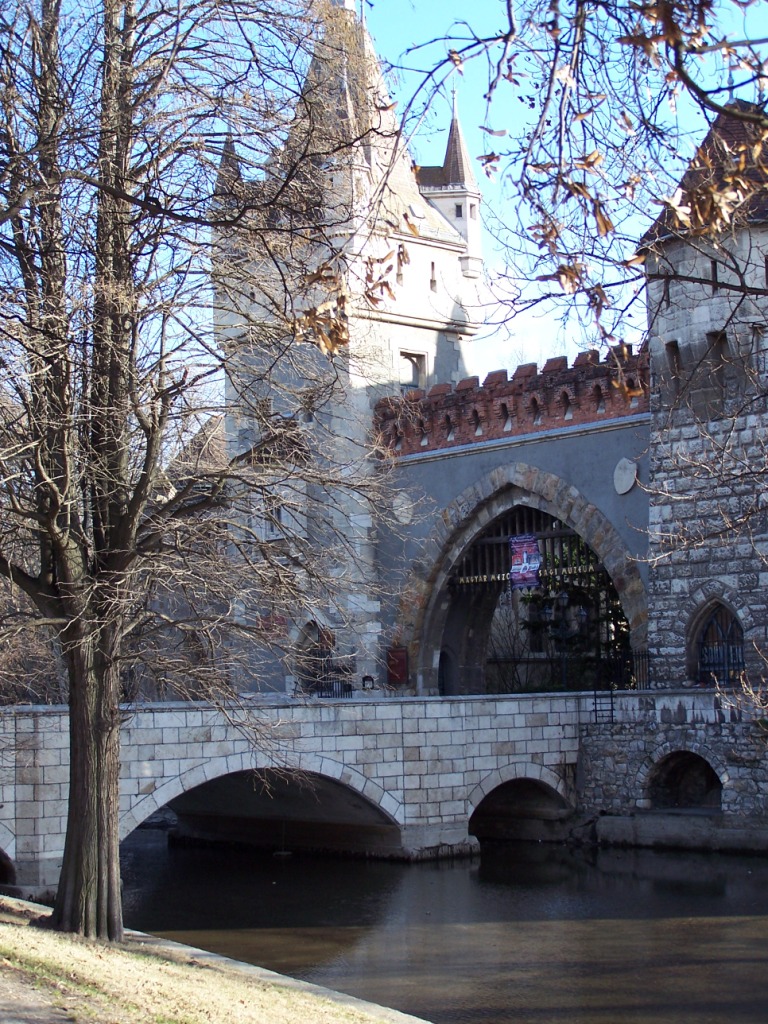
TODAY’S PHOTO: Vajdahunyad Castle Entrance in Budapest

You just don't see enough moats these days.

You just don’t see enough moats these days.

TODAY’S PHOTO: Roadside Cambodia

This is Cambodia

This is Cambodia

Traveling cross-country through Cambodia at the end of the wet season, the road seems to be just the Mac-daddy paddy dike, and the rest of the country is a flooded rice paddy. What once was jungle is now solitary trees, often palms, jutting out of a verdant sea. Farmers fish waist deep, casting nets, as emaciated oxen cool their bellies. Everyone lives and dies by water.

BOOK REVIEW: Solaris by Stanislaw Lem

SolarisSolaris by Stanisław Lem

My rating: 4 of 5 stars

Solaris is the  best known work of the Polish sci-fi writer Stanislaw Lem. It’s the story of the planet Solaris’s super-intelligent ocean and the humans that are observing it from an orbiting space station. Scientists discover that the ocean is intelligent because the planet orbits two stars, and the ocean must redistribute itself as ballast to keep Solaris from flying off out of its star systems.

Having had no luck in learning about this ocean, the scientists begin more invasive operations–bombarding the ocean with electromagnetic radiation. The ocean then begins to project human beings into the space station, using blueprints in the minds of the scientists. Each of the scientists begins to see, and eventually interact with, someone from his past. Each “guest” is physically indistinguishable from the person in the respective scientist’s past, but the simulacra are “off.”  These simulacra stir up bad memories.

The most extensive interaction we see between a crew member and one of these manifestations is that of the protagonist, Dr. Kris Kelvin, and his ex-wife. Dr. Kelvin is a psychologist and is the most recent crew edition. (The novel actually starts with him as a new arrival, we learn of the earlier incidents as he does.) His “visitor” is the spitting image of his wife, a woman who committed suicide after the couple broke up.

The novel plays with an intriguing question. What if a person you loved and lost came back from the dead, but you would only be able to experience them as they existed in your mind? In some sense, they’d be more real to you than the actual person. But you’d know they were just a fabrication, and you could never learn anything new about them. At first Kelvin rejects, even banishes, his wife’s doppelgänger, but when she inexplicably returns he finds it hard to maintain his distance.

I enjoyed this book. The translation seemed skilled to me (though I don’t read Polish, and hence didn’t read the original.) I’d recommend it.

View all my reviews

There have been three film adaptations of this novel. I haven’t seen any of the movies, but this is the trailer for the most recent one. The trailer emphasizes the love relationship more and the sentient ocean less than the novel (though the interaction of the protagonist with his imagined wife is central to the work.)

Cash Cow Disease: or, I Hope The Americans Don’t Get Lost

AmericansTVIn political economy, “Dutch disease” is a term used to describe a situation in which a nation’s windfall successes in one sector lead to everything else going to crap.

Dutch disease reminds me of a phenomenon rife in television today. A series pilot is shown. It’s wildly successful. The writers came in with a clear overall narrative arc, but now the show is a cash cow and they have to extend it out indefinitely. This is a script-writing nightmare. Writers have to give the viewer a new puzzle piece each episode but they’ve got to end the episode with a cliffhanger and they’ve got to be able to tie up all their loose ends at some undefined point when the series becomes a train wreck.

I was aware of this phenomena, let’s call it “Cash Cow disease,” when Lost came on the air. I’d been through it with the X-files.  But damned if I didn’t go and get myself engrossed in Lost. Lost started out with such promise. It seduced me, and even when it became clear that the writers and director might not know where the ship was headed, they kept feeding me tasty bread crumbs.  Then the network said, “Get us off this crazy train, quickly.” So  it was that the show that began with an atomic bang ended with the whimper of one of the worst endings ever.

Having been hurt twice thusly, I’d given up on watching television serial dramas. Then I made the fatal blunder of watching the pilot of The Americans. Why did I do this? Ironically, I probably watched it because I assumed it would be bad. It was, after all, a Cold War show in a post-911 world. Oh, the thwarted expectations. Now, I’m hooked.

The Americans is about a man and wife who are Soviet sleeper spies during the early 1980’s. The couple lives in the suburbs of Washington DC with their oblivious kids, and appear to operate a travel agency (for young readers, there used to be people who booked one’s flights and hotel before the days of Kayak, Orbitz, and Travelocity.)  In reality, however, the couple are deep cover spies who are attempting to get information about America’s ballistic missile shield, Reagan’s “Star Wars”, and other strategic concerns. The show depicts the cat-and-mouse game of Cold War espionage with great tension.

In an act of coincidence that strains credulity (but which is no stranger than things that actually happened) an FBI counter-intelligence agent moves in right across the street from the couple. The KGB couple and the FBI man are working at cross  purposes without the FBI agent (played by Noah Emmerich) being the wiser. (Emmerich’s character has early suspicions that he dismisses as paranoia after a close call for the KGB couple.) The male lead KGB sleeper spy (played by Matthew Rhys) plays racket-ball with the FBI agent.  This apparent friendship is to the chagrin of the female lead (played by Keri Russell) because she’s not quite sure if her husband is working the FBI man (as he says), or whether he’s facilitating changing sides. Part of the tension of the series stems from the fact that Keri Russell’s character is a dyed-in-the-wool patriot of Mother Russia, but her husband is having second thoughts–he sees himself as a family man first and a patriot second and America is growing on him. This tension is made all the more complicated by the fact that she seems to be just starting to fall in love with him, though he seems to have loved her from the early days of their planned, forced, and in some sense fake relationship.

The signature trait of The Americans is that characters on both sides are sympathetic  but complicated. This is part of a “shades of gray” motif that informs the show. Emmerich’s character, the FBI agent, is a loyal patriot and family man trying to do his best under the pressures of a hectic and tense job. However, we see him torment and rob a suspected Soviet information trafficker. Rhys character, the KGB sleeper, is also quite likable and sympathetic. At one point we see Rhys’s character beat up a pedophile (what’s more likable than that.) Russell’s character is not so likable, but that’s good for the tension. She’s a cold, fanatical Communist, but we can see the outlines of humanity in her character. For example, despite her jingoistic nature, she refuses to report her husband’s second thoughts.   On the FBI side, the most unlikable character is the boss (played by Richard Thomas, aka John Boy.) He’s a rash hot-head who,  in last night’s episode, wrecked an operation through his knee-jerk reaction (or maybe he’ll turn out to be a mole.)

I can already imagine how the wheels may roll off. There’s a supporting character, a mole in the Soviet Embassy (played by Annet Mahendru), that I imagine they intended to kill off to add to the angst of the Emmerich character (the FBI agent cultivated her through “soft-blackmail” and acts as her handler.) However, she’s really an endearing character. In a field of patriots that sometimes approach zealotry on both the US and Soviet sides, she seems to just want to have a peaceful life, but she’s trapped. Despite being manipulated, she’s a strong character. I can imagine her becoming a more central role–not that that’s an inherently bad thing.

I’d like to recommend this show, but I face a dilemma. If fewer people watch, I think it’s more likely to end well.

TODAY’S RANT: The Lonely Omnivore

My salami has a first name, it's B-E-S-S-Y.

My salami has a first name, it’s B-E-S-S-Y.

I’m a member of a group that has long suffered the bitter pill of discrimination. How is it–you may ask–that a white, heterosexual, suburban, graduate-educated male knows the foul taste of discrimination? I love meat, but my wife is a vegetarian.  This makes me a lonely omnivore.  When I go to the market, I can’t find meat packaged for my kind. No individual could cope with such quantities of meat as packaged by supermarkets. Well, that is besides those not averse to contracting colo-rectal cancer from the rotting carcass wedged in his transverse colon, e.g. Adam Richman.

One option–the healthy option–would be for me to go vegetarian. Did I mention that I love meat? I love bacon and beef and poultry and pork and rabbit and reindeer. I would eat meat on a boat. I would eat meat with a goat, and then I’d make a stew out of the goat. Cut off the beak and the bung, and you’ve got yourself a customer. You say you got horse meat in my beef? Sounds tasty. So option one is a nonstarter. I’m out of the omnivorous closet. I’m here; I eat steer; get used to it.

Another option is to find the store butcher and ask him to wrap me a solitary steak.  The problem is two-fold. First, the butcher is never just hanging out at the counter, and so there will be a PA announcement. In the 1950’s, before computers with Facebook and solitaire, the butcher would hang out at the counter, but now he’s in the back–presumably goofing off like 90% of the workforce. The announcement will be quick and neutral, but it will sound enough like the following to garner widespread attention, “Attention in the meat department, there’s a pathetic soul with no one to love him who needs steak for one, I repeat STEAK FOR ONE.” Then everyone in the store has to take a peak at the lonely omnivore. Don’t stare, Johnny, it’s just a hobo.

The second problem is that, while the butcher is smiling and polite, I know he is thinking, We have half a mile of prepackaged meat, and you really want me to take a break from my hectic schedule of playing solitaire in the back office to cut you one steak? Haven’t you heard of a nifty invention called a “freezer?” It should be located somewhere in the general vicinity of your refrigerator.   

The third option is, of course, the freezer. If you had any idea how disheveled my mind was, you wouldn’t even suggest this. Using the freezer would require that I anticipate that I will eat again in the future so that I can take the meat out to thaw. Here’s how it really works. I’m sitting here typing and think, That steak would really be good about now! However, presently it isn’t a steak, it’s a block of meatcicle. So I take it out of the freezer. I stare at it for a few minutes, hoping to use my ill-developed Superman-like powers of heat vision. Then I try running hot water on it, but it remains crystalline on the inside. Then I leave it and go back to typing. Then I check on it in three minutes. Then I go back to typing. Then I check on it after two minutes. Sensing the beef will never thaw, I break down and make myself some unsatisfying but filling Top Ramen. The next time I see the steak it’s a soggy and unappetizing lump hanging out in my sink.

Now if you’re an outline-and-note-card kind of writer, you may wonder how a writer could be so unskilled at planning. I’m not that kind of writer. If you haven’t guessed it, if it hasn’t shown through, I just make shit up as I go along. For me, writing is a process of paginated diarrhea, with an admittedly messy cleanup process.

My final option is to go to one of the huge “farmer’s markets” that we have in the area. (I use quotes because I’ve never seen an actual farmer there, and the food is as likely to be from Armenia as it is from Americus, Georgia.) These markets have heaped slabs of meat on ice, they’ll and cut it however one wants. I do this sometimes. There’s a very cool thing about these places. Because they serve such a diverse population, they hire a lot of immigrants.  However, while it’s cool that my butcher is a native Lao speaker, it can be problematic for me as a non-Lao-speaking English speaker. Inevitably, my desire for ONE PIECE of meat is translated into ONE KILO of meat or ONE CRATE of meat. I know, you’re saying that there’s one simple and obvious solution: learn the Lao language.  The problem is that the next time I go I might get the Urdu-speaking butcher.

I don’t like to complain about my plight [which is why I have a regular series of posts called TODAY’S RANT], but we should make room in our society for those of different meat needs.

BOOK REVIEW: It’s Getting Better All the Time by Moore & Simon

It's Getting Better All the Time: 101 Greatest Trends of the Last 100 YearsIt’s Getting Better All the Time: 100 Greatest Trends of the Last 100 Years by Stephen Moore

My rating: 3 of 5 stars

Amazon page

The title says it all. The authors, Stephen Moore and Julian Simon, discuss 100 trends in 20th century America that give one reason to be optimistic about the future. These trends are grouped into the following areas: health, nutrition, wealth, poverty, children’s issues, labor, leisure, housing, transportation & communications, innovation, information technology, education, safety, environmental protection, natural resources, socio-cultural indicators, sports, women’s issues, racial issues, and freedom & democracy.

One of the co-authors, Julian Simon, died before publication of this book, but is famous for a bet that he made with Paul Ehrlich. The bet was that any five commodities of Ehrlich’s choosing would decline in price over the subsequent decade. Ehrlich, author of The Population Bomb, was a doomsayer, and believed the five commodities and most others would become more expensive. In other words, Ehrlich was betting resources would become more scarce as they were used up, but Simon believed our technological advances in discovery and extraction would outstrip our consumption. Simon won the bet. All five commodities became cheaper, though some have pointed out that if they had gone double or nothing over another decade the tables would have turned.

The authors attribute the world’s 20th century success to three technologies: electricity, vaccines/medicines, and the microchip. In answer to the question of why the United States did particularly well, the authors point to freedom as the main driver. Neither of these hypotheses are systematically evaluated in this work; they’re just presented with anecdotal support. I say this not so much as harsh criticism, but so as to make the reader aware that it is not that kind of book. The bulk of the book is one page of text for each trend, plus a line or bar graph to visually depict the trend.

This book makes some excellent points. People have a tendency towards pessimism, hence all the dystopian, zombie, nuclear holocaust literature. There’s also a common fallacy that there was once a golden age of humanity in the past that is never to be surpassed. One may find it hard to believe that it’s getting better all the time, but one can’t argue with the numbers. Life expectancy is up. Infant mortality is down. Housing is less crowded. We have more symphonic orchestras. On a host of issues, the quality of life of Americans has risen.

The previous paragraph notwithstanding, there’s room for criticism. While one can’t argue with the numbers, in some cases one might find oneself asking whether they are the right numbers or whether they tell the whole story. For example, the section on disease shows a strong decline across a range of diseases. However, it doesn’t cover any of the many chronic disease that arose in the 20th century and disproportionately affect wealthy countries such as diabetes and crohn’s disease. It’s hard to know how much of the trends represented are a function of data availability (covering so much ground, they had to rely on second-hand data) and how much reflects selection bias intended to support their argument. As implied in the preceding paragraph, some of the measures are undeniably the right ones. However, the reader may find themselves wondering about others.

It would be interesting to see an update to the study. For example, GDP growth is shown to be higher on average among the freest nations. However, with countries like China and Vietnam rocketing upward in GDP in recent years, it would be interesting to see if this trend has held.

There’s a CSPAN Book TV program with Moore available here.

Even though this book is 13 years old, I’d still recommend it. Given all the doom and gloom as of late, it might be a particularly good time to pick it up.

View all my reviews

TODAY’S PHOTO: Fine Dining in Tipton, Indiana

Truth in advertising is such a rare event.

Truth in advertising is so refreshing.

TODAY’S RANT: Punked by NPR

Sleeping CatsI’m driving along, my mind roving, the droning radio only faintly registering in my subconscious, and suddenly I’m ripped from my reverie by a shrieking siren. I punch the brakes, slowing from a present speed that, unbeknownst to me, is two miles an hour below the limit to an octogenarian crawl. I hear the screech, and look into my rear-view mirror to see the black behemoth, an  SUV, becoming ever bigger. The driver’s solitary finger pressed up against the window, not pointing  at me accusingly, but rather straight up in the air. The SUV slows just enough to not ram me. We travel onward in our respective soiled underwear, I not looking back, her boiling rage now just a flush face and a fading headache (or at least that’s what I expect from my vast experience in her shoes.)

I’ve been punked by a stranger, an audio tech who likes to put background noises into every news story or ad spot to gain the attention of an ADD -riddled populace. Yes, I should have been more in the moment; that’s how they get you.

I would be remiss if I didn’t act as a mouthpiece for another individual wronged by similar antics. I have a cat that only gets about 20.5 hours of sleep per day, and he’s inevitably robbed of precious slumber whenever he hears a “BING-BONG.”  This is another much beloved sound effect for the wicked curs in radio. This particular cat can comfortably ignore any other sound in the universe–including my high-volume rants about use of various personal possessions as a scratching post. I don’t know why our cat knows what a doorbell is. Does he get lots of visitors when we are not there? Who is he expecting? These are questions that I cannot answer.

BOOK REVIEW: Steel and Other Stories by Richard Matheson

Steel: And Other StoriesSteel: And Other Stories by Richard Matheson

My rating: 4 of 5 stars

Amazon page

Steel and Other Stories is a collection of 15 short stories from the author of I am Legend. Thirteen of the fifteen stories are from the 50’s, and motifs of that time are common (e.g. Cold War phobia, the Western, etc.)

1.)The title story, Steel, is about android boxers. Viewers of the movie Real Steel, which was loosely based on this story, will find the story not much like the film. In the film the boxers are robots, but in the story they are androids. For those readers who aren’t sci-fi geeks, the difference is that androids look and move like humans. There is more on the line in the final fight in the story than in the film.

2.) Fit the Crime is about a cantankerous old poet on his deathbed. It’s a humorous story and will be enjoyed by those who love language play.

3.) The Wedding is about a superstitious groom who gets on his bride’s last nerve.

4.) The Conqueror is the sole Western in the collection. It features gunfights and a final line revelation.

5.) Dear Diary is a very short sci-fi piece that is written in the form of three diary entries: one in 1954, one in 3954, and one at an undesignated date presumed to be later than the second entry. In typical Mathesonian style, the third entry, only a partial sentence, turns expectations on end.

6.) In Descent two couples are preparing to move underground to survive nuclear holocaust. Confronted with the decision of dying above ground or living a subterranean life, one of the men opts for the former. This creates a dilemma for the man’s wife.

7.) In The Doll That Does Everything two parents of a horrid child contemplate whether the lifelike doll they buy their child really can do everything.

8.) The Traveler is about scholars who go back in time, cloaked, to observe biblical history first hand.

9.) When Day is Dun is about the last man alive, but, unlike I am Legend, the apocalypse is of nuclear annihilation.

10.) Splendid Source is one of the most famous stories in the collection. It’s about a search for the point of origin of ribald jokes. Viewers of Family Guy will recognize its depiction in an episode of that series.

11.) Lemmings is one of the shortest pieces in the collection. It imagines humanity walking one after another into the sea.

12.) In The Edge a man finds that people he doesn’t know know him. This begs the question of whether he has a doppelgänger or he’s lost his mind.

13.) In A Visit to Santa Claus a man reconsiders a contract on his wife’s life that is to be executed on a visit to the mall to see Santa.

14.) In Dr. Morton’s Folly a dentist gets an after-hours emergency case.

15.) In The Window of Time A man travels back in time 68 years by mysterious circumstance, walking familiar territory in transformed in time.

Matheson is a master story craftsman, and this collection is an interesting mix of stories from various genres–some humorous and some dark.

View all my reviews