Unknown's avatar

About B Gourley

Bernie Gourley is a writer living in Bangalore, India. His poetry collection, Poems of the Introverted Yogi is now available on Amazon. He teaches yoga, with a specialization in pranayama, and holds a RYT500 certification. For most of his adult life, he practiced martial arts, including: Kobudo, Muay Thai, Kalaripayattu, and Taiji. He is a world traveler, having visited more than 40 countries around the globe.

DAILY PHOTO: Budavári Palota Park

Taken in December of 2014 in Budapest

Taken in December of 2014 in Budapest

They’re building a new park area at the base of Buda Castle, in front of the Palace. It was open while we were in town for the holidays. (Apparently, it has opened and closed several times and is still not entirely complete–though it does look nice.) The opened-closed thing being tied to the electoral cycle. Though apparently a significant portion of the funds came from the EU rather than domestic tax revenues.

BOOK REVIEW: The Philosopher at the End of the Universe by Mark Rowlands

The Philosopher at the End of the Universe: Philosophy Explained Through Science Fiction FilmsThe Philosopher at the End of the Universe: Philosophy Explained Through Science Fiction Films by Mark Rowlands

My rating: 4 of 5 stars

Amazon page

This is one of those books that’s designed to make tedious material palatable. Rowlands achieves this by conveying the concepts of erudite philosophers such as Plato, Nietzsche, Sartre, Laplace, Kant, Heraclitus, Wittgenstein, Hume, and Heidegger through the lens of popular speculative fiction movies (almost all Sci-fi.)

The book uses thirteen films as case studies to consider ten critical philosophical concepts (over ten chapters.) Virtually all sci-fi fans are likely to have seen most—if not all—of these films. They include: Frankenstein, The Matrix, the first two Terminator films, Total Recall (1990), The Sixth Day, Minority Report, Hollow Man, Independence Day, Aliens, Star Wars, Blade Runner, and The Lord of the Rings. I am not a film fanatic (though I do like Sci-fi) and I’d seen all but two of these movies (i.e. Hollow Man and The Lord of the Rings.) I can say that the book is understandable without having seen the movies, but it’s much more enjoyable when you have seen them. Although, as far as the two movies that I’d missed went, Hollow Man was easy because it’s a relatively straight-forward invisible man story, and—therefore—the link to that chapter’s question “Why Be Moral?” was simple. However, for The Lord of The Rings book I had to rely more on the synopsis the author provides to follow the chain of thought.

The philosophical issues that are addressed include: the meaning of life, what can we really know (if anything), what am I (or you or any other individual), what makes me (you, etc.) different from everyone else, is there free will, why behave morally, how broadly does morality apply (in other words, is it applicable outside humanity), do good and evil exist and (if so) what differentiates them, what does it mean to be mortal, and what’s wrong with moral relativism. If you’ve seen the movies, and give it some thought, you can probably match the movies to the questions easily.

I enjoyed this book. First of all, I will admit that it’s easier to follow the concepts and for them to stick with one when one puts them in terms of movies one has seen (in some cases, several times.) Second, the author has a good sense of humor. While Rowlands is a Professor of Philosophy, this book doesn’t read in the humorless and dry tone of academic writing. On the contrary, it’s meant for a popular audience and it reads for a popular audience. It should be noted that the humor and the exclusive focus on movies (versus literature or films) set this book aside from a number of others that are superficially quite the same. I have another book in storage back home called Science Fiction and Philosophy that is by an academic publisher, maintains the scholarly tone, goes into a bit more depth, but covers many of the same ideas (e.g. Brain-in-a-vat, etc.) using similar examples. I didn’t finish the more scholarly book, but if you’re looking for great depth but not reading ease you might pick it up for comparison.

Rowlands does overplay the “these-movies-are-so-bad-they’re-good” card, and when he does he sounds a tad professorial / pretentious. However, the book often reads like it was written by a colorful football coach rather than a Philosophy Professor. And, to be fair, in some cases it’s true that the films are delightfully bad. However, these are not B-movies like Attack of the Killer Tomatoes as one might think from the commentary.

If you’re interested in philosophy, but can’t get through two pages of Kant without falling asleep, I’d recommend this book.

View all my reviews

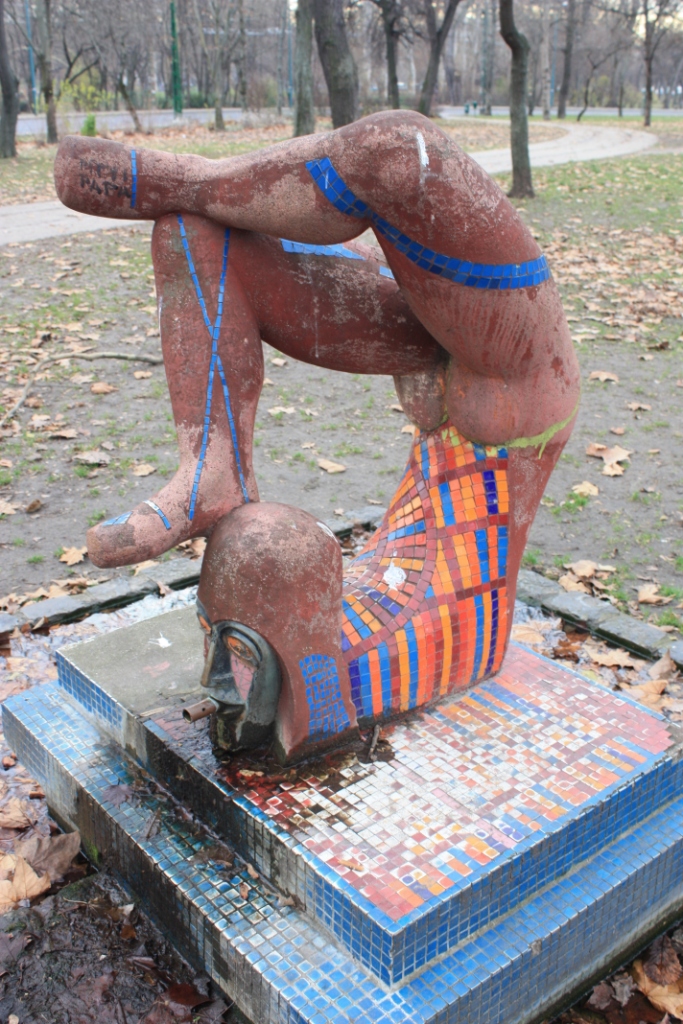
DAILY PHOTO: Városliget Bizarre Yogi Fountain

Taken in December of 2014 in City Park (Városliget) in Budapest.

Taken in December of 2014 in City Park (Városliget) in Budapest.

DAILY PHOTO: Szentendre Steeple

Taken in December of 2014 in Szentendre, Hungary

Taken in December of 2014 in Szentendre, Hungary

DAILY PHOTO: Lion with Soldiers

Taken in Vác in December of 2014

Taken in Vác in December of 2014

IMG_2810

Vác was getting ready to install or remove a few statues and had them all grouped together in the town square. The juxtaposition of a lion with a WWI monument made for a couple interesting images.  

DAILY PHOTO: Vörösmarty Tér Light Spheres

IMG_2408

Taken on December 23, 2014 in Vörösmarty tér in Budapest

Taken on December 23, 2014 in Vörösmarty tér in Budapest

These spheres of light, ostensibly designed to mimic glittery ornaments, were hung throughout the trees on Vörösmarty Tér during Christmas season in Budapest.

I have to say, I’ve never seen Budapest’s Christmas markets thriving like they were in 2014. Granted, my last holiday visit was in 2008 (bad times all around), and my first time was in the mid-90’s (Hungary was still trying to get its post-Cold War feet under it.) I have been a few times in between, but this year was clearly in a different league from previous years.

BOOK REVIEW: Leaves of Grass by Walt Whitman

Leaves of GrassLeaves of Grass by Walt Whitman

My rating: 5 of 5 stars

Amazon page

There are a number of editions of this collection of poems, as Whitman apparently continued to revise it right up until his death. The 1855 edition is popular but there is a “Deathbed Edition” which–as the name implies–is the closest thing to a final draft that exists.

Back in the day (the late 19th century), this was considered racy and controversial stuff, and the collection got Whitman fired from is civil service job as well as a great many vitriol-filled reviews. Like the works of Emerson and Thoreau, with whom Whitman shared some beliefs, it was also controversial in that the poem put man at the fore and religion was shunted out of the picture. (Trust in yourself and don’t blindly follow anyone was still a heretical notion among many at the time.) This isn’t to say that Whitman eliminated spirituality from his work (any more than Emerson did), references to the soul are commonplace—but it’s a mystic spirituality. There were features outside the “prurient” and religious that angered many, such as Whitman’s shining of light on the barbaric institution of slavery. However, today Leaves of Grass is considered one of America’s greatest and most beloved works of poetry, and for good reason. It beautifully reflects an America that was changing, an America subject to a new era of ideas both from science and from distant lands.

It should be noted that this is a life’s work. If you are expecting a typically thin poetry collection, you will be in for a surprise. Leaves of Grass is of a page count normally reserved for histories and epic novels. The collection consists of 35 “Books” that are quasi-themed sub-collections of poems. Individual poems vary greatly with some being only a few lines and some running for pages. Most of the poems are free verse, though there are sections that display a meter (specifically iambic pentameter.) Free verse is poetry without meter or rhyme. If you didn’t know there was such poetry, you may want to work through your Doctor Seuss before you crack open a tome like this one.

There are a few themes that are repeatedly revisited. One idea that made the collection so controversial is that it exalted in the human form and the physicality of humanity. In recent years, a lot of discussion of this work revolves around whether Whitman was or wasn’t homosexual or bisexual. Not that it matters, but the fact is there is a dearth of information about what form of sexuality Whitman practiced—if any, but one can imagine why people wondered. Whitman writes descriptively about both the male and female forms, and was not shy about verse that suggested lying with this gender in one poem and the other in the next. The poem “I Sing the Body Electric” is probably the most famous example of Whitman’s discussion of the body.

However, perhaps the most striking theme is a celebration of America, both in its natural state and as it was shaped by the people who settled there. In multiple poems one sees long strings of description and exposition about the various states of the United States. Whitman paints pictures of the nation as a collage showing the variations among its constituent parts. To a lesser extent, he does the same for the world (e.g. see Book VI.)

I enjoyed this collection, although I will admit I read it a bit here and a bit there over a long time period. I, therefore, probably missed some of the depth of meaning coming from how the poems were arranged. Maybe someday I’ll have time to go back and read it once more. However, the beauty of this collection is that it’s so many different things. It meanders like a river, and peers overland with an eagle-eyed view. It offers scenes that are like a hard-boiled work of film noir and ones that are like Ansel Adams pictures. It’s not anti-god, but rather about the god within, or the god within the blade of grass. Leaves of Grass offers brilliant turns of phrase, bold descriptions, and always interspersed with the author’s personal philosophy.

View all my reviews

DAILY PHOTO: Shoe Memorial

Taken in December of 2014 in Budapest.

Taken in December of 2014 in Budapest.

On the bank of the Danube, Pest-side just south of the Parliament building, there is an eery memorial consisting of an irregular row of shoes. The shoes are made of metal, but their brown rust looks like worn, brown shoe leather. It is in remembrance of the victims of the Arrowcross Militia who were shot there and left to topple into the river.

The Arrowcross Militia were Hungary’s Nazis. Hungary was allied with Germany at the beginning of World War II, but at one point (in 1944, as I recall) Hungary tried to break this alliance. Germany responded by taking over Hungary, and giving the Arrowcross (their fellow hardcore fascists) greater power and influence.

IMG_2176

DAILY PHOTO: Old Lady Street Art

Taken in December of 2014 in Pécs

Taken in December of 2014 in Pécs

BOOK REVIEW: Neverwhere by Neil Gaiman

NeverwhereNeverwhere by Neil Gaiman

My rating: 5 of 5 stars

Amazon page

Neverwhere taps into a reader’s imagination and the fantasy that beyond closed doors and locked grates, beyond the prying eyes of common men, lies something magical—not just the mundane sewers and conduits our rational mind tells us exist there. This magical world is “London Below,” and–to a lesser extent–rooftop London. It’s a world that exists below the workaday London that we know. It’s a London of angels and cutthroats, witches and warriors. It’s a London trapped in time, but unconstrained by the laws of physics or men as we know them.

The lead character is Richard Mayhew, a perfectly normal resident of London Above. He has a fine—if boring—job in the business world, and a fiancé isn’t right for him, but who he believes is close enough for an imperfect world by virtue of her being pretty, smart, and capable.

Mayhew is living an ordinary and comfortable life until he and his girlfriend come across an injured young woman on the street. While his fiancé, Jessica, steps over the girl because the couple are on their way to meet Jessica’s VIP boss, Richard refuses to leave the girl. The injured girl is a resident of London Below, and had collapsed to the sidewalk after escaping from the two London Below master assassins who killed her family. It turns out the girl, Door, is from a family whose magical gift is the ability to open doors—even doors that are locked, sealed, or that no one even recognizes the existence of. As no good deed goes unpunished, Richard’s assistance of Door pulls him into the world of London Below, and he soon finds that he’s almost invisible to the residents of London Above and that he’s been forgotten by Jessica, his friends, and his coworkers.

The rest of the book is a hero’s quest in which Door is trying to discover who ordered the assassination of her family and why, and Richard is trying to find out whether (and, if so, how) he can get back his life in London Above. Because the fates of Richard and Door are intertwined, they travel together along with a bodyguard named Hunter and a Marquis / conman in the debt of Door’s father named the Marquis de Carabas.

I enjoyed this book immensely. It’s highly readable and the reader will be drawn to the fate of the characters. It has that page-turner quality. I’d highly recommend this book for anyone who reads fantasy / speculative fiction–or who doesn’t but is willing to give it a try.

Neil Gaiman is, as always, the master storyteller. When the story calls for humor, it is genuinely funny. When it’s time to be scary, it creates shivers. The storytelling was good enough that I was willing to overlook an ending that—in less capable hands—would have felt flat and too easy.

I didn’t realize that Neverwhere was based on a BBC miniseries. In other words, for a change the book is based on the movie rather than the other way round. However, the book does concisely but vividly portray setting—a task that one might imagine being easier having gone in this developmental direction. And, of course, setting is extremely important in this book. The distinct feel of London Below, London Above, and Rooftop London must be conveyed.

Here is a link to a piece of said BBC miniseries:

View all my reviews