Bernie Gourley is a writer living in Bangalore, India. His poetry collection, Poems of the Introverted Yogi is now available on Amazon.
He teaches yoga, with a specialization in pranayama, and holds a RYT500 certification. For most of his adult life, he practiced martial arts, including: Kobudo, Muay Thai, Kalaripayattu, and Taiji.
He is a world traveler, having visited more than 40 countries around the globe.
The Vāc Cathedral (Vāci Székesegyhāz) is one of the most impressive structures in the small Danubian village of Vāc. Vāc is similar to Szentendre, which I posted about earlier in the week, but it’s a little bit less touristy because it’s not as close to Budapest.
There are some people in the above photo to give one a sense of scale, but probably a better indicator is the picture below which shows an average height female adult reaching for the door knob.
NOTE: I’ve revised this post with up-to-date information. Please see that post here.
My third annual preview of martial arts movies will be presented in two installments. Many of the movies in the latter half of the year do not yet have release dates or trailers by January. Ergo, I’m posting the first part now, and will do a revision in mid-summer.
“Martial arts movie” is a bit ambiguous. Almost every action movie features martial arts. The leaked teaser for Ant-Man was pretty much a sequence of Scott Lang (Ant-Man) fighting his way through a corridor to access an elevator. So, does such a movie get included? I’ve opted against putting every action film with a kick in it into this post. Yet, I don’t want to stick to films that feature martial arts cliches (e.g. they killed my master, an evil billionaire is hosting a death match tournament, they killed me and left me for dead, etc.) I, therefore, use the admittedly subjective litmus test of whether there would be a movie if one took away the martial arts and replaced it with brawling–not just whether it would be a less slick movie with a diminished “woo” factor.
I’ve tried to go as international as possible this year, including Bollywood (using the term colloquially if not precisely) and SE Asian releases in addition to the usual Hong Kong & Hollywood fare.
Underdog Kids (January 16): Described on IMDb as: “Inner city kids from a poor neighborhood go up against the undefeated Beverly Hills Junior National Karate Team.” I’ve seen no trailer for this, just a poster:
Wild Card (January 30): This may be a cheat given what I said above. However, it’s a Jason Statham film, and like the “Transporter” films it probably doesn’t amount to much without the ass-kickery. Let’s face it, you’re not going to see Jason Statham for his extensive acting range.
Dragon Blade (February 19): Featuring Jackie Chan, John Cusack, and Adrien Brody. This is a period piece, and–as you can tell from the casting–is big budget as martial arts flicks go.
Wolf Warrior (March 1) [China]: This looks like more of a shoot-em-up action film than a martial arts film, but some have listed it as a martial arts film and the close quarters action is definitely reminiscent of a martial arts film.
Skin Trade (April): This film stars Tony Jaa and Dolph Lundgren as the good guys and Ron Perlman as the villain. As the title suggests, it’s set around a theme of human trafficking.
Bollywood Dragon (May 15) [India]: The blurb for this one is: “An English martial arts instructor travels to Mumbai to identify her twin sister’s body, discovering she lived a mysterious life among the criminal underworld and decides to investigate by being her.”
There is no trailer up for this movie as of yet.
The Kickboxer: City of Blood: (May 15): This is a different project than the Bautista / Van Damme / Carano film that was originally titled “Kickboxer” and is now going by “Kickboxer: Vengence,” but there’s no graphic publicity out on it yet. It may not come out as scheduled.
The Transporter Legacy (June 19): Another “Transporter” film, but Ed Skrein plays the role of Frank Martin in this one. As with “Wild Card” it may be a cheat to include it as a martial arts film, but car chases don’t get these movies all the way to watchability.
I haven’t seen a trailer, but there are still photos.
The Boy and the Beast (July 11) [Japan]: This also may be a cheat because it’s an animated film, but martial arts does seem to be a prominent feature of the work. (I believe I included one of the Kung fu Panda movies in one of my past posts, so I think this is fair game.)
Brothers (July 31) [India, in Hindi]: An Indian remake of the American film Warriors. In the American movie, two estranged brothers must fight each other in an MMA bout. (Hence the name of the Indian version, Brothers.) There’s not a proper trailer out, but there is this:
Crouching Tiger, Hidden Dragon: The Green Legend (August 28): Interestingly, this sequel to an immensely popular film will be released on Netflix and IMAX simultaneously. If this were some risky, low-budget film, going straight to Netflix wouldn’t be at all surprising, but this is the sequel to a movie that was (maybe still is) the highest grossing foreign language film playing in America. If this bold move pays off, it could be the beginning of a new paradigm of movie releases. [Also with The Interview going with an unconventional release owing to North Korean threats and intervention, there maybe a great deal learned about alternatives to a traditional film release.]
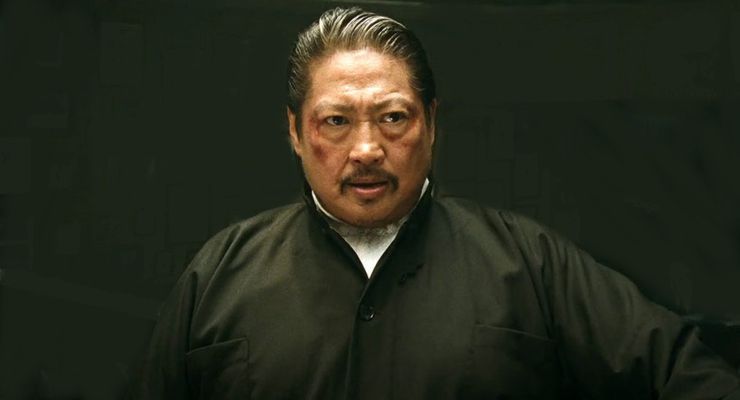
The Bodyguard (undesignated Summer release) [China]: Featuring and directed by Sammo Hung.
Movies with unspecified release dates:
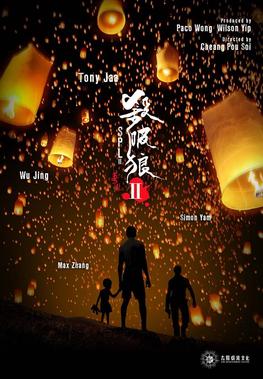
SPL (Sha Po Lang) II / A Time for Consequences / SPL2: Rise of Wong Po [China]: This Hong Kong film will feature Thai superstar Tony Jaa. (Is he in everything? Have they cloned him, or does he not need to sleep, eat, and poop like the rest of us.)
The Chemist: A grain of salt on the 2015 release, please. This is an “assasin-who-can’t-bear-to-kill-his-victim-and-ends-up-protecting-her-instead” film.
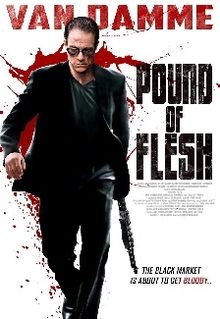
Pound of Flesh: Jean-Claude Van Damme. The blurb says: “A man’s heroic attempt to help a woman in distress ends up with him waking up the next day without a kidney and plotting his revenge.”
Kickboxer: Vengence: Featuring Dave Bautista, Jean-Claude Van Damme, and Gina Carano.
The Martial Arts Kid: As the unimaginative title (generic knock-off of the alliterative “Karate Kid”?) suggests, this is low budget. It features past martial arts competitors like Don Wilson and Cynthia Rothrock.
Ultimate Justice [Germany]: The blurb on IMDb reads: “A team of former elite soldiers are drawn back into action when the family of one of their own is attacked.”
I haven’t seen any publicity for this movie yet.
The Monk (Summer) [China]:This movie is based on a popular Chinese novel entitled Dao Shi Xia Shan (A Monk Comes Down the Mountain.)
I’ve seen no graphic publicity on this one, and the novel has apparently not been translated to English, so I don’t have much to tell you.
Unlikely 2015 Releases:
Stan Lee’s Annihilator: IMDb has it listed for an unspecified 2015 release. If so, those involved are better at keeping secrets than anyone else in Hollywood.
Showdown in Manila: Featuring Mark Dacascos. It’s supposed to begin filming early in February, so a release this year is unlikely. It’s said to be like “The Expendables.” I assume that means that it’s a big cast of past super-stars, but it might just mean that it sucks badly.
The largest mobile ferris wheel is currently located in Erzsébet Tér (Elisabet Square) on Pest-side in Budapest, and is being called the Budapest Eye. The name must be a nod to the famous London Eye, though the Budapest wheel design is much less reminiscent of an eye than the one in London–this owning to the use of a framework rather than cables to form the “spokes.”
It is big, and the top of it can clearly be seen from the Castle on Buda-side.
This photo was taken from inside the Budapest Whale, which is sometimes called the CET Building. The Whale is a building that houses galleries and shops on the Pest side of the Danube. It’s so named because one end of it is a gracefully shaped glass and steel construct that is reminiscent of a whale shape. Hence the light traveling through onto the water. (The other end is a more traditional red brick structure.)
One can see Freedom Bridge (Szabadság híd) and Gellért Hill in the background toward the upper right-hand corner.
The title of this book, Tears in Rain will be instantly recognizable to sci-fi fans as a reference to the Roy Batty (played by Rutger Hauer) monologue at the end of the movie Blade Runner. For those who aren’t familiar, Roy Batty is an android who is about to die as the result of a preset lifespan established in his programming, and he’s reflecting on all those unique experiences that he’s had that will be forever lost with his demise—as tears in rain.
When I picked up this book, I thought it would exist in the Blade Runner universe. It does not. However, it exists in a universe that shares several common features with the world of Blade Runner, and—in fact—it gives a nod to the film as a prescient historic work of fiction. What Montero’s novel has in common with the Ridley Scott film is a world in which there are both humans and androids that have surpassed the uncanny valley—i.e. they are generally indistinguishable from humans (if they want to be.) Furthermore, these androids (also called replicants) have a short and predictable lifespan–though it’s presented as a mysterious flaw rather than intentional programming. Further, there is a degree of tension between humans and replicants (reps.) The book also shares the movie’s film noir feel. The book’s lead character, Bruna Husky is a private dick–if you will—and a replicatant, and she is investigating a series of murders by replicants gone haywire.
The focal point of the book is something not extensively addressed in Blade Runner or that film’s point of origin, the Philip K. Dick novel Do Androids Dream of Electric Sheep, and that is the need to build memories into these androids so that they can function like humans. Reps discover at some point that all their childhood memories—good and bad—are fake, and this is a point of consternation for Husky. It is the corruption of the memories that leads the replicants to kill. That fact is established almost from the novel’s beginning. What isn’t clear is who is doing it and why, and book follows Husky through her investigation of these questions.
For the most part, I found the book to be readable. It’s a translation from the original, which was written in Spanish. It didn’t have that rare page-turning aura that made me have to find out what would happen next, but it was a good, solid science fiction work. The characters are—as one might expect from my “film noir” comment—overwhelmingly gruff and terse and / or broken people. Not that the unlikable nature of the characters is responsible for the lack of intensity of interest in what will happen to them. I recently read an article about unlikable characters, and it pointed out (correctly in my view) that Nick and Amy Dunne of Gillian Flynn’s Gone Girl are among the most detestable characters of recent literature, and yet that is a book one can’t put down. It’s difficult but not impossible to build intense interest with such characters.
Interspersed throughout the book are a few multi-page information dumps in the form of reports to an archivist who is a secondary character in the book–and who probably only exists to justify these info dumps. While the dumps aren’t excessive, neither do I think they are necessary. I don’t think there was much information in them that was necessary to the storyline, and what was could have been communicated more smoothly.
Part of Montero’s problem is that by tying her work’s title and important background details to Blade Runner, it becomes almost impossible to not compare her novel to either Blade Runner or Do Androids Dream of Electric Sheep. I might have given this work another star if I wasn’t thinking about how it was less visceral than the movie and less clever than Dick’s book. (Without the info dumps or the comparison it would have been a 4-star for me.)
Szentendre is a village just north of Budapest on the Danube. It’s known for its churches, bohemian atmosphere, and shops selling knick-knacks, bric-a-brac, curios, and antiques to tourists. It’s popular on the tourist circuit because it’s so close to Budapest and is readily accessed by car, train, or ferry. Here, third world market behavior often applies–i.e. the shopkeepers will quote an insanely high price with the expectation that one will try to negotiate an acceptable price.
Among the festive things to see include the marzipan museum and at Christmas time there is a large Christmas shop and “Museum.” (FYI: Marzipan is the mega-sweet concoction made from sugar, almond paste, and egg. Some people love it, but beware one bite may be enough to put you into a sugar coma.)
I’m fully adjusted to life in the tropics. I’m used to days that are almost exactly half light and half dark year round, and annual temperatures that vary less than 10°C from the year’s low to its high. However, I just got back from Hungary, and was reminded of some of the redeeming features of the great, white, whitest-of-white north.
Fortunately, we were eased into the winter experience. When we arrived, it looked like this:
By the end it looked more like this:
So beyond visiting family, why travel into the arctic chill?
9.) Christmas markets: If you’re tired of this year’s mass-produced doodads and gizmos churned out of massive factories in China, you can see some new and interesting wares within these markets (though there’s no escaping mass-produced tsotchkes altogether.) In Budapest’s markets, you can even find blacksmiths to custom make your metal needs.
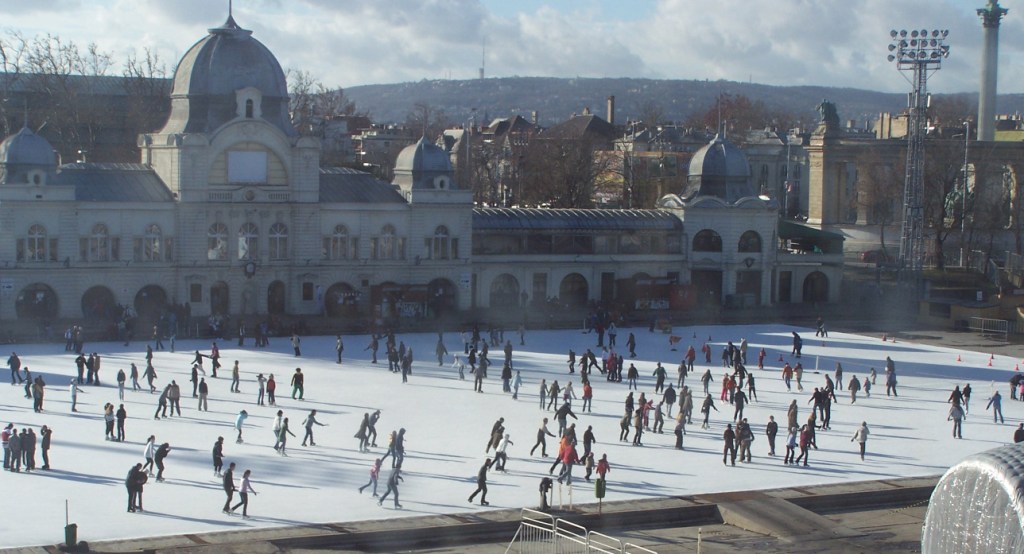
8.) Skating and winter sports / activities: In India one has three choices for viewing or participating in sports: cricket, soccer, or–did I mention–cricket. It was refreshing to see skiing, skating, etc. on TV and in practice.
7.) Vivid sunsets: Something about the high latitude and proclivity for cloud cover made for brilliant colors, and you can’t miss the sunset because it happens at about 4 o’clock in the afternoon.
6.) Street food: There are so many outstanding high-calorie food options too keep your internal furnace burning.
5.) Color: There’s no place that outdoes India in the brilliant colors department, but villages like Szentendre are no strangers to vivid colors–though not necessarily ones that assault the eyes. Besides the warm yellow-orange that is ubiquitous throughout the region, there are a range of colors that one doesn’t see everyday and that I–as a straight man–have no idea of the names of.
4.) Concerts: Music is big in Hungary, and there are bills for Christmas concerts all over the place. That said, we missed most of the Christmas music in favor of going to hear a popular Dixieland Jazz band and a New Years Concert that mostly rock-and-roll cover songs. Dixieland Jazz isn’t what one expects in Hungary, but it’s nice to see American art forms other than Hollywood cinema and television programming that have a huge following abroad.
3.) Finding your inner child: If you grew up in a wintery place–as I did–the cold, colors, and lights of the holiday season transport one back to the simple and energetic time of one’s youth.
2.) Hot beverages: You develop a renewed appreciation for coffee, tea, mulled wine, and hot cocoa when it’s freezing.
1.) Kürtőskalács: If you don’t know what this is, it’s worth the visit for it alone. It’s one of the best wintertime snacks anywhere in the world, and is hand’s down the best cylindrical food in existence.
I’m back from Hungary with a load of photos to share. Here’s the first installment.
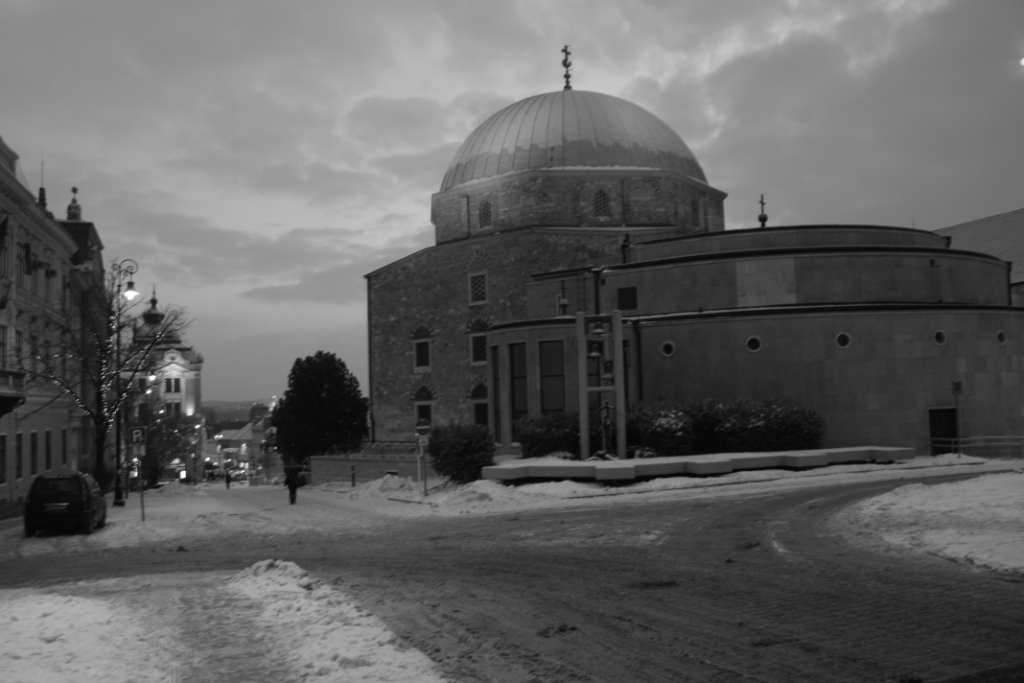
This building is also–and currently–known as the Downtown Church of the Blessed Virgin Mary, and in the intervening period was known as St. Bartholomew’s Church. It’s located on Széchenyi Tér in downtown Pécs. It was built as a mosque in the latter half of the 16th century under Ottoman control, but was converted to a Roman Catholic Church when the Turks were defeated. There are several such re-purposed mosques in the area, but this one has been said to be the best example of Turkish architecture in Hungary.
The WordPress.com stats helper monkeys prepared a 2014 annual report for this blog.
Here’s an excerpt:
The concert hall at the Sydney Opera House holds 2,700 people. This blog was viewed about 32,000 times in 2014. If it were a concert at Sydney Opera House, it would take about 12 sold-out performances for that many people to see it.
This is my 1,000th post on this site, and I’ve finished it just in time to get on a plane and leave the country, rounding out my blogging year with a nice round number. It’s been fun, and I’ll be back in early January to crank it back up.