BOOK REVIEW: Sins of the Cities of the Plain by Jack Saul

Sins of the Cities of the PlainSins of the Cities of the Plain by Jack Saul
My rating: 4 of 5 stars

Project Gutenberg page


This is a short work of Victorian erotica that describes the sexual adventures of a male prostitute of the variety then called a “Mary-Ann.” The “Mary-Ann” was an effeminate male who — to a large extent, but not exclusively — serviced male clients. The story is presented in an epistolary form. It opens with a chapter that’s written as if by a john of the pseudonymous author / main character. This opening sets up the rest of the work by explaining how this john, a Mr. Cambon, came to use Jack Saul’s services, and – furthermore – how he then became involved in the publication of this story.

After the details of Mr. Cambon’s interaction with Jack Saul is presented, the book proceeds as if a diary conveying the saucy bits of Saul’s sex life (both professional and personal.) While Saul explains that he prefers engaging older male clients, the book presents a mix of homosexual and heterosexual activities (both in his work and in his personal relationships.)

There is some ancillary matter in the book. After Saul concludes [what is presented as] his personal story, he offers some second-hand accounts of individuals in the same line of work. Here one learns about the worst elements of these sex workers in the form of “George,” an anti-Semitic mary-ann who engages in blackmail and other heavy-handed and sociopathic tactics that – as far as we know – Jack Saul doesn’t engage in. [Although, under the direction of a client, Saul does take part in some unsavory practices.]

There are also a couple of essays at the end, one on sodomy and another on tribadism. If you’re like I was, you have no idea what tribadism is. That brings up a point worth mentioning. If you decided to read this work, you may want to have a good dictionary near at hand. The slang and terminology of the sexual domain have not aged well, and you may find yourself needing to look up many words. (Though, admittedly, context often gives one a strong clue.)

If you’ve gotten this far, it should be clear that there is a great deal of explicit sexual content in this book. While readers of some modern-day erotica might not find it particularly racy, it’s graphic in its descriptions and does involve a wide range of practices.

This book shines a light on a domain of Victorian society that one will not learn about from Dickens or Austen. Like most pornography, it’s not particularly well-developed or artistically grand, but it’s intriguing in its own way.

View all my reviews

BOOK REVIEW: 30 Days of Night, Vol. 3: Run Alice Run by Steve Niles

30 Days of Night Vol. 3: Run Alice Run30 Days of Night Vol. 3: Run Alice Run by Steve Niles
My rating: 4 of 5 stars

Amazon.in page


This volume picks up at the end of the vampire raid on the Los Angeles FBI offices, a raid whose primary goal is to retrieve the remains of Stella Olemaun. The vampire-savvy agent, Alice Blood, seems to be the sole survivor (more properly, only one not turned into a vampire for Eben Olemaun’s army of the undead.) The balance of the book turns Eben Olemaun’s war in a new direction, toward the European old guard. In the original book, this division is introduced between the old-world vampires who want to remain myth and quietly live out their immortal days, and the hot-headed American vampires who are eager to war and watch the world burn.

I enjoyed this volume more than the previous one, but not nearly so much as the original story. Sadly, I suspect the reason that I preferred it to the last volume is that it’s so fast-paced and action-packed that I had no time to notice that it’s often not clear why characters are doing what they’re doing (or, more damningly, that they sometimes adopt behavior that seems at odds with the character as established through his or her recent behavior.) While I seem to have leap-frogged material and may have missed an answer, I continue to be perplexed by an anomaly from the original book and that’s why Eben is so easily able to defeat any other vampire. He’s vampire superman, and it’s not clear why he should be.

As I wrote in my review of Volume 2, at this point the series doesn’t really distinguish itself among the mass of modern-day vampire stories. The original book, I felt, did build a novel concept that made it more interesting and intense than usual. The book is well-written and gruesomely drawn, but so are tons of other vampire stories. Having read three volumes, I’m over this series, but it is well constructed – if a bit Hollywood.

View all my reviews

BOOK REVIEW: 30 Days of Night, Vol. 2 by Steve Niles

30 Days of Night Volume 230 Days of Night Volume 2 by Steve Niles
My rating: 3 of 5 stars

Amazon.in page

[Note: this isn’t the Vol. 2 that follows immediately from the original book.]

I enjoyed the original three-issue “30 Days of Night” series. That book imagines a vampire attack on Barrow, Alaska during the winter when the sun does not rise for weeks. That concept of eliminating one of the vampires’ greatest vulnerabilities while putting the survivors in the demoralizing state of being hunted in the darkness and brutal cold makes for a visceral story.

While I thought this volume was written and drawn well (and quite similarly to the original – same writer, different artist) I have two gripes. First of all, I guess owing to the immense success of the franchise which resulted in many series and sub-series, it’s quite confusing to pick up the order of storytelling at this point. After reading the original book, I read Volumes 2 and 3 (sometimes labeled “Ongoing”,) thinking they would follow up on the Vol. 1 [the original] that I’d read. However, while I could follow the story, there was clearly a substantial gap in time and events. It seems like the Vol. 2 and Vol. 3 that I read (labeled “Ongoing”) were fitted together, but at least one series must fit between this Vol. 2 and the Vol. 1 that I read. Even scanning through a Wiki-page on the overall series didn’t really lend me clarity — though I had no desire or inclination to read through 30 summaries to figure out where this Vol. 2 and 3 belongs. [Especially as I don’t intend to read further as the series seems to have devolved from that gripping and unique Barrow, Alaska plot to being just another modern-day vampire story.]

So, the story of the Vol. 2 that I read is essentially Sheriff Eben Olemaun first feeding his way through a rebuilt [security super-maxed] Barrow before going to Los Angeles to do both more recruiting and turning, and then attacking the LA FBI offices in order to retrieve the remains of his wife, Stella. [My first clue of discontinuity was that at the end of the first [first] volume, Eben is dead and Stella was alive, and in this book those tables were inexplicably turned.] The other “half” of the story revolves around an FBI agent, Alice Blood, who is apparently the FBI’s star Vampire-slayer. We find out that she is the one who killed Stella, though she seems a bit broken up about it. Being the virtuous hero, Alice is also fed up with the bureaucratic moral ambiguity of her employer.

Getting around to my second gripe, it’s that this isn’t really a satisfying story arc as a standalone entity, it’s just carrying a story through. To clarify, I’m not saying it doesn’t stand alone because I’d missed who knows how much of the preceding story and didn’t understand. In that sense, I thought they actually did a great job of making clear what was going on without getting bound up in a lot of “as-you-know-Bob” exposition. What I’m saying is that this book gives one a chain of action without providing much understanding of motivation. I will grant that my not understanding the motivation in the first chapter is probably the result of not reading the immediately prior issue. However, I didn’t see much convincing motivation for anything in this volume. I saw that Eben wanted his wife’s head and torso back, but as he seems to have zero of the devoted husband and law enforcement professional left at this point and is just monstrous killing machine, it’s hard to know why he would care.

Long story short, I thought this book was alright, but not particularly satisfying and that the ordering is quite confusing. I picked up all three volumes I’ve read on Amazon Prime, so no great loss there. However, I mention that so no one else expects the Volume 1, 2, and 3 presented on Prime to present a contiguous story. Continuity issues aside, I don’t think the story still distinguishes itself from the massive number of modern-day vampire tales available today.

View all my reviews

DAILY PHOTO: Charyn Canyon

Taken in the summer of 2019 in Charyn Canyon

POEM: Reading Courageously


If you’ve never been incensed,
challenged, or nauseous —
your reading is too safe, puny,
and far, far too cautious.

Reading should be a courageous act
that threatens all you know.
It should shove your feet into shoes
far different from your own.

If you want your world unchanged,
T.V. is right for you.
Books will insist you be torn a-
part and rebuilt anew.

DAILY PHOTO: The Sun Sets on Stone Mountain Lake

Taken in Stone Mountain Park in July of 2013

POEM: Paradise Unknown

In a meadow, amid a dark forest
grows a grass so green it glows.
Never sets foot a pilgrim or tourist.
Where it lies, only an old local knows.

Plus, the grazing creatures of the forest
who wander that way when dining time comes.
It sings but silence — no insect chorus.
No sound is heard, save one’s own thin heart thrum.

Burdened is the keeper of that meadow,
with a secret for which some would murder.
But paradise is too frail to be known
to the heartless hand of human herders.

Paradise trampled is paradise lost.
So, the keeper keeps his secret at all costs.

Tree Haiku

two live oaks
stretch toward each other —
a faux hug


eucalyptus,
silver trunks glow warm
in setting sunlight


one tree field,
its canopy echoes
floating clouds


a faint smell —
the secret message of an
arboreal cabal


in tree time,
the world must unfold in
seasons — not days

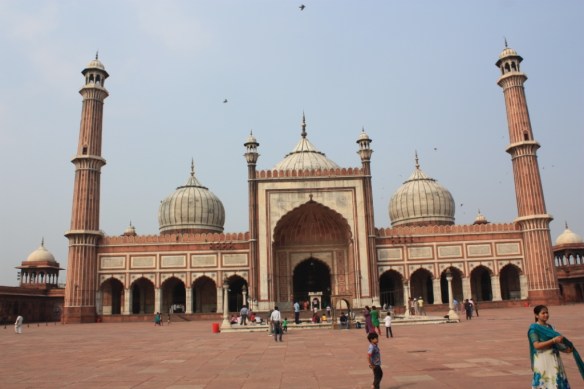
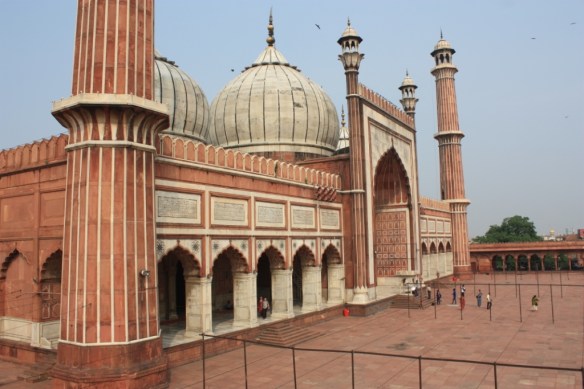
DAILY PHOTO: Jama Masjid, Delhi

Taken in October of 2013 in Delhi

POEM: Baudrillard’s World

What’s it take to turn a symbol into something which is something [rather than symbolic of something?]

Treasuries turn high-rag paper and indelible ink into slips for which people will give one a shirt or a bicycle.

-Paper and pot metal as symbol of value

Admen turn color and font into a dollar more per kilo of a chemically-identical product. [The dollar can be used for someone’s ill-advised gas station hot dog.]

-Brand as symbol of value

Countries are defended by the potential to use weapons — not by their actual use.

-WMD as symbol of defense

Social media presents a lot of talking and the illusion of listening.

-Screaming into a dark forest as symbol of communication

Stories and verse get turned into potent chemical reactions in the body.

-Vicarious living as symbol of living

The letters of this post are symbolic of philosophy, which — in turn — is symbolic of something meaningful, which — in turn –… which — in turn –… which — in turn–…