BOOK REVIEW: Taoist Yoga & Chi Kung by Eric Yudelove

Taoist Yoga and Chi Kung- For good health,better sex,and longer life.Taoist Yoga and Chi Kung- For good health,better sex,and longer life. by Eric Yudelove
My rating: 4 of 5 stars

Amazon page


This book was originally released under the title: “100 Days to Better Health, Good Sex & Long Life.” It offers a 14 week qi gong practice that proposes to improve health, sex life, and longevity. It’s presented as a step-by-step explanation of the practice aimed at those who intend to carry out the practice—as opposed to those who are looking for a more general explanation or overview.

The book offers a systematic presentation of the 14 week / 100 day practice. It’s divided into two parts. The first is a short explanation of Taoist concepts as they pertain to health building practices, and particular emphasis is given to the concepts of chi (energy / breath), jing (body), and shen (mind.) That emphasis is valuable as each of the chapters (i.e. the description of each week’s practice) is outlined according to these three concepts. So, each week there is a new breath practice, new bodily practices, and a new meditation or visualization practice. That said, these practices build on each other—i.e. starting with very basic activities and either adding to them or shifting to more complex variations.

The sections on breath and mind are fairly straight forward and mostly involve one practice each per week. Those practices become quite complex over the course of the book, but it’s one practice per week. This is in contrast to the middle section that has three or four subsections of activities per week. The middle section on Jing, or body, includes subsections on making sounds, self-massage, “sexual kung fu” (exercises intended to tone the reproductive system and prevent chi “leakage”), and the movement exercises that one might most closely associate with qi gong (chi kung.)

The book has many graphics in the form of line drawings used to clarify anatomy or how one is to visualize the practices. There is a glossary to help explain both Chinese terms and terminology in English that is specific to qi gong. There is also a two page bibliography that includes many works by one of Yudelove’s teachers, Mantak Chia, but also including works by individuals from other lineages and systems.

I have practiced through week eight. One may find the parts of the practice vary in their usefulness, but there doesn’t seem to be any harmful practices and there are many from which one will benefit. I’d recommend the book if one is looking for practices—as opposed to background. The explanations are systematic and the overall practice is well-organized. It’s not the kind of book that is much of a pleasure to read for reading’s sake. Much of the book is lists and bullet points of step-by-step explanation.

View all my reviews

BOOK REVIEW: Trying Not to Try by Edward Slingerland

Trying Not to Try: The Art of Effortlessness and the Power of SpontaneityTrying Not to Try: The Art of Effortlessness and the Power of Spontaneity by Edward Slingerland
My rating: 5 of 5 stars

Amazon page


This book’s paradoxical title is perfect for its paradoxical subject matter, which is famously expressed in such quotes as, “When nothing is done, nothing is left undone” [ver. 48 of the Tao Te Ching.]  Slingerland lays down the ancient Chinese wisdom of wu-wei and de, but provides something novel by putting it in the context of the positive psychology and neuroscience of today. Wu-wei literally means “no doing,” but can be more meaningfully defined as “effortless action.” De (pronounced “duh”) is a charisma seen in people who have mastered the effortlessness and spontaneity of wu-wei.

While the book is built around the varied approaches of four Chinese philosophers—two Confucians (i.e. Confucius and Mencius) and two Taoists (i.e. Laozi and Zhuangzi)—the author relates this philosophy to the present-day thinking found in Daniel Kahneman’s “Thinking, Fast and Slow,” Mihaly Csikszentmihalyi’s conception of Flow, and the neuroscience of the subconscious.

The book consists of eight chapters. The introduction and the first two chapters outline the concepts of wu-wei and de using both Chinese and Western stories and examples to help clarify these arcane ideas and put them in the context of the social and spiritual spheres. Chapter 1 offers an extensive discussion of the operation of the brain as it relates to the discussion of effortlessness and spontaneity.

Chapters three through six make up the core of the book, and present the approach and thinking of Confucius, Laozi, Mencius, and Zhuangzi, respectively. This “boy-girl-boy-girl” Confucian-Taoist organization offers the reader sound insight into the varied approaches and allows one to see the evolution of thinking. Confucius gets the first cut, but his approach to effortlessness and spontaneity involves a great deal of effort and planning. It might seem that Laozi’s approach–which does away with effort and planning–might be more apropos, but it’s hard to imagine anything of benefit actually being spawned by such a loosy-goosy approach. The more nuanced approaches of Mencius and Zhuangzi offer additional insight, but do not eliminate the paradox. It’s this paradox that’s the subject of chapter seven.

The final chapter examines what the reader can take away–given that the paradox of wu-wei seems inescapable. The author proposes that, paradox or not, there is value in pursuit of effortlessness and spontaneity, and progress can be made by understanding and accepting said paradox.

The book has no graphics, but is annotated and has a bibliography–as well as an appendix table that summarizes the various approaches to wu-wei.

I enjoyed this book and found it fascinating. It’s highly readable, having humor and a wide range of examples from ancient myths to pop culture. The book offers a great value-added by considering the relevance of modern science and psychology to this ancient concept. I’d highly recommend this for individuals interested in Chinese / Eastern philosophy, as well as anyone hoping to bring a little more effortlessness and spontaneity into his or her life.

View all my reviews

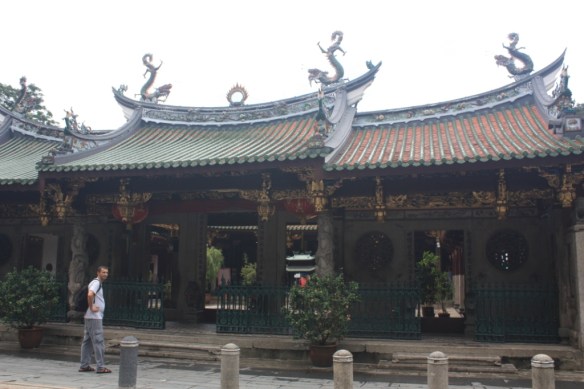
DAILY PHOTO: Thian Hock Keng

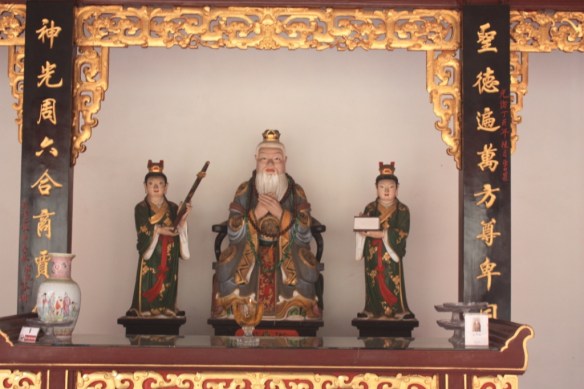
Confucius; Taken on October 29, 2016 in Singapore

Confucius; Taken on October 29, 2016 in Singapore

img_3549img_3548

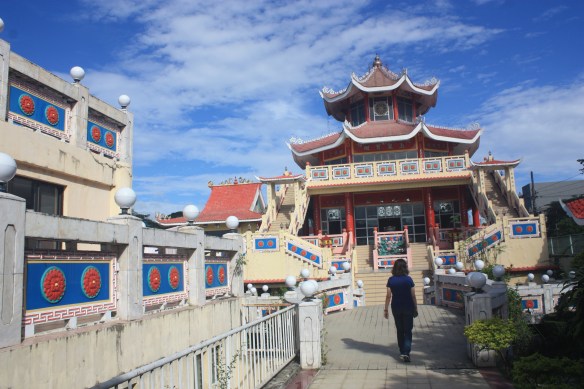
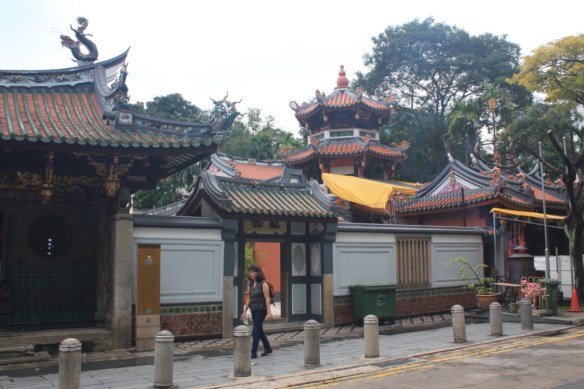
This Chinese temple sits in the heart of Singapore’s Chinatown. It’s said to be the oldest Hokkien or Hoklo temple (i.e. Han Chinese) in Singapore. It’s a temple related to Han Chinese culture generally, rather than to a particular sect or religion. While the main deity is Mazu (a.k.a. Ma Cho Po,) a maritime goddess from Chinese folklore that is sometimes associated with Taoism, there is also a Confucian shrine as well as homages to several Buddhist Bodhisattvas (a Bodhisattva is one who has achieved enlightenment but sticks around to help others out of compassion.)

BOOK REVIEW: The Way of Chuang Tzu by Thomas Merton

The Way of Chuang TzuThe Way of Chuang Tzu by Thomas Merton

My rating: 5 of 5 stars

Amazon page

The Way of Chuang Tzu is Thomas Merton’s take on Chuang Tzu’s lessons of Taoism. One might ask why a person should learn about Taoism from a Trappist monk any more than one would learn the teachings of St. Francis of Assisi from a Zen monk. Maybe you should and maybe you shouldn’t, but I think Merton did a remarkable job in putting this book together and that there’s a lot to be learned from it. Some may find a fresh fusion in Merton’s approach to Chuang Tzu.

What I like most about this version of Chuang Tzu’s teachings is that Merton doesn’t foul it up with a bunch of analysis. Because the lessons are short and—admittedly, in some cases—arcane, there’s a temptation to write in a bunch of explanation and analysis—both to hit a page quota and to prove how smart the translator is. Ironically, some don’t seem to see the irony of rambling on in explication of Taoism—a philosophy that advocates simplicity and rebukes the wordy for their arrogance. Merton doesn’t fall into this trap. He offers a few pages of introduction as context for the reader, and then moves straight into 62 lessons of Chuang Tzu.

I’d say the introduction is useful, particularly for individuals without a great deal of background in Taoism. In it, Merton gives insight into potentially confusing topics like wu-wei (actionlessness), the yin/yang dichotomy, and the divergence of Taoists from Confucian scholars on the four-fold Ju philosophy of virtue. However, the intro can also be skipped if you do know a about Chinese philosophy, and don’t care to read a commentary on Taoism inflected with Trappist worldview. (Taoists may want to skip the intro if they’re prone to becoming infuriated by an outsider proposing that their life philosophy took a wrong turn along the way. Merton suggests that one shouldn’t confuse Chuang Tzu’s Taoism with what the system has become, the implication being that it was a sound philosophy and became voodoo hokum in modern times.) Merton does inevitably project some of his own worldview as a Christian monk into Chuang Tzu’s teachings. Some might find this to make for a refreshing commentary on it, and others may find it a bit off the mark on occasion.

Merton’s poetic background serves him well here as many of the lessons are in poetic form—partially or totally. Translating poetry is one of the most difficult linguistic tasks imaginable. Merton has the added challenge of never having read the original. He doesn’t read any Chinese languages. He did, however, consult four different translations in three different languages (English, French, and German.) This, of course, means that besides Merton being in the text, there’s a further seepage of Western framing into these Eastern teachings. I’ll leave it to the reader to decide whether this is a good or bad thing, and arguments could be made either way.

One of the strengths of Chuang Tzu’s lessons is his use of the narrative form. That is, the Taoist sage liked to use stories to impart his wisdom, like the wheelwright who insults the Emperor but then ends up teaching him a valued lesson. One of my favorites is the story about the Prince of Chu sending out high-ranking emissaries to appoint Chuang Tzu to a ministerial post. Chuang Tzu explains why he is turning down the offer by way of an allegory about a turtle.

Chuang Tzu also uses dialogue to get his point across in a way that is easy to follow and clear. A prime example of this is the discussion between Chuang Tzu and Hui Tzu about the happiness of fishes, which has an almost Socratic ring to it. The combination of story and dialogue makes Chuang Tzu’s lessons sometimes easier to follow than the Tao Te Ching of Lao Tzu. Lao Tzu tends to be more arcane by way of his use of short, declarative statements that are more vague and abstract (that could be a good thing, but given vast loss of cultural context it might be confusing as well.)

I’d recommend this book for anyone interested in Taoism. I enjoyed the Merton’s sparse approach, and think that he does a good job conveying Chuang Tzu’s lessons.

View all my reviews

Chi: The Power of What Isn’t

Every morning I start my day with chi kung (a.k.a. qi gong), and many days I do tai chi (tai qi.) For those who are unfamiliar, chi is usually defined as “life force” or “life energy.” However, defining chi is neither simple nor will one find a consensus agreement. Some say chi is  “breath,” at which point its existence becomes a much less controversial, but also less explicative, concept. Others would say that chi is much more broadly dispersed than the “living” so “life force” is an understated definition.

Chi Kung are exercises combining breathing, movement, meditation, visualization, and self-massage that are used to keep one healthy. Because yoga also contains these components (e.g. breathing, movement, and meditation; though with very different specifics) some have even been known to call chi kung “Taoist yoga.” The idea behind these exercises is that chi is lost through living (some activities more than others), and can become blocked in the channels through which it is believed to move. Various exercises are used to replenish and ensure healthy circulation of the chi. Tai chi is a series of martial arts forms that are also considered to have the effect of replenishing and / or enhancing chi.

Two questions may leap to mind, especially among those who know me as a skeptic. First, do you believe in chi–despite the lack of evidence that it exists? (When I mention this lack of evidence, I am obviously not defining chi as breath or bodily fluids, in which case the most rabid skeptic would have to acknowledge its existence. However, then an entirely different set of questions is raised about the vast and complicated nature of chi kung exercises needed to circulate oxygen, which travels through blood vessels and not through channels or meridians. In other words, there’s no reason not to abandon a lot of the Traditional Chinese Medicine (TCM) / Taoist conceptions of health if one considers a narrow definition of chi.) Second, if you don’t have any reason to believe that chi is a real thing, why bother with the exercises?

First, no, I don’t believe in chi as a substance or physical entity in the way that your average Taoist priest does. I don’t mock or ridicule those who do, and I acknowledge it could always turn out that they were right and I was wrong and that my current state of ignorance combined with an incorrect deference to Occam’s Razor led me astray.

However, I have a pretty high standard for believing a person, place, or thing exists. I need to be able to observe it.  If I can’t perceive it directly, but there is some indirect sign it exists, then that indirect sign needs to be the simplest possible explanation I can imagine given my current state of knowledge. (Yes, I realize that Occam’s Razor isn’t a law, it can always be that an unlikely explanation is the correct explanation. I also know the raft of indirect signs of chi, and, yes, I’m saying I can imagine simpler explanations than an energy source that is immeasurable but powerful enough have bodily effects.) While I don’t believe in chi (or meridians, or the yet undiscovered organ called the “triple heater”) as physical things, I do believe in conceptual chi which is an object of visualization.

Moving on to the second question, I practice these exercises because they make me healthier.

This, of course, raises another question, “How can these exercises be effective if chi is not real?”

Now I have to go Socratic on my hypothetical questioner. The Socratic dialogue goes like this:

S: Have you ever been to a scary movie?

A: Of course, I have. What kind of a troll has never seen a scary movie?

S: I’m Socrates. I’ll ask the damned questions around here, thank you very kindly.

So while you were watching said movies, did you ever get startled? That is, did your pulse ever pound a bit harder; did you ever take a gasping breath; did your hands ever grip the armrest with white knuckles; or did you ever get butterflies in your stomach?

A: Of course, that’s part of the horror movie watching experience.

S: So, then, you were under the impression that the events you were watching were actually happening, and that the killer might come out into the theater after you at any moment?

A: No, of course not. Don’t be absurd!

S: And yet this thing that was not real–that was just symbolic or conceptual–had actual physiological effects?

[At this point Socrates breaks into his superiority dance.]

I think visualizing chi flow has positive benefits both mentally and physically. The mental benefits may be clear. The physical benefits result from putting oneself in the moment and conducting activities (deep breathing and movement) that help one de-stress. This process of de-stressing helps one to be healthier. Does it matter that one does the exercises as they have been handed down from ancient China? Probably not, but I believe that trial and error (even without complete information about anatomy and physiology) yield some impressive results. Of course, there are many other systems (e.g. yoga) that can work equal wonders using an approach that is quite different in its detail. (I also don’t believe in Chakras, but can imagine great benefits from behaving as if they exist.)

MindOverMedicineI just started reading a book by a medical doctor named Lissa Rankin. Rankin’s book, entitled Mind Over Medicine, presents evidence from a large body of scientific literature suggesting the mind often plays a major role in wellness by way of mechanisms that aren’t yet fully understood, but which defy the traditional view of Western medicine.

Rankin was intrigued by the vast number of anecdotal cases of what doctors call “spontaneous remissions.” Spontaneous remissions are when a patient becomes healthy in a way that defies explanation (i.e. they had no treatment, they had insufficient treatment, and they had an illness for with the body’s immune system is normally believed incapable of doing the job on its own.) She wasn’t satisfied with these one-off stories involving placebos, fake surgeries, busted radiology equipment, faith healing, etc, but rather wanted to see what the scientific literature contained by way of scientific double-blind studies on the subject.

She found there was evidence to support mind over matter when it came to illness, and that there was a fledgling explanatory literature. She also learned that while there was a large database of spontaneous remissions, there had not yet been an attempt to determine whether there were common characteristics of those who showed the “placebo effect” (getting well while being in the placebo group of a double-blind study) or other spontaneous remissions.

My point is that there is good reason for skeptics to consider that there may be a lot more to health and well-being than our current paradigm suggests.

BOOK REVIEW: The Book of Tea by Kakuzo Okakura

The Book of TeaThe Book of Tea by Kakuzō Okakura

My rating: 4 of 5 stars

Amazon page

This book is neither about tea the drink nor tea the plant; it’s about tea the experience. It’s about what the author refers to as “Teaism,” which is akin to Taoism and Zen and which extols the virtues of simplicity, purity, and humility. Teaism is a philosophy that exists around–and in conjunction with–so many familiar philosophies, but is not subsumed by any of them.

The book is divided into seven parts: I.) The Cup of Humanity; II.) Schools of Tea; III.) Taoism and Zennism; IV.) The Tea Room; V.) The Art of Appreciation; VI.) Flowers; and VII.) Tea Masters.

Part I gives us an overview of what Teaism is. One may get a better feel for the author’s view of Teaism through a few choice quotes than from my rambling description. (I’ll take advantage of the book’s 1906 birth date–and, hence, public domain status–to quote heavily from it.)

“Those who cannot feel the littleness of great things in themselves are apt to overlook the greatness of little things in others.”

“It’s [The Tea cult’s] very spirit of politeness exacts that you say what you are expected to say, and no more.”

“For Teaism is the art of concealing beauty that you may discover it, of suggesting what you dare not reveal.”

“Let us dream evanescence, and linger in the beautiful foolishness of things.”

The first part also devotes considerable space to contrasting East and West. The author defends the Eastern ways, which include an exacting and meticulous approach to tea, as not being backwards–as suggested by some in the West.

It should be noted that her commentary, while sometimes sharp in tone, isn’t an attack on the West so much as a defense of the East. It’s interesting to me that there was such conflict as Teaism sprang from Taoism, which is the individualistic strain of Southern China. There is much in common between the values of Taoism and Western liberal thinking. Both share irreverence for tyranny and authoritarianism, and a dislike of that which is forced on one by dictate.

The second part gives a mini-history of the development of tea, but soon sows more of the philosophy of tea in what becomes a lead-in to the following chapter. A couple more choice quotes:

“Perhaps we reveal ourselves too much in small things because we have so little of the great to conceal.”

“Teaism was Taoism in disguise.”

The third part is the core chapter. It discusses the like mind of Taoism and Zen, and how these systems made fertile soil for the growth of Teaism. It is the heart of the book, as it reveals most vividly what Teaism is by explaining the concepts of nothingness and duality.

“One who could make himself a vacuum into which others might freely enter would become a master of all situations.”

“In jujutsu one seeks to draw out and exhaust the enemy’s strength by non-resistance, while conserving one’s own strength for victory in the final struggle.”

“Truth can be revealed only through the comprehension of opposites.”

“The followers of Zen aimed at direct communion with the inner nature of things, regarding their outward accessories only as impediments to a clear perception of truth.”

Part IV describes the place in which the tea ceremony takes place. The key points are: The tea room should be small and simple, and emulate a Zen monastery. The entryway should be less than three feet high, so that all–Shogun or shepherd alike–can be reminded of the need for humility. The first requisite of being a tea master is the ability to sweep and clean. Earlier, Okakura mentions how the most senior monks in a Zen monastery do the most arduous tasks, rather than the novices. This point translates to Teaism. By becoming a master, one doesn’t escape the requisites of modest tasks, but must carry them out all the more skillfully.

Part V, on the art of appreciation, was summed up for me by the quote, “We classify too much and enjoy too little.”

Part VI is where the author goes a little astray in my opinion. She seeks to address the co-development of flower arranging with tea ceremony. She begins by bemoaning the waste of so many flowers–even more-so in the West than the East. “Why were the flowers born so beautiful and yet so hapless.”

Interestingly, she never bemoans the plucking of tea. She anthropomorphizes flowers–not, apparently, because they are living–but because they are beautiful. She imagines that they must feel the excruciating pain of being wrenched from a stem in a way that a rather lackluster looking tea-bud cannot. It’s her deference to the consensus of beauty as represented by the flower as opposed to the simple tea-bud in which she performs the greatest sin against her own philosophy.

Furthermore, she says, “The man of the pot is far more humane than the man of the scissors.” Failing to recognize that the flower planter and the flower harvester are, in most cases, one in the same person.

She eventually explains how those whose philosophy so despised the destruction of life and beauty came to engage in flower arranging. “We shall atone for the deed by consecrating ourselves to purity and simplicity.”

The final part tells us about the nature of the tea master–a monk of leaf and beverage, if you will.

“The tea-masters held that real appreciation of art is only possible to those who make of it a living influence.”

“He only who has lived with the beautiful can die beautifully.”

I recommend giving this thin book a read. I packs a lot of food for thought into a small package. The language is excellent. (The book was originally written in English, and directed toward a Western audience. Hence the extensive defense of Eastern thinking up front.Therefore, there is no worry about getting a particular translation.)

View all my reviews

DAILY PHOTO: Temple of Heaven Grounds in Beijing

The pointy-topped building is the Hall of Prayer for Good Harvests

The pointy-topped building is the Hall of Prayer for Good Harvests

The Temple of Heaven is a complex of buildings used for Heaven worship.  It was built in the 15th century, and is a Taoist temple  (Heaven worship predates Taoism–though the Temple doesn’t.) The most distinctive building, the Hall of Prayer for Good Harvests–shown only partially in the picture–was built without any nails or spikes.

It’s  located in a beautiful park south of central Beijing. The park has a rose garden and is a popular hangout for people doing tai chi, playing instruments, and dancing.