BOOK REVIEW: The Geography of Bliss by Eric Weiner

The Geography of Bliss: One Grump's Search for the Happiest Places in the WorldThe Geography of Bliss: One Grump’s Search for the Happiest Places in the World by Eric Weiner
My rating: 5 of 5 stars

Amazon page


This book combines travel writing with pop science discussion of what makes people happy (or unhappy.) Weiner travels to ten countries in pursuit of happiness, and reflects upon the cultural components of bliss.

Some of the countries, like Switzerland and Iceland, rank among the world’s happiest in international surveys. Some of the countries, such as Qatar and America, have every reason to be happy, but aren’t necessarily as blissful as the rest of the world would expect. Some of them, like India and Thailand, have good reason to be unhappy, and yet they manage to be global exemplars of happiness [at least within certain domains.]

Then there are a few nations that have unique relationships to happiness. Bhutan has a national policy on happiness [plus it’s a Buddhist country, and Buddhism probably offers the most skillful explanation of what it takes to be happy of any world religion.] Moldova provides a counterweight as it’s one of the least happy countries in the world. Weiner visits the Netherlands in part because one of the biggest academic centers studying happiness is located in Rotterdam, but it also offers an opportunity to study whether the country’s unbridled hedonism (drugs and prostitution are legal) correlates to happiness. That leaves Great Britain, a country known for wearing the same happy face as its sad, terrified, and enraged faces.

I’ve been to half of the countries on Weiner’s itinerary, and—of the others—I’ve been to countries that share some—though not all—of the cultural constituents of happiness. (e.g. I haven’t been to Qatar, but I’ve been to the UAE. I haven’t been to Moldova, but I’ve seen somewhat less grim Eastern European states. I haven’t been to Switzerland or Iceland but I’ve been to cold countries in Western Europe. I haven’t been to Bhutan, but I’ve been in areas where Tibetan Buddhism was the dominant cultural feature.) This allowed me to compare my experiences with the author’s, as well as to learn about some of the cultural proclivities that I didn’t understand during my travels. And I did find a lot of common ground with the author, as well as learned a lot.

I found this book to be interesting, readable, and funny. Weiner has a wacky sense of humor that contributes to the light-hearted tone of the book—perfect for the subject. That said, some people may be offended because the author doesn’t pull punches in the effort to build a punchline, and this sometimes comes off as mocking cultures. However, in all cases—even that of Moldova—Weiner does try to show the silver lining within each culture.

The paperback edition I read had no graphics or ancillary matter. There are no citations or referred works (except in text), and the chapters are presented as journalistic essays. The chapters largely stand alone, and so one could read just particular countries of interest. He does refer back to events that happened in earlier chapter or research that related to another country’s cultural proclivities, but not often. The first chapter, on the Netherlands, would be a good one to read first because he describes many of the scientific findings on happiness in that one.

I would recommend this book for anyone interested in what makes some places happier (or sadder) than others.

View all my reviews

5 Tips for Introverts

5.) Eye contact: Train yourself to be aware of eye contact. Eye contact doesn’t come naturally for an introvert. It’s common to not only avert one’s gaze, but to zone out in the process because one’s mind is trying to anticipate the direction of the conversation and formulate a replies. There’s not enough consciousness left for monitoring the visual stream. This has a number of side-effects such as:

-missing non-verbal cues

-appearing uninterested

-staring in the wrong direction (crotches, cleavage, Hells Angels, etc.)

Just don’t let the pendulum swing too far such that one stares like a homicidal maniac.


4.) Scheduling: Bracket social and /or noisy events with quiet time. It’s not just social activity that can be draining for the introvert, being in environments with high levels of sensory stimulation will run down one’s energy even if one isn’t interacting socially. Living in India, I find that sometimes just walking down the street and minding my own business wears fairly rapidly. In moderated doses, these sensory-intensive situations are enjoyable and beneficial, but the secret is to avoid redlining. Extended periods of high stimulation may result in you being grumpy and / or dull.


3.) Readings: Come on, you’re an introvert, you know you love reading. There are a number of books that have come out in recent years to help introverts both better understand introversion and to learn to arrange their lives in a manner optimized to it. I’ll mention two of the more well-known ones.

The first is The Introvert Advantage by Marti Olsen Laney. I mention this one first because it was the first book I read on the subject, and it transformed my thinking about what it meant to be introverted. Though I’m an introvert, I didn’t really understand introvertism until I read Laney’s work.

introvertadvantage_laney


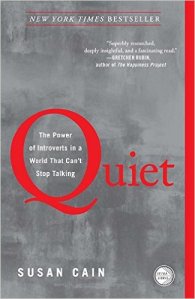
The more well-known and critically acclaimed book, however, is Quiet by Susan Cain.

quiet_cain


2.) Introversion ≠ Shyness: Know the difference between introversion and shyness (social anxiety.) Introversion has long been considered synonymous with shyness. Even many psychologists and mental health professionals seem to believe they are one in the same–or at least they did until the recent spate of books, TED Talks, etc. It’s true that many people are both shy and introverted, but it’s more complicated than that. One can be extroverted and shy. Talk about a raw deal. The shy introvert faces forces pulling them in one direction. The shy extrovert is being pulled in two different directions at once.


1.) Embrace it:  Accept your introverted nature. Given an extrovert bias, there’s a proclivity for introverts to wish they were extroverted or to even try to force themselves to be so. This is a recipe for disaster. I discussed the difference between introversion and shyness above, shyness is something that one can work on reducing through visualization, mindfulness, and–most importantly–practice interacting, but introversion is hardwired.

BOOK REVIEW: The Devils of Loudun by Aldous Huxley

The Devils of LoudunThe Devils of Loudun by Aldous Huxley
My rating: 5 of 5 stars

Amazon page


In 1634, a parish priest named Urbain Grandier was tortured to exact a confession that he’d engaged in sorcery and made a pact with the devil. There was plenty of reason to believe that Grandier was a less than virtuous fellow (e.g. that he knocked up the teenage daughter of his best friend in Loudun), but no evidence of the crimes that he was actually accused of–and that the Church insisted he cop to despite his steadfast denials. However, there was some potent circumstantial evidence in the form of a case of mass hysteria by members of a convent of Ursuline nuns that was attributed to demonic possession at the time.

Huxley tells this fascinating story in great detail. At some points, perhaps too much detail. The writing style can come across as pretentious, needlessly complicated, and slow-moving at times. (For example, there are frequent quotes and snippets of poetry in French–and a few in Latin—and many of these were not translated to English in the edition that I read. Apparently, the assumption was that the reader would have a basic competency in these languages.) However, when it comes to the climax of the story, the book is as gripping as they come. Having been presented with great insight into Father Grandier, we know him to be a deeply flawed man. He’s like the priests and bishops of a Marquis de Sade novel, lecherous and libertine. Yet, he manages to become a sympathetic character as he shows virtue of sticking to his guns in denial of being in league with Satan long after the truth of his vices has been admitted. In essence, when juxtaposed to his inquisitors, he becomes the lesser of two evils.

I also don’t fault that Huxley delves into analysis, because there is a fascinating question at the heart of the event—one that deserves to be batted around. What made this group of nuns behave in such an un-nun-like fashion? There was writhing, foul language, wardrobe malfunctions, etc. Today, it’s impossible for a rational skeptic to write these events off as demonic possession. However, while the Mother Superior, Sister Jeanne of the Angels, clearly had an axe to grind against Grandier (for issues regarding organizational leadership and not so much for womanizing the townies), that also seems unsatisfactory as a cause for these sisters to behave as they did. There have been a number of cases of pretended possession, but generally these were individuals—e.g. Martha Broissier. There seems to be some fascinating psychology at work in this case.

The book is arranged in 11 longish chapters, largely following a chronological progression of events. The edition that I have has some interesting appendices as well as a bibliography. There isn’t much in the way of graphics, but as the book reads like a novel one doesn’t expect there to be.

I’d recommend this book for those who are interested in history or psychology. It’s fascinating in both domains. While I thought the book could have been a little clearer and more concise, it’s still quite readable and the heart of the story is highly engaging. I was also reading the book as a general interest reader. A scholarly reader might appreciate Huxley’s thoroughness more.

View all my reviews

BOOK REVIEW: Siddhartha’s Brain by James Kingsland

Siddhartha's Brain: Unlocking the Ancient Science of EnlightenmentSiddhartha’s Brain: Unlocking the Ancient Science of Enlightenment by James Kingsland
My rating: 5 of 5 stars

Amazon page


Kingsland builds his niche by connecting the dots between the teachings of the Buddha and scientific discoveries about meditation and mindfulness. There are many books that tell the life story of Siddhartha Gautama from various perspectives (e.g. famously the books by Hermann Hesse and Karen Armstrong.) There are also a number of books reporting the science of meditation (e.g. Herbert Benson and Sat Bir Singh Khalsa.) However, it’s not so common for the subjects to be overlapped.

There’s a reason that this middle path hasn’t been more widely studied. While Buddhism is arguably the most science-friendly of the major world religions, there’s always a gulf between spiritual and scientific thinking. The writer has to figure out how to chart a course through rocky waters. Books appealing to spiritual seekers are likely to come across as insubstantial fluff to the scientifically minded reader, and books appealing to skeptics are likely to feel materialistic and cold (and, perhaps, naive) to the spiritualist. The Buddha’s teachings about the need for the practice to be experiential, rather than faith-based, offers a unique opportunity to tread this tightrope. Furthermore, the Dalai Lama’s willingness to facilitate a dialogue between science and Buddhism has been crucial as well. One can easily set aside controversial issues like reincarnation and karmic law as they aren’t essential to the value of mindfulness.

The book consists of twelve chapters. The chapters generally begin with a story or teaching from the life of Buddha, and then go on to investigate the relevant lesson in more detail with particular emphasis on any relevant scientific discoveries that support said teachings.

The story of Buddha begins in a wealthy, high-caste household with young Siddhartha Gautama being kept from seeing the effects of aging, illness, and death. When the young Siddartha, nonetheless, sees these things, it is a powerful introduction to the concepts of impermanence and suffering that will play a central role in his future teachings. Chapter 1 starts this introduction and also offers an overview of the book. Chapter two continues it. In Chapter three, Kingsland describes a little of the known history of meditation, though its origins are lost to time.

Chapter 4 is entitled “The Second Dart” and it discusses the Buddha’s teaching of the same name—the second dart being one’s mental reaction to an event (i.e. the initial dart.) Chapter 5 investigates the question of whether there is a self—and, if so, of what manner. A core idea within Buddhism is that the self is illusory.

Chapter 6 gets to the heart of the matter by explaining the mechanism of mindfulness meditation and what has come to be known as MBCT (Mindfulness Based Cognitive Therapy)—a secular approach to the use of mindfulness to improve well-being. The next chapter tells the story of how a group of fire worshippers came to follow the Buddha after he made clear that everything (their senses, thoughts, and emotions) were aflame with craving, hatred, and delusion, and that springboards into a discussion of how mindfulness is used to reduce craving and addiction.

Chapter 8 tells the story of an attempt to kill the Buddha via an angry, drunk elephant, and the Buddha’s thwarting of the plot by way of calm and compassion. As one might have guessed, the chapter is about moderating emotions, just as the Buddha controlled his fear before the elephant.

Chapter 9 takes a jaunt into evolutionary biology to question how the mismatch between what humans evolved to do and what we do in the modern world causes mental illnesses and how mindfulness can help mitigate the problem. Chapter 10 is about metacognition, or the ability to observe and reflect upon our own mental experience—i.e. thinking about thoughts. Chapter 11 is about cognition and decision-making, and the role that meditation can play in improving our performance in this domain. The last chapter discusses the Buddhist conception of death and enlightenment. It isn’t until this point that there’s a major divergence between the Buddhist and scientific viewpoints. There is a discussion of the Buddha’s teachings emphasizing that belief in ideas from on high is not so important as experience.

Six of the chapters (2, 4, 6, 8, 10, & 11) are concluded with guided meditations to offer the reader an introduction into the basics of mindfulness. These are simple practices that many readers will already be familiar with in some variant or another. (e.g. breath awareness, bodily awareness, and mindful eating.)

There are only a few graphics (e.g. maps and diagrams—mostly of the brain) but there is no need for additional graphics. The book has references annotated.

I found this book interesting and thought-provoking. It uses the stories of Buddha as well as some stories from the present day to make the reading more engaging and approachable. The discussion of scientific research is easy for a neuroscience neophyte to follow.

I’d recommend this book for anyone interested in learning more about the science behind Buddhist practices.

View all my reviews

BOOK REVIEW: Subliminal by Leonard Mlodinow

Subliminal: How Your Unconscious Mind Rules Your BehaviorSubliminal: How Your Unconscious Mind Rules Your Behavior by Leonard Mlodinow
My rating: 4 of 5 stars

Amazon page


If one tries to detect lies using conscious analysis, one stinks—wrong as often as right. However, if one distracts the conscious mind so as to produce what is often called a hunch, one performs much better. This is because not only is there is another mind below one’s conscious mind, but it’s better at many tasks than is our conscious mind. This will be hard news for many readers to take because they are reading and comprehending it with their conscious minds—a conscious mind that thinks it’s better than sliced bread when it comes to things that are awesome. Mlodinow’s book is about the many aspects of this mind that we generally don’t have access to (unless one is skilled in lucid dreaming or is conscientious in the hypnagogic state [on the edge of falling into sleep]—topics the author doesn’t get into.) It’s about why humans evolved to have subliminal mental operations, how they benefit us, and how they sometimes fail us.

Ideas about what the unconscious mind is have varied over the ages, though its existence has long been recognized. Ancient traditions often attributed the unconscious to the supernatural causes like a collective consciousness. Mlodinow begins his book with a chapter entitled “The New Unconscious,” presumably to distinguish it from Freud’s conception and to emphasize the wellspring of results that have come about during the last couple decades of brain research.

The second chapter deals with our sensory experience and the role that unconscious elements play in shaping it. People tend to overestimate the extent to which they experience a high-fidelity and high-resolution display of the world, and underestimate the degree to which the brain fudges to make it seem so. Facial recognition, which is one of the most fundamental of human skills, is a centerpiece of the discussion.

The third chapter discusses memory. Again, the underlying theme is how the brain can make mistakes as it tries to cobble together a story with a combination of information we have, blank spots, and guesses. One may be surprised to discover how poorly one is able to describe the details of things that one sees—if not every day—at least thousands of times in a lifetime.

The next chapter examines how our unconscious plays into our social life. The concept of a “theory of the mind” is at the center of this discussion—and it may not be what you think. Theory of the mind is the ability to figuratively see the world through the eyes of others, to understand justifications for what others have done, and to anticipate what they will do in the future. We also learn about oxytocin and vasopressin, the so-called “love hormones,” whose presence corresponds to our fond feelings for others.

Chapter five continues the discussion of the previous chapter along a specific line of discussion—that of reading people. We are wired to make sense of the facial expressions and non-verbal behavior of other people and this chapter explores that ability as well as its limits. Chapter six describes how we draw quick and unconscious conclusions about people on the basis of how they look, feel, and smell. By way of example, I’ll offer a case from another book I read recently (I don’t believe Mlodinow refers to this particular study, but I may be mistaken) in which a mock interview was set up. Right before their interview meetings, some of the individuals were asked to hold either a hot or cold coffee (or nothing.) It turned out that whether a subject had held a beverage (and what kind) had a profound influence on the interviewers’ feelings about that subject (i.e. the degree to which an interview subject was seen as a cold or warm person had as much to do with an unconscious evaluation of a handshake as it did the conscious interpretation of the individual’s personality.)

The next couple chapters (7 and 8) explain the crucial role of the unconscious mind in categorizing things and people, how that skill has been essential to our survival, and how this sometimes gets us in trouble (e.g. racism.) Chapter 9 delves into the role of emotions, and what the author calls “emotional illusions.” Sometimes we make a decision because we have an emotional experience associated with the decision scenario, but being in an emotional state that is unrelated to the decision still affects the decision.

The last chapter is about how our attachment to self can influence decisions. You’ve probably read about studies showing 90+ percent of the population think they are better than average at something. Also, you may remember from Psychology class a discussion of the self-serving bias (attributing positive outcomes to one’s awesomeness, while blaming external forces for negative outcomes.) This chapter deals in these types of phenomena.

The book has a few relevant black-and-white graphics as well as annotations / citations.

I found this book to be interesting, but not unlike many books that are presently available. I thought it could have ventured into more novel and interesting territory. There are actually a number of books that focus on how we are wired, and the glitches that result. Sometimes our evolutionary programming served us well under hunter-gatherer conditions, and sometimes it still serves us most of the time–but fails us on occasion. There are a number of books that discuss this–often using the same or similar examples as Mlodinow (e.g. consider Eagleman’s “Incognito.”) However, the ways in which the unconscious mind can be interacted with, such as lucid dreaming, are now being scientifically studied, and so there exists a capacity to move beyond the blooper reels of the mind—though that topic is certainly a popular subject, both of scholarly study and pop science books such as this one.

If you are looking for a book on how the unconscious mind both benefits and deceives us, this is a good choice. Mlodinow has a sense of humor and writes complex subjects in an easy to comprehend fashion. However, if you’ve read up on the subject, you might not find much new here.

View all my reviews

BOOK REVIEW: Sleeping, Dreaming, and Dying ed. by Francisco J. Varela

Sleeping, Dreaming, and Dying: An Exploration of ConsciousnessSleeping, Dreaming, and Dying: An Exploration of Consciousness by Dalai Lama XIV
My rating: 4 of 5 stars

Amazon page


This book is a product of the 4th Mind & Life Institute Conference that took place over five days in October of 1992 in Dharamsala, India. It reads as a narrated description / transcription of the event. The Mind & Life Institute was established as a dialogue between science and Tibetan Buddhism, and is actively supported by His Holiness the Dalai Lama—who is an important figure in the book, both asking questions of the presenters and offering clarification on Tibetan Buddhist thinking on various points. The exact subject of each conference is different, but the mind is a recurring theme. Which makes sense as Tibetan Buddhist practices of the mind are as advanced as any, and it would be of great benefit to understand them better from a scientific perspective.

As the title suggests, this conference (and the book) deal with three topics: sleeping, dreaming, and dying. This may seem like a case of “one of these things doesn’t belong,” but from the Buddhist perspective on consciousness it’s a sensible enough grouping. One can think of it this way, sleeping and dying are points at which consciousness goes bye-bye. [Although, lucid dreamers retain consciousness in REM sleep, and there are unsubstantiated claims of the ability to maintain consciousness in sleep by extremely advanced practitioners.]

There is some front matter (a forward by the Dalai Lama and an editor’s Introduction) and then eight chapters. The first chapter discusses both the Western and Tibetan perspectives on “the self,” what it is, and whether it is [real or illusory.] This topic seems unrelated to the book’s theme, but it’s a way to develop a common understanding for the rest of the discussion. If participants have different views on what a person is, mentally speaking, and what consciousness is, then it’s easy to talk past each other without even realizing it. The second chapter is an overview of what was known about sleep, principally from the perspective of neuroscience (it should be noted that neuroscience was a fairly fledgling term at that time.) The next three chapters (ch. 3, 4, and 5) are about dreaming. The third chapter is a bit unique. The general approach throughout the book is to give the understanding of science and then to compare and contrast that with Buddhist thinking. However, chapter three’s discussion is led by a proponent of psychoanalysis (i.e. the Freudian approach,) which isn’t so scientific, but is a Western philosophical approach. [Chapter one is also heavily philosophical.]

Chapters four and five delve into the subject of lucid dreaming, which is referred to as dream yoga in the Tibetan Buddhist tradition. For me this was the meat of the subject, and it was the reason that I bought the book. Tibetan practices on lucid dreaming are incomparable, and at this point science’s understanding was beginning to blossoming as well.

The last three chapters are on death, and each offers a different character. The first two emphasize Western views, but in different ways. Chapter six outlines the Christian position on death—a theological rather than scientific understanding. Chapter seven explains the medical community’s view of death. This sounds straight forward, but it’s a much more technical subject than one might imagine. What organ has to stop functioning and for how long before one is actually dead. Besides all the coma patient stories, one may be aware of cases historically in which people were discovered to have been buried alive accidentally due to bad calls by doctors. The last chapter is about near-death experiences. This is an area in which there is a great potential for differing views. While science doesn’t deny that people have all sorts of fascinating experiences such as seeing bright lights at the end of “tunnels” and out-of-body experiences, scientists tend to attribute such events to material causes. [Neuroscientists can now induce out-of-body experiences by zapping a specific part of the brain.]

There are graphics in the form of diagrams and tables in the chapters that are most technical (e.g. chapter two and chapter seven,) but they are used sparingly. There’s an appendix that describes the Mind & Life Institute, as well as a glossary that explains both Tibetan and scientific terms. There are also a few pages of end notes that will help one find related material.

The weakness of this book is clearly its age. The Buddhism probably hasn’t changed much, but the science has changed a lot. Since 1992 there has been a revolution in understanding of the brain due to advances in functional Magnetic Resonance Imaging (fMRI) and other technologies.

However, despite the book’s age, there’s a lot of thought-provoking discussion, which offers plenty of room for both scientists and Buddhists to gain a better understanding of the mind and consciousness. I’d recommend this book for anyone interested in dream yoga / lucid dreaming, or—for that matter—death.

View all my reviews

BOOK REVIEW: Meditations on Violence by Rory Miller

Meditations on Violence: A Comparison of Martial Arts Training & Real World ViolenceMeditations on Violence: A Comparison of Martial Arts Training & Real World Violence by Rory Miller
My rating: 5 of 5 stars

Amazon page


I’ve long realized that all martial arts are models. Models are simplifications; they inevitably leave elements out—sometimes because those elements don’t seem relevant and sometimes because they can’t realistically (re: sanely) be included. Those of us trained as social scientists say two things about models. 1.) All models are wrong, and 2.) All models lie. The question is whether your martial art is the least wrong, i.e. tells the most acceptable lie, for your purposes. Rory Miller’s work illuminates the most crucial part of what martial arts leave aside, violence and the context in which it takes place in the modern world. I say the most crucial part because it’s not excluded because it’s irrelevant; it’s left out because it’s impossible to shun safety / encourage violence without the practice devolving into a last man standing competition. (FYI: If you’re saying, “Man, the martial art I study is completely street realistic,” then you need this book more than anyone.)

While it’s important to have safety in a training environment and, therefore, true violence must be prohibited (simulated, but not carried out), it’s important to understand violence so that one can prepare one’s mind for it and train oneself to recognize various types of violence so that one knows the best approach to avoid a bad outcome. One doesn’t want to end up wondering “how could this happen” as one is bleeding out on the ground as martial artists from a range of styles have experienced. I’m not saying martial arts aren’t valuable, and I don’t think Miller is either (he’s long practiced them, as have I.) While martial arts may not prepare one perfectly for a violent conflict, they move one in the right direction. The only real downside is if one allows oneself to be deluded into thinking one is going to roll through waves of enemies without a scratch like Jet Li or Steven Seagal on the silver screen. That’s why it’s important not only to read such a book as this, but to give serious thought to changing the narrative that plays out in one’s mind about the nature of violence so as to move it away from movie / sport fighting towards an approach that is most likely to get one and one’s loved ones out alive.

The book consists of seven chapters, plus front and back matter. The first chapter introduces two matrices as ways to frame one’s thoughts on the conflict. The first, the tactical matrix, looks at different types of attacks one might experience (eg. surprise ambush through preemptive attack) relative to allowable use of force (can one legitimately injure or kill one’s opponent?) The second, the strategic matrix, considers the various types of combative endeavors (e.g. self-defense, duel, sport, combat/military operations) and there goals, approaches, and dangers.

Chapter two is entitled, “How to Think,” and the emphasis is on “to think.” The central lesson is to not take ideas on faith, particularly ideas about the nature of violence from people who haven’t experienced it—particularly when those ideas seem to run counter to reality. Because violence is such a rarity, it is a subject for which there is a great disconnect between expertise and experience. (i.e. Chances are your plumber has unclogged tens to thousands of drains, but also that the person teaching you knife disarms has never been in a single knife fight.) The chapter considers the various fallacies and how they can be resistant to destruction. Emphasis is given to understanding your goals, making them realistic, and having a pragmatic path to achieving them. The take-away quote is, “Do not let yourself be crippled by something that only exists in your mind.” The chapter ends by looking at decision-making at the speed of a fight, which is pretty quick.

Chapter three gets to the heart of the subject, violence. It differentiates various types of violence, and considers the context (setting, timing, and the nature of the interaction) in which violent interactions take place. Much of the discussion revolves around what Miller calls the “monkey dance” -an attempt to exert dominance that often escalates into a fight. This is differentiated from predatory violence that demands a different approach. This section also addresses the neurochemical cocktail that gets shot into one’s system and the effects that it typically has—which is a leading cause of events unfolding differently than expected.

Chapter four describes the various types of individuals with whom one might find oneself engaged in a violent altercation. This is an important topic because the path to a best outcome varies depending upon the nature of the criminal, and so one’s ability to differentiate types of predator and to know how to best deal with each is as essential a skill as knowing the technical nuances of a punch or choke.

The fifth chapter examines training approaches, and how the typical martial arts education leaves one with blind-spots and built-in flaws. The chapter begins by looking at the many ways in which martial arts make modifications from realistic conditions in order to be safe. Most martial artists realize that they are training techniques or drilled responses into their subconscious so that their bodies can respond automatically–without the need for [slow] conscious thought–during a conflict. However, there’s a further assumption that the unrealistic parts of that movement (e.g. slowness or avoiding vulnerable targets) will go away under real life conditions. In an earlier chapter, there was a discussion of the fact that attacks are usually faster, harder, at closer range, and more surprising than expected (Miller calls it the four basic truths), and this chapter considers some ways that one can prepare for those realities.

The sixth chapter considers how one can make self-defense work. It should be pointed out that this isn’t just about how to engage in the fight, but also how to stay out of a fight or get away from it as quickly as is possible. There’s also a discussion of set rules for determining when one must fight. This is the type of notion that one must think about ahead of time, because one can’t expect to think clearly once the adrenaline has been dumped into one’s system. The remainder of the chapter explores how one is most likely to get out of an altercation alive once the fight has become inevitable.

The final chapter delves into the question of what comes after the violent encounter. This is also a subject on which many martial artists have unrealistic notions. If one survives in an unheroic / ungraceful way, one may have guilt or dismay about how imperfectly events unfolded. On the other hand, say everything works out for one, but one kills the predator. Most people seem to think that this won’t be troubling, because it was justified. This misses the fact that there are many traumatized soldiers who were also completely justified, but if you aren’t a hardcore psychopath, you aren’t wired for killing.

I found a lot of valuable food for thought in this book. The author includes many stories (sometimes funny and sometimes disturbing) that help to make the lessons memorable and poignant. Tables, charts, and the occasional photograph are used to illustrate points as well.

I’d recommend this book for anyone who’s concerned about violent altercations. If you’re a martial artist who has no such concerns because you think you have a lock on it, then you probably doubly need this book.

View all my reviews

BOOK REVIEW: Remember When by Scientific American

Remember When?Remember When? by Scientific American
My rating: 3 of 5 stars

Amazon page


This book is part of a series put out by Scientific American magazine that collects articles on a specific topic of interest, in this case memory.

I’ll get straight to the point:

Pros: The style is readable and concise, and the book is well-organized and full of fascinating tidbits [Note: when I say “well-organized,” it’s clearly a collection of past articles of various types, and so there are a mix of short pieces, long-ish pieces, and an interview or two. However, these inconsistent “chapters” are placed in sections in a logical fashion. Furthermore, I expected much more repetitiveness from this type of collection than there was.]

Cons: First, the Kindle version that I read had lots of typos, and they were systematic typos. [Fun fact, considering this is a book on memory. My memory was that this book had typos throughout, but when I looked back through to review it, I noticed it was only some chapters, but—influentially—including the last.] By “systematic typos” I mean the same characters were replaced throughout with the wrong character(s.) While this isn’t the kind of typo that leads to confusion, it’s the kind that makes one say, “Did you really not have anyone look this over after it was machine-converted, you lazy …?” Second, because it’s a collection of magazine articles, one might see a piece from recent years right next to one from the 1990’s. This wouldn’t necessarily be anything to concern one, and might even be a positive. However, once one has seen the aforementioned laziness, it makes one wonder whether half the information isn’t outdated.

The 30 pieces that make up this collection are divided among seven sections to provide a logical organization and progression of the material.

Section 1 explains what memory is and why it seems to work so well in some cases but so poorly in others.

The second section explores the neuroscience of memory and how the brain turns experiences into memories.

Section 3 offers insight into the connection between learning and memory. This describes some fascinating discoveries on the importance of white matter (not the cells that store the memories, but the ones that connect those that do) and the role of sleep.

Section 4 is where it really gets interesting. This section investigates amnesia, hypnosis, and déjà vu.

The fifth section considers a few of the many ways that memory can fail. Besides discussing how false memories are created and attempts to erase traumatic memories, the section also explores the connection between emotion and memory.

Section 6 answers why memory gets worse with age, with discussion of a few of the methods for reducing this tendency.

The last section describes some of the methods used to improve memory. Here, I will offer the same warning as I did for the last review I did on a book of this topic (i.e. “Memory: A Very Short Introduction”), which is to say that if this is your primary purpose for buying the book, you probably want to look for a more specialized book. (Where the AVSI book was a cursory summation of proven techniques, this one focuses on the science of the moment [e.g. experimental medicines and blueberries] and not well-established techniques.)

The graphics are those from the magazine, and, therefore, tend to be detailed and “slick.” This can be a disadvantage when reading on a base model Kindle, such as mine. Even with the graphics expanded, the font is tiny and hard to read. Also, the color graphics on a black-and-white device would likely be clearer as simple line diagrams rather than complex computer renderings. However, most of the articles have little to no graphics, and so it’s not a problem that comes up with great frequency.

I’ll compare this book with the Oxford University Press “A Very Short Introduction” on the same topic that I just reviewed because they are clear competitors. This book covers a broader range of topics, including some intriguing ones such as: hypnosis and memory, déjà vu, the role of fitness on memory, and more detailed information about the connection between sleep and memory. In other words, this book is full of the latest (at the time) research of a nature intended to attract popular science magazine readers. However, the AVSI book is more concisely arranged to get a neophyte up to speed on memory without offering extraneous information. I suspect the AVSI book will age better. The Scientific American book has a fair amount of current events reporting that may be overturned (if some of it hasn’t already been) by subsequent research. The AVSI book was much more easily readable on my Kindle.

I found this book to be interesting and informative—though not without significant flaws. Overall, I’d recommend it for those wanting to learn about the research of recent decades on memory.

View all my reviews

BOOK REVIEW: The Tibetan Yogas of Dream and Sleep by Tenzin Wangyal Rinpoche

The Tibetan Yogas Of Dream And SleepThe Tibetan Yogas Of Dream And Sleep by Tenzin Wangyal
My rating: 5 of 5 stars

Amazon page

I stumbled upon this book in a used bookstore, and didn’t know what to expect–but was intrigued. It’s a book on the Tibetan Bön approach to dream yoga and sleep yoga, written by a Bön lama (monk.) Dream yoga is a term used in Buddhism and other Eastern traditions to refer to what is called lucid dreaming in Western scientific circles. My review will focus on the more than 3/4ths of the book that deals in dream yoga (lucid dreaming.) The 40-ish pages that deal with sleep yoga are outside my wheelhouse. The author suggests that that part is for initiates who are familiar with certain background concepts. I’m not an initiate, and—in fact—I have no idea whether there is any merit to sleep yoga practice. Lucid dreaming is a well-studied and documented phenomena, but, as far as I know, what the author calls sleep yoga remains unstudied. All I can say is that the part on dream yoga is readily comprehensible, despite much of it being couched in spiritual terms, but a lot of the section on sleep yoga is arcane and ethereal.

As it happens, I was pleasantly surprised with the portion of the book about dream yoga. Having read a number of books dealing with the subject recently, I wasn’t sure whether I would learn anything that was both new and useful. But I was exposed to ideas that were new, useful, and mind-blowing. There were a few ideas for helping one to achieve lucid dreaming—mostly through practices carried out during the day—that I’d not seen in other works, at least not put in such clear terms. Also, while there is a lot of reference to the Bön and Buddhist spiritual traditions, this didn’t result in the explanations being needlessly complicated or arcane. There is a lot of information that one doesn’t need if one is a secular practitioner, but many readers will find it interesting, even if it’s not necessary to advance their practice.

The book is organized into six parts: 1.) The Nature of Dream, 2.) Kinds and Uses of Dreams, 3.) The Practice of Dream Yoga, 4.) Sleep, 5.) The Practice of Sleep Yoga, and 6.) Elaborations. The last part has information pertinent to both dream yoga and sleep yoga.

There are some graphics in the book including photos, line drawings, and tables. Most of these aren’t essential, but some make it easier to imagine what the author is describing (e.g. when he discusses sleeping positions.) The book has a glossary and bibliography. The former is useful, and the latter doesn’t hurt (but it’s only one page and offers only a handful of citations.) The glossary is mostly of foreign terms, but includes English terms specific to the religious traditions discussed. It offers both Tibetan and Sanskrit variants of the word if they exist, which is a nice feature. There is also an appendix which summarizes the crucial practices elaborated upon in the book.

I’d recommend this book for those interested in developing a lucid dreaming practice. I will say that it may not be the best first book to read on the subject, unless you are a practitioner of Bön or intend to be. (For that, I would recommend Charlie Morley’s “Lucid Dreaming: A Beginner’s Guide…” which I recently reviewed.) However, this book makes an excellent follow-up once one has read a book that is couched in simpler terms (i.e. not specific to a certain spiritual tradition) and which reports on the science. I found that the book gave me a number of new ideas, and—in fact—offered some insightful ideas.

View all my reviews

BOOK REVIEW: Lucid Dreaming by Charlie Morley

Lucid Dreaming: A Beginner's Guide to Becoming Conscious in Your DreamsLucid Dreaming: A Beginner’s Guide to Becoming Conscious in Your Dreams by Charlie Morley
My rating: 4 of 5 stars

Amazon page


Lucid dreams are those in which the dreamer is aware he or she is in the dream and can interact with the dreamscape. Most people experience lucid dreaming only as a happy accident. Some people dream lucidly in their youth, but never as an adult. Some people become aware they’re dreaming under specific conditions, e.g. on a certain medication. However, lucid dreaming has been practiced in some traditions for centuries, most notably by Tibetan Buddhists (though chapters 5 & 6 demonstrate that it’s much broader than just the Tibetans.) Furthermore, having confirmed lucidity in dreams in sleep laboratories, scientists have moved to advance our understanding of the phenomena using the scientific method and by taking advantage of the latest brain imaging technologies.

Charlie Morley has written a couple books on the subject as well as giving a well-received TEDx Talk on the subject. Morley studied under a Tibetan lama as well as studying up on the science of the phenomenon.

There are eight chapters in this book. The first three chapters constitute part one, the basics. This part introduces one to the subject of lucid dreaming, considers some of the reasons why people get into it, and explains how to recognize one is in a dream. The remaining five chapters form the second part, which is about going deeper with one’s practice. The second part explores what one may see in a dream, and how one can use the experience of being lucid for self-improvement. Lucid dreaming is one of the few access points to one’s subconscious mind. The second part also charts the development of lucid dreaming in both the West and the East, as well as offering suggestions about how nutrition may help in one’s practice.

The book is written as an instructional manual, and offers “toolboxes” of techniques to help advance one’s lucid dream practice by teaching one to remember one’s dreams, understand the phases of sleep, recognize one is in a dream, achieve lucidity, and know what to do once one is lucid in a dream. These are handy summaries of the lessons taught in greater detail in the text. All of the chapters but 5 and 8 have one of these toolbox summaries. There are also frequent text boxes of strange but true facts about lucid dreaming, tips from experienced lucid dreamers, case studies, and stories used to make relevant points about lucid dreaming. There are no graphics, but they aren’t missed.

I found this book to be useful and interesting. It’s readable and logically organized. I’d recommend it for anyone interested in developing a lucid dreaming practice—particularly if one is starting from scratch. There are a number of books on the subject, but many will be too ethereal to be of value to a new practitioner, but Morley writes in an approachable fashion and organizes the book to help one get into a practice as efficiently as possible.

View all my reviews