BOOK REVIEW: Classic Haiku ed. by Yuzuru Miura

Classic Haiku: A Master's SelectionClassic Haiku: A Master’s Selection by Yuzuru Miura

My rating: 5 of 5 stars

Classic Haiku is a collection of 106 poems by masters such as Matsuo Bashō, Kobayashi Issa, and Yosa Buson. It’s logically arranged into five sections: Spring, Summer, Autumn, Winter, and New Year’s Day. While haiku has come to be thought of as any poem in a 5-7-5 syllable arrangement, those familiar with traditional haiku know that there are other requirements that are at least as fundamental as the syllabic arrangement. One of these is that the poem be pure observation devoid of exposition. Another criteria is that it be rooted in nature. A final criteria, historically, has been that the poem indicate the season, if not giving an explicit seasonal word or phrase. This makes the season an optimal organizational unit for the book.

One nice feature of this book is that it includes the English translation, the Japanese romaji version (i.e. the way it would be spoken in Japanese but using roman alphabet characters), and the version using the Japanese system of writing. Granted, for those who aren’t fluent in Japanese, these features might not seem to add much. However, sound can be evocative itself in poetry, and so it can be interesting to read the Japanese for that reason. Furthermore, there are those who argue that 5-7-5 syllables is not the closest facsimile to Japanese haiku for haiku written in English. Because of the average length of syllables, some say that a 2-3-2 accented syllable pattern for English haiku is closer to the original Japanese form. Reading the Japanese, gives one an idea of the sound characteristics of Japanese haiku.

[Furthermore, if one loves a haiku enough to want to get it tattooed in Japanese on one’s body, one can double-check the characters before one gets it done at a Chinatown tattoo parlor only to find that what one really has tattooed on one’s butt is, “Syphilitic nightmare – Ketchup bottle mayhem day – Rides the goat to school”]

Here’s a sampling my favorites:


the raftsman’s straw cape
brocaded with
the storm-strewn cherry blossoms
– Yosa Buson

calm and serene
the sound of cicada
penetrates the rock
– Matsuo Bashō

in summer grasses
are now buried
glorious dreams of ancient warriors
– Matsuo Bashō

oh, cricket
act as grave keeper
after I’m gone
– Kobayashi Issa

View all my reviews

BOOK REVIEW: Solaris by Stanislaw Lem

SolarisSolaris by Stanisław Lem

My rating: 4 of 5 stars

Solaris is the  best known work of the Polish sci-fi writer Stanislaw Lem. It’s the story of the planet Solaris’s super-intelligent ocean and the humans that are observing it from an orbiting space station. Scientists discover that the ocean is intelligent because the planet orbits two stars, and the ocean must redistribute itself as ballast to keep Solaris from flying off out of its star systems.

Having had no luck in learning about this ocean, the scientists begin more invasive operations–bombarding the ocean with electromagnetic radiation. The ocean then begins to project human beings into the space station, using blueprints in the minds of the scientists. Each of the scientists begins to see, and eventually interact with, someone from his past. Each “guest” is physically indistinguishable from the person in the respective scientist’s past, but the simulacra are “off.”  These simulacra stir up bad memories.

The most extensive interaction we see between a crew member and one of these manifestations is that of the protagonist, Dr. Kris Kelvin, and his ex-wife. Dr. Kelvin is a psychologist and is the most recent crew edition. (The novel actually starts with him as a new arrival, we learn of the earlier incidents as he does.) His “visitor” is the spitting image of his wife, a woman who committed suicide after the couple broke up.

The novel plays with an intriguing question. What if a person you loved and lost came back from the dead, but you would only be able to experience them as they existed in your mind? In some sense, they’d be more real to you than the actual person. But you’d know they were just a fabrication, and you could never learn anything new about them. At first Kelvin rejects, even banishes, his wife’s doppelgänger, but when she inexplicably returns he finds it hard to maintain his distance.

I enjoyed this book. The translation seemed skilled to me (though I don’t read Polish, and hence didn’t read the original.) I’d recommend it.

View all my reviews

There have been three film adaptations of this novel. I haven’t seen any of the movies, but this is the trailer for the most recent one. The trailer emphasizes the love relationship more and the sentient ocean less than the novel (though the interaction of the protagonist with his imagined wife is central to the work.)

BOOK REVIEW: Steel and Other Stories by Richard Matheson

Steel: And Other StoriesSteel: And Other Stories by Richard Matheson

My rating: 4 of 5 stars

Amazon page

Steel and Other Stories is a collection of 15 short stories from the author of I am Legend. Thirteen of the fifteen stories are from the 50’s, and motifs of that time are common (e.g. Cold War phobia, the Western, etc.)

1.)The title story, Steel, is about android boxers. Viewers of the movie Real Steel, which was loosely based on this story, will find the story not much like the film. In the film the boxers are robots, but in the story they are androids. For those readers who aren’t sci-fi geeks, the difference is that androids look and move like humans. There is more on the line in the final fight in the story than in the film.

2.) Fit the Crime is about a cantankerous old poet on his deathbed. It’s a humorous story and will be enjoyed by those who love language play.

3.) The Wedding is about a superstitious groom who gets on his bride’s last nerve.

4.) The Conqueror is the sole Western in the collection. It features gunfights and a final line revelation.

5.) Dear Diary is a very short sci-fi piece that is written in the form of three diary entries: one in 1954, one in 3954, and one at an undesignated date presumed to be later than the second entry. In typical Mathesonian style, the third entry, only a partial sentence, turns expectations on end.

6.) In Descent two couples are preparing to move underground to survive nuclear holocaust. Confronted with the decision of dying above ground or living a subterranean life, one of the men opts for the former. This creates a dilemma for the man’s wife.

7.) In The Doll That Does Everything two parents of a horrid child contemplate whether the lifelike doll they buy their child really can do everything.

8.) The Traveler is about scholars who go back in time, cloaked, to observe biblical history first hand.

9.) When Day is Dun is about the last man alive, but, unlike I am Legend, the apocalypse is of nuclear annihilation.

10.) Splendid Source is one of the most famous stories in the collection. It’s about a search for the point of origin of ribald jokes. Viewers of Family Guy will recognize its depiction in an episode of that series.

11.) Lemmings is one of the shortest pieces in the collection. It imagines humanity walking one after another into the sea.

12.) In The Edge a man finds that people he doesn’t know know him. This begs the question of whether he has a doppelgänger or he’s lost his mind.

13.) In A Visit to Santa Claus a man reconsiders a contract on his wife’s life that is to be executed on a visit to the mall to see Santa.

14.) In Dr. Morton’s Folly a dentist gets an after-hours emergency case.

15.) In The Window of Time A man travels back in time 68 years by mysterious circumstance, walking familiar territory in transformed in time.

Matheson is a master story craftsman, and this collection is an interesting mix of stories from various genres–some humorous and some dark.

View all my reviews

BOOK REVIEW: Night by Elie Wiesel

Night  (The Night Trilogy #1)Night by Elie Wiesel

My rating: 5 of 5 stars

Amazon Page

Nobel Prize Winner Elie Wiesel’s book, Night, tells his story as a boy caught in the Holocaust. A Jew from Sighet in Transylvania, Wiesel was evacuated from the ghetto as a teenager and shipped off to Auschwitz–later to be moved to Buchenwald.

At little over 100 pages, this thin book is tragedy distilled and condensed.

A few of Wiesel’s experiences stick with one because they are just so gut wrenching. One such story is about a woman in the train car who hallucinates fire and flames. Her insanity no doubt spurred by hearing of the massive crematoria. Her delusions were prophetic for all too many of those packed in that cattle-car.

Another key moment came after their train rolled into Auschwitz. Both Elie Wiesel and his father followed advice to lie about their ages, he to make himself older and his father to become younger. This got them both directed to the left; the people who would live for the time being– though they didn’t know that at the time.

The climactic portion of the book deals with the boy’s attempts to cope with his father’s severe illness. On the one hand, his father was all he had. On the other hand, he feared that he would not survive if he had to keep looking after the ill elder. Wiesel is quite frank about the dilemma that clouded his mind. His father’s death would make his own survival more likely. The guilt caused by these thoughts tormented him. This kind of guilt is a prevailing theme in genocide literature. It reminds me of Viktor Frankl’s comment in Man’s Search for Meaning in which he says that the sad truth survivors must live with is that, “the best of us did not return.”

I will end my review by suggesting that you read this book. It’s quick and–while not painless–insightful. I’d intended to ramble on with some personal experiences and observations, but have decided to make that its own post entitled <em>The Bullets that Bore no Name: or, the Burden we all Bear</em>.

If you’re just here for the Night review, thanks for visiting and Godspeed in your journeys through cyberspace.

If you’re at all curious about what I have to say, grab your mint julep and join me on the veranda. The veranda is this way.

View all my reviews

BOOK REVIEW: Story of O by Pauline Réage

Story of OStory of O by Pauline Réage

My rating: 3 of 5 stars

Amazon page: See Here

I haven’t read 50 Shades of Grey, but was surprised to hear that it began as Twilight fan fiction. From the descriptions that I’d seen, it seemed much more like a relatively softcore, commercial-fiction version of Story of O. I don’t whether the Story of O fits into this recent genre development called “mommy porn,” because the book predates that terminology.

In Story of O a successful fashion photographer named “O” is in love with a man whose tastes run to the extreme. Her lover, René, asks her to come into this lifestyle, and she willingly submits to his wishes. Submission involves some harsh tests of her willingness to endure.

I expect the initiated will point out that one major difference exists between the two works. 50 Shades seems to involve a monogamous relationship, whereas– in the Story of O— O is handed off from René to a more senior dominant for her “training.” O then begins to fall for her new master. Moreover, there is no monogamy in Story of O–whatsoever. (i.e. O is passed around like a doobie at a Greatful Dead concert.) I’m not saying they are the same books, just that they seem similar. They are both books about women who willingly surrendering to men with exotic (re: freaky) desires.

There also seems to be a difference in endings between the two story lines (vis-á-vis who walks), but I will not go into that.

Actually, one major fault of Story of O is that there is not a proper ending (completion of a narrative arc.) The version I have has a brief annotation that says the ending was suppressed. It goes on to give a description of two alternate versions of a similar ending. I suspect the drafts of those endings were lost to the ages because I have a copy of the 1973 edition (the book came out in the 50’s) and to my knowledge there is no subsequent edition.

Those who are freaked out by kinkiness will find Story of O hard to stomach. In terms of language, I’ve read that it’s calmer than 50 Shades…, but in terms of the actions carried out I suspect it runs a bit more toward the exotic. Another group that will find this book to not be their cup of tea are those who have strong feelings about women’s empowerment. If that’s you, you will likely find it hard to relate to a woman who has power in her life, but who willingly–nay, eagerly– relinquishes it. Moreover, O seems to thrive on being dominated. That is, she falls hardest for the man who will most forcefully enslave her.

View all my reviews

BOOK REVIEW: Eclipse of the Crescent Moon by Géza Gárdonyi

Bas relief of Siege of Eger

Bas relief of Siege of Eger

Eclipse Of The Crescent MoonEclipse Of The Crescent Moon by Géza Gárdonyi

My rating: 4 of 5 stars

This book is the English translation of a volume originally written in Hungarian and titled Egri Csillagok, i.e. “Stars of Eger.”

Historical fiction works best when the event it’s built around requires no fictitious embellishment to fascinate the reader. Eclipse of the Crescent Moon takes place during the 1552 siege of Eger. During this siege, 2,000 Hungarians held off at least 40,000 Turkish invaders for over one month. (In the book the Turks have a two order of magnitude advantage.) The Turks retreated despite having had superior armaments as well as a massive numeric advantage. It’s the perfect underdog story.

Reading a purely historic account would be interesting enough, but Géza Gárdonyi creates value-added by imbuing his characters with depth, particularly his lead Gergely Bornemissza. There wasn’t much known about Bornemissza. He was a minor character in history compared to Eger’s commander, István Dobó. However, his expertise in explosives did play a role in this Hungarian success story.

The book begins when Bornemissza is a young boy. He and a girl named Éva are captured by a Turk. The couple escapes and manages to free others. They later elope to avert Éva’s arranged marriage. They have a child who is later captured by the same Turk who had captured them.

A major subplot is a trip made to Istanbul in the heart of enemy territory to attempt to aid in the escape of Bornemissza’s  adoptive father.

The book is well translated and an engaging read.

View all my reviews

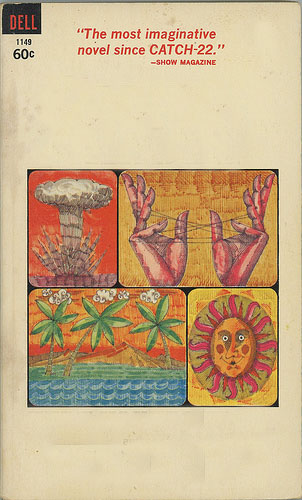
BOOK REVIEW: Cat’s Cradle by Kurt Vonnegut

Cat's CradleCat’s Cradle by Kurt Vonnegut

My rating: 5 of 5 stars

Cat’s Cradle is Vonnegut at his most brilliant and witty.

The book follows a writer, John/Jonah, as he does research for a book on the Hiroshima A-bomb. To learn about the (fictitious) inventor of the bomb, the deceased Felix Hoenikker, he interviews  Hoenikker’s children and former supervisor. In the process he becomes entangled in global catastrophe in a way he couldn’t have imagined.

As it turns out, Hoenikker had invented another weapon of mass destruction, one that would make the H-bomb look like a firecracker. However, ice-9, as the weapon was designated, wasn’t intended as a weapon at all. Ice-9 turns all water into ice at temperatures below 114 degrees Fahrenheit. The idea was to make marshes crossable by Marine Corps units. It’s the failure to anticipate the ramifications of using such a chemical, i.e. the hydrologic cycle, that’s the central premise of this book.

A lot of the book deals with a fictitious religion called Bokononism. Bokononism is the cynical faith of the Island of San Lorenzo, and it perfectly reflects Vonnegut’s mildly misanthropic attitudes. The first sentence of the Book of Bokonon says it all, “All of the true things I am about to tell you are shameless lies.”

At the beginning of Cat’s Cradle we find out that John is a Bokononist, but that he’d grown up a Christian. Bokononism is prohibited on the island by the dictator, Papa Manzano. The reader comes to discover that not only is the prohibition a fraud designed to give the religion more sex appeal, but also that Manzano is a practitioner himself. This is just one of the quirky oddities that defines life on San Lorenzo.

It’s when John and all the Hoenikker children are assembled in San Lorenzo that the action really unfolds. Manzano is dying and turns the presidency over to Franklin Hoenikker (the non-midget son of the father of the bomb); Manzano later commits suicide in the oddest imaginable way. Franklin convinces John to take the presidency, but it becomes moot as the book approaches climax.

I’ll leave you with my favorite piece of Bokononist wisdom, “Peculiar travel suggestions are dancing lessons from God.” By the way, you should go to San Felix island off the coast of Chile. [Picked via a spinning globe.]

View all my reviews

BOOK REVIEW: Ishmael by Daniel Quinn

Ishmael: An Adventure of the Mind and SpiritIshmael: An Adventure of the Mind and Spirit by Daniel Quinn

My rating: 4 of 5 stars

A man answers an ad that says, “Teacher seeks pupil. Must have an earnest desire to save the world. Apply in person.” Expecting to find a charlatan, the man is surprised to find his new teacher is, in fact, a gorilla.

Like Socrates, this gorilla, Ishmael, uses questions to guide his pupil toward crucial knowledge. Ismael teaches his student to challenge some of his most deep-seated beliefs such as, the world was made for humans, humans are the ultimate culmination of biology, humans are inherently separate from (and above) nature, and that humans are fundamentally flawed in such a way as to make ruination of the planet inevitable.

The core of the book differentiates two human cultures. The author calls them the “takers” and the “leavers,” but they correspond to what we might call “us” and the “aboriginal peoples.” Takers are specialized, agricultural, and technologically advanced (if you’re reading this review on a computer and not chiseled on a cave wall, you, my friend, are a taker.)

The lives of “Leavers” aren’t that different from those of humans 10,000 years ago. They are tribal as opposed to (to borrow Desmond Morris’s term) super-tribal. [In a tribe everyone knows everyone else. Morris suggests that things go to shit –re: war, crime, and deviant behavior– in super-tribal societies.] Leavers live like animals in that they tend towards equilibrium within their ecosystem. Takers do not.

If you long for thrillers or potboilers, this isn’t the book for you. It’s a thinking person’s book. The nice thing about Ishmael’s use of the Socratic method is that one can think through the questions in parallel to the narrator’s discovery. In this way, the reader can install himself or herself into the conversation.

At the most generic level, the book’s value is in showing one how much one takes for granted. We can’t see forests for trees.

One may agree or disagree with the author, but either way one will be subjected to powerful food for thought. Some of the discussion may evoke a visceral emotional reaction that one may have trouble reconciling with logic, such as the discussion of the morality of feeding the starving.

The downside of the book is that the dialogue can be strained in places and it can get a bit repetitive. The latter serves to reinforce key concepts, but some of them feel as though they are reinforced inordinately. In making the narrating protagonist struggle, Quinn creates a lead who seems a bit dense sometimes. Also, as I indicated, the journey is by-and-large in the mind, and so the tension is limited. There is some drama when the narrator shows up one day to find that Ishmael has been evicted. However, this is resolved without too great a difficulty and they resume lessons with  Ishmael’s irritability being the only change to be seen. There is drama at the end that will remain unspoiled herein.

I’d recommend this book as a thought-provoking exercise for the mind.

View all my reviews

BOOK REVIEW: The Sun Also Rises by Hemingway

The Sun Also RisesThe Sun Also Rises by Ernest Hemingway

My rating: 4 of 5 stars

Get Speechify to make any book an audiobook

Whatever the blurbs or critics might say, this book is about the raft of men left in the friend-zone after brief dalliances with Lady Brett Ashley. One may have been led to believe it’s about the life of Jake Barnes. Barnes is the lead character, but he’s not the most influential character.

Besides Barnes, the list of men who fall hard for Lady Brett Ashley include, boxer Robert Cohn, the bankrupt Michael Campbell, and the bullfighter Pedro Romero. Oddly enough, the physically toughest, Cohn, is the one who falls the hardest. Barnes may be the strongest in this sense; perhaps because his relationship with Ashley is over before the novel begins. Barnes comes off as likable with a pragmatic “live and let live” nature. (He can maintain a friendship with a woman that he loves, a feat that seems beyond Cohn’s ability. Campbell is used to having lost everything, and so seems to bob comfortably in Ashley’s wake. We don’t reliably learn about how Romero takes it.)

As the blurb says, The Sun Also Rises is about a journey from Paris to Pamplona. In Paris, the cast of Lost Generation friends hang out in cafés. In Pamplona they attend bullfights. In between, Barnes goes fishing with friends.

In a broader sense, the book is about dissatisfaction and restlessness, and not only within Ashley. This is summed up nicely by Cohn’s words to Jake, “Don’t you ever get the feeling that all your life is going by and you’re not taking advantage of it?”

Of course, the book shines in its language. Hemingway’s lean buy meaty prose is readable and engrossing. The minimalist dialogue beautifully conveys the interaction of a group of intimate friends.

Here’s a great line that captures the character of Hemingway’s writing in this book, “The beer was not good and I had a worse cognac to take the taste out of my mouth.”

The book rises to crescendo with the Pamplona bullfights and Hemingway adeptly ends on a sad note apropos of the morning after a great party.

View all my reviews

BOOK REVIEW: Dracula by Bram Stoker

DraculaDracula by Bram Stoker

My rating: 4 of 5 stars

Dracula leaves Transylvania to find a new pool of victims, and the only thing standing between him and the people of London is Dr. Van Helsing and his cast of allies.

The novel begins with the arrival in Transylvania of Jonathan Harker, a real estate agent from England. Both Harker and his beloved wife, Mina, play an important role in unraveling the mystery of Dracula. Soon after a ghost ship rams into port, Lucy Westenra (a friend of Mina’s) begins to suffer an unusual illness. A Dr. Seward brings in Dr. Van Helsing who has a rare expertise in her particular ailment. Professor Van Helsing’s knowledge is essential to driving Dracula out of London and back to Transylvania. They pursue the vampire– resulting an a final show down.

Bram Stoker uses a series of journal entries, letters, and memos to convey the story. This is an interesting approach, and popular at that time, but it does have its limitations.

Dracula was written early in the age of science and reason. While it was an age of superstition, there is an attempt to elevate vampirism from a strictly supernatural phenomena to one in which science has something to say.

The 19th century language and approach to tension makes for a less gripping tale than one would likely see today, but it is still a very readable book.

View all my reviews