BOOK: “Hell’s Angels” by Hunter S. Thompson

Hell's AngelsHell’s Angels by Hunter S. Thompson
My rating: 5 of 5 stars

Publisher Site – Penguin

This, the first published book of Hunter S. Thompson, is said to be from his pre-Gonzo period, but it bears many of the hallmarks Thompson would later be famous for: inventive colorful language, immersion in scenes of debauchery, and insight into the American cultural landscape.

The book is part exposé of the Hell’s Angels motorcycle gang, an organization shrouded in a reputation that was as much myth as reality and whose tightknit inner circle made obtaining an accurate picture a challenge. It would take someone as fearless / crazy as Thompson to get close enough to learn about the gang and then to tell enough truth to make at least some of the members unhappy.

The book also takes the temperature of America and reports on what ails the country. One might think this would not be worth reading, given that its insight of America is from the late sixties (it came out in ’67.) However, as I read the penultimate chapter, I was surprised to find how much of what was being said could be seen as prophetic. Thompson wrote about the Angels not as a romantic throwback to wild west outlaws (as many saw them,) but as a class of people who were ill-equipped to make a living in an ever more technologically advanced America, leaving them with little money and loads of resentment. He wrote of them as “prototypes,” and his description connects up to the latest model. It was at that point that I started seeing Thompson not only as a brilliant creative writer, but — perhaps — as a prophet.

I’d highly recommend this book for anyone curious about the Hell’s Angels or American outlaws, more generally.

View all my reviews

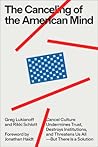
BOOKS: The Canceling of the American Mind by Greg Lukianoff & Rikki Schlott

The Canceling of the American Mind: Cancel Culture Undermines Trust and Threatens Us All―But There Is a SolutionThe Canceling of the American Mind: Cancel Culture Undermines Trust and Threatens Us All―But There Is a Solution by Greg Lukianoff
My rating: 5 of 5 stars

Amazon.in Page

This book presents an in-depth exploration of cancel culture in its many varied manifestations, from both the left and the right of the American political spectrum. The biggest part of the discussion is with respect to the educational system, and particularly higher education. Sadly, this is because the institutions that used to be among the most formidable bulwarks of free speech, expression, and academic freedom have increasingly become untenable to multiple points of view. (The authors point out that there have been more dismissals of faculty members for cancel culture speech and expression issues than there were during the McCarthy era for political stance.)

However, the book doesn’t restrict itself to education, but also investigates cancelations in journalism, publishing, the scientific community, standup comedy, and the medical and psychiatric communities. The authors also present cases of the effect that wokeness and other expression limiting activities are having in these areas. One of the most disturbing revelations to me was the role of wokeness in psychotherapy and the negative effect it may have on people getting the help they need.

The book presents a series of cases in detail to advance the discussion. It also has a couple chapters that examine the tactics that are used to apparently “win” debates by silencing / demoralizing the opposition while avoiding any actual contest of ideas. The authors go through tactics favored by the Right as well as those by the Left. (Though it’s clear that, in a race to the bottom, both sides adopt the approaches of the other side that seem to be effective. e.g. the Left is getting into book banning (historically a Conservative tactic) and the Right is getting into cancelling and shout-downs (usually Progressive tactics.)) I think it was smart to have two authors, one from the left and one from the right, in order to help ensure balance in the project. That said, as the Left has been in the cancel culture vanguard, they come up more often.

Some have called this a sequel to “The Coddling of the American Mind,” with which it shares a co-author, Greg Lukianoff. I don’t know that I’d think of it that way. While it does address some of the same issues as background, psychology and child development are not at the fore in this book (Jonathan Haidt – the other co-author of “Coddling” is a psychologist,) but rather are the legal, cultural, and political issues.  

This is probably the most important book I’ve read this year (and, being late November, it’s likely to retain that status) and I’d highly recommend it for all readers.

View all my reviews

BOOKS: How Long Can the Moon Be Caged by Suchitra Vijayan & Francesca Recchia

How Long Can the Moon Be Caged?: Voices of Indian Political PrisonersHow Long Can the Moon Be Caged?: Voices of Indian Political Prisoners by Suchitra Vijayan
My rating: 4 of 5 stars

Amazon.in Page

It’s no secret that the Gandhian pluralistic vision for India has been taking some hard knocks under the current administration (and the rise of Hindu nationalism that it represents,) but it’s also not as widely and intensely discussed as it could be. This book represents an attempt to make the stories of dissident political prisoners more widely heard.

For that attempt, I would give it high marks, but the execution is problematic. The middle part of the book does a reasonably good job of telling the stories of these individuals. However, the book comes across far too much like a reference book than a journalistic account for much of its length — particularly in the beginning and at the end. The beginning has a long bullet point account of relevant events that I’m sure is meant to give readers an idea of the scope of the problem, but it also sterilizes the information. At the end there are letters and a chapter that consists entirely of data. Letters can be fine, but they aren’t the most evocative way to convey these stories because they contain a good deal of information that is extraneous to the author’s point, and thus the message is diluted.

I do wish supporting evidence was turned up and gratuitous statements turned down a bit. In other words, I assume the government could present a counter-narrative that these are not just dissenters voicing unpopular opinions but rather individuals actively engaged in subversive operations. Granted, the prominence of poets, the ill, and the elderly does make it hard to believe these are some sort of guerrilla warfare masterminds. True, there is a challenge in disproving a negative that makes it hard to prove a person has done nothing wrong.

At any rate, it’s a book I’m glad I read, and I did learn about the issue, but I wish the execution had been better. Maybe that’s for another book.

View all my reviews

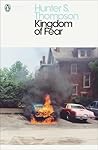
BOOKS: Kingdom of Fear by Hunter S. Thompson

Kingdom of Fear: Loathsome Secrets of a Star-crossed Child in the Final Days of the American CenturyKingdom of Fear: Loathsome Secrets of a Star-crossed Child in the Final Days of the American Century by Hunter S Thompson

My rating: 5 of 5 stars

Amazon.in Page

Kingdom of Fear is part memoir and part commentary on the state of America at the turn of the millennium. As a memoir, it explores Thompson’s bid for Sheriff, his arrest and judicial proceedings for drug and explosives charges that resulted from a “he said / she said” accusation that did not warrant charges in and of itself, a wild and wooly road-trip through Nevada, and Thompson’s position at the center of an investigation of a “threat” on the life of actor, Jack Nicholson.

As a commentary on the decline of America it discusses the battle for Grenada, a trip to Cuba, 9-11 and its aftermath, and the book revisits the ’68 Democratic Convention. It’s all written in Thompson’s drug-fueled Gonzo style, making it incredibly entertaining to read even as the hard walls between fact and fiction seem to dissolve. While the factualness might be at times in question, there is always a kind of truth that can only be received from those who’ve tossed off the shackles of societal convention and are willing to tell it as it is — even the embarrassing bits (especially the embarrassing bits.)

It’s not for those who take life and authority figures too seriously, but otherwise it’s a tremendously compelling and sometimes hilarious in its depiction of pre- and post-Y2K America.

View all my reviews

Misleading Lines [Lyric Poem]

The headline read, "The World 's at War!"
   It turns out "with halitosis."
 I couldn't bring myself to read more.
   I don't need no bad breath gnosis.

ESSAY REVIEW: The Kentucky Derby is Decadent and Depraved by Hunter S. Thompson

The Kentucky Derby Is Decadent and DepravedThe Kentucky Derby Is Decadent and Depraved by Hunter S. Thompson
My rating: 5 of 5 stars

Online Available Free: Grantland

Available within the collection: The Great Shark Hunt

This story is cited as the first work of gonzo journalism, a highly entertaining style of immersion journalism which takes liberties with objectivity and factual detail for comedic effect or heightened narrative impact. The Kentucky Derby is more setting than subject of the story. It’s Thompson attempting to throw together coverage of the horse race at the last minute for Scanlan’s Monthly, a magazine that existed less than a year. So, the story is as much Thompson racing around trying to con his way into some press passes as he and the graphic artist sent by the magazine go on a booze-fueled junket on and around the race track grounds.

The story is laugh-out-loud funny in places, and features Thompson’s irreverent and fast-paced style throughout. It really was something new. Thompson, apparently, thought he’d failed completely when he sent in the story, but the response indicated that – rather – he’d invented something new, something for which there would be a huge market.

It’s definitely worth reading this story, just don’t expect deep insight into the horse racing tradition of Kentucky.

View all my reviews

BOOK REVIEW: Ten Days in a Mad-house by Nellie Bly

Ten Days in a MadHouse: The Original 1887 Edition ( Nellie Bly's Experience on Blackwell's island )Ten Days in a MadHouse: The Original 1887 Edition by Nellie Bly
My rating: 5 of 5 stars

Amazon.in Page

Free Public Domain Version Here

This late 19th century work of immersion journalism tells the tale of Nellie Bly getting herself put into (the aptly nefarious sounding) Blackwell’s Island Insane Asylum for ten days (after which time her editor got her released.) Unlike the famous Rosenhan Experiment in 1973, in 1887 Bly had to get herself committed, and had her editor not gotten her released she might have been institutionalized indefinitely. Disturbingly, yet fortunately for Bly, it took no great acting skills to convince the authorities that she was mentally ill, pretending to be poor and having no husband got her at least 90 percent of the way to being institutionalized. Like the Rosenhan Experiments, Bly’s story showed that nobody seems to have any great capacity for determining sanity from insanity, not even the people with advanced degrees and board certifications on the subject.

At first, I wasn’t sure how skewed Bly’s account would be. She does show some bias in practically deifying journalists. She was confident that no psychiatrist would be able to discover her ploy, but she seemed sure that any journalist could out her through the briefest of conversations. So, when she complained the food was “inedible,” I considered that the same has always been said about any institutional food – from military mess halls to college cafeterias, and usually it’s perfectly adequate. That said, one of the asylum staff members did acknowledge the food was pretty horrific. Ultimately, I think the story was probably accurate because, sadly, it rings true. Bly had intended to get herself put in the violent ward, but had second thoughts after hearing and seeing what she did, being concerned that she might be seriously injured by the rough treatment those patients received.

This short book is riveting. If you enjoy nonfiction, this piece is definitely worth reading.

View all my reviews

A Post-Journalistic Limerick

I asked an online reporter,

“How do you live post-bricks-n-mortar?”

“I’ve tricks up my sleeve:

tell ’em what they believe,

and if facts remain cut it shorter.”

BOOK REVIEW: Into the Wild by Jon Krakauer

Into the WildInto the Wild by Jon Krakauer

My rating: 5 of 5 stars

Nature is a harsh teacher. That was the last lesson Chris McCandless ever learned. A recent college graduate, McCandless struck out for the Alaskan wilderness with minimal resources, his body was found by a party of moose-hunters several months after he’d begun his Alaskan adventure.

Into the Wild gives us a well-researched explanation for how McCandless died, but it also tells us a great deal about how he lived– and that story is fascinating in its own right. Many thought McCandless must have been crazy, but refusing to acquiesce to the work-a-day world is often incorrectly diagnosed as insanity.

McCandless had an obsessive desire to find out whether he could make it on his own, not just separate from his parent’s wealth but from all the trappings of modern society. McCandless’s most iconic indicator of insanity-by-way-of-thwarting-convention was when he gave away the entirety of his $25,000 savings account and burnt all the money in his wallet. He wanted to know whether he could survive if he was returned to the state of nature from whence mankind came. Sadly, the answer was no.

It would be easy to dismiss McCandless as a dumb kid who got in over his head. Though he certainly was that. On his deathbed, in a bus carcass in the remote Alaskan wilderness, McCandless likely had a revelation that most teenagers pass into adulthood without ever realizing, that he was mortal.

However, McCandless was more than a kid with an underdeveloped sense of his own mortality. He was a kid with the courage to confront a question that most of us just let nag in the back of our minds. That question being,do we have what it takes to live not as a cog in a machine but as a human in the natural world.

I know many are intrigued by this question in part because there are entire TV channels that are practically devoted to survival shows. Yet most people don’t take it beyond sitting on a couch contemplating whether they could survive. Will thinking man (Homo sapiens) be replaced by doing man (Homo effectus)?

View all my reviews

There was a movie based on this book. I didn’t see it, but here is its trailer.