The New Acropolis Explorations Course and My Experience Thereof

IMG_1576Last fall I attended a panel talk hosted by the New Acropolis in Bangalore. I’d never heard of the New Acropolis before, and only heard of said event because the head teacher from my yoga teacher training course was among the panelists. I found the environment at the New Acropolis to be friendly and intriguing. The talk took place amid a small library (not necessarily small for an institution of its size) and books always put me in my happy place.


There were brochures out for an upcoming 16-week Explorations Course. “Explorations” is the name for the introductory course that’s taken by non-members to dip their toes into the New Acropolis curriculum, and see if they’d like to continue as members of this school of “philosophy.” (You may be asking, “Hey–wait a minute–why’d he put quote marks around the word philosophy. I’ll get to that in due time.) At  any rate, perusing the brochure, I decided to enroll.


The course consists of 13 lectures given over a 16-week timeline. The reason there are more weeks than lectures is that there are two sessions in which one meets briefly with the instructor one-on-one, and one session that consists of exercises that one does with one’s classmates. (The latter is one of the highlights of the course.) The course is organized into three parts. The first and longest section deals with the idea of “know thyself.” That is, it presents several approaches to developing oneself as an individual. The second section expands the scope, looking at society and the role of individuals in it. The third section is about the “philosophy of history,” (there go those telltale quote marks again) or what they refer to as “evolution,” (really?) which shouldn’t be confused with Darwinian Evolution (which–as near as I can tell–has no status in their system of teachings.)


In my opinion, the transitions from one part to the next represent downshifts in the value of the course. (i.e. The course is at its most beneficial in the first section. That’s also the portion in which it’s presenting ideas that are fairly mainstream among the various philosophical / religious systems it studies.) As the course moves into the second section, one begins to see a few ideas that are either archaic or that depart from rationalism (e.g. the word “magic” gently enters the discussion.) By the time the third section rolls around, ideas that have no relationship to observable reality are being presented as if they were a given.


I was reading Nassim Nicholas Taleb’s book entitled Antifragile the other day and he used the term “neomania.” Neomania–a term that Taleb coined for all I know–means an exuberance for the new for its own sake (as opposed to any objective improvement it represents.) Taking this cue, I will cobble together the term “paleomania”(an exuberance for old ideas for their own sake) to describe one of the main underlying features of the New Acropolis syllabus. One might easily believe that nothing of value has been learned in the past 2000 years and that modern thinkers (not to mention modern science) have nothing worthwhile to lend to the discussion.


This can be seen in the ideas presented from ancient Greece. Let me first say that I’m a big fan of Plato. His words “Be kind, for everyone you meet is fighting a hard battle” is one of my favorite philosophical quotes. However, while I like Plato, the New Acropolis pretty much deifies him. I’m sure they wouldn’t agree with that statement. However, even Plato’s ideas on those subjects about which he was least in a position to write intelligently or authoritatively are presented as if irrefutable. A couple of his most ill-informed ideas are at the forefront of two of the lessons–notably the Platonic hierarchy of forms of government and the ideas he accepted [I don’t know that these are properly attributed to him, but he seems to have believed them] about astrology. (Note: New Acropolis’s teachings about forms of government seems to be one of the biggest causes of ill will toward the organization in Europe. Plato was an elitist on the subject. He distrusted democracy–to be fair they killed his teacher under [a form of] democracy–but believed that if you could just give a philosopher unlimited power he’d do the right thing for everybody–and not just himself. Plato wasn’t a believer of Baron Acton’s “…absolute power corrupts absolutely…” an idea that came later by those with a greater body of exposure to varying forms of government.)


The first couple of lectures I attended didn’t seem in any way untoward or unusual. The first lecture was about knowing oneself, and presented two ancient approaches to this question–i.e. Greek and Indian Vedic. The Greek three-pronged model of soma/psyche/nous, which is translated various ways–but commonly as body, soul, and reason.  The Indian approach was a seven-layered variant that also started with the physical body and moved toward more conceptual elements of being.


Now, it might have occurred to me that both of these approaches take the supernatural as a given, but as they were true representations of the systems in question, I didn’t find it bothersome. This raises a point that I think bears saying, I don’t think that the New Acropolis distorts the teachings that they include in the syllabus, but they do use selectivity to frame the subject. This framing gives the student a limited view philosophy and the various approaches to leading an examined life (as opposed to the unexamined life that Socrates told us was not worth living.)


The second lecture I attended was actually the third lecture–because I was out-of-town for a class on the Bhagavad-Gita–and it dealt with Buddhism. This session was the most orthodox and arguably the least controversial of the lectures. The four noble truths and the eight-fold path were the core of the lesson, and one doesn’t get any more fundamentally Buddhist than that.


However, the fourth lecture, which was ostensibly about Tibetan Buddhism, started me wondering where the course was going. One would expect a lecture on Tibetan Buddhism to refer heavily to the words of lamas, but most of the ideas presented in this lecture were attributed to a woman who I don’t think I’d ever heard of before. Her name was Helena Petrovna Blavatsky. (If you’re saying, “Hey, that name doesn’t sound Tibetan, you are correct.”) It’s not that I don’t think that a 19th century Russian woman is capable of giving informed insight into Tibetan Buddhism. However, one becomes curious when there’s not a single Lama, Rinpoche, monk or nun in the picture. While I’m admittedly a bit of a neophyte on the subject, I’ve been to hear Tibetan monks and nuns before and have visited the local Tibetan meditation center on occasion, so I’m not completely ignorant of that system’s teachings–enough to have an idea what the most fundamental ideas would be.


So, after the Tibetan Buddhism class, my Googling fingers got to work. I just wanted to be sure I wouldn’t be asked to drink any Kool-Aid made Jim Jones style. There wasn’t a lot on the organization besides their various websites, but there were a few negative comments and would-be controversies to be found. I wasn’t too concerned by these comments for a number of reasons. First, the claims were isolated and unverifiable. To elaborate, if a person is either far to the right or far to the left, then the middle seems an extreme way off. Therefore, when a leftist organization calls an organization a “fascist cult” one has to consider the bias of the source of the claim. (Note: the same could be said from the other end of the spectrum, but I stated it that way because that’s essentially what I read in one post.) Nothing I’d seen at New Acropolis would lead me to think they were fascist, or even particularly politically conservative (if anything, I’d guess that individual members would be more likely to be left of center, but it wasn’t really an issue that came up.) Second, most of the negative comments were directed at a couple of the European centers, specifically.


I will say that, despite the fact that I didn’t believe the extreme claims, I can’t say that they weren’t cause for concern. I’ve had a little experience with organizations prone to being embroiled in drama. Even if the organization has many worthwhile attributes and individuals, that inclination to attract drama will inevitably bite a member in the ass. In my experience, one can’t just sit on the sidelines and pretend the drama won’t affect you. If you do, you’ll just be all the more surprised when you feel your ass being bitten.


My web searches confirmed that the New Acropolis was an offshoot of the Theosophical Society. This wasn’t kept a secret. In fact, I believe it was mentioned in the Tibetan Buddhism lesson, and I know it was intimated at various junctures in the course. I was aware of the Theosophical Society, and–in particular–the falling out that Jiddu Krishnmurti had had with them. (A parting of ways that was apparently amicable on Krishnamurti’s side as well as on the side of some from the Theosophical Society’s side–though some Theosophists apparently went dark.) Krishnamurti is among my favorite thinkers, and it was a concern that New Acropolis was an offshoot of an organization whose beliefs were so at odds with his own. I don’t want to deify Krishnamurti (that would be ironic as he was explicit that he didn’t want followers and believed followers were missing the point), but many of his ideas resonated with my own–particularly those on organizations to advance personal or spiritual development (of which he [& I] are quite skeptical.)


Krishnamurti opposed the idea of religions, sects, and paths as means to betterment.  The New Acropolis would likely agree with Krishnamurti’s stance on religion as they’re explicit in their antipathy for the ritualism of religion. However, Krishnamurti went further to oppose entities that proposed that they had a path to guide one to some enlightened state. This is where the New Acropolis would presumably part ways. They seem to believe they have such a path. The aforementioned framing that they do seems to designed to carve out the waypoints so that future courses can work on building the path.


There’s  a common saying that a good education teaches one HOW to think and not WHAT to think. By that definition, I wouldn’t classify the New Acropolis’s approach as a good education, generally speaking. The course is set up for a one way flow of learning. There’s no time for discussion or refutation of the concepts presented in the course. The teacher presents concepts in a lecture format, and there are designated times in which students can ask questions (in many cases outside the class time when peers might have ideas to add or questions  to build off.) Despite the nominal homage to ancient Greece, the New Acropolis pedagogic approach is at odds with the Socratic method by which students are asked questions rather than being presented with answers.


What’s my beef with their use of the term “philosophy?” Depending upon how it’s used, I don’t have a problem with it. When they’re explicitly talking about their particular philosophy, (i.e. New Acropolis’s philosophy) it’s perfectly acceptable. It’s only when one uses the term in a general sense, e.g. as in “school of philosophy,” that students might expect that they’ll learn rational approaches to consider life’s big questions for themselves, rather than learning a specific ideology’s answers to said big questions.


The term “theosophy” would be much more honest and apropos, though I understand their reticence to use that term–given their strained relationship with the Theosophical Society–which has a corner on the market of that term. The fact that the New Acropolis takes the divine or supernatural as a given is hard for me to reconcile with philosophy, which implies an open discussion and refutation of ideas–particularly of those notions for which there is little or no evidence.  I’m not saying that philosophy can’t and shouldn’t consider the question of whether there is a god (or spirits or divinity or whatever term you prefer.)  I’m just saying that taking the existence of such ethereal entities as a given flies in the face of rationality, because the existence of such ethereal entities isn’t rooted in observation or application of logic but in emotion. Faith is the domain of theology (or theosophy, if you prefer), rationality is the domain of philosophy. A lot of the teachings in this course were couched in terms of feelings or the beauty of ideas rather than in rational investigation.


It might seem that I was quite negative about the experience, and that I wouldn’t recommend it for others. That’s not exactly true. There are some individuals that I wouldn’t recommend it for, but others that I might. I did learn a lot during the course, and brought away a number of ideas that I think will be of service to me. For example, we did a throwing stick concentration exercise that was eye-opening (no pun intended), and there were many ideas and stories presented in the course that provided good food for thought. There was only one class /idea that I found not only completely baseless but also potentially dangerous.


(FYI-If you’re wondering what idea that was, it was in the penultimate lecture on astrological cycles (yeah, I know, right?)  The lecture presented both Indian Maha Yugas and Greek zodiac cycles. Guess what? According to both mythical sets of cycles we’re currently in the crappiest of times. [FYI- If there’s anything my education and experience as a social scientist taught me, it’s that notions of determinism applied to the sphere of human behavior are inevitably wrong. The physical world may be clockwork, but the minds of men are a clockwork orange.] Why do I think these conceptions of cycles may be dangerous? Because a lot of damage is done by people who go through life thinking the world is feeding them a steady diet of shit-sandwiches. This is, of course, all perception. Nature–unlike gods and other supernatural mythical creatures–doesn’t draw targets on the backs of individuals, nor weigh them good or evil. However, now you’re going to tell people who already see the world through dung-colored glasses that your [pseudo-]science shows they were born in the worst of times. That–my friends–is not helping make a better world.)


I think those interested in the course should be aware of three things: 1.) a god, gods, the divine, the supernatural, or whatever you wish to call it is taken as a given by the course (you’re not going to see a Nietzschean counterpoint in this school of philosophy); 2.) you aren’t going to get a broad-based exposure to philosophy in that a.) the ideas are all from ancient traditions and b.) the concepts presented are cherry-picked to be consistent with the New Acropolis agenda (which isn’t to imply the agenda is onerous by the standards of sects or religions, but there’s an agenda) ; 3.) you should banish any expectations of engaging in rousing class discussions or dialogues with the teacher because it’s very much a one way street.  If you’re good with those three factors, you may want to give it a try. You might find it’s the right approach for you.

DAILY PHOTO: Ornamental Pillar at Ajanta

Taken in November of 2014 at Ajanta Caves.

Taken in November of 2014 at Ajanta Caves.

BOOK REVIEW: Yoga Body by Mark Singleton

Yoga Body: The Origins of Modern Posture PracticeYoga Body: The Origins of Modern Posture Practice by Mark Singleton

My rating: 3 of 5 stars

Amazon page

I was excited to stumble across this book because it proposed fresh insights into the history and development of posture-centric yoga. Singleton’s premise is that yoga as it’s practiced in studios around the world today (i.e. practices focused heavily on asana, or postures) has almost nothing to do with historic yogic traditions and is to a large extent European (or Western) fitness practices fed back to the world with a patina of Indian-ness instilled by a few Indian fitness teachers (e.g. T. Krishnamacharya and students.) This is a bold and stunning hypothesis. The problem is that Singleton leaves plenty of room to doubt his thesis. I’m not saying that I’m certain Singleton is wrong, but after reading the book I’m no more inclined to believe his hypothesis than when I first read the book blurb.

The book consists of nine chapters:
1.) A Brief Overview of Yoga in the Indian Tradition
2.) Fakirs, Yogins, Europeans
3.) Popular Portrayals of the Yogin
4.) India and the International Physical Culture Movement
5.) Modern Indian Physical Culture: Degeneracy and Experimentation
6.) Yoga as Physical Culture I: Strength and Vigor
7.) Yoga as Physical Culture II: Harmonial Gymnastics and Esoteric Dance
8.) The Medium and the Message: Visual Reproduction and the Asana Revival
9.) T. Krishnamacharya and the Mysore Asana Revival

One can see the flow of the book in this chapter listing. It begins by describing the ancient yogic traditions (e.g. Jnana yoga, Bhakti yoga, and Karma yoga.) Singleton then goes on to put immense weight on very few voices that were speaking globally about yoga in the late 19th century—largely European but notably including Swami Vivekananda. (This, by the way, is where I noticed the most glaring weaknesses of the book. There seems to be an assumption that what the most vocal people were saying during this time was the truth, the whole truth, and nothing but the truth.) One will note that the late 19th century is an arbitrary point to make the critical juncture for a study of yoga—this era’s sole importance seems to be in that that’s when Europeans started entering the scene (and documenting it in English and Western languages to a large extent.) I understand that there may have been a dearth of information previously; however, I’m also skeptical of equating the sum of truth with the sum of what is documented.

The book then shifts into the early 20th century when Singleton proposes the proto-postural yoga is beginning to coalesce with both Western and indigenous Indian influences. Singleton writes extensively about this period, and presents what he believes is the path by which postural practice evolved over a short time into modern yoga as we know it. The book ends in the mid-20th century with an extensive discussion of T. Krishnamacharya and his pack of brilliant students (i.e. B.K.S. Iyengar, Pattabhi Jois, T.V.K. Desikachar, and Indira Devi) who are responsible for a lot of how yoga is practiced today (for virtually all of modern yoga by Singleton’s reckoning.)

It should be noted that this book is put out by an academic press, Oxford University Press, and there’s all the front and post matter that one would expect of a scholarly press publication. This includes an introduction, notes, and a bibliography.

So, you might be wondering how I could have so much doubt about the veracity of the book’s central claim—a book written by a Cambridge educated scholar and published by Oxford University Press. It’s, after all, chocked full of facts that are designed to bolster Singleton’s argument. I’m certainly not suggesting that Singleton lied or presented false facts (however, I have–and will further–argue that he frames facts throughout the book to diminish those statements and facts that run counter to his argument while wholeheartedly accepting statements that validate his argument—even when the people whose statements he leaves unchallenged would seem to have their own agendas. I don’t know, perhaps T. Krishnamacharya was—as Singleton intimates though never explicitly accuses—lying when he claimed to have received his sequence and approach from a scripture he was taught by a Himalayan master. However, interestingly, he would be lying to minimize his role in the development of yoga rather than to increase his fame. This stands in contrast with the European authors who Singleton readily accepts who were seeking to build their bona fides as experts in the esoteric systems of India and the Himalaya, who arguably had a lot to gain from being seen as having a full understanding of these systems.)

The best way to understand the root of my skepticism is to tell a make-believe story. Imagine a race of aliens came down to Earth. For whatever reason, they want to understand (presumably among many other things) the Roman Catholic Church. One astute alien scholar notes that, after having reviewed not only the entire Bible but a vast canon of theologian discourse, there is scant mention of sitting or kneeling. However, when cameras came around, there came to be clear evidence of pews and kneelers in the church. The aliens conclude that Catholics had always stood during worship, but with the advent of the camera they began to sit and kneel. The aliens, having big and bulbous butts, conclude that the Catholics have become concerned that their own big, bulbous butts will be captured for posterity (pun intended) by the cameras and have, thus, opted to adopt postures that would more adequately provide cover. In the present day, sitting and kneeling are the bulk of what Catholics do with their bodies when [overtly] practicing their religion, and so it must be those postures–rather than abstract notions like achieving “grace” are now the most critical part of the practice. (Besides, the earliest photos of kneelers came from Protestant churches, so perhaps Anglicans taught Catholics how to kneel.)

If you haven’t figured it out, in my little scenario, the late 19th century Europeans who were writing the English language tracts that formed the heart of Singleton’s research material are the aliens with big, bulbous butts. I would propose that the Europeans aren’t viewing yoga completely objectively but through the lens of their own experience and desires. Furthermore, they are also only giving weight to what they see and hear (which may or may not be a full picture.) I would further argue that just like Catholics don’t devote much text to discussing sitting and kneeling in the documents of the Vatican library doesn’t mean there isn’t a long history of those practices. Postural practice is:

a.) not the critical end result that everyone is concerned with even if it takes up the bulk of one’s time in [overt] practice. It’s certainly true that there are a vast number of yoga practitioners whose only interest is in the fitness aspect of the practice. However, there are also many who spend most of their yoga reading time learning from Vedas and reading yogic philosophy even though the bulk of their practice time is asana.
b.) extremely difficult to convey via text but readily conveyed through demonstration and hands-on teaching. If you were a Catholic and wanted to teach someone kneeling, would you write them a three paragraph text description of the process, or would you just demonstrate how to kneel and correct any glaring (albeit unlikely) deficiencies in form.

At no point does Singleton get into the postural details of individual asana. He mentions another scholar that supposedly has done some of that work, but Singleton feels it’s not critical. However, it’s very hard to prove what he’s trying to prove without getting into that level of detail. Yes, there will be similarities between various systems of stretching because of the nature of the body. For example, European stretching systems had a forward bend that looks reminiscent of paschimottanasana (the body folds that way and stretching the hamstrings is one of the most important functions in any stretching regimen), and it shouldn’t be surprising or revealing if the first photograph of this posture was in a European gym (the fact that Scandinavians had cameras before Himalayan yogis isn’t a sound basis to conclude that Himalayan yogi’s learned to bend forward from Scandinavians.) A there are a lot of postures that two systems might reasonably independently discover, but one also can’t rule out that the Indian yogi taught the Europeans and not the other way around. (I know it’s hard to comprehend in the era of FaceBook, but failure to be documented does not equal failure to be true. The farther one goes into the past, the less of what happened is going to be documented, and some cultures are going to be more likely to document events than others. e.g. Would our aliens be right or wrong if they concluded that 85% of humans are females between the age of 12 and 24 years old because 85% of the selfies posted on the internet are among that group. )

Singleton’s book does have some graphics. They didn’t always help his case, however. I was struck by how few of the fine details of the European postures correspond to practice as we know them, while some of the very old paintings look almost exactly like present day asana. (If one accepts that the fact that they didn’t have the greatest grasp of capturing perspective back then isn’t indicative of how flat the postures and people were back then.) I’ll readily admit that I wouldn’t definitively count Singleton wrong on my subjective observation of the pictures, but it does leave me with a lot of room for doubt.

I suppose the next question is why I didn’t completely pan the book. Three stars isn’t a tragic rating. I thought the book contained a lot of good information and food for thought (even if it fell far short of proving its central hypothesis.) I particularly enjoyed the chapter on T. Krishnamacharya and his now-famous student body. I’ll also say that part of why I came away from the book with such a muddled perception of this history is that Singleton doesn’t hide facts that are damning to his case, but rather presents them and then tries to marginalize them. A prime example would be the Hatha Yoga Pridipika (HYP), a 15th century text that mentions a number of the asana considered classic yoga postures today (some of which form the core of a Hata practice)—though admittedly HYP emphasizes the importance of only four seated postures.

I can’t say that Singleton didn’t help give me pause to wonder about the truth of the received understanding of yoga’s evolution. I’ve practiced yoga in places as varied as India, the U.S., Thailand, and Hungary, and I found it shocking how similar the practice is around the world. This bodes well for the argument that yoga as it’s practiced today has coalesced recently. By way of contrast, there are many myths about how one martial art is the ancestor of another but the two systems often look nothing alike. (e.g. I’ve studied Kalaripayattu, which many believe was the ancestor art taken to China by Bodhidharma through Southeast Asia, but which today looks nothing like Kung fu or Muay Thai. Furthermore, Kung fu styles usually look quite unlike the Korean and Japanese martial arts that they are said to have inspired.) If the latter among these martial arts did come from the earlier, they evolved apart quickly. While the evolution into different martial art forms is quite possible, it raises the question of why yoga should be so similar internationally. A skilled yoga teacher would likely give a given student the same alignment adjustments for, say, Warrior I, regardless of whether the teacher was in Prague, Manila, Tokyo, or San Diego.

I can’t say that I’d endorse Singleton’s argument. It would take much more precise information for me to buy it (and it’s likely that said detailed historical information doesn’t exist.) However, if you’re interested in the history of yoga, you might want to check out this book. Your conclusions may differ from mine, but even if they don’t I suspect you’ll learn a thing or two of interest. Yoga Body was reasonably priced as a Kindle book when I bought it.

View all my reviews

DAILY PHOTO: Back Water Taxi

Taken in Kerala in July of 2014.

Taken in Kerala in July of 2014.

The answer to how one gets around in the water world of coastal Kerala? Either you hoof it down the trails that run atop paddy dikes, or you go by boat. (A dearth of bridges and hypothenusal shortcuts can make for long hauls by way of the former.) If you don’t have your own boat, the one above is the backwater version of the local bus.

DAILY PHOTO: Gandhi Bazaar

Taken in September of 2013 in Bengaluru.

Taken in September of 2013 in Bengaluru.

IMG_0233

DAILY PHOTO: Lahori Gate of Red Fort


Taken in October of 2013 in Delhi

Taken in October of 2013 in Delhi

RedFort13The seven white, bulbous mini-domes in the top background of the bottom shot are the same as those at the top of the upper photo. Fortifications are built out in front of the gate to add a measure of security. There is no line-of-sight view of the gate from the front.

DAILY PHOTO: Pregnant Street Art in Kochi

Taken in Kochi in July of 2014

Taken in Kochi in July of 2014

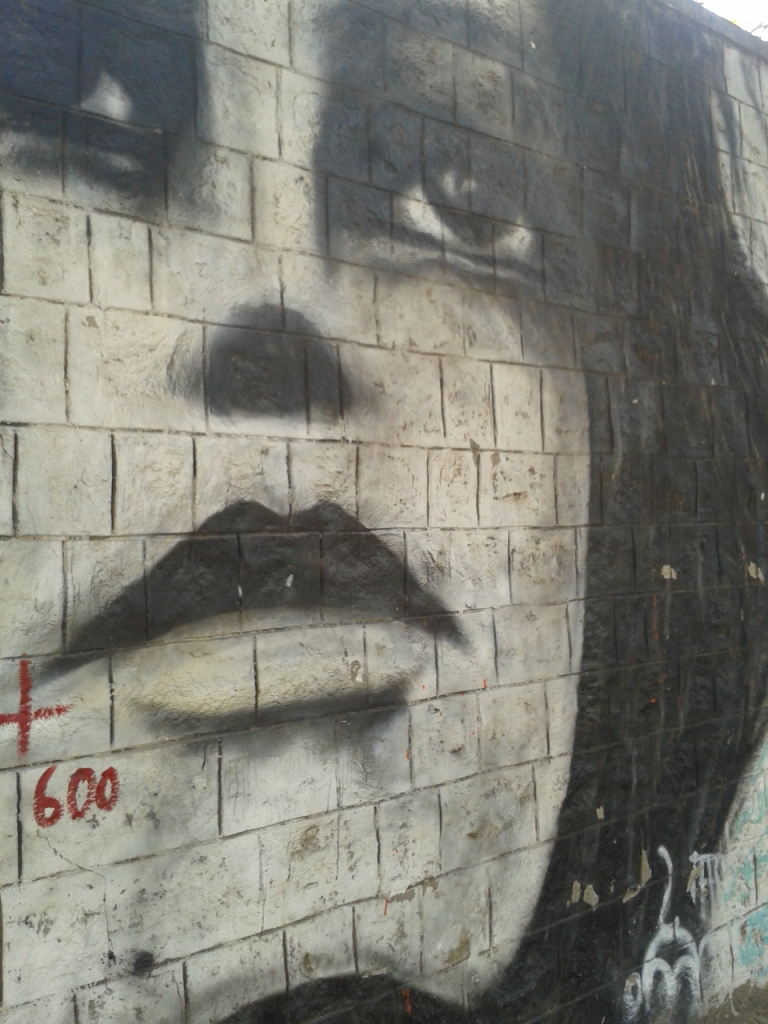
Every once in a while, I see some graffiti that’s intriguing and / or evocative.

DAILY PHOTO: Hampi Scorpion

Taken in November of 2013 at Hampi

Taken in November of 2013 at Hampi

This dead scorpion was sitting on some stonework at the Achyutaraya Temple.

DAILY PHOTO: Macaque Portrait

Taken in the July of 2014 near Chamarajanagar.

Taken in the July of 2014 near Chamarajanagar.

Learning Indian Cooking in Bangalore

I'm stirring the pot.

I’m stirring the pot.

The thing about Indian food–with its penchant for pureed gravies–is that I find it delectable, but often have no idea what I’m eating or how it got to me looking, tasting, and smelling like it does.


That is until recently. A couple of weeks ago I attended a cooking class at Manju’s Cooking School in RT Nagar in an attempt to rectify (or at least reduce) my ignorance. Manju’s offers a wide variety of classes (Indian and non-Indian, veg and non-Veg, cooking and baking, etc.)


I attended with a group of friends, and we constituted a class unto ourselves. We, therefore, got a quick and dirty introduction to a number of common / typical Indian foods (veg and non-veg, and both North and South Indian.) The menu we prepared consisted of two breads (kulcha and Malabar parota), dal makhani, paneer butter masala, and kadai chicken.


The class took 2.5 or 3 hours, and ended in a banquet of the foods we hand prepared.

20150201_170142 20150201_170013


Some of the fun facts that I learned include:

-“Kadai” in the name of dish just means that it’s wok-cooked.

20150201_154859

-A Kulcha is essentially a naan of a different thickness.

-Dal makhani requires a lot of prep, even if you have access to a pressure cooker.

-There’s a lot of finely chopped onion in these gravies that often goes unnoticed.

-One can cook with the pot upside-down. This is how we cooked Kulcha. In a restaurant it would be cooked in a Tandoor oven, but at home you can cook it stuck to the bottom of a deep pot.

20150201_163717

-Lastly, the key to a the flaky goodness of a Malabar parota is lots of fat… who’d have thought?

20150201_162915

Me&Parota