The Prostate Exam

Before moving to India, I got a stem to stern medical checkup. This included the dreaded  first prostate exam (emphasis on “prostate exam” not on “first” as I don’t suspect the process gets any more pleasant.) When my wife and I had both been on my work insurance, we had a HMO that said they didn’t do prostate exams for white males until they were 65 and older (or postmortem, if they died of prostate cancer, whichever came first.) That should’ve been a clue that they were a bunch of bean-counting quacks, but as I was less than eager to get said exam I took their word for it.


Anyhow, the area where I lived was fairly close to Emory University, and my new doctor’s office was even closer. (For those of you unfamiliar with Atlanta or Georgia–Emory has one of the preeminent medical schools in the Southeast and for some specialties the country) When I got my physical, after the preliminaries conducted by the nurse, I was next seen by what–for lack of a better term–I’ll call a junior doctor (ER went off the air too long ago for me to remember the proper terminology). This was a poised and professional young woman–I know not whether a medical student or recent graduate from Emory medical school.


She reviewed my medical history and did a few rudimentary “stick out your tongue and say ‘ahh'” kinds of things.   Then she told me that my doctor–a man I’d never met before–would be into look me over and write the prescriptions for the meds that I needed for coming to an area prone to malaria and other plagues.


She then asked, “If you’d prefer, your doctor can do your prostate exam. Otherwise, I’ll do it. Do you have a preference?”


I said, “Having never met the man, and at the risk of sounding sexist, I’m going to assume that you’ve got daintier hands. Ergo, you’ve got the job.”   To which she replied, “Yeeeah, me,” in the feeblest monotone voice, her tone suggesting that she might not be as thrilled by the prospect as her words would have indicated.


I had the exam. It was quick, painless, but–I’ll not lie–not without the inevitable awkwardness associated with one person having a hand–or part thereof–lodged in another person.


For those of you who know me, it goes without saying that my doctor turned out to be the most petite homuculus of a man. (You know what they say about what happens when you ASS-U-ME, U get the hand of  a bigger ME in your ASS.) However, you pays your money and you takes your choice. I wouldn’t have felt comfortable asking the doctor and intern to place their palms together to see who had bigger digits.

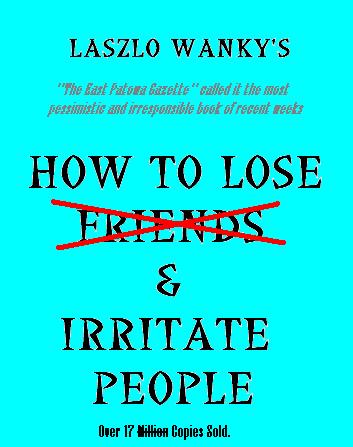
BOOK REVIEW: How to Lose Friends & Irritate People by Laszlo Wanky

Cover_How_to_Lose_Friends


How to Lose Friends and Irritate People by Laszlo Wanky

My Rating: 5 out of 5 Stars

Amazon Page


Wanky pays an homage to Dale Carnegie’s seminal self-help book by calling it, “a book for its time–that time being one in which people were lonely, pathetic, and didn’t understand social networking.” The author’s central premise is that we live in very different times, and today people are inundated by Facebook friends they neither like nor find interesting. Furthermore, Wanky goes on to argue, gone are the days when likable people are  liked. We live in an era in which douche-bags and drug-addled celebrities are gods among men. The book offers many headline examples, such as how Miley Cyrus’s career crashed as the sweet and admirable Hannah Montana, but then she caught her second wind by adopting the persona of a meth-addicted prostitute.


Roughly half of the book is dedicated to how to find success in defriending unwanted virtual amigos. Wanky suggests that the usual tactic of subtly “un-adding” people almost always fails because people are too “wussified” to make it stick. The only effective strategy, according to the author, is to trick others into removing you from their list of pseudo-friends. Be forewarned, however, being uninteresting and annoying is not enough–one must be spectacularly despicable. This is hard for most people–whom Wanky calls “the sychophantic masses”–because they slobber over being liked. Wanky devotes three chapters to helping people get over their love of being liked. The most cogent of these chapters is, “Kim Jong Un or Gandhi: Who Ya Wanna Party With?


The aforementioned chapters also help set up Part II of the book, which explains how one can put a skyrocket on one’s career by borrowing the techniques of the likes of Howard Stern, Rush Limbaugh, and Piers Morgan. Wanky shows how, like these individuals, one can be thoroughly unlikable while having people hang on your every word.  Again, three chapters form the core of this part of the book. They are: “Loud = True”, “Bombastic Fact Picking for Beginners”, and “Your Hairstyle Makes You Sound Stupid.”


I’m not going to pretend that Mr. Wanky’s language is fluid or graceful.  The author’s prose is colloquial… at best. A typical sentence–seen in chapter 8–is, “If ya wanna get with the boom-chiggy-booms, you gotta shout those fart-monkeys down, cause if they hear ’em they’ll all be like, ‘who’s the fart-monkey now, bitch, who’s the fart-monkey now?'”


The book’s strengths include its incredible brevity. Weighing in at only 26 pages, four chapters consist entirely of 27-syllable haiku. It also features fine graphics such as a picture of a “fart-monkey” that any grandmother would be proud to stick on their refrigerator. (The color choices were bit odd, but Wanky was clearly limited to the 16-color box of Crayolas.)


I’d recommend this book for anyone who doesn’t like friends and who really despises people’s indifference toward them. I have no doubt that by following Mr. Wanky’s recommendations, one can become a thoroughly loathsome individual in a matter of days.


Lastly, Happy April Fool’s Day.


Two Things To Keep On You In India

20140316_160803If you though I was going to say “Passport and FRRO Registration”– WRONG! First of all, that would make the most boring blog post ever–not a distinction for which I have aimed (but I wouldn’t turn down the award for it, if it comes with a cash prize.) Second, I’d keep those items some place safe–like a hollowed out Ganesh (but that’s not where I keep mine, so don’t get any ideas.)

1.) Tiny pictures of yourself: After about the ninth time I went someplace random and was matter-of-factly asked for a “passport size” print or a “stamp-size” print, I asked whether it was common for Indians to carry a bunch of photos of themselves around on their person–because there seemed to be such a presumption that I would have a stack of selfies on hand at any random moment.  The answer was “Yes, yes we do keep photos on hand.” Not only is it common to carry a small pack of passport pics–some keep a stock in various sizes. Long story-short, a lot of places will want a photo besides government offices–more than you might expect.

Americans just take a billion pictures of themselves and post them to Facebook, and would be self-conscious about the apparent narcissism of carrying around physical pictures of oneself. The only Americans who carry physical pictures of anybody are grandmothers who haven’t figured out how to use their phones (admittedly, a large but shrinking demographic) and they carry pics of munchkins–not themselves.

2.) Change: That’s “change” as in coins and small bills–I’m not getting abstract on you. India has a crisis of change–still not being abstract. I’m not just talking about the auto-rickshaw driver who negotiates a fare that is merely twice the metered rate, and then when you get to your destination they inform you that they have no change for a 100 rupee note (and because only someone who values “the principal of the matter”  at more than 30 cents will argue, you end up paying too much.) I’ve gotten the evil eye at such places as restaurants, stores, and even the Metro counter (who should have coins in stock if not the metro counter?) In India, there isn’t a strong expectation that the business will be the one who makes change in a commercial transation–like it is in …well, every other place in the world that I’ve visited.

I’m not sure if this change crisis is created by an inability of the Central Bank to calculate how much small currency to release into the economy, or whether the vast number of beggars are bogarting all the coin.

At any rate, if you are a nice guy and always make change for every business you deal with, you will inevitably end up in a situation in which you desperately need a pay toilet and the smallest money you have on you is a 1000 rupee note.  As paying 1000 rupee to visit the most disgusting place on Earth (a third-world public toilet) is demoralizing, I suggest you horde change like everybody else.

Yoga Instructor / Lotto Girl–A Most Dispicable Combination

A Product of Non-linearity.

A Product of Non-linearity.

Today, I did Power and Hatha Yoga classes back to back. The instructor for both these classes was highly-skilled, knowledgeable, and challenging–which is to say, somewhere between a Marine Corps Drill Sergeant and the Marquis de Sade in terms of capacity to bring the pain. If there’s not something that threatens to collapse  me into a disheveled  heap of limbs in each class, I risk getting bored. So when I say this yoga instructor is sadistic, I mean it in the most appreciative way imaginable.  And not appreciative  in that “Thank you, Sir. May I have another?” Animal House sort of way, but genuinely.

All that being said, there’s one particular piece of Sadism that stands above the rest, and that is a predilection for non-linear counting.

Imagine you’re in a pose, say a back bridge with one leg up in the air. The teacher has been counting down in the usual fashion taught to school children. You are quaking and your muscles are burning, but, from the integers being rattled off, you suspect you’re near being able to release and seek the momentary solace of some other unforgiving act of contortionism that will eventually have a different part trembling. However, sensing she needs more time to make a circuit of corrections, the teacher abandons our much-beloved linearity and begins rattling off numbers like the weather-girl who makes the nightly lotto drawing. (e.g. “and 4…3…37… 19…”)

Wait, what?   I can’t cry–at least not first. I’m the only man in room. Besides, sobbing might dislocate something.

Now, I’m aware that a true yogi wouldn’t give a whit what random numbers were being “counted” off. Said yogi would find his bliss in the asana and melt into oneness with the universe. However, being closer to the type of Yogi who likes to steal pic-i-nic baskets than the kind whose “Kundalini is awakened” (I’m not even sure what that means; I hope it’s not dirty), I still find it presents a challenge.

DAILY PHOTO: Fruity Flower Sculptures

Taken January 26, 2014 at Lal Bagh Gardens

Taken January 26, 2014 at Lal Bagh Gardens.

So, I spent an hour Googling what the correct term was for a “sculpture” made out of flower blossoms. I’m sure there’s some lingo used amongst the Flower & Garden Show crowd (but you must need to know the secret handshake.)

However, after viewing the websites for many flower shows around the world from Philadelphia to Hong Kong, all I was able to learn is that–whatever they are–these examples from the Bangalore Republic Day 2014 Flower Show… well, they aren’t good. I hesitate to say this because someone may come back and say, “You monster, those [whatever they are] were constructed by children with Down Syndrome.”

If that is the case, I  stand corrected and must say that those are the finest examples of [whatever they are] that I have ever seen made by children with Down Syndrome.  I may also be showing my ignorance of Down Syndrome because perhaps children with Down Syndrome do ikebana like Rain Man counted match sticks–which is to say freakishly well.

The [whatever they are]  just seem a little misshapen compared to those from, for example, the Hong Kong Flower Show.  If the Hong Kong arrangements are the X-Box 360 version, these are clearly the mid-1980s Atari Pong version–not that there is anything wrong with that.

First World Problems Are So Adorable


How deep is it? No one knows.

How deep is it? No one knows.

In the interest of enhancing global understanding and camaraderie, I’ve built a translator of common first world (FW) problems–putting them in terms of their Rest of the World (RoW) equivalents.

FW: This food needs salt.
RoW: This food needs food.

FW: My health insurance premiums went up $20 per month.
RoW: My right foot, which recently turned from purple to black, just fell off.

FW: My car is in the shop again.
RoW: My right foot, which recently turned from purple to black, just fell off.

FW: It’s raining again today.
RoW: My house was washed off its foundations and is currently floating down the Brahmaputra River.

FW: Looks like those devils from the other party got a majority in the legislature.
RoW: This coup was particularly bloody.

FW: Squirrels are getting into my bird feeder.
RoW: A tiger ate my family.

FW: A traffic jam made me late for Pilates class.
RoW: While limping through the Kyber Pass to get antibiotics for my right stump, I was socked in by an unanticipated blizzard.

FW: My GPS says this road cuts under the interstate, but now I’ve got to go around.
RoW: What’s GPS?

DAILY PHOTO: Say, “Hello Kitty,” and Eat Lead

Taken in January of 2014 at Phuket, Thailand

Taken in January of 2014 at Phuket, Thailand

These billboards are all over Phuket, which isn’t to say that it’s one identical billboard (or even just one shooting range), but billboards showing ALMOST the widest possible demographic enjoying their arms.  I say “almost” because for some reason they don’t include any old folks. I’m a little offended by that. Do they think that seeing crotchety elders holding guns will scare their potential customers, or are the old just not sexy enough for the advertising world?

I wonder if there was irony intended with the little girl with the Hello Kitty! shirt, bows in her hair, and gun bigger than her head in her hands?

Facebook Poems

Facebook
I.

How thrilling to learn
without delay
that now was to be
your laundry day.

Oh, how I waited
with bated breath
to hear if you’d hit
wash-day sudden death

Your posts banal?
Who would think?
You took us to
the wash-day brink…

never knowing if there’d be a Boxer Rebellion or a Brazilian Thong Crisis!


II.

“It’s Complicated”
are two words
often posted
but never heard
amid the complication.

1 + 1, easy as pie.
Calculus is “complicated.”
Are you in wedlock?
Or have you dated?
Is she human…oid?

It begs the question,
can a complication read
the words typed on
your daily feed,
and solve for x?

BOOK REVIEW: Memoirs Found in a Bathtub by Stanislaw Lem

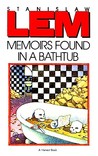
Memoirs Found in a BathtubMemoirs Found in a Bathtub by Stanisław Lem

My rating: 5 of 5 stars

Amazon page

If you enjoyed Joseph Heller’s Catch 22, which is to say you like gallows humor that scoffs at the folly of thinking of “bureaucratic logic” as anything other than an oxymoron, then Stanislaw Lem’s Memoirs Found in a Bathtub will be right up your alley. The premise is that future archeologists are trying to decipher what happened to humanity from a dearth of remaining documentation. One of the best and most extensive of these records is the memoirs of a bureaucrat telling of his experience in a subterranean complex that reads a lot like a spoof on the Pentagon. The 31st century timeline in which a future generation tries to understand the intervening dark ages is only discussed in the prologue, the remainder is the first person account of this bureaucrat of ill-chosen profession.

The narrator tells us about his final assignment, one that was so secret that his superiors couldn’t even tell him what it was. When he finally does get some written guidance, it’s stolen. Throughout the story, the author is shifting through various departments of this complex trying to figure out what is going on and with little initial success. At first he’s trying to figure out what his mission is, but later he’s just trying to figure out what’s real and meaningful–and if those concepts retain any usefulness. Along the way, odd and spectacular events occur that leave him thinking he’s being framed. He doesn’t know if he’s in a test, in the middle of a conspiracy, or amid a collection of lunatics.

There are sections that read quite like a Monty Python sketch, and the absurdist humor is sometimes like that of Douglas Adams–though more sparing and dark. There’s a scene featuring an officer who tries to talk the narrator into confessing, and I could only picture said officer in my mind as Eric Idle. Among the absurdist elements is the explanation of office operations. We are told that command was unable to deal with accurately and swiftly circulating memos because of the volume, and so they took to a random system in which paperwork was indiscriminately circulated until it happened upon the correct desk. There’s an officer who begins to chew and swallow envelopes to prevent information from falling into the wrong hands. One of the best examples of absurdist humor is a conversation with a cryptologist who suggests that everything is a code and, ignoring messages that seem to be of military value and that are not coded, takes to using a machine to “decipher” random literature into nonsensical messages.

Nothing is as it seems in this book, and the humor derives from the narrator being the only individual who insists on the world making sense. If you’ve ever been in a position where you had to interact regularly with a bureaucracy, you’ll understand the value of laughing at such humor to avoid weeping. Much of the humor comes from the desire to keep things secret while trying to know everything there is. The narrator keeps finding not-so-subtle fly-shaped spy devices on his coffee saucer. There are blatant lies about behavior that takes place right before the narrator’s eyes. When he’s institutionalized, it turns out that the other inmates are not at all who they seem to be either.

If Stanislaw Lem is not an author familiar to you (he’s a Polish writer who died in 2006), this is a good work to cut your teeth on. It’s not one of his most well-known pieces, but it’s humorous and easier to follow than Solaris. Fans of Kurt Vonnegut and Robert Heinlein are also likely to enjoy this book. I recommend it.

View all my reviews

POEM: The Hippo

IMG_4377

The Hippo never took an oath

to watch its weight or check its growth.

Hungry, Hungry, it is in deed.

Five hours per day it’s known to feed.

The Greeks called it the river horse.

A horse that’s not a horse, of course, [of course.]

Hippos do like rivers, though they don’t float.

Submerged below, they’ll wreck your boat.

Where else can one find two tons of fun?

But careful, don’t think them too fat to run.

They’ve been clocked at 30 miles per hour,

and there’s scarcely a thing they won’t devour.