PLAY: “A Streetcar Named Desire” by Tennessee Williams

A Streetcar Named DesireA Streetcar Named Desire by Tennessee Williams
My rating: 5 of 5 stars

Available online – Internet Archive

I’ve never seen the play, nor the movie. Of course, this is one of those works that has so scrawled itself across pop-culture that it’s impossible to go in without some reference from it kicking around in one’s brain, be it the pained shout of “STELLA!” or character names like “Blanche DuBois” or “Stanley Kowalski.” Even the name of the plantation on which the fallen socialite sisters grew up, Belle Reve, has been lent to a prison for supernatural villains in the world of DC Comics.

At the play’s heart are two sisters raised in a wealthy Southern family. One, Stella, has adapted well to the family’s fall from grace. Stella has married a fellow who is rough around the edges (to say the least,) Stanley, but Stella is satisfied that Stanley is a dependable provider — even if he does rough her up a bit now and again. The other sister, Blanche, hasn’t coped nearly so well. Blanche lies perpetually to try to shield herself from reality — and to present a more appealing reality to others. It is when Blanche, having nowhere else to go, moves into the small New Orleans apartment of Stanley and Stella that the tension is set to form the play’s story.

I enjoyed reading this play. It’s well-paced and effectively mixes comedy and drama. It’s in character building where the play shines. The main characters are well-defined and behave quite believably within the context of each one’s neuroses and vices. The constant conflict between Blanche and Stanley drives the story.

I’d highly recommend this for readers of plays and / or of American Literature.

View all my reviews

BOOKS: “George Bernard Shaw: A Very Short Introduction” by Christopher Wixson

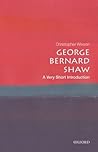
George Bernard Shaw: A Very Short Introduction (Very Short Introductions)George Bernard Shaw: A Very Short Introduction by Christopher Wixson
My rating: 4 of 5 stars

Publisher Site – OUP

This concise guide to George Bernard Shaw is an exploration of the works of the prolific playwright and how his philosophy and life experiences influenced the stories he created. The book is arranged by periods of Shaw’s own determining, including: Unpleasant, Pleasant, Puritan, Political, Extravagant, and Farfetched. The book does mention Shaw’s novels, literary criticism, and some of his major non-literary activities, but largely in the context of the comedies, tragedies, and histories he wrote for the stage.

If you are interested the works of George Bernard Shaw and how they came to be, I’d recommend this book. It’s a quick read and offers some fascinating insights.

View all my reviews

PROMPT: Learned

Daily writing prompt
What is the last thing you learned?

I was just reading George Bernard Shaw: A Very Short Introduction and learning about how his philosophy informed his plays. In particular, I learned why the play Pygmalion, which I recently read and which is the origin of the popular musical My Fair Lady, has an odd appendix which tells of the main characters’ continued life stories after the events of the play — as Shaw imagined them. Apparently, audiences pined for a love story between Henry Higgins and Eliza Doolittle, and Shaw never wanted that. Apparently, when Shaw saw what actors and directors were doing to tilt the story toward that love affair, he felt the need to add a postscript to set things straight.

BOOKS: “Pygmalion” by George Bernard Shaw

PygmalionPygmalion by George Bernard Shaw
My rating: 5 of 5 stars

Available on Project Gutenberg

Pygmalion is a play about class and human connection, and is probably the best-known work of George Bernard Shaw, having been adapted into a popular movie entitled My Fair Lady.

Henry Higgins, an expert on accents and dialects, bets his friend, Col. Pickering, that he can train a poor Cockney flower girl (Eliza Doolittle) to pass as a duchess at a soiree with genteel elites. Higgins is educated and of upper-crust upbringing but is neither refined nor does he have much in the way of people skills. Pickering is a personable and mannerly gentleman. Eliza is on a journey of transformation and her interaction with the two men offers insight into how those of different classes view dignity. (Besides examining class differences, some insight into how men and women differently view human interactions is generated.)

Beginning the last act (Act V,) it felt like the earlier acts hadn’t done the work required of them to motivate the last act behavior / discussions, but — I must admit — that feeling went away by the time the dialogue was complete. (Also, I give benefit of the doubt to the fact that good acting may have conveyed inklings to an audience that couldn’t be garnered from reading dialogue and stage directions.)

There was an Afterword that sketched out what happens in the lives of the characters after the events of the play. I didn’t care for it. There is a certain level of ambiguity in the ending, and I was good with that. I understand that many readers / viewers are not, however. (If you watched Christopher Nolan’s Inception and the spinning top ending drove you batty, you’d probably appreciate this Afterword. I believe the movie (My Fair Lady) tweaks the ending to make it more definitive.)

At any rate, this is a witty and evocative play and is well worth reading (or seeing.)

View all my reviews
“All the World’s a Stage” [Soliloquy from AS YOU LIKE IT] by William Shakespeare [w/ Audio]

All the world's a stage,
And all the men and women merely players:
They have their exits and their entrances;
And one man in his time plays many parts,
His acts being seven ages. At first the infant,
Mewling and puking in the nurse's arms;
Then the whining school-boy, with his satchel
And shining morning face, creeping like a snail
Unwilling to school. And then the lover,
Sighing like furnace, with a woeful ballad
Made to his mistress' eyebrow. Then a soldier,
Full of strange oaths, and bearded like the pard,
Jealous in honour, sudden and quick in quarrel,
Seeking the bubble reputation
Even in the cannon's mouth. And then the justice,
In fair round belly with good capon lin'd,
With eyes severe and beard of formal cut,
Full of wise saws and modern instances;
And so he plays his part. The sixth age shifts
Into the lean and slipper'd pantaloon,
With spectacles on nose and pouch on side.
His youthful hose, well sav'd, a world too wide
For his shrunk shank; and his big manly voice,
Turning again toward childish treble, pipes
And whistles in his sound. Last scene of all,
That ends this strange eventful history,
Is second childishness and mere oblivion;
Sans teeth, sans eyes, sans taste, sans everything.

NOTE: Sometimes called the “Seven Ages of Man,” this soliloquy is spoken by Jacques in Act II: Sc. 7 of As You Like It.

“Tomorrow and Tomorrow and Tomorrow” [Soliloquy from MACBETH] by William Shakespeare [w/ Audio]

Tomorrow, and tomorrow, and tomorrow,
Creeps in this petty pace from day to day,
To the last syllable of recorded time;
And all our yesterdays have lighted fools
The way to dusty death. Out, out, brief candle!
Life's but a walking shadow, a poor player,
That struts and frets his hour upon the stage,
And then is heard no more. It is a tale
Told by an idiot, full of sound and fury,
Signifying nothing.

“Curtain” by Paul Laurence Dunbar [w/ Audio]

Villain shows his indiscretion,
Villain's partner makes confession.
Juvenile, with golden tresses,
Finds her pa and dons long dresses.
Scapegrace comes home money-laden,
Hero comforts tearful maiden,
Soubrette marries loyal chappie,
Villain skips, and all are happy.

PROMPT: Performance

Daily writing prompt
Have you ever performed on stage or given a speech?

With respect to giving a performance, not since elementary school plays, and I was not good. As for speeches, yes, a number of them.

St. Crispin’s Day Speech [from HENRY V] by William Shakespeare [w/ Audio]

This day is call'd the feast of Crispian.
 He that outlives this day, and comes safe home,
 Will stand a-tiptoe when this day is nam'd,
 And rouse him at the name of Crispian.
 He that shall live this day, and see old age,
 Will yearly on the vigil feast his neighbours,
 And say "Tomorrow is Saint Crispian."
 Then will he strip his sleeve and show his scars,
 And say "These wounds I had on Crispian's day."
 Old men forget; yet all shall be forgot,
 But he'll remember, with advantages,
 What feats he did that day. Then shall our names,
 Familiar in his mouth as household words --
 Harry the King, Bedford and Exeter,
 Warwick and Talbot, Salisbury and Gloucester --
 Be in their flowing cups freshly rememb'red.
 This story shall the good man teach his son;
 And Crispin Crispian shall ne'er go by,
 From this day to the ending of the world,
 But we in it shall be remembered --
 We few, we happy few, we band of brothers;
 For he today that sheds his blood with me
 Shall be my brother; be he ne'er so vile,
 This day shall gentle his condition;
 And gentlemen in England now a-bed
 Shall think themselves accursed they were not here,
 And hold their manhoods cheap whiles any speaks
 That fought with us upon Saint Crispin's Day.

BOOKS: The Importance of Being Earnest by Oscar Wilde

The Importance of Being EarnestThe Importance of Being Earnest by Oscar Wilde
My rating: 5 of 5 stars

Amazon.in Page

This play is an amusing cautionary tale on the dangers of “Bunburying” and / or leading a double life. “Bunburying,” a term coined by Wilde in this play, is the act of concocting meetings with a fictitious friend to get out of tedious familial (and other social) obligations. Don’t want to go to Aunt Bessie’s potluck? Tell her that your friend with a plausibly absurd name (e.g. Bunbury) has ruptured a disc in his back and desperately needs your assistance. Bunburying is the specialty of one of the two bachelor characters this story is built around, a man named Algernon. The other, Jack, goes by the name Ernest when he is in London, and has to invent the story that he has a brother when his town and country dichotomy of personalities starts to be seen through by those other than Algernon.

This humorous tale revolves around both Algernon and Jack finding desirable fiancés while being tangled in the web of their own duplicity. Much of the humor comes from the interactions of Algernon and Jack, two men who are quite alike, though Jack thinks himself more respectable. Algernon is more at ease with his own scamp-like nature and plays a role similar to that played by Lord Henry in Wilde’s novel, The Picture of Dorian Gray. That is, Algernon offers many a quotable line that at least has the appearance of wisdom — if, often, a kind of nihilistic wisdom.

This play is definitely worth reading.

View all my reviews