“Spring Dawn” (春曉) by Meng Haoran [w/ Audio]

My Spring sleep is unswayed by dawn --
Though birds are heard through screen, still drawn.
Recalling night sounds of rain and wind,
I wonder how the flowers have thinned?

Original in Chinese:

春眠不覺曉,
處處聞啼鳥。
夜來風雨聲,
花落知多少。

“Silk-Washing Stream” by Su Shi [w/ Audio]

Stream-washed leaves are glistening.
Someone is boiling cocoons.
Workers gossip, I'm listening.

Dim-eyed man with a cane spoons
Food into a bowl, bending
To pass it before I swoon.

I ask when the bean leaves yellow.

“The Blue-Green Stream” by Wang Wei (Lowell version) [w/ Audio]

Every time I have started for the Yellow Flower River,
I have gone down the Blue-Green Stream,
Following the hills, making ten thousand turnings.
We go along rapidly, but advance scarcely one hundred li.
We are in the midst of a noise of water,
Of the confused and mingled sounds of water broken by stones,
And in the deep darkness of pine-trees.
Rocked, rocked,
Moving on and on,
We float past water-chestnuts
Into a still clearness reflecting reeds and rushes.
My heart is clean and white as silk;
it has already achieved Peace;
It is smooth as the placid river.
I long to stay here, curled up on the rocks,
Dropping my fish-line forever.

NOTE: This version was translated by Florence Ayscough and adapted by Amy Lowell in the book: Fir-Flower Tablets (1921) New York: Houghton Mifflin, p. 123

“Above the blossoms sing the orioles” by Han-Shan [w/ Audio]

Above the blossoms sing the orioles:
Kuan kuan, their clear notes.
The girl with a face like jade
Strums to them on her lute.
Never does she tire of playing --
Youth is the time for tender thoughts.
When the flowers scatter and the birds fly off
Her tears will fall in the spring wind.

Translated of Burton Watson in: Cold Mountain: 100 poems by the T’ang poet Han-Shan, New York: Columbia University Press, p. 22

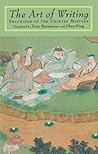
BOOKS: “The Art of Writing” Trans. / Ed. by Tony Barnstone and Chou Ping

The Art of Writing: Teachings of the Chinese MastersThe Art of Writing: Teachings of the Chinese Masters by Tony Barnstone
My rating: 5 of 5 stars

Publisher Website

This thin volume is packed with insights on writing — especially, but not exclusively, poetry. It consists of four chapters. The first two are the ars poetica of Lu Ji and Sikong Tu, respectively (i.e. The Art of Writing and The Twenty-Four Styles of Poetry.) The second half of the book consists of two chapters of collected sayings and poetry commentary excerpts.

I haven’t read a book so dense with quotable lines in a while. Some of the advice offered is universal and timeless (e.g. avoid cliches and read voraciously,) but some of it reflects a uniquely Chinese perspective rooted in Taoist and Zen sentiments (e.g. how to use wu wei [effortlessness] in one’s writing and so forth.)

There is a preface and each of the sections has its own editorial opening, but these never feel like padding (which often happens with books that come out to less than a hundred pages of content.) Instead, this ancillary material is concise and helps to offer historic and cultural context.

I’d highly recommend this book for writers and those interested in Eastern aesthetics and literature. That said, you don’t necessarily have to be interested in both. Any writer could pick up some beneficial tips while reading this book, and it’s compact, highly readable, and even humorous in places.

View all my reviews

“Tiantai” [天台] by Fēnggān [w/ Audio]

I came once to Tiantai,
And back ten-thousand times.
Like clouds or water tides:
Drift and flow, come and go.
I stroll, free of worry,
Buddha's Path - in no hurry.
While the world's forked roads
Lead men to fret and scurry.

“Spring Rise” by Fan Chengda [w/ Audio]

In Spring, the waters rise --
Shore grass sways with breezes,
And geese drift right beside;
Boats glide as the stream pleases.
Yon pagoda looks far,
but feels quite close.

Streamside, one feels a chill.
Fields have yet to be plowed --
Not while the torrents spill.
Mulberry limbs are bowed.
Soon we'll have a taste,
and harvest cocoons.

NOTE: The title of this poem is 蝶 戀 花. Xu Yuanchong uses the quite literal “Butterflies in Love with Flowers” as his translated title. I chose differently because a wet Spring is the throughline of the poem and, well, there are no explicit butterflies (or flowers) in the poem [only their potential.] Of course, maybe that’s exactly why the original is a great title.

“Broadminded” [Poetry Style #23 (旷达)] by Sikong Tu [w/ Audio]

One may live a century --
Short span though it may be:
Joys are bitterly brief
And sorrows are many.
You may take a wine jug
On your wisteria rounds:
See flowers grow to the eves
As sparse rains wet the grounds.
And when the wine is gone,
One strolls with cane and croons.
We become wizened with age;
South Mount, fair through countless moons.

NOTE: The late Tang Dynasty poet, Sikong Tu (a.k.a. Ssŭ-k‘ung T‘u,) wrote an ars poetica entitled Twenty-Four Styles of Poetry (二十四诗品.) It presents twenty-four poems that are each in a different tone, reflecting varied concepts from Taoist philosophy and aesthetics. Above is a crude translation of the twenty-third of the twenty-four poems. This poem’s Chinese title is 旷达, which has been translated as: “Illumed” [Giles,] “Big-hearted and Expansive [Barnstone and Ping,] “Expansive,” and “Open-minded.”

“Transcendent” [Poetry Style #21 (超诣)] by Sikong Tu [w/ Audio]

With no god, but with spirit;
With no mass of tiny things;
Up on high, with the white clouds --
Borne aloft on breezy wings.
From afar all seems in place.
When you arrive it's not there.
Just like acting with the Way
Leaves customs beyond repair.
Chaotic mountain woodlands,
Sweet green moss in the sunshine.
Keep reciting your mantra,
Till it's lost among the pines.

NOTE: The late Tang Dynasty poet, Sikong Tu (a.k.a. Ssŭ-k‘ung T‘u,) wrote an ars poetica entitled Twenty-Four Styles of Poetry (二十四诗品.) It presents twenty-four poems that are each in a different tone, reflecting varied concepts from Taoist philosophy and aesthetics. Above is a crude translation of the twenty-first of the twenty-four poems. This poem’s Chinese title is 超诣 and it’s been translated as “The Transcendental” and “Super”

“Sad” [Poetry Style #19 (悲慨)] by Sikong Tu [w/ Audio]

Strong winds ripple water;
Forest trees are laid low...
A bitter urge to die --
One can't come; one can't go.
Ten decades flow, stream-like;
Riches are cold, gray ash.
Life 's a death procession --
Unless you're adept and brash,
And can take up the sword
To hasten the anguish...
No rustling dry leaves, or
Leaky roof as you languish.

NOTE: The late Tang Dynasty poet, Sikong Tu (a.k.a. Ssŭ-k‘ung T‘u,) wrote an ars poetica entitled Twenty-Four Styles of Poetry. It presents twenty-four poems that are each in a different tone, reflecting varied concepts from Taoist philosophy and aesthetics. Above is a crude translation of the nineteenth of the twenty-four poems. This poem’s Chinese title is 悲慨, and it has been translated as: “Despondent,” and “Sorrowful.”