9 Lessons Learned During Children’s Yoga Teacher Training

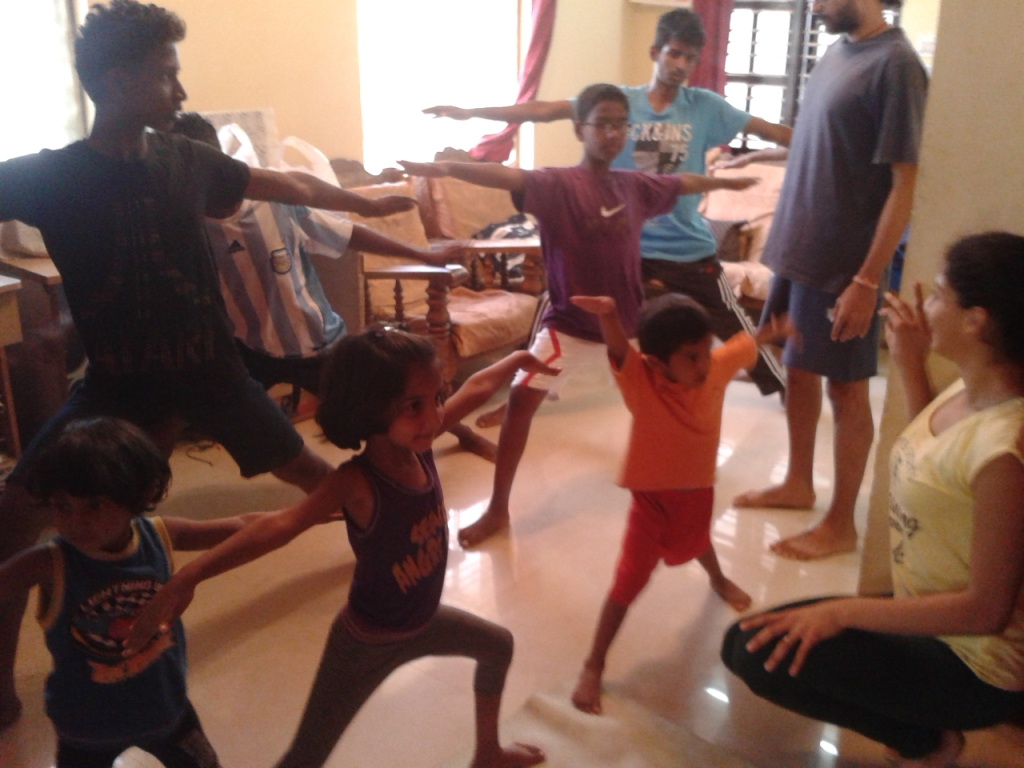
I recently finished the course requirements for Registered Children’s Yoga Teacher (RCYT) training at a1000 Yoga in Bangalore. (As of this writing, I still have a kid-specific teaching requirement to meet before I can add this to my Yoga Alliance certification portfolio.)  When I did my seva (charitable teaching) requirement for RYT-200 at an orphanage, I discovered that teaching kids was a different monster. That’s what led me to take up this specialization, and I thought I’d share some of what I learned.


IMG_1580

1. Eight is [soon] enough:  The traditional age for introducing children to a practice of yoga is eight. This doesn’t mean that kids aren’t taught postures (asana) or other yogic techniques earlier, but for younger kids it’s typically done as play. Traditionally, surya namaskara (sun salutation), nadi shodhana (alternate nostril breathing), and Gayatri mantra (a particular chant) serve as the core of the child’s practice.

Why eight? It has to do with a number of physical and mental development factors including lung development, the state of the pineal gland, and the arrival of abstract reasoning capacity.
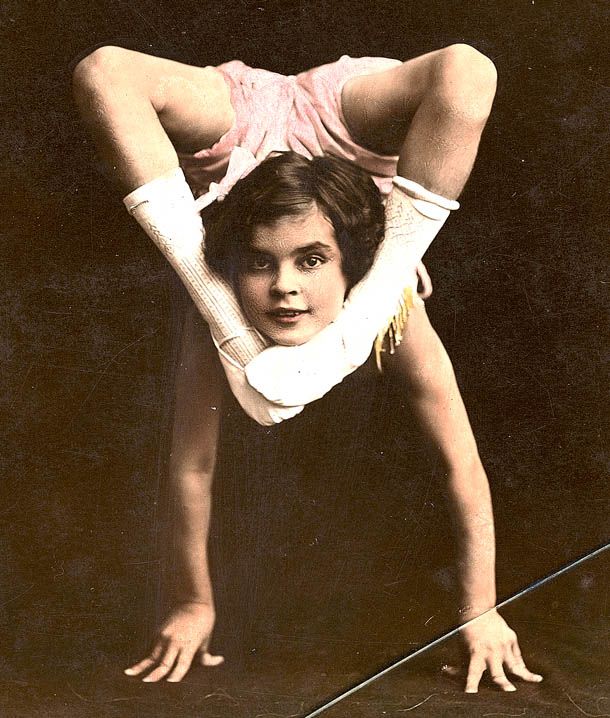
Kids_contortionism2.) There are no youth-related contraindicated postures: I expected to spend a fair amount of the course learning what postures one shouldn’t teach children and why. However, instead we were told that kids could be exposed to any Hatha yoga postures.

Of course, this is predicated on: a.) the fact that one is dealing with a child eight and up; b.) one recognizes that the strengths and weaknesses of children will need to be taken into account and modifications or capacity building may be necessary in some cases. (For example, the flexibility of kids may allow them to achieve postures that few adults can, but at the same time their lack of strength and balance may be limiting factors for some postures.); c.) obviously, one needs to take into account that kids may have contraindicated conditions that aren’t age-related but are due to their particular physical condition.

It should also be noted that children are typically not taught breath retention (khumbaka) as part of their (breath exercise) practice. So it’s not true to say that there are no contraindicated practices.

3.) In stillness, your results may vary: One of the nice things about a yoga practice for kids is that it acknowledges that most kids, by nature, don’t want to be still. As opposed to mainstream education, which attempts to force stillness upon them, yoga offers a mixture of activity and stillness. However, it was interesting to see the range of abilities to remain motionless during yoganidra (“yoga sleep,” i.e. a hypnogogic state) practice. There is, of course, an age component to this. That is, young kids have a harder time staying still than older kids. However, that isn’t all there is to it. A few of the older kids couldn’t stay still in savasana (corpse pose) for five seconds, but a few of the young seemed able to be still for as long as required–not necessarily awake, but still.

the exception

the exception

4.) Balance isn’t in a child’s wheelhouse:  I knew that strength was ill-developed in prepubescent children, but I didn’t realize how challenging kids would find even simple balance postures. They’re a little like drunks in this regard.

Obviously, kids tend to be freakishly bendy, and so it’s not a surprise that most of them could learn to do chakrasana (wheel pose, i.e. a full back bridge) from a standing position in short order. In fact, the challenge for those who had one was more likely to be confidence with not falling on one’s head than with a lack of back-bending flexibility.

The moral of the story is that one must recognize that children are a little like senior citizens in this one domain. That is, consideration must be given to the risk that they will fall down during balancing poses. Unlike seniors, they don’t have too far to fall, and they’ll heal lickety-split if they do, but–still–they’ll fall like a drunken sailor.

5.) Teaching kids’ partner yoga requires a different approach:  The usual advice is that one should teach kids from “inside the circle.” That is, one shouldn’t set oneself off at the head of a class like one would usually do with an adult class. One sits with with the kids and does the class with them. (You probably won’t be doing 6 classes a day that way.)

I had the opportunity to teach a pairs yoga class and found that an entirely different approach was needed. First let me say that pairs (partner) yoga is a great approach for teaching kids. Many kids will enjoy the interaction, and they can learn about teamwork and (in some cases) take advantage of the stabilization of additional limbs / grounded surface area. However, because it requires so much attention to be focused on the partner, it’s best not to teach it from inside the circle. One won’t necessarily be able to see what one’s students are doing, and that can be dangerous.

6.) There’s a yoga for special needs children: Among our guest speakers, we had a yoga teacher from Prafull Oorja, which is an organization that teaches special needs children using yoga, dance, and various other methods. These approaches are used to increase bodily awareness, which is a common problem across many different afflictions. We learned about the range of challenges faced by such children and how the usual approach is varied to adapt to their needs.


The course included information about several non-yogic methods that could be used to complement yoga practice to achieve the objectives of a yoga course. I write this by way of explanation as to why the last few lessons seem to have little to do with yoga.


7.) Stories must be physical, animated, and repetitive for small kids:  These features serve to help adjust to the child’s limited vocabulary, while helping them to build vocabulary. We had a speaker from Kathalaya (House of Stories) who offered a great deal of insight into story-telling for kids.

Lest one think that story-telling is just filler in the yoga context, I’ve been learning a great deal about how our minds need stories, and am inclined to believe that one’s insight into the mind will be limited if one doesn’t understand story and why stories appeal to our minds. I recommend the book Wired for Story by Lisa Cron.

8.) Games used in theater can go hand-in-hand with yoga practice:  I was completely new to the idea of theater games before this course, but we had someone teach us a number of these games, and the logic behind building our own. Games which aren’t too cerebral can go help build some of the same skills that are sought in a course of yoga. Such games include practices that help develop one’s voice and physical expressiveness. These games can also help bring some kids out of their shells so that they are more ready to actively participate in a yoga class.

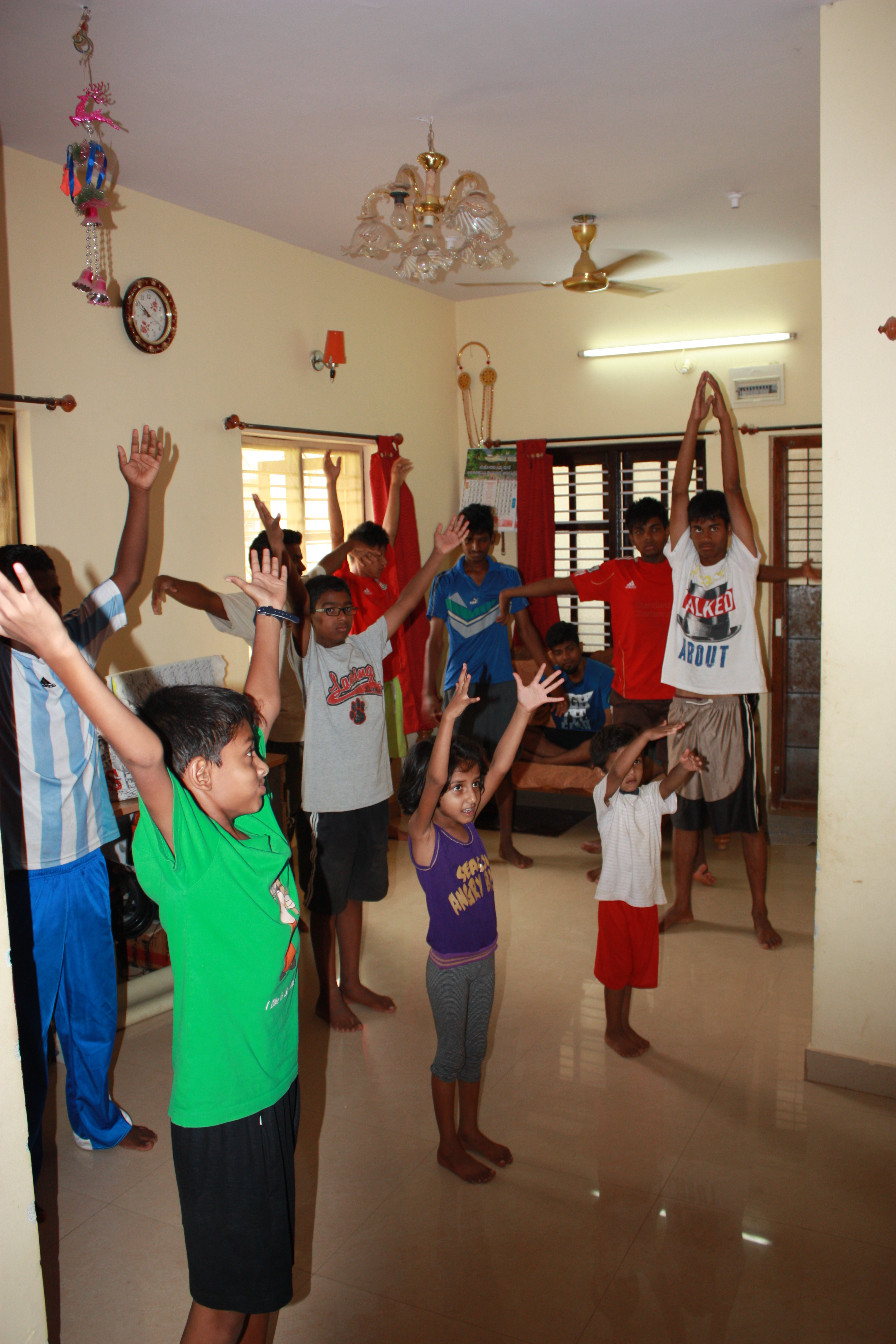
9.) We need mental hygiene as much as dental hygiene: This actually comes from a quote by Sir Bat Khalsa, a Harvard Neurologist who studies the effects of yoga. When I was doing research for my final presentation, I ran across said quote, which goes:

“There’s no preventive maintenance. We know how to prevent cavities. But we don’t teach children how to be resilient, how to cope with stress on a daily basis… We’ve done dental hygiene but not mental hygiene.”
IMG_1582

READING REVIEW: April 24, 2015

I completed three books this week. The first was Richard Wiseman’s Night School. I wrote a lot about this book in my last Reading Report. Night School examines what happens when we sleep, what happens when we don’t, and a host of events that happen in and around our sleeping life (i.e. nightmares, night terrors, sleep walking, etc.)  The notion that dreams and nightmares are our subconscious working out waking life problems is well established, but there was some interesting discussion of how to change one’s dreamscape (i.e. lucid dreaming) that was fascinating.

NightSchool


The second book I finished was Sam Harris’s Free Will. I had high hopes for this book, but they didn’t pan out.   It’s a very short book (less than 100 pages) on the subject of free will–or the lack thereof. There’s a well-established scientific literature supporting the notion that free will is an illusion. This conclusion was reached by observing that subconscious parts of the brain involved with decision-making light up well in advance of the conscious parts of the brain. The most illuminating example offered is an experiment in which participants were asked to press a button to select a letter or number of their choosing from among a string of rotating letters / numbers. Some subjects became convinced that the scientists had mastered precognition (a class III impossibility according to physicists–i.e. impossible according to the laws of physics as we know them.)  What was really happening was an exploitation of the lag between when the individual’s subconscious decided and when they became aware of their decision.

While I’m normally a big fan of brevity, Harris could have put some more pages to good use. First, he barely mentions a couple of the neuroscience experiments, and expects that the reader will treat this all as law. That is, we are to accept that always and everywhere people’s subconscious minds decide some measure before their conscious minds. Harris also scoffs at the suggestion that perhaps the conscious can overrule the subconscious. He seems to deem this as not worthy of study because it would just be the subconscious making a second decision. So we learn about a couple of studies in which a.) the decision-maker has no stake in the decision (is it possible the mind treats decisions about picking a spouse or a house differently than picking a letter or number in which there is no more costly outcome?) b.) those studied are a random sample of individuals who have no particular expertise with their minds. (If I drew a random sample of people and asked each to lift 300 lbs over his or her head. If no one could do it, would I be safe in concluding that lifting 300 lbs was something forever beyond the capacity of every member of the human race? In other words, what if exercising conscious control over decision-making requires training and expertise with the mind.) Maybe all of this has been studied (e.g. high stakes cases and cases with monks and meditators), and we can safely conclude that free will is always and everywhere an illusion–but Harris didn’t make this point. He concludes we will take it as a given just as he has. (Much like he suggests that anyone who truly studied their mind would understand this point already. Would it surprise Mr. Harris to learn that there are people who have spent far longer alone with their minds than he, who have concluded quite the opposite?)

Second, if the conscious mind is just a Matrix Revolutions-style (and Rube Goldberg-style) machine for tricking us into thinking we have choice and control over the direction of our lives (what happened to evolution not over-engineering?), what guides all of these “decisions?” Given that they produce, I might point out, a fairly orderly world. Harris doesn’t answer this. One might guess that he would point to Dawkinesque suggestion that it’s all about genes advancing their own agenda. (A proposition that seems to me has trouble explaining a corporeal who throws himself on a grenade to save his comrades.) I shouldn’t put words in the author’s mouth. Quite frankly, I have no idea whether he believes there are rules or some guide to these subconscious decisions, because he doesn’t tell us. (Maybe he thinks they are random neuronal firings, but I doubt it.) From what I’ve heard of his other books, he doesn’t think it’s a god making these decisions–a sentiment I share. However, there must be something underlying these decisions, and an author writing about this topic should at least make some effort to address it. Black boxes aren’t persuasive.

FreeWill


The final book I finished this week is entitled The Sensual Body. This is a book that discusses a number of systems of movement and bodily activity as means to increase bodily awareness. Among the systems included are Tai chi, Eutony, Kum Nye, running, Aikido, and massage. It’s an interesting overview, but without sufficient detail of anything in particular to be of practical value. It’s the kind of book one might read to see what kind of classes one should take or what more focused books would be of benefit.


Besides the aforementioned books, I spent most of my reading time on two books that look at two very different subjects from the viewpoint of neuroscience. The first is Wired for Story, and it’s a how-to book for writers that sets itself apart by explaining how humans are hardwired by evolution to love stories. Just as a few notes produce an infinite variety of music. There is an inherent limiting / shaping structure to stories that is ignored at the writer’s peril. Much of the advice offered isn’t that different from other books on writing or storytelling, but one gets insight into which advice one should really treat as inviolable because it touches upon something fundamental to our human nature.


Wired for Story


The other book is the only book I purchased this week. It’s entitled Brainwashing: The Science of Thought Control and is by Kathleen Taylor. So far the book is intriguing. The chapters I’ve read so far provide an overview of brainwashing and cults. The middle section of the book delves into the neuroscience behind brainwashing, and the final section gets into practical matters such as how one can make oneself resistant to thought control techniques.


Brainwashing_Taylor


BOOK REVIEW: The New Rules of Posture by Mary Bond

The New Rules of Posture: How to Sit, Stand, and Move in the Modern WorldThe New Rules of Posture: How to Sit, Stand, and Move in the Modern World by Mary Bond

My rating: 4 of 5 stars

Amazon page

This book’s author, Mary Bond, was a UCLA-trained dancer who became an Ida Rolf-trained Rolfer. If that sentence makes no sense, you’re probably unaware Dr. Ida Rolf and her self-named system. Rolfing was popular decades ago, but fell out of favor—possibly owing to its reputation for being agonizing. (However, I did recently read an article suggesting renewed interest in this practice.) Rolf’s system is generically called Structural Integration, and it’s intended to better align the body with respect to the force of gravity. The heart of the practice (though not addressed in this book) is a massage-like system that focuses on fascia (connective tissue) rather than musculature (as massage generally does.)

[This paragraph is background, but isn’t about the book per se. Feel free to skip it if you are familiar with structural integration or don’t care.] It should be noted that Rolfing is controversial. I’m not sure what to make of this controversy. On the one hand, the system hasn’t been helped by zealous advocates and practitioners. In any such system, zealots often suggest their beloved system is a panacea for all that ails one. Furthermore, the more hippie-esque practitioners try to reconcile / unify Structural Integration with ancient systems like Ayurveda or Traditional Chinese Medicine (TCM.) This neither helps to validate those ancient systems nor improves the case of Rolfing as a methodology rooted in science. On the other hand, not even yoga has been free of haters. There is a sector of humanity that is openly hostile to the notion that the only way for many people to feel better is for them to do the work of improving their bodies (e.g. posture, range of motion, strength, etc.) (i.e. If your problem is rooted in your shoulders not being over your hips or you have an imbalance in your core between your ab and back muscles, there is no pill nor surgery to cure you—you’ve got work to do. And—it should be noted–both of my examples can cause a person to feel like crap in a number of different ways.) Another element of controversy is that Structural Integration places special emphasis on fascia (connective tissue.) While it’s not clear from scientific evidence that fascia deserve special attention, I’m also not sure that Rolfers don’t have a point when they note that everyone else completely ignores this tissue.

Having written all that, The New Rules of Posture isn’t a book about Rolfing as massage-like practice. Instead, as its subtitle (how to sit, stand, and move in the modern world) suggests, this is a book about how one can improve one’s posture, breathing, and movement (i.e. most notably walking). It’s arranged as a workbook, and it contains over 90 exercises and observations for the reader to perform. The author calls these exercises “explorations” and “practices”; the latter are more extensive and are more likely to require revisiting.

The ten chapters are arranged into four parts: awareness, stability, orientation, and motion. Each part has two or three chapters. The author divides the body into six zones (pelvic floor, breathing muscles, abdomen/core, hands, feet, and head)—the first three of which are associated with stability and the latter three with orienting the body. The six middle chapters (parts 2 and 3) are each tied to one of these zones. The book uses vignettes and side-bars in an attempt to make the material more palatable to readers who aren’t deeply interested in the topic.

The author gives attention to a wide variety of modern-day activities that can have an adverse impact on bodily alignment such as driving, computer time, and rushing about. I suspect this book will offer something useful to almost anyone.

The book’s graphics are line drawings—some are anatomical drawings and others demonstrate postural problems or exercises. The drawings are clear, well drawn, and useful. In addition to the usual front and back matter, there’s a brief bibliography and a resources appendix.

I’d recommend this book for yoga teachers and those interested in the body generally and movement and postural improvement specifically. If you’re having problems that you think may be linked to postural problems, this isn’t a bad place to start thinking about how one might improve one’s situation. It’s very readable and clear.

View all my reviews

READING REPORT: March 13, 2015

Welcome to a special–not really–Friday the 13th edition Reading Report. Were I one to plan ahead, I might have read something horrifying for this week, but I’m afraid there’s nothing to inspire dread… well, I don’t really know what your dread threshold is, but unless you have phobias about good posture or classic literature, I think you’re safe.


I bought The New Rules of Posture this week, and spent a lot of my reading time with my nose in it. It’s one of those books that has one periodically getting up to try some movement or postural experiment, but I’m about 2/3rds of the way through nonetheless. It’s written by a dancer turned Rolfer, and offers good insights on the subjects of posture and breathing for those of us who are interested in evaluating and improving such things. The line drawings, many anatomical in nature, are helpful and the readability is high for a such a book. I suspect I’ll finish it in the upcoming week and will have a review up within a couple weeks.

NewRuleofPosture


I finished only one book this week, Why Do People Get Ill? I’ve mentioned this book in earlier reports, and will soon be doing a review, so I won’t spend much time on it now. It’s essentially about the roles that stress and the inability to articulate one’s feelings about illness play in catching a disease as well as its progression.

WhyDoPeopleGetIll_Leader&Corfield


As one can see, I’ve been on a body-mind nexus reading kick lately. I’m trying to educate myself about anatomy, physiology, and related biological sciences as a means to improve  the operation of body and mind. In addition to the featured titles above, some of the other books I’ve been reading during the past week include: Zen and the Brain (there was a fascinating chapter on indigenous opioids–i.e. morphine-like substances produced within the body–among this week’s chapters), The Trigger Point Therapy Workbook, and The Sensual Body.

Zen&Brain

TriggerPtTherapy

TheSensualBody


Moving beyond the body / mind books, I did do some reading that wasn’t research related. I’m about 40% through The Painted Word, having read the entries for the letters D, E, and (part of) F. My favorite word from the week was “dromomania” which means an intense passion for travel or wandering. As in, “I, Bernie Gourley, have a bad case of dromomania.”

Painted Word


The short story collection that I’m currently reading (I try not to neglect this medium) is Meeting the Dog Girls. I read about half-a-dozen stories this week (most of them are short, and a few of them–it could be argued–don’t really constitute stories), and I’m about 20% of the way through. Absurdism is a prevailing theme, though in some stories more than others. So far, I’m enjoying this collection. It’s mostly light and easily digestible reading, but has some intense moments.

Meeting the Dog Girls


With respect to novels, I slipped away from Mo Yan’s Life and Death are Wearing Me Out, and resumed reading Victor Hugo’s Les Misérables–a book which I started a while back. I’ve got to admit that reading 19th century literature can be a struggle, and–at the risk of offending–Hugo could’ve used a modern-day editor. (I realize that an alternative interpretation is that modern-day people–myself included–could use an attention span.) I’m only about 10% in, but I got through a powerful moment during which the gendarmes bring Jean Valjean before the Bishop. If you’ve read it (or seen one of the movie or theatrical adaptations) you’ll know what I’m talking about.

LesMiserables


The only other book I spent any significant time was The Taiheiki, and if–like me–you think reading a translation of 19th century French literature can be a challenge, try reading a translation of 14th century Japanese literature. As I’ve mentioned, this book is research for the novel I’m working on. The challenge is the vast cast of characters. It’s a blend of history and fiction, and if you don’t know who was allied with whom during the war between Emperor Go-Daigo and the Hojo, it’s hard to figure out who you should be rooting for–unless it’s talking about the legendary warrior Kusunoki Masashige or one of the few other really well-known samurai.  (Kusunoki was the lord of a small and inconsequential province and his name would likely have been lost to history–despite being a brilliant General–had he not become Japan’s national paragon for the virtue of loyalty.)

Taiheiki

Wat Po v. Chiang Mai Massage: A North / South Divide?

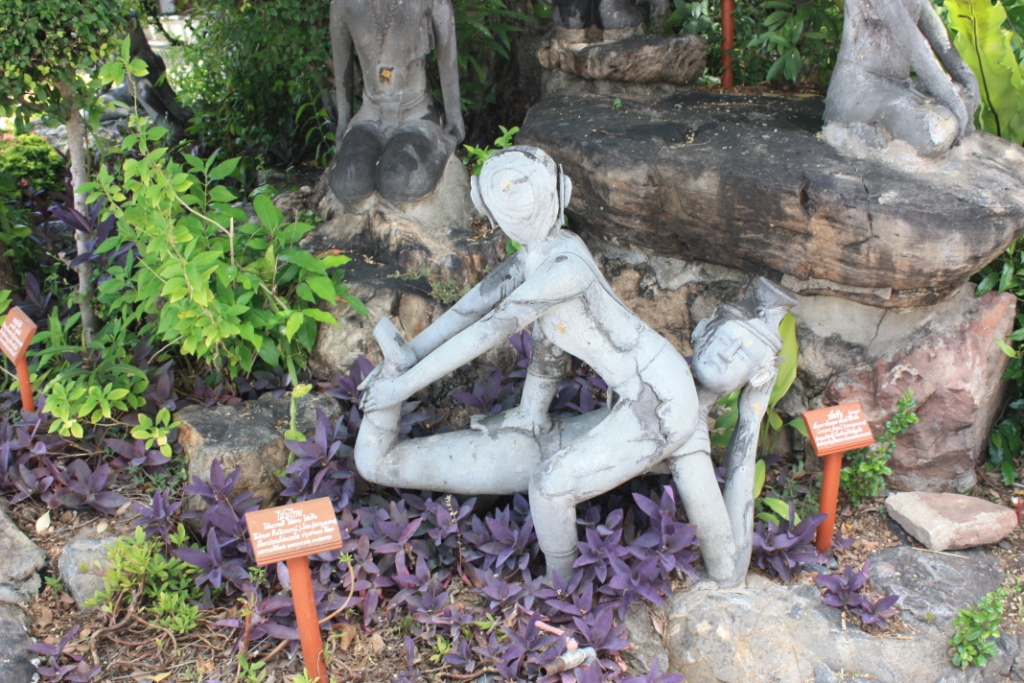
One of the sculptures in the Thai Yoga outcrop at Wat Po.

One of the sculptures in the Thai Yoga outcrop at Wat Po.

In September I attended the General Thai Massage and Foot Massage courses at Wat Po. The teacher from whom I first learned Thai Massage (a.k.a. Thai Yoga Bodywork or Nuad Bo Rarn) was trained in Chiang Mai by various teachers, and the style he teaches reflects that northern heritage. I was curious to see how the style of massage varied in the south from the northern approach that I had already learned. Would I be in uncharted waters? Or would the Wat Po course merely be a refresher of what I had already learned? These questions were on my mind as I began the course.


The answer turned out to be somewhere in between. The Wat Po approach wasn’t radically different from what I had already learned, but neither was it a carbon copy. One could clearly see the common origin of these styles. For yoga practitioners, a reasonable comparison would be to imagine you studied Bihar yoga, and then you sat in on an Ashtanga Vinyasa class. Most of the postures would be similar if not the exact same—e.g. a downward dog is a downward dog. However, the sequence is a little different, you may run into a posture or two that you hadn’t seen before, and there will be many little differences in points of emphasis and so on. The same could be said of two martial arts that have a recent common ancestor art. (However, I think martial arts evolve more rapidly than other systems of movement because there is a life and death urgency to adapt to local conditions, and so martial arts can diverge rapidly.)


I won’t get into every little difference in this post. For one thing, the first course I took was a 60 hour (10 day) course, and the Wat Po course was only half as long (5 day / 30 hours.) Therefore, some of the apparent differences might have more to do with the need to conform to time limitations than true stylistic differences. The Wat Po course was designed to impart a sequence that could be done in an hour-and-a-half bodywork session. The first course I took taught some material that was redundant in the belief that one could tailor one’s sequence to the recipient’s needs and / or the masseuse’s preferences.


As an example, at Wat Po we didn’t learn any massage of the chest or abdomen, but I was shown (in fact, I was recipient of) the Wat Po approach to abdominal massage and it was pretty much the same as I’d learned previously. In my earlier learning, the approach to energy lines was to stretch (longitudinally) the limb, then apply palm pressure, then work the line (typically with the thumbs), and then one would repeat the palm pressure and finish with a repeat of the stretch. At Wat Po, they went straight for the energy line (sen) and followed that with the palm pressure work. I have no way of knowing whether this difference was more due to timing or style.


Before getting into the differences, I will talk a little about similarities. The general approach was the same (e.g. the recipient is fully clothed in a light, comfortable garment(s)) and the massage is ideally given on a thin, dense mattress/pad on the floor–rather than on a table. The general principles of sequencing were the same. Namely, one began at the feet and worked in the direction of the head. Also, when working on a limb, one began at the distal end, worked toward the torso, and then back toward to the starting point. Also, energy line work was done before the stretches.  There were four positions in both styles: supine, side, seated, and prone, and—unlike many other forms of massage—the supine position was at the fore (i.e. neither style emphasized the prone position and back work over the supine in the way other varieties of massage often do.) Both styles of massage (as probably all massage) began with a brief introduction and questioning designed to make sure the individual didn’t have any contraindicated conditions. Both styles of Thai massage began with a moment of prayer or contemplation—this is similar to some styles and different from others and speaks to the traditional nature of Thai massage.


IMG_0031

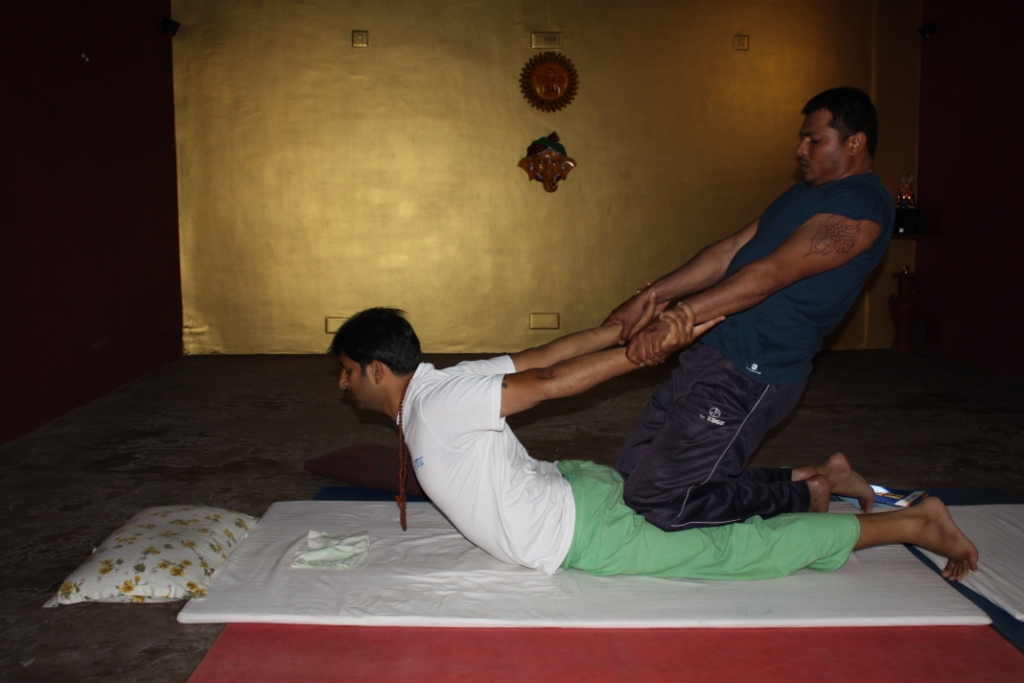
The side and seated sequences were the most similar between the two styles.  I learned more in these sequences in the longer (Chiang Mai) course, but what was included in the Wat Po course was largely the same. Where the stretches were of the same type, they tended to be virtually identical. By that I mean to say that both styles had stretches that weren’t taught in the other style, but where that was not the case, the stretches were indistinguishable. For example, the pictured variant on sarpasana / bhujangasana [snake / cobra backbends] was done in the same manner in either style. (I learned more stretches in the first—Chiang Mai–course, because it was longer.)  Over all, the energy lines (sen) tended to be identical, but there weren’t always the same number of them, nor were the same ones always emphasized. There were some differences in the feet lines that I’ll get into below.


Now let’s get to the differences. Starting with some small differences, the manner of palm pressure work was different between the two systems. In the Wat Po style, there was always one fixed point that one hand locked in place while the other hand applied palm pressure. I had previously learned to use both hands in a rhythmically alternating series of palm pressure applications.


One little difference that I found interesting involved the technique of closing the little flap over the ears at the end of the face and head massage (both styles close off the ears.) I had been taught to very gently release pressure so as to avoid any kind of popping that might disturb the recipient. However, at Wat Po the instructor taught to vigorously pull the fingers away—resulting in a pop. My guess would be that the idea was to get the recipient’s attention so that one could transition them from the face massage (which notoriously puts people to sleep) to a wakeful state so they could follow instructions for the stretches that followed. (We were taught face massage as part of the seated sequence. Previously, I had learned that this was an option, but that it was easier to do the face massage from supine so you didn’t have to worry about the recipient falling asleep and possibly falling over literally.


A final little difference was how the blood stop was done for the lower extremities. At Wat Po, they did the leg blood stop with both legs straight, whereas I had previously learned this technique with an open groin, i.e. the knee pointed out. (Both ways work about the same, but I think it might be a little less awkward to do it with the groin open as one is not in as close of proximity to the recipient’s privates.) The blood stop for the arm was identical.


The energy lines are one of the most fundamental aspects of Thai massage, and one would expect little variation in them between styles. This proved largely, but not entirely, true. For example, the leg lines were the same (as one might expect because one cannot stray too far from some lines without getting onto bone.) Also the points at the top of the shoulder, around the neck, the base of the skull, and the scapulae were the generally the same–except more or fewer points might be employed from one style to the other.


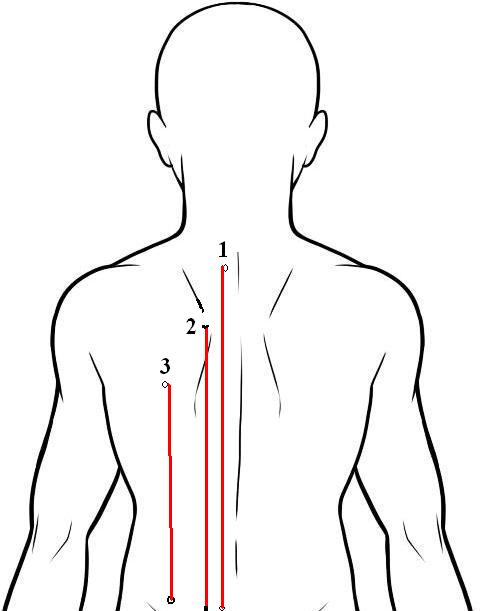
The arm lines were almost the same. The line on the back of the arm was the same, and the line that goes up the middle of the inner arm was the same. However, there was a second inner line that ran in line with the little finger along the lower edge of the arm (presuming the arm is straight out from the shoulder as it is for massaging the inner arm in both styles.) The lines of the back that were used were different. In my (not very accurate) diagram, the lines 1 and 3 were emphasized in the Chiang Mai style, but 1 and 2 were the lines used in the Wat Po system.


Back diagram_CM


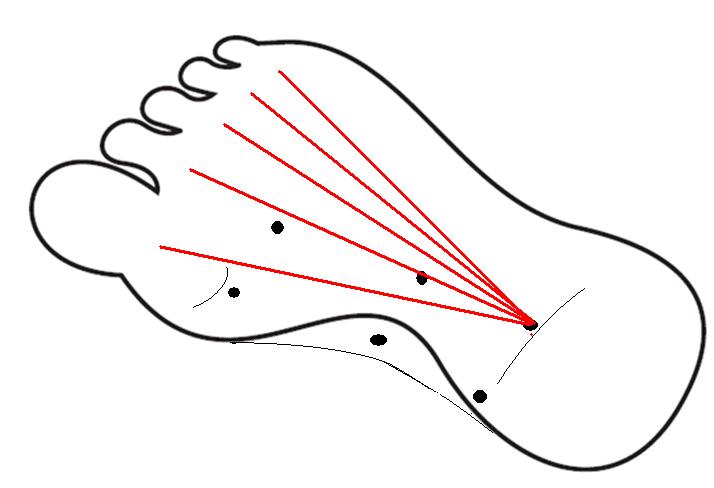
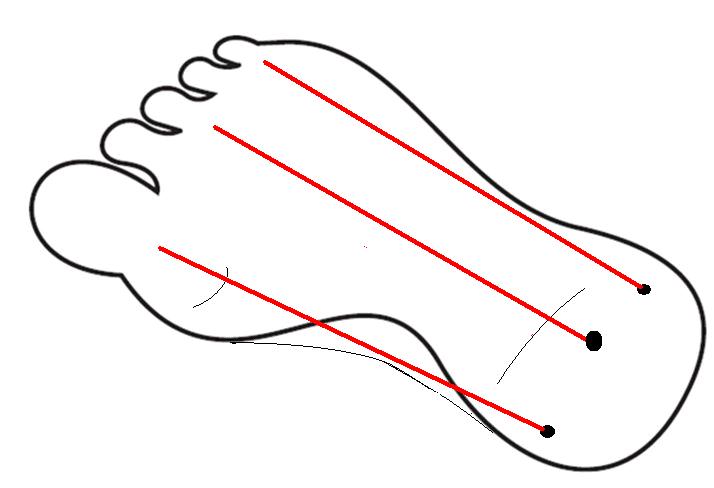
The greatest divergence in lines and points was in the area of the feet. The best example of this can be seen in the lines of the sole. In the Chiang Mai style I’d previously learned there were five lines that radiated from a point where the heel transitioned into the arch about midway across the foot and went toward the base of each toe. The Wat Po style had three lines that were more or less parallel in line with the big toe, middle toe, and the little toe.  See diagrams.


The Chiang Mai 5 lines of the sole.

The Chiang Mai 5 lines of the sole.

The Wat Po 3 lines of the sole.

The Wat Po 3 lines of the sole.


In summary, the difference between these two styles wasn’t that great. In many cases the techniques were exactly the same, in most they were marginally different, and only rarely were they completely different.  I don’t really have a preference between the two styles. I think which would be a better experience comes entirely down to the skill of the masseuse / masseur.

TODAY’S RANDOM THOUGHT: Yoga, Mirrors, & Proprioception

OLYMPUS DIGITAL CAMERAThis morning a yoga teacher I’ve studied with posted this article on her Facebook feed. It’s by an Indian yogini who moved to the U.S., and it offers five differences between the practice of yoga in India and in America.

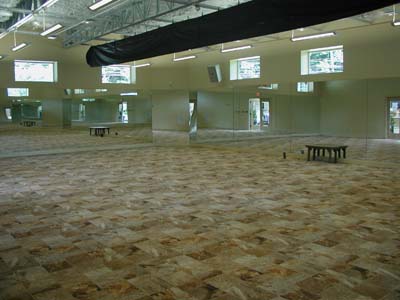
It occurred to me that one additional difference that’s frequently commented upon is that mirrors are ubiquitous in American yoga studios, but a rarity in Indian studios.

There are many possible explanations of this point of divergence. Among the more cynical interpretations is that when yoga spread internationally it was never explained that there are no asana (postures) whose drishti (focal point of gaze) is the reflected “bootilicious”, yoga-panted backside of other students.

The explanation one is likely to hear, however, is that a student needs mirrors to be able to see whether his or her alignment is correct. Sounds logical? Actually, it’s lazy in the same way as saying, “I wanted to know what Lord of the Flies is about, so I rented the movie.” (Read the damn book.)

Yes, looking in the mirror will give one instantaneous feedback, but it won’t help one develop the bodily awareness that’s a huge part of the value of yoga. One should be seeking to enhance one’s proprioception. That’s a fancy way of saying, “know where your parts are.” Proprioception is defined as:  “the ability to sense the position, location, orientation, and movement of the body and its parts.” The body has a built-in ability to determine where one’s various parts are in space and whether said parts are straight or crooked. One may not realize this because one may have poor proprioception… because one looks in the mirror instead of closing one’s eyes and listening to what one’s body has to say.

Yoga for Martial Artists

Long before I ever took a yoga class, I was doing a kind of yoga. It may have even had its roots in India, but it also might have blossomed independently. In the Japanese martial art I study, we called it junan taiso, and many of the poses would be recognizable to a yogi. While it didn’t include the complex and balance-challenging poses seen in yoga, stretches like the butterfly (Poorna Titali Asana), straddle stretch (Upavistha Konasana), and the back stretch (Pashchimottanasana) were virtually identical. As with yoga, the manner of breathing was as important as the nature of the stretch.

Butterfly Stretch (Poorna Titali Asana)

Butterfly Stretch (Poorna Titali Asana)

Back Stretch (Paschimottanasana)

Back Stretch (Paschimottanasana)

Straddle Stretch (Upavisthakonasana)

Straddle Stretch (Upavisthakonasana)

Flexibility is key in the martial arts, and not just the ones with high-flying kicks. Even grapplers and practitioners of the less fancy striking systems gain from increased flexibility, but it isn’t only increases in range of motion that yoga offers.

Let’s consider a modest front kick to a target no higher than the solar plexus. One might be inclined to say, “I don’t need yoga to help with that, I do that kick all the time, and have no problem reaching my target.” Do an experiment. Take a full 30 seconds to do the kick, from the time the foot leaves the floor to the time it extends out, and then hold it for 15 seconds, or so. If you succeeded in this without any problem, you may be good to go.

Front kick, slow-motion style.

Front kick, slow-motion style.

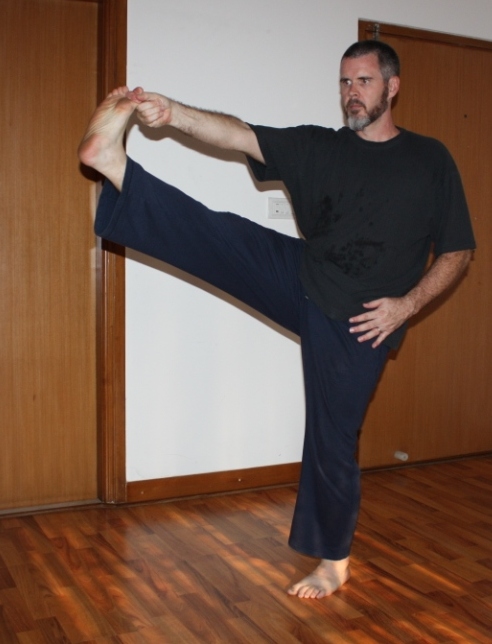
However, there are three problems that might plague one, and yoga is tailor-made to fix two of them. First, you may not have adequate range of motion. You may have thought you did because you can kick at speed and reach the target. But, you say, “Why would I need to kick in slow motion?” You wouldn’t, but this exercise shows you that you are having to use inertia to kick through the resistance of your own muscles. Unless you’re a hardcore bodybuilder that resistance might not seem too daunting, but you are essentially having the brakes applied–albeit softly–to your kick and that’s costing you speed and power.  Yoga can help you develop that range of motion. Consider the pose below, which requires the same type of flexibility.

Hand to Big Toe (Utthita Hasta Padangusthasana)

Hand to Big Toe (Utthita Hasta Padangusthasana)

Maybe you can raise your leg, but keeping it cantilevered in place is too much for you. This means you don’t have the strength to support your own leg. Either your leg is  heavy, your strength is lacking, or both. Building this kind of strength isn’t necessarily yoga’s forte. There are styles and approaches that may help you build that strength, but there are other things you can do that may be more efficient for that purpose–not the least of which is doing a whole bunch of kicks one after the other without a break until your leg is burning, and then doing some more.

You may have had the strength and flexibility, but found it hard to stay on balance. The naysayer says, “Yeah, but that imbalance would never be noticeable at speed. That is (as with the lack of flexibility) one can hide weaknesses with speed. While there maybe some truth in this, a lack of balance will cost you in subtle ways, and yoga can help. There are a number of postures that enhance one’s balance, balance on one’s foot, one’s head, or one’s hands (the latter could be useful for the ground grapplers.)

Warrior III (Virabhadrasana III)

Warrior III (Virabhadrasana III)

Headstand (Shirshasana)

Headstand (Shirshasana)

The Crane (Bakasana)

The Crane (Bakasana)

Tree (Vrksasana)

Tree (Vrksasana)

There are a couple of other areas in which yoga can help one’s performance as a martial artist. One is expansion of bodily awareness of issues of alignment and posture. These might not seem so crucial, but if you are in the martial arts for the long-haul, then having the awareness to make small adjustments can be the difference between chronic ailments or a lack thereof. It can be difficult to discover a misalignment in the quasi-combative environment of martial arts training. It’s easier to notice these issues in the slow and controlled practice of yoga.

Postures like Warrior II and the Side Angle Pose and show you where you are holding tension that you might not otherwise be aware of.

Warrior II (Virabhadrasana II)

Warrior II (Virabhadrasana II)

Side Angle Pose (Utthita Parsvakonasana)

Side Angle Pose (Utthita Parsvakonasana)

It must also be remembered that asana (postures) are only a part of yoga. Another aspect that can be extremely helpful for martial arts is pranayama, or the discipline of breathing.  There’s no substitute for cardio, but that doesn’t mean that one can’t benefit greatly from learning more about how to breath, and the science of breath. This is an area in which yoga excels. The great yogis made extensive study of breath and the effects that are achieved by various types of breathing, and these exercises can expand and strengthen the diaphragm and the muscles of the rib-cage. One tends to see the coup de grace strike and think, “There’s your problem.” However, often it’s fatigue that’s the underlying culprit. Better breathing can reduce fatigue.

Of course, meditation is another critical skill for calming the mind and learning to live in the present. Many martial artists already practice some form of meditation, but this is another option.

There is one more benefit and that is building greater confidence in your ability to exercise control over your body. There are many challenging postures in yoga. I don’t advocate all asana that have been taught historically because there can be such a thing as too much flexibility for a martial artist and some poses exercise joints in ways that were not meant to operate. There needs to be a proper balance of strength and flexibility, a proper tension within /between the skeletal and muscular systems. However, there are many poses that just take a bit of time and effort to develop the skill without putting too much wear on the body.

8-Twists Pose (Astavakrasana)

8-Twists Pose (Astavakrasana)

Chi: The Power of What Isn’t

Every morning I start my day with chi kung (a.k.a. qi gong), and many days I do tai chi (tai qi.) For those who are unfamiliar, chi is usually defined as “life force” or “life energy.” However, defining chi is neither simple nor will one find a consensus agreement. Some say chi is  “breath,” at which point its existence becomes a much less controversial, but also less explicative, concept. Others would say that chi is much more broadly dispersed than the “living” so “life force” is an understated definition.

Chi Kung are exercises combining breathing, movement, meditation, visualization, and self-massage that are used to keep one healthy. Because yoga also contains these components (e.g. breathing, movement, and meditation; though with very different specifics) some have even been known to call chi kung “Taoist yoga.” The idea behind these exercises is that chi is lost through living (some activities more than others), and can become blocked in the channels through which it is believed to move. Various exercises are used to replenish and ensure healthy circulation of the chi. Tai chi is a series of martial arts forms that are also considered to have the effect of replenishing and / or enhancing chi.

Two questions may leap to mind, especially among those who know me as a skeptic. First, do you believe in chi–despite the lack of evidence that it exists? (When I mention this lack of evidence, I am obviously not defining chi as breath or bodily fluids, in which case the most rabid skeptic would have to acknowledge its existence. However, then an entirely different set of questions is raised about the vast and complicated nature of chi kung exercises needed to circulate oxygen, which travels through blood vessels and not through channels or meridians. In other words, there’s no reason not to abandon a lot of the Traditional Chinese Medicine (TCM) / Taoist conceptions of health if one considers a narrow definition of chi.) Second, if you don’t have any reason to believe that chi is a real thing, why bother with the exercises?

First, no, I don’t believe in chi as a substance or physical entity in the way that your average Taoist priest does. I don’t mock or ridicule those who do, and I acknowledge it could always turn out that they were right and I was wrong and that my current state of ignorance combined with an incorrect deference to Occam’s Razor led me astray.

However, I have a pretty high standard for believing a person, place, or thing exists. I need to be able to observe it.  If I can’t perceive it directly, but there is some indirect sign it exists, then that indirect sign needs to be the simplest possible explanation I can imagine given my current state of knowledge. (Yes, I realize that Occam’s Razor isn’t a law, it can always be that an unlikely explanation is the correct explanation. I also know the raft of indirect signs of chi, and, yes, I’m saying I can imagine simpler explanations than an energy source that is immeasurable but powerful enough have bodily effects.) While I don’t believe in chi (or meridians, or the yet undiscovered organ called the “triple heater”) as physical things, I do believe in conceptual chi which is an object of visualization.

Moving on to the second question, I practice these exercises because they make me healthier.

This, of course, raises another question, “How can these exercises be effective if chi is not real?”

Now I have to go Socratic on my hypothetical questioner. The Socratic dialogue goes like this:

S: Have you ever been to a scary movie?

A: Of course, I have. What kind of a troll has never seen a scary movie?

S: I’m Socrates. I’ll ask the damned questions around here, thank you very kindly.

So while you were watching said movies, did you ever get startled? That is, did your pulse ever pound a bit harder; did you ever take a gasping breath; did your hands ever grip the armrest with white knuckles; or did you ever get butterflies in your stomach?

A: Of course, that’s part of the horror movie watching experience.

S: So, then, you were under the impression that the events you were watching were actually happening, and that the killer might come out into the theater after you at any moment?

A: No, of course not. Don’t be absurd!

S: And yet this thing that was not real–that was just symbolic or conceptual–had actual physiological effects?

[At this point Socrates breaks into his superiority dance.]

I think visualizing chi flow has positive benefits both mentally and physically. The mental benefits may be clear. The physical benefits result from putting oneself in the moment and conducting activities (deep breathing and movement) that help one de-stress. This process of de-stressing helps one to be healthier. Does it matter that one does the exercises as they have been handed down from ancient China? Probably not, but I believe that trial and error (even without complete information about anatomy and physiology) yield some impressive results. Of course, there are many other systems (e.g. yoga) that can work equal wonders using an approach that is quite different in its detail. (I also don’t believe in Chakras, but can imagine great benefits from behaving as if they exist.)

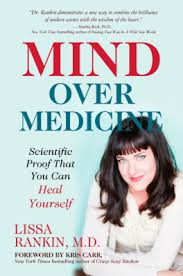
MindOverMedicineI just started reading a book by a medical doctor named Lissa Rankin. Rankin’s book, entitled Mind Over Medicine, presents evidence from a large body of scientific literature suggesting the mind often plays a major role in wellness by way of mechanisms that aren’t yet fully understood, but which defy the traditional view of Western medicine.

Rankin was intrigued by the vast number of anecdotal cases of what doctors call “spontaneous remissions.” Spontaneous remissions are when a patient becomes healthy in a way that defies explanation (i.e. they had no treatment, they had insufficient treatment, and they had an illness for with the body’s immune system is normally believed incapable of doing the job on its own.) She wasn’t satisfied with these one-off stories involving placebos, fake surgeries, busted radiology equipment, faith healing, etc, but rather wanted to see what the scientific literature contained by way of scientific double-blind studies on the subject.

She found there was evidence to support mind over matter when it came to illness, and that there was a fledgling explanatory literature. She also learned that while there was a large database of spontaneous remissions, there had not yet been an attempt to determine whether there were common characteristics of those who showed the “placebo effect” (getting well while being in the placebo group of a double-blind study) or other spontaneous remissions.

My point is that there is good reason for skeptics to consider that there may be a lot more to health and well-being than our current paradigm suggests.

BOOK REVIEW: The Book of Massage by Lucinda Lidell

The Book of Massage: The Complete Step-By-Step Guide to Eastern and Western TechniquesThe Book of Massage: The Complete Step-By-Step Guide to Eastern and Western Techniques by Lucy Lidell

My rating: 4 of 5 stars

Amazon page

I picked up this book because I recently began studying Thai Yoga Bodywork (TYB.) While The Book of Massage doesn’t specifically deal with Thai massage, as a neophyte, I figured some general reading was in order, and there aren’t a lot of widely available books that deal with Thai massage specifically (at least not where I currently reside.)My first testimonial of this book is that I looked through over a dozen books on massage at my local bookstore, and this is the one with which I walked home.

I found Lidell’s book to be a valuable resource. The book covers three approaches to massage: oil massage, shiatsu, and reflexology. As the subtitle suggests, this book addresses both Eastern and Western approaches to massage. The section labeled simply “Massage” is one that deals largely in the Western approach, as it’s suggestive of the Swedish style of massage. This involves oil, no / few clothes on the recipient, and a variety of strokes that are delivered over relatively broad areas (as opposed to the deeper acupressure approach of the latter methods.) The oil massage chapter begins with an overview including what type of oil to use and the basic strokes, and then provides a sequence before delving into specific techniques for various body parts or groups of body parts.

Shiatsu is a Japanese form of massage that is based on the concepts of Traditional Chinese Medicine (TCM.) I found this style to be much closer to what I’ve learned in TYB. Like TYB, both patient and recipient are clothed, there is no oil, acupressure is the norm, it requires no table, and there is a match up between what are called “energy lines” in TYB and “meridians” in Shiatsu. Shiatsu even employs similar stretching techniques to those that are the hallmark of TYB. I can imagine these systems having a common ancestral art.

The order of the shiatsu chapter is basically the same as the chapter on Massage. First, there’s necessary background information. This consists of a couple of pages on the basic Taoist concepts on which TCM is based (e.g. Chi, Yin & Yang, and the five elements) and related vocabulary like “tsubo” (pressure points) and meridians. The section then goes on to address basics of posture and bodily tools (palms, thumbs, elbows, knees, etc.), the sequence of the massage, and then the specifics of various body parts.

Reflexology massages only the feet and hands in the belief that points on these appendages map to other parts of the body. In other words, practitioners believe one can increase wellness throughout the body by working points on only the feet or hands. It’s said that the roots of reflexology may be ancient and that it may have been practiced in Egypt in 2300BC, but the modern school was developed by an American physician in the early 20th century. TYB does borrow from reflexology (though not necessarily the modern form of it), so some of this was also similar to what I learned in TYB. Again, the order of this section went from the generic information one needs toward the specifics of how to apply a given technique on a particular part of the foot or hand.

In addition to the three core sections, there were chapters before and after that provide the reader with useful information. Some of this was banal but obligatory (e.g. a brief history of massage and a discussion of the importance of touch among the human species), but some of it was essential practical information such as how to create the proper environment and how to center oneself before delivering a massage. There was also information that will be useful for some about massages involving babies, expectant mothers, the elderly, athletes, and oneself.

Perhaps the most beneficial of the “supplementary” chapters was one that dealt with the subject of how to read bodies. This may seem like an odd topic. However, it’s useful to be able to recognize where an individual holds his tension or where her posture is off–a problem that can create many muscular difficulties. There’s a short overview of anatomy, which I found useful, and a shorter overview of “chakras and auras,” which I personally didn’t find useful but can see where others might.

There are several strengths and relatively few weaknesses to this book. I found the organization to be logical. The graphics are a combination of photos and line drawings, and they work well together. I thought it was great that the author explained that Shiatsu is to be done in comfortable, loose-fitting clothing and that the only reason the graphics display the masseuse in a skin-tight body suit was so that the baggy clothing wouldn’t inhibit the reader’s view. Also, I found the written descriptions worked well with the graphics. One often needs a written cue as to where to find a certain point or line, and just showing it in a picture can be misleading given the wide variety of body types as well as the granularity of the graphic in contrast to the specificity of a point one may need to hit.

I suppose I should warn the easily mortified and / or very religious that there are full and partial frontal nude photographs in the section on oil massage. [I doubt such people are a major demographic for giving or receiving massage, but one never knows.]

I don’t have a lot of complaints. As it’s set up like a workbook, a spiral binding might have been nice, but I recognize the huge challenges of that. Plus, I’m not certain that one can or should learn massage from a book. Rather one should look at it as information to support study with a skilled teacher–or to experiment with once one has already developed some skill. The sections early and late in the book that talk about the importance of human touch didn’t add much, but they were also brief.

If you’re looking for a book on massage that covers a broad set of bases, but yet gives adequate detail for learning, I think this book is a good choice. I’d say it piqued my interest in learning Shiatsu.

View all my reviews