I have perceiv'd that to be with those l like
   is enough,
 To stop in company with the rest at evening
   is enough,
 To be surrounded by beautiful, curious,
   breathing, laughing flesh is enough,
 To pass among them or touch any one, or
   rest my arm ever so lightly round his or
   her neck for a moment, what is this then?
 I do not ask any more delight, I swim in it
   as in a sea.

There is something in staying close to men
    and women and looking on them, and in
    the contact and odor of them, that
    pleases the soul well,
 All things please the soul, but these please
    the soul well.
I knew a man, a common farmer, the father
   of five sons,
 And in them the fathers of sons, and in
   them the fathers of sons.

This man was of wonderful vigor, calmness,
   beauty of person,
 The shape of his head, the pale yellow and
   white of his hair and beard, the
   immeasurable meaning of his black eyes,
   the richness and breadth of his manners,
 These I used to go and visit him to see, he
   was wise also,
 He was six feet tall, he was over eighty years
   old, his sons were massive, clean,
   bearded, tan-faced, handsome,
 They and his daughters loved him, all who
   saw him loved him,
 They did not love him by allowance, they
   loved him with personal love,
 He drank water only, the blood show'd like
   scarlet through the clear-brown skin of
   his face,
 He was a frequent gunner and fisher, he
   sail'd his boat himself, he had a fine one
   presented to him by a ship-joiner, he had
   fowling-pieces presented to him by men
   that loved him,
 When he went with his five sons and many
   grand-sons to hunt or fish, you would
   pick him out as the most beautiful and
   vigorous of the gang,
 You would wish long and long to be with
   him, you would wish to sit by him in the
   boat that you and he might touch each
   other.
The love of the body of man or woman
   balks account, the body itself balks,
   account,
 That of the male is perfect, and that of
   the female is perfect.

The expression of the face balks account,
 But the expression of a well-made man
   appears not only in his face,
 It is in his limbs and joints also, it is
   curiously in the joints of his hips and
   wrists,
 It is in his walk, the carriage of his neck, the
   flex of his waist and knees, dress does not
   hide him,
 The strong sweet quality he has strikes
   through the cotton and broadcloth,
 To see him pass conveys as much as the best
   poem, perhaps more,
 You linger to see his back, and the back of
   his neck and shoulder-side.

The sprawl and fulness of babes, the bosoms
   and heads of women, the folds of their
   dress, their style as we pass in the street,
   the contour of their shape downwards,
 The swimmer naked in the swimming-bath,
   seen as he swims through the transparent
   green-shine, or lies with his face up and
   rolls silently to and fro in the heave of the
   water,
 The bending forward and backward of
   rowers in row-boats, the horseman in his
   saddle,
 Girls, mothers, house-keepers, in all their
   performances,
 The group of laborers seated at noon-time
   with their open dinner-kettles, and their
   wives waiting,
 The female soothing a child, the farmer's
   daughter in the garden or cow-yard,
 The young fellow hoeing corn, the sleigh-
   driver driving his six horses through the
   crowd,
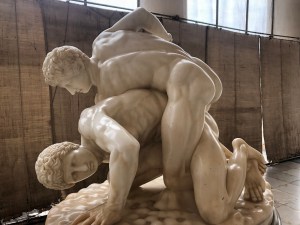
 The wrestle of wrestlers, two apprentice-
   boys, quite grown, lusty, good-natured,
   native-born, out on the vacant lot at sun-
   down after work,
 The coats and caps thrown down, the
   embrace of love and resistance,
 The upper-hold and the under-hold, the hair
   rumpled over and blinding their eyes;
 The march of firemen in their own
   costumes, the play of masculine muscle
   through clean-setting trowsers and waist-
   straps,
 The slow return from the fire, the pause
   when the bell strikes suddenly again, and
   the listening on the alert,
 The natural, perfect, varied attitudes, the
   bent head, the curv'd neck and the
   counting;
 Such-like I love -- I loosen myself, pass
   freely, am at the mother's breast with the
   little child,
 Swim with the swimmers, wrestle with
   wrestlers, march in line with the firemen,
   and pause, listen, count.
I sing the body electric,
 The armies of those I love engirth me
   and I engirth them,
 They will not let me off till I go with them,
   respond to them,
 And discorrupt them, and charge them full
   with the charge of the soul.

Was it doubted that those who corrupt
   their own bodies conceal themselves?
 And if those who defile the living are as bad
   as they who defile the dead?
 And if the body does not do fully
   as much as the soul?
 And if the body were not the soul,
   what is the soul?
One's-Self I sing, a simple separate person,
 Yet utter the word Democratic, the word En-masse.

Of physiology from top to toe I sing,
 Not physiognomy alone nor brain alone is
      worthy for the Muse, I say the Form complete
      is worthier far,
 The Female equally with the Male I sing.

Of Life immense in passion, pulse, and power,
 Cheerful, for freest action form'd under the laws
      divine,
 The Modern Man I sing.
Rested. Definitely. I believe one has to think of rest and recovery as part of the process of living. If one thinks of it as just wasting time between “doing things,” then one isn’t going to get the most out of body and mind.
This machine can flow,
     moving over, around,
     & through.

Skin conforms to the contours
     of musculature.

Muscle binds to bone,
     muscle that thickens
     and lengthens and ripples
     and pulses.

Bones that flex and recoil.

But that machine can flow --
     over, around, and through.

It can cause air to pop
     and water to slosh
     and earth to tremor.

It crawls through liquid,
    slices through gases,
    and slams the solids,

but can move over, around,
    and through.
Amazon.in Page
This book presents a pop science accounting of some of the more interesting scientific literature on the benefits of moving one’s body – be it through dance, martial arts, walking, or otherwise. That being active is an important element of maintaining a healthy mind and body will come as no surprise. Still, there are a number of specific points this book makes that may come as a surprise to many, such as that those who do an hour of intense exercise a day but otherwise live desk warrior lives may not be as well off as they think.
As the topic (and the scientific literature from which the book draws) is huge, the author focuses specifically on the mental benefits of physical movement, both attitudinal / psychological benefits and cognitive benefits such as improved creative thinking or memory. I found the book’s organization to be beneficial, and – in particular – believe it was a smart move to include chapters on breath and rest – topics that are integral to a life of movement, but which might not spring to mind. Particularly, the chapter on breath discusses findings on synchronization of breath and movement more than does many books on breath or movement, as well as offering extensive discussion of the benefits of 3 and 6 breath per minute (bpm) breathing.
There are a lot of books out there on this subject – though usually they focus either on exercise or on a particular approach to movement. Those who read extensively on the topic may not find much that is new in this book. However, I think “Move” holds its own, and also distinguishes itself in some of its fine points of emphasis. Certainly, if one is looking for a book to introduce someone to the benefits of movement, this is a prudent choice.
I saw something sad in the park this morning. A boy was trying to learn to ride a bicycle, but I could see that he never would — not with his present approach. Why? He had one training wheel, and the bike was leaning about 15-degrees off vertical as he struggled to use the bicycle as a tricycle. I could see that the metal arm that supported the training wheel was starting to bend from the strain — thus making the lean ever more pronounced. [Incidentally, with two training wheels, I think he might rapidly learn to ride because he’d experience tipping from one side to the other, through the balance point.]
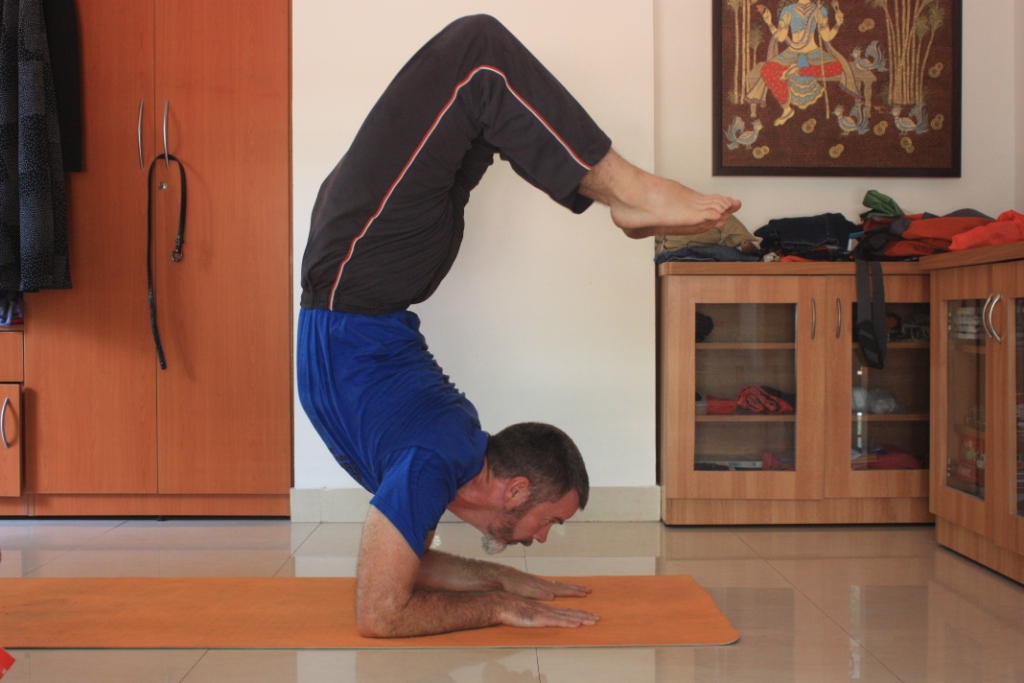
I’ve told yoga students before that there are three timelines for learning inversions (upside-down postures, which all require one’s body to learn to balance 180-degrees out of phase with the balance we all mastered as toddlers.) The first timeline is if you are willing to learn break-falls (i.e. how to safely land when — not if, it will happen — one loses balance.) If so, one can learn any inversion (that one is otherwise physically capable of performing) in an afternoon. Second, if one gets near (but not up against) a wall, and only uses the wall when one is falling towards over-rotation, then one can learn the inversion in a month — give or take. Finally, one can lean up against the wall for a million years and one will not spontaneously develop the capacity to independently do the posture. Why? Because one’s center of gravity is outside one’s body, which means one is in a perpetually unstable state, and one cannot stabilize into a balanced position from a state of falling (and leaning is just falling with a barrier in the way.)
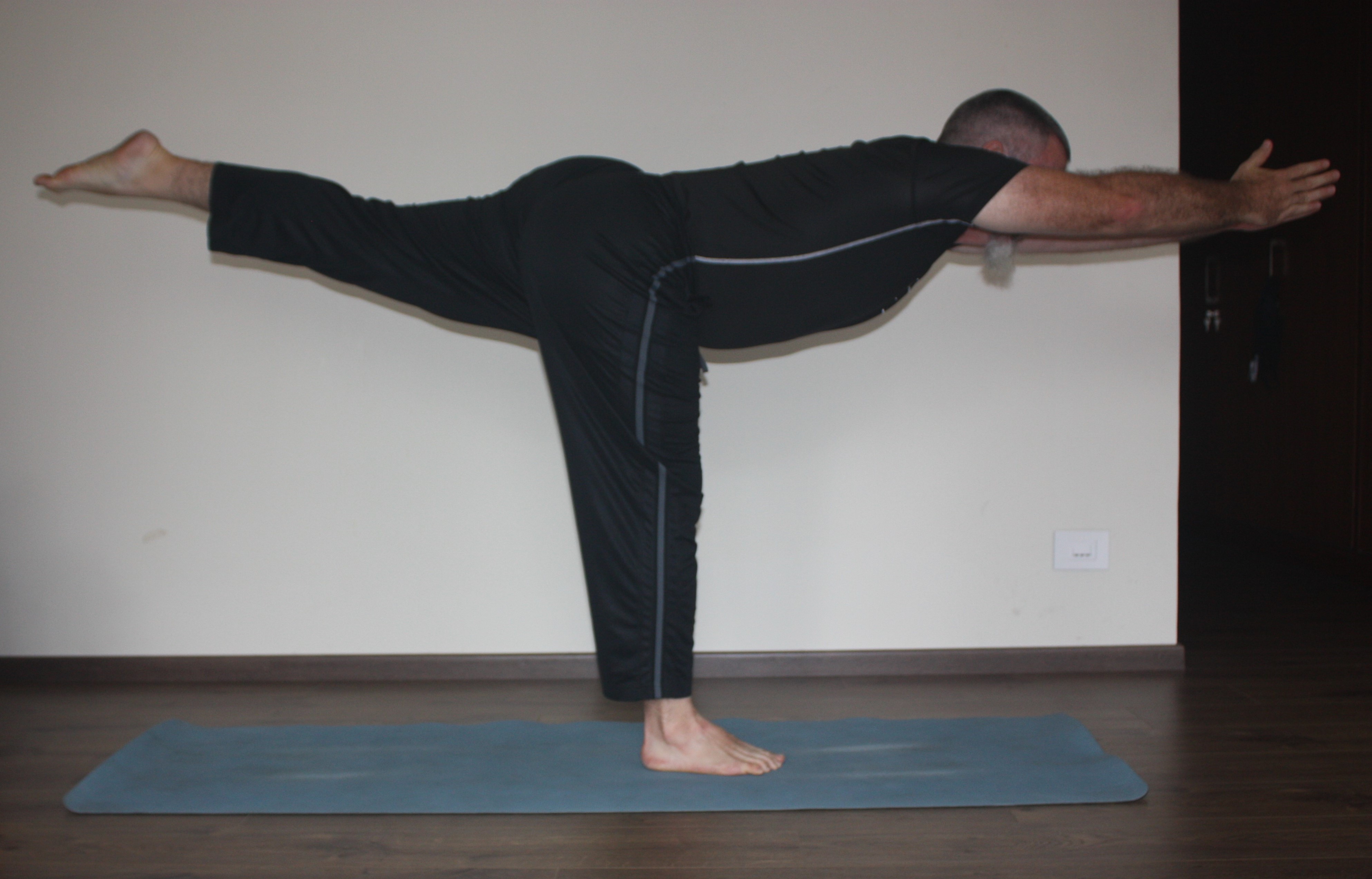
Finding balance requires that the body be able to adjust toward any available direction to counteract the beginning of a fall in the opposite direction. I was fortunate to have studied a martial art that required learning break-falls from the outset, this made learning balances (not just inversions, but also arm balances, standing balances, etc.) much easier because there was no great concern about falling. I knew my body could fall without being injured.
Without falling there’s no learning balance, and if you only fall into the under-rotated position, you are still not learning to achieve stable balance. At some point, you will need to experience the dread fall towards over-rotation.