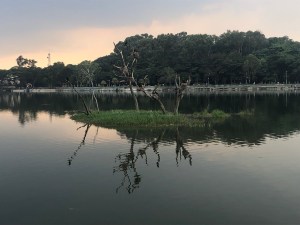
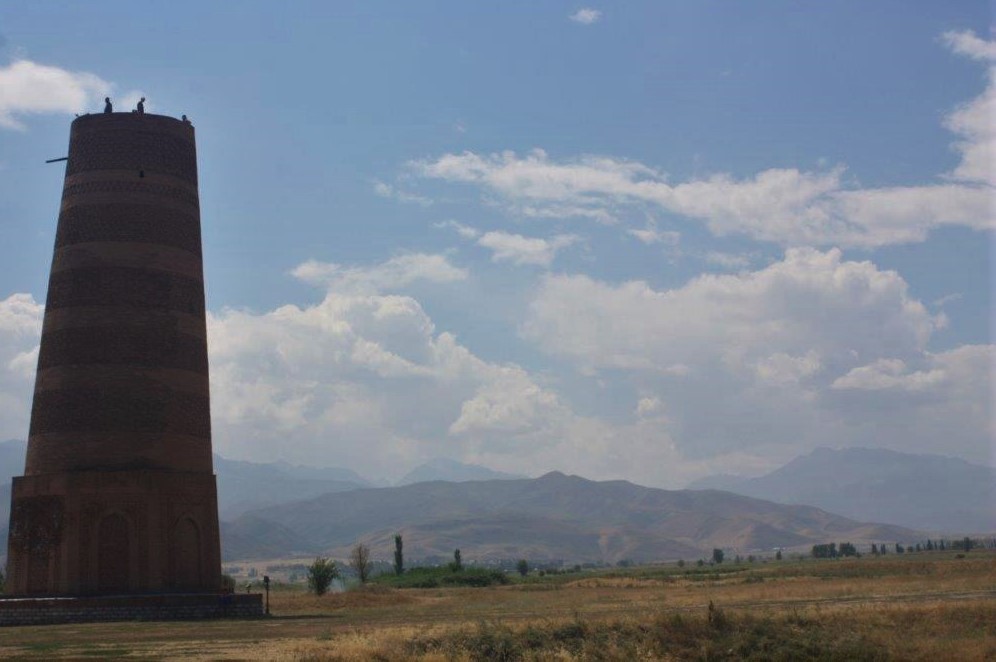
DAILY PHOTO: Wat Mahathat, Ayutthaya

Taken in October of 2012 in Ayutthaya

Self-Aware World [Free Verse]

I am a witness 
for a self-aware world,

a world that's not just 
chunks of matter,
but an organism that dances
 matter into 
an entity that can know.

It can know truth
and fiction 
and the truth of fiction
and the fiction of truth.

It turns order into disorder,
but with knowledge salad
on the side.

I'm a compartmentalized agent
 of a super-organism that is 
beyond my capacity
to understand
or speculate the purpose of.

I am a lonely witness.

DAILY PHOTO: Nepalese Wall Shrine

Taken in Patan in May of 2018

Jackfruit Nirvana [Haiku]

in the temple,
a monkey finds nirvana
through jackfruit focus

Early Hours [Common Meter]

On a bacon-scented sidewalk,
an hour before the dawn,
awaiting the man with a key
as I make a dazed yawn.

I've a vaguely swimming headache,
and thoughts that fail to form.
Will we have a crisp, red sunrise,
and would it mean a storm?

I'd remembered an old saying
of red sky morning dread,
but that's for sailors out at sea
not landsmen missing bed.

DAILY PHOTO: Karnataka High Court

Taken in March of 2022 in Bangalore

Copperpod [Haiku]

morning light
hits downed copperpod blossoms:
ground guilded

BOOK REVIEW: Ashtavakra Gita Trans. by Bart Marshall

Ashtavakra Gita: (bootleg version)Ashtavakra Gita: by Bart Marshall
My rating: 4 of 5 stars

Amazon.in Page

There are many translations of this Hindu classic of Advaita Vedanda, a non-dualist school that teaches the oneness of all things and the illusory nature of the universe that we think we know. “The Song of Ashtavakra” explores self-realization and the path to liberation (i.e. Moksha.) [Ashtavakra was a sage with birth defects from which the name “8 angles” derives. Yoga practitioners will know the name from an arm balance pose that involves balancing the kinked body on bent arms in a manner that was apparently reminiscent of the look of this sage’s body.]

The translation that I read, one by Bart Marshall, is clearly written in readily understandable language. It’s presented as a series of short-form poems arranged into twenty chapters that also form a dialogue between Ashtavakra and Janaka. This version doesn’t contain commentary and analysis as some translations do. Because it’s both highly readable and inexpensively acquired, I’d recommend one give it a chance. If you later decide you’d benefit from commentary, you’ll not be at a loss by having read this version first.

As is common enough in such tracts, the book can be repetitive as it reiterates ideas like the need to avoid desire and aversion and the nature of oneness. That said, there were some quite powerful statements that genuinely expanded on the ideas of the work. (e.g. 18.100: “One of tranquil mind // seeks neither crowds nor wilderness. // He is the same wherever he goes.” Or 3.12 “Why should a person of steady mind, who sees the nothingness of objects, prefer one thing over another?”)

If you’re a student of philosophy or of yoga as a philosophy, I think this is well worth a thoughtful read.


View all my reviews

BOOK REVIEW: The One-Straw Revolution by Masanobu Fukuoka

The One-Straw RevolutionThe One-Straw Revolution by Masanobu Fukuoka
My rating: 5 of 5 stars

Amazon.in Page

I kept running into references to this book in my readings about food and farming, and, eventually, I figured it must be a must-read. One topic that’s of interest to me (and should be of interest to everyone) is how [or, perhaps, whether] humanity can be sustainably fed, given the realities of human nature. Fukuoka (d. 2008) was at the vanguard of what’s been called the “natural farming” movement (a term he admitted he didn’t love.) He spent decades growing rice, other grains, and fruits in rural Shikoku, Japan, using a minimalist approach.

The book mixes philosophy, biography, commentary on food / nutrition, and instruction in Fukuoka’s approach to agriculture. Guided by a philosophy of “wu wei” (i.e. “effortless action,”) Fukuoka figured out how to reduce the amount of effort and resources put into farming, while maintaining crop yields that were competitive with the standard farming model. His approach appears backwards, lazy, and unlikely to succeed. He didn’t plow his fields. He planted by casting seed into the previous crop before harvesting it (note: he alternated rice with winter grains.) He didn’t weed, but rather let white clover grow freely and used the stalks and chaff from one harvest as cover for the next (again, rotating crops,) a cover that biodegraded into nutrients. He used no chemicals, neither fertilizer nor insecticide. And yet, important details of his approach kept his yields up while using minimal resources to maximum effect by operating in accord with nature (e.g. no insecticides seems to risk infestation, but it also means that you haven’t killed the creatures that eat pests.)

Fukuoka’s philosophy combines the principles of nature, Buddhist & Taoist concepts, and – believe it or not — something reminiscent of Nihilism (without calling it such.) There are parts of the book that some might find disagreeable. For example, Fukuoka uses an analogy that draws on the Mahayanist view of the distinction between Mahayana and “Hinayana” that Theravadins may find offensive (fyi: the older branch of Buddhism considers “Hinayana” to be derogatory and believes it’s a label based on a mistaken belief.) [To be fair, Fukuoka explicitly stated that he belonged to no religion and he claimed no expertise on the subject.] More likely to take offense are scientists and agricultural researchers, a group who takes it from both barrels. [Fukuoka says his opposition to scientists is that they fill the same role in society as the discriminating mind plays in mental activity, and he values the non-discriminating mind.]

I found this book to be loaded with food-for-thought. It raises a number of questions that aren’t answered inside (e.g. is Fukuoka’s approach scalable?,) but it’s a fascinating and highly readable introduction to natural farming. I’d highly recommend it for those interested in the subject.


View all my reviews

DAILY PHOTO: On the Rocks at Gandikota Canyon

Taken in November of 2021 at Gandikota Canyon in Andhra Pradesh