BOOK REVIEW: The Lone Samurai by Wm. Scott Wilson

The Lone Samurai: The Life of Miyamoto MusashiThe Lone Samurai: The Life of Miyamoto Musashi by William Scott Wilson

My rating: 4 of 5 stars

Amazon page

[Note: this was previously posted in my martial arts blog, Jissen Budōka.]

This is a concise and well-researched biography of one of Japan’s most famous swordsmen. Miyamoto Musashi, however, wasn’t just a swordsman, he was also a writer, a painter, a sculptor, a Zen Buddhist, a poet, a philosopher, and a strategist. In short, he was a renaissance man. While The Lone Samurai focuses heavily on Musashi’s many duels as a traveling warrior, it also describes his artwork as it paints a portrait of a complex and beguiling character.

Musashi holds a curious allure among figures in Japanese history. The Japanese tend to be strictly bound by societal conventions, and being respectful and well-mannered is valued above all else. Musashi flouted convention whenever it served him. He used irreverence for strategic advantage. He was an astute reader of men. He often showed disrespect in order to get into his opponent’s head. This is most famously exemplified in his Ganryu Island duel with Sasaki Kojiro.

Musashi adopted a life of musha shugyo, or warrior errantry, though he could have been much wealthier and more comfortable had he chosen to be. He enjoyed simplicity, and only owned a few possessions. In his travels, he engaged in over 60 duels, and is usually credited with being undefeated [Note: I’ve heard some dispute the outcome of his second duel with Muso Gonnosuke. Wilson calls it a draw, but I’ve heard it called Musashi’s only defeat as well.] He fought as a samurai in battle at Sekigahara as well, but his adulthood was a relatively peaceful time.

One fascinating, but controversial, claim is that Musashi had no teachers–neither in swordsmanship nor in any of the fine arts he practiced. Musashi said this himself, but some historians dispute it. If true, it really takes being an extraordinary person up a notch. It should be noted that Musashi was only 13 when he had his first duel.

There is much about Musashi that is lost to the ages, but this book does a great job of pulling together what is known and weaving it into a portrait of the man.

There is an extensive series of appendices providing background information, notes, a glossary, and even a collection of pop culture (e.g. movie and novel) depictions of Musashi.

It’s well worth the read if you’re interested in strategy, history, or the biographies of incredible people.

View all my reviews

The Bullets that Bore no Name: or, the Burden we all Bear

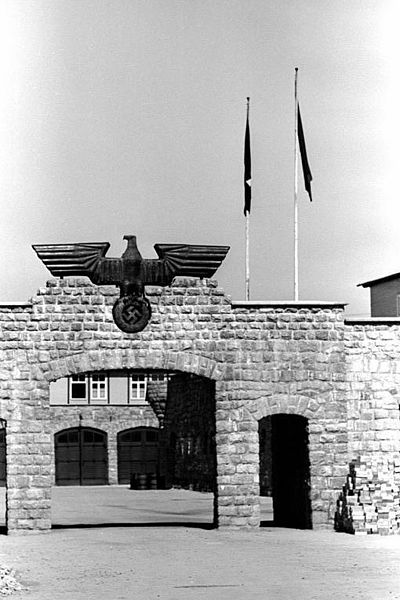
Attribution: Bundesarchiv, Bild 192-334 / CC-BY-SA

Mauthausen                     Attribution: Bundesarchiv, Bild 192-334 / CC-BY-SA

Thanks for joining me on the veranda. If you don’t know what I’m talking about, this post flows from a book review I did on Elie Wiesel’s Night, which can be seen here. But don’t wander off just yet.

I married into a family of holocaust survivors.

Being sufficiently narcissistic, I haven’t been able to avoid thinking of the profound impact this had on my life.  I am married to the most extraordinary woman in the universe [my apologies to all other women, I’m sure you’re someone else’s most extraordinary woman] by virtue of the strength of a man who wrestled his way to the top of a pile of corpses, bleeding profusely from multiple shrapnel wounds, clawing his way out of a pit, and cleaning the gashes with his urine. That man was married to a woman, tiny of body but colossal of mind, who was in the group force marched from Budapest to Mauthausen. After the war, they had a child–my mother-in-law. Yada-yada-yada. I have marital bliss.

Not being completely narcissistic, I’m reminded that every one of our lives have been shaped by strong people who lived through close calls. Each of us comes hither as a gift from men and women who passed through a hail of bullets that bore no name. Some, like my wife’s grandfather, were riddled by bullets bearing their name, and still refused to heed their deadly whisper.  Every holocaust survivor survived by a thin margin. Every battlefield veteran’s life is an execution order rescinded. Every prisoner of war was one germ away from an unmarked grave.

No pressure or anything, but that sounds like a heavy debt we  all bear.

Telling this story in greater detail is one of my bucket list tasks. It’s a project I’ve had on the back burner for far too long. There are several reasons for this. The most feeble of which is a hope to find the right timing. Sadly, there are so many such stories that I fear it will be lost amid a sea of sorrow.  Then there is my need to develop grace with language sufficient to do the story justice. In a way the two novels I have drafted, and whose mess I am now painstakingly trying to dance into shape, are practice exercises.  Wish me luck.

On the plus side, my wife’s uncle had the foresight to have her grandfather speak his story onto about 20 tapes before he died. With today’s technology, there’s no excuse for anyone’s life-altering story to go untold.  So I guess if there is a moral to my rambling post it’s this: don’t let anyone in your life with a spectacular story pass from this world without it being heard.

BOOK REVIEW: Bones of the Master by George Crane

Bones of the Master: A Journey to Secret MongoliaBones of the Master: A Journey to Secret Mongolia by George Crane

My rating: 4 of 5 stars

I’m a sucker for a tale of the sage next door. In an unwise world, it’s nice to believe that the wise exist, and that they walk among us. That they are not relegated to secluded retreats, but live in suburban subdivisions. In Bones of the Master a quirky Asian man drops in on his neighbor. The neighbor turns out to be the author of this book, poet George Crane. The visitor is Tsung Tsai, a Cha’an monk who trekked from Inner Mongolia to Hong Kong in 1959 in order to ensure the teachings of his monastery would survive.

The two men strike up a friendship, collaborating on poetry translation and eventually making a journey together back to Tsung Tsai’s home. The first part of the book tells of their meeting and describes Tsung Tsai’s 1959 journey to freedom. The second part deals with the two men’s mid-1990’s return trip. The monk’s ambitious plan is to find the bones of his master, cremate them, and relocate them in accord with the dictates of his religious tradition. He also wants to rebuild the temple that was razed by the Red Guard during the cultural revolution. As this is nonfiction, it’s not all happy endings. Not everything works out as they’d like it to. A brief third part tells of their return to the states with an interesting stopover in Hong Kong.

Much of the appeal of the book stems from how the monk’s worldview rubs off on the author. The monk assumes matter-of-factly that they will be able to sell the book for a sufficient advance to pay for the trip and a monument to his teacher. As one can imagine– particularly anyone who knows a bit about publishing– Crane is suitably skeptical, but ultimately buys into the plan. The monk often tells Crane that he worries too much. However, most of us would worry about these daunting challenges. For example, how to get a one ton statue from New York to Inner Mongolia, or–more importantly–whether the aged and ailing monk will be able to complete the trip alive.

There are tidbits of insight as well as poetry scattered throughout the book.

View all my reviews

BOOK REVIEW: The Journeys of Socrates by Dan Millman

The Journeys of SocratesThe Journeys of Socrates by Dan Millman

My rating: 4 of 5 stars

The Journeys of Socrates shines the spotlight on Dan Millman’s mysterious teacher from The Way of the Peaceful Warrior. We discover that Socrates was born Sergei in Russia to a Cossack father and a Jewish mother.

His youth is scarred by tragedy. His mother died in labor with him and his father died of alcohol poisoning while Sergei was away at military school. His only remaining relative that we know of, his grandfather, dies. He flees military school to avoid having to harass Jews as a soldier, and in the process he has to battle his arch-rival. He marries into a family, but that brings its own tragedy. His family by marriage are Jews living under false identities at a time when it is very dangerous to be a Russian Jew.

It is after this tragedy that Socrates’ search for warrior skills and revenge drive the narrative. In injecting so much tragedy into his life, Millman makes the main character’s transformation all the more impressive. At every turn, Socrates is faced with events that should fill him with bitterness and hatred, but he must keep going and learn to control his emotions to become the warrior that he wants to be.

He proceeds to train under a warrior trained in the way of Japanese swordsmanship, a man named Razin. Razin only reluctantly accepts him as a student. He then lives at a hermitage, learning to reign in his mind and to respond freely and appropriately to attacks. His teacher at the hermitage, Father Serafim, teaches him to fight, while encouraging him to give up his vendetta. Finally, he travels abroad to train with a convened collection of sages from various traditions (Taoism, Buddhism, Judaism, Christianity,etc.)

Socrates narrative arc is well developed. He is pitted against a powerful enemy named Zakolyev, aka Gregor Stakkos, a military school rival who became an antisemitic Cossack gang leader. Socrates is reluctantly drawn into a final decisive battle with this nemesis, but there is a twist at the end to further complicate that event.

I’ll admit I’ve had mixed feelings about Millman’s work. I was a big fan of the original books Way of the Peaceful Warrior and to a lesser extent Sacred Journey of the Peaceful Warrior. Those books provided great insight into mind-body development in a readable narrative form. However, I later picked up one of his subsequent books and found it to be some sort of numerology/astrology drivel. That was disconcerting not only because it offended my sensibilities as a Cartesian skeptic, but even more so because it seemed to fly in the face of the Peaceful Warrior message– which was one of self-empowerment, not passive acceptance of some randomly bestowed fate.

So I picked The Journeys of Socrates reluctantly. However, I found this book to be the most readable of all. It is written like a novel or the memoir of someone who led the rare novel-shaped life.

View all my reviews

BOOK REVIEW: Ishmael by Daniel Quinn

Ishmael: An Adventure of the Mind and SpiritIshmael: An Adventure of the Mind and Spirit by Daniel Quinn

My rating: 4 of 5 stars

A man answers an ad that says, “Teacher seeks pupil. Must have an earnest desire to save the world. Apply in person.” Expecting to find a charlatan, the man is surprised to find his new teacher is, in fact, a gorilla.

Like Socrates, this gorilla, Ishmael, uses questions to guide his pupil toward crucial knowledge. Ismael teaches his student to challenge some of his most deep-seated beliefs such as, the world was made for humans, humans are the ultimate culmination of biology, humans are inherently separate from (and above) nature, and that humans are fundamentally flawed in such a way as to make ruination of the planet inevitable.

The core of the book differentiates two human cultures. The author calls them the “takers” and the “leavers,” but they correspond to what we might call “us” and the “aboriginal peoples.” Takers are specialized, agricultural, and technologically advanced (if you’re reading this review on a computer and not chiseled on a cave wall, you, my friend, are a taker.)

The lives of “Leavers” aren’t that different from those of humans 10,000 years ago. They are tribal as opposed to (to borrow Desmond Morris’s term) super-tribal. [In a tribe everyone knows everyone else. Morris suggests that things go to shit –re: war, crime, and deviant behavior– in super-tribal societies.] Leavers live like animals in that they tend towards equilibrium within their ecosystem. Takers do not.

If you long for thrillers or potboilers, this isn’t the book for you. It’s a thinking person’s book. The nice thing about Ishmael’s use of the Socratic method is that one can think through the questions in parallel to the narrator’s discovery. In this way, the reader can install himself or herself into the conversation.

At the most generic level, the book’s value is in showing one how much one takes for granted. We can’t see forests for trees.

One may agree or disagree with the author, but either way one will be subjected to powerful food for thought. Some of the discussion may evoke a visceral emotional reaction that one may have trouble reconciling with logic, such as the discussion of the morality of feeding the starving.

The downside of the book is that the dialogue can be strained in places and it can get a bit repetitive. The latter serves to reinforce key concepts, but some of them feel as though they are reinforced inordinately. In making the narrating protagonist struggle, Quinn creates a lead who seems a bit dense sometimes. Also, as I indicated, the journey is by-and-large in the mind, and so the tension is limited. There is some drama when the narrator shows up one day to find that Ishmael has been evicted. However, this is resolved without too great a difficulty and they resume lessons with  Ishmael’s irritability being the only change to be seen. There is drama at the end that will remain unspoiled herein.

I’d recommend this book as a thought-provoking exercise for the mind.

View all my reviews

TODAY’S RANT: Stupid is as Cupid Does

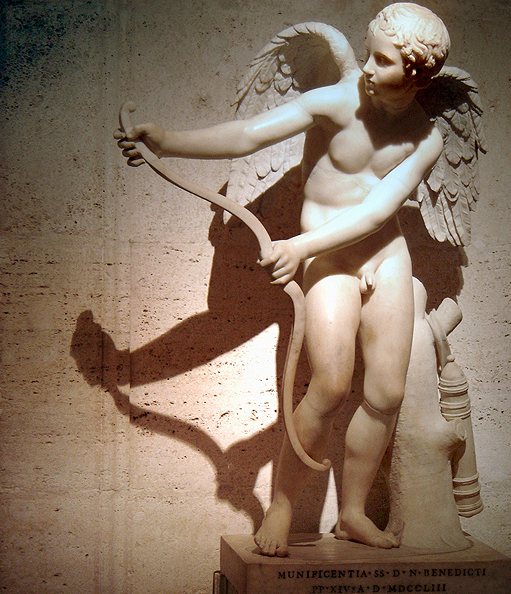
Attribution: Ricardo André Frantz Nothing says lovin' like  a prepubescent archer.

Attribution: Ricardo André Frantz
Nothing says lovin’ like a prepubescent archer.

This isn’t a generic rant about Valentine’s Day. I am not the curmudgeon of ardor or the Grinch of St. Valentine’s Day. All I’m saying is that nothing is less sexy than a naked baby archer.

I guarantee that if you polled paramedics who’ve responded to bow-hunting accidents, none would say that their patients reported sexual arousal as a symptom of arrows sticking out of thighs. How being impaled with a razor-sharp implement came to be associated with the transmission of love, I’ll never know. Yes, little boys have been known to sock a girl they like in the deltoid, but breaking out the device single-handedly responsible for Mongol hordes sweeping across Eurasia is taking that dysfunction up a notch.

I have no problem with nudity. Nudity and erotic love is like getting your chocolate in her peanut butter– so to speak. My problem is with prepubescent nudity. All that does is remind one of the end product of amour, and that’s terrifying, not arousing. No one needs that kind of pressure in a budding relationship.

I know I said this wasn’t a blanket condemnation of the holiday, but I’ve got one more sub-rant. What is with flowers and chocolate as the iconic gifts of the holiday? Is it that nothing says everlasting love like a bouquet that will be shedding wilted petals by day’s end. And chocolate says, “I love you so much that I’ll even love you if you get fat. Furthermore, I’m willing to prove it by doing my damnedest to make you fat.”

I won’t even get into the jewelry ads. “Show her you love her by implying that you think she’s in it just for the swag.”

5 Minefields of Armageddon for 2013

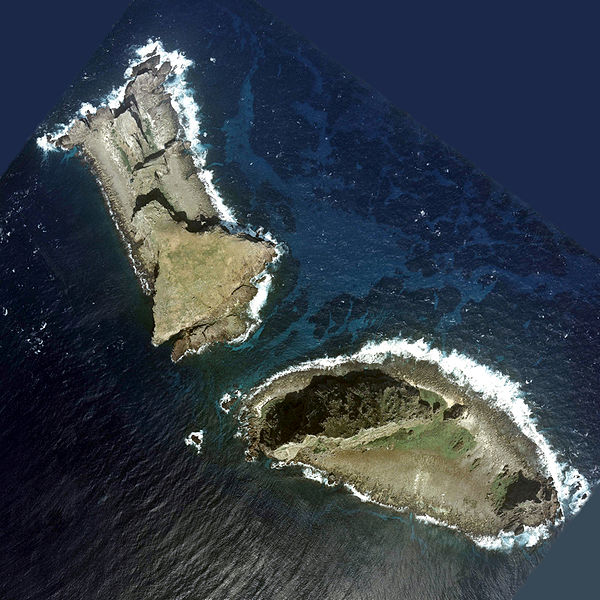
National Land Image Information, Ministry of Land, Infrastructure, Transportation & Tourism, Japan

National Land Image Information, Ministry of Land, Infrastructure, Transportation & Tourism, Japan

1.) Ever heard of the Senkakus? What about Diaoyus? If not, you should look them up. When you’ve been wearing a gas mask for the 33rd day straight, you may want to know about the chunks of rock in the East China Sea that we tripped into nuclear winter over. Simmering tensions between Japan and China have been flaring up over these islands of late. So you’re probably wondering who lives there who’s so important that it’s worth wandering through a minefield that could trigger World War III. If you answered, “absolutely no one,” give yourself a prize.  They’re uninhabited. It’s not the islands themselves that anyone gives a rat’s as about, it’s the ramification they have for underwater drilling rights.

The reader may accuse me of hyperbole. (Shh! Dont tell anyone, but– of course– that’s what I do.) After all, China has a boldly stated “No First Use” policy. That is, they claim they will not use nukes in a first strike. Given that Japan isn’t a nuclear weapons state (NWS), there doesn’t seem to be much risk. Except that a.) Japan lives under the U.S. nuclear umbrella;  b.) Japan is the non-NWS that could develop nuclear weapons in the shortest time imaginable — they have the material, infrastructure, and technical know-how (okay, Germany is in the same bag); and c.) see #2

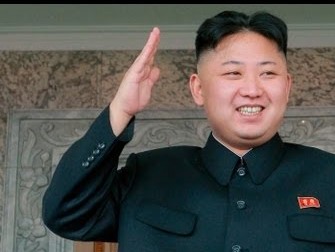
KimJongUn3

2.) North Korea conducted its third nuclear test. This presents a risk because: a.) it provides an incentive for Japan to build its own nukes (particularly if faith in the US umbrella wanes.) b.) [and more importantly] Kim Jong Un has too many yes-men, and no one to slap him in his chubby face and say, “are you smoking powdered unicorn horn?” In other words, he doesn’t have a good idea of what he can get away with before the world unleashes a crate of whoop-ass on his sad country. So he wanders in the minefield.

3.) Europe is getting depressed. Fat and happy Europeans are productive and polite. Downtrodden Europeans have been known to swallow some pretty despicable narratives, and– in doing so– drag the world into war. At the moment this seems really far-fetched. These political movements are at best in the political fringe of countries on Europe’s fringe, right? Maybe so. Time will tell.

4.) If America’s economy is crash-landed, everyone is going to be hit by the debris. This will be depressing, see #3 and then multiply globally. Times like these  echo Churchill’s comment, “Democracy is the worst form of government, except for all those other forms that have been tried from time to time.” Any person, company, or government that sees the train coming in the distance but can’t find its way off the tracks can’t be expected to thrive for long.

5.) India and Pakistan, enough said…

BOOK REVIEW: Vagabonding by Rolf Potts

Vagabonding: An Uncommon Guide to the Art of Long-Term World TravelVagabonding: An Uncommon Guide to the Art of Long-Term World Travel by Rolf Potts

My rating: 5 of 5 stars

Vagabonding is a book about how to make the leap from a cubicle-dwelling company-man (or woman) to a wandering free-spirit.

This book serves two functions. The first is to answer questions about how one goes about seeing the world if one is not independently wealthy or a recent lotto winner. In this role it provides information such as how one can fund one’s travel time, and, perhaps more importantly, how one can get a job after one has an 18 month void in one’s resume.

The second function is to psyche one up to take the leap. In this role it is more persuasive than informative. In both roles it succeeds, but it is in this second role that it is most useful. The Introduction title is “How to Win and Influence Yourself” and Chapter 1 is entitled “Declare your Independence.”

Each chapter has a list of tips and/or references, quotes from those who have done it, and a profile of a famous person associated with the lifestyle, including: Thoreau, Whitman, Muir, and Annie Dillard. The quotes show you that mere mortals have made this leap. The profiles show that you that you will be in excellent company if you do it.

One of the most important themes in this book is simplified living. If one isn’t independently wealthy, one will have to make “sacrifices” to adopt this lifestyle. However, if one learns to live lean, one will be able to make do with much less. One must also live lean during one’s travels. Potts’s advice is to travel light, and leave the electronics at home. (The latter may seem impossible these days, but as a person who recently lost a laptop in a travel accident, I respect the logic.)

I highly recommend this book for anyone who is ready to take the leap, but only if you’re serious.

View all my reviews

BOOK REVIEW: The Book of Five Rings by Miyamoto Musashi

A Book of Five Rings: The Classic Guide to StrategyA Book of Five Rings: The Classic Guide to Strategy by Miyamoto Musashi

My rating: 5 of 5 stars

Miyamoto Musashi is probably the most famous swordsman in Japan’s history. Oddly enough,he’s not known for his experience in battle(he lived at the tail end of the Warring States period and was only in a couple of battles), but for his time spent in musha shugyo (warrior’s errantry), during which he engaged in over 60 duels. It is The Book of Five Rings that largely accounts for his continued fame. That being said, Musashi was quite the renaissance man, a painter and sculptor of note. He also left behind a school of swordsmanship, Niten Ichi-ryū.

The Book of Five Rings is divided into five parts: earth scroll, water scroll, fire scroll, wind scroll, and void scroll.

The earth scroll provides an overview of martial science and an introduction to Musashi’s school, which is noted for its simultaneous use of both the large and short sword. A section is devoted the rhythm of martial arts, a crucial topic. It also includes what might be considered Musashi’s 9-point budō kun (a list of warrior precepts.)It’s worth mentioning a couple of these.
#7 Become aware of what is not obvious.
#9 Do not do anything useless.

The Water scroll describes Musashi’s approach to swordsmanship. It covers a range of elements of a martial art including footwork, the focus of one’s eyes, physical posture, mental posture, techniques,kiai (spirit shout), and approaches to cutting and thrusting.

The Fire scroll deals with the strategic or interactive aspects of the battle. Among my favorite quotes from this scroll is, “If your own power of insight is strong, the state of affairs of everything will be clear to you.”

The Wind scroll teaches us about other martial arts. Musashi discusses martial arts that use an unusually long sword, an atypically short sword, that focus on powerful strikes, and those that focus on many rapid strikes. He contrasts other martial arts with his own on subjects such as their focus with the eyes and their footwork.

The void scroll deals with, well, emptiness.

Musashi had great insight into strategy from his career of dueling. His book is worth being read and reread.

View all my reviews

TODAY’S RANT: Hyper-relativistic Mathematical Zones: or, When Will my Car be Done?

Albert Einstein theorized that distance and time are relative depending upon one’s speed. In everyday life we rarely notice this because of a little-known tenet of General Relativity that says, “Whenever one attempts to approach the speed  of light, there will be an octogenarian in the left-hand lane.”

Since the early 20th century, physicists have thought they were this close (author holds up hand with thumb and index fingers about 3/4 of a centimeter apart) to being able to explain the whole shebang. Figure out why very small things behave differently from very big things, and, Bob’s your uncle, we’ve got your Eureka moment.

I, however, think physicists will find that they have yet another hurdle to solve (mixed metaphor intended, smartypants.) This has to do with certain zones in which conventional measurements of space and time break down even when one is only moving at the speed the planet is revolving (24 hours/day, I think, no that sounds wrong somehow.)

I don’t think physics is quite prepared to explain why an hour in a mechanic’s shop is equal to about 4.33 hours on the outside. We’ve all experienced the inverted time-dilation effect of the Department of Motor Vehicles. According to Einsteinian relativity, time slows as one approaches the speed of light. However, time slows even more when one is in the slowest state of movement possible, the DMV line.

I won’t go into the distance contraction effects localized to the crotch region of men who wear wife-beaters and gold hood ornaments around their necks.

Are these just zones in which bistromathics trump mathematics (Sorry only readers of Douglas Adams’s Life, the Universe, and Everything will get that reference.)

Any Unified Field Theory must explain these phenomenon before I can accept it.