BOOK REVIEW: Vagabonding by Rolf Potts

Vagabonding: An Uncommon Guide to the Art of Long-Term World TravelVagabonding: An Uncommon Guide to the Art of Long-Term World Travel by Rolf Potts

My rating: 5 of 5 stars

Vagabonding is a book about how to make the leap from a cubicle-dwelling company-man (or woman) to a wandering free-spirit.

This book serves two functions. The first is to answer questions about how one goes about seeing the world if one is not independently wealthy or a recent lotto winner. In this role it provides information such as how one can fund one’s travel time, and, perhaps more importantly, how one can get a job after one has an 18 month void in one’s resume.

The second function is to psyche one up to take the leap. In this role it is more persuasive than informative. In both roles it succeeds, but it is in this second role that it is most useful. The Introduction title is “How to Win and Influence Yourself” and Chapter 1 is entitled “Declare your Independence.”

Each chapter has a list of tips and/or references, quotes from those who have done it, and a profile of a famous person associated with the lifestyle, including: Thoreau, Whitman, Muir, and Annie Dillard. The quotes show you that mere mortals have made this leap. The profiles show that you that you will be in excellent company if you do it.

One of the most important themes in this book is simplified living. If one isn’t independently wealthy, one will have to make “sacrifices” to adopt this lifestyle. However, if one learns to live lean, one will be able to make do with much less. One must also live lean during one’s travels. Potts’s advice is to travel light, and leave the electronics at home. (The latter may seem impossible these days, but as a person who recently lost a laptop in a travel accident, I respect the logic.)

I highly recommend this book for anyone who is ready to take the leap, but only if you’re serious.

View all my reviews

BOOK REVIEW: The Book of Five Rings by Miyamoto Musashi

A Book of Five Rings: The Classic Guide to StrategyA Book of Five Rings: The Classic Guide to Strategy by Miyamoto Musashi

My rating: 5 of 5 stars

Miyamoto Musashi is probably the most famous swordsman in Japan’s history. Oddly enough,he’s not known for his experience in battle(he lived at the tail end of the Warring States period and was only in a couple of battles), but for his time spent in musha shugyo (warrior’s errantry), during which he engaged in over 60 duels. It is The Book of Five Rings that largely accounts for his continued fame. That being said, Musashi was quite the renaissance man, a painter and sculptor of note. He also left behind a school of swordsmanship, Niten Ichi-ryū.

The Book of Five Rings is divided into five parts: earth scroll, water scroll, fire scroll, wind scroll, and void scroll.

The earth scroll provides an overview of martial science and an introduction to Musashi’s school, which is noted for its simultaneous use of both the large and short sword. A section is devoted the rhythm of martial arts, a crucial topic. It also includes what might be considered Musashi’s 9-point budō kun (a list of warrior precepts.)It’s worth mentioning a couple of these.
#7 Become aware of what is not obvious.
#9 Do not do anything useless.

The Water scroll describes Musashi’s approach to swordsmanship. It covers a range of elements of a martial art including footwork, the focus of one’s eyes, physical posture, mental posture, techniques,kiai (spirit shout), and approaches to cutting and thrusting.

The Fire scroll deals with the strategic or interactive aspects of the battle. Among my favorite quotes from this scroll is, “If your own power of insight is strong, the state of affairs of everything will be clear to you.”

The Wind scroll teaches us about other martial arts. Musashi discusses martial arts that use an unusually long sword, an atypically short sword, that focus on powerful strikes, and those that focus on many rapid strikes. He contrasts other martial arts with his own on subjects such as their focus with the eyes and their footwork.

The void scroll deals with, well, emptiness.

Musashi had great insight into strategy from his career of dueling. His book is worth being read and reread.

View all my reviews

TODAY’S RANT: Hyper-relativistic Mathematical Zones: or, When Will my Car be Done?

Albert Einstein theorized that distance and time are relative depending upon one’s speed. In everyday life we rarely notice this because of a little-known tenet of General Relativity that says, “Whenever one attempts to approach the speed  of light, there will be an octogenarian in the left-hand lane.”

Since the early 20th century, physicists have thought they were this close (author holds up hand with thumb and index fingers about 3/4 of a centimeter apart) to being able to explain the whole shebang. Figure out why very small things behave differently from very big things, and, Bob’s your uncle, we’ve got your Eureka moment.

I, however, think physicists will find that they have yet another hurdle to solve (mixed metaphor intended, smartypants.) This has to do with certain zones in which conventional measurements of space and time break down even when one is only moving at the speed the planet is revolving (24 hours/day, I think, no that sounds wrong somehow.)

I don’t think physics is quite prepared to explain why an hour in a mechanic’s shop is equal to about 4.33 hours on the outside. We’ve all experienced the inverted time-dilation effect of the Department of Motor Vehicles. According to Einsteinian relativity, time slows as one approaches the speed of light. However, time slows even more when one is in the slowest state of movement possible, the DMV line.

I won’t go into the distance contraction effects localized to the crotch region of men who wear wife-beaters and gold hood ornaments around their necks.

Are these just zones in which bistromathics trump mathematics (Sorry only readers of Douglas Adams’s Life, the Universe, and Everything will get that reference.)

Any Unified Field Theory must explain these phenomenon before I can accept it.

TODAY’S RANT: Pronunciation Police

Pronunciation is tricky.

Pronunciation is tricky.

If you’ve ever had someone tell you that any water can be put in a pot (for pronouncing drinking water pot-table rather that po-table), then you may be with me here. If you frequently exercise your perogative, rather than your prerogative, you may agree. Have you had sherbert, or only sherbet? Do both your eggs and oxen have yokes?

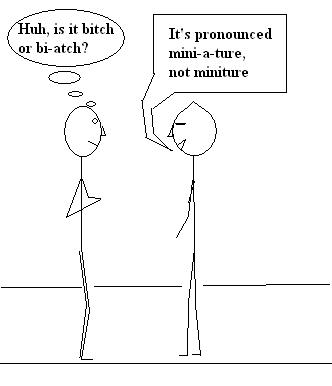
If you’re not with me, you –my friend– might be the person on the right in my little stick cartoon.

I’m as anal about language as the next writer, but let’s try to dial down the pretentiousness. The big question I have for pronunciation police is this: What in your experience with the English language has led you to believe it is a phonetic language?

For those who think English is phonetic because they learned it via “Phonics,” let me expose you to a poem that says it more eloquently than I ever could. (I would attribute the poem, but it is to my knowledge owed to that most prolific “Anonymous” chap.)

Hints on Pronunciation for Foreigners

I take it you already know
of tough and bough and cough and dough.
Others may stumble, but not you,
On hiccough, thorough, laugh and through.
Well done! And now you wish, perhaps,
To learn of less familiar traps.

Beware of heard, a dreadful word
That looks like beard and sounds like bird.
And dead-it’s said like bed, not bead.
For goodness sake, don’t call it deed!
Watch out for meat and great and threat.
They rhyme with suite and straight and debt.

A moth is not a moth in mother,
Nor both in bother, broth in brother,
And here is not a match for there,
Nor dear and fear for pear and bear.
And then there’s dose and rose and lose
Just look them up–and goose and choose.
And cork and work and card and ward.
And font and front and word and sword.
And do and go, then thwart and cart.
Come, come I’ve hardly made a start.

A dreadful language? Man alive,
I’d mastered it when I was five!

If you still don’t believe that the language can handle multiple pronunciations, check out what the experts say.

TODAY’S MINI-RANT: On Groundhog Day

Attribution: Marumari (through Wikipedia)ALL HAIL, GREAT GROUNDHOG

Attribution: Marumari (through Wikipedia)
ALL HAIL, OH WISE GROUNDHOG

Today is the one day each year that I hope for first contact with an alien race, because I want their first report back to their home world to be: “Earthlings anxiously await the weather prediction of a large rodent.”

Furthermore, when the aliens ask to be, “taken to our leader”, they will be stunned to find that it isn’t the chubby omniscient rodent. They will be dismayed to learn that our political leadership not only isn’t omniscient, but isn’t even that “scient.”

On the other hand, perhaps they will back the rodents in an overthrow of  our kind. I’m not saying this will happen, but have your varmint rifles at the ready.

BOOK REVIEW: Blue Zones by Dan Buettner

The Blue Zones: Lessons for Living Longer From the People Who've Lived the LongestThe Blue Zones: Lessons for Living Longer From the People Who’ve Lived the Longest by Dan Buettner

My rating: 4 of 5 stars

Blue Zones are places with disproportionately large numbers of 100+ year old folks. Buettner’s book contains case studies on four of these blue zones: Sardinia, Okinawa, Loma Linda (California), and Hojancha (Costa Rica), and provides interesting insights on living from the places that produce lots of centenarians.

Even those who aren’t particularly interested in longevity will find a great deal of valuable information in the book. Not unexpectedly, nutrition is at the fore in this book. However, there are other factors such as family and social life, sleep, and being active that correlate strongly with longevity.

A few things I picked up:
– As in Okinawa, one should say hara hachi bu before each meal as a reminder to stop when one is 80% full– rather than 100% or 180% full.
– Most nuts make a good snack even if they’re roasted in an oil that isn’t particularly healthy (the density means limited saturation.)
– Despite our species’ history, which presumably involved gorging on meat when it was available,vegetarians (and near-vegetarians) live longer.
– When you eat is as important as what you eat.

View all my reviews

TODAY’S RANT: Emerson Haters

Ralph_Waldo_Emerson_ca1857_retouchedI began reading the Best American Essays of 2012 and was disappointed by the first  essay entitled, The Foul Reign of Self-Reliance by Benjamin Anastas.

Self-Reliance: In or out of the canon?:

Anastas rails against the essay Self-Reliance by Ralph Waldo Emerson. The only nice thing he has to say about Emerson (as a parenthetical insert) was that the philosopher spoke out against slavery and the poor treatment of American Indians.  Anastas suggests Emerson’s essay should be eliminated from the  canon of required reading. This desire to censor ideas that he (or his collective) find objectionable is a telling indicator of why he finds Emerson so vile. In my ideal world, students would read Emerson and Marx and Jefferson and Socrates and Confucius and eventually even the likes of Hitler and they’d make up their own minds about what ideas were sound and which were suspect. I’m  confident that on the whole that a free-thinking people will overwhelming reject the poorest and most vile of ideas. Obviously, not all will draw the same conclusions as I about which ideas are best, but I prefer the company of such people to those who completely agree with me but have turned their thinking caps off. Anastas seems to favor control of the flow of ideas to those society or teachers or some collective finds agreeable.

An undeniably powerful idea:

About all that Anastas and I agree on is that the thesis of Emerson’s Self-Reliance is powerful. By a powerful idea, I mean one that has the ability to grab a reader by the collar and demand his or her attention –whether they like it or not. Where Anastas sees Emerson’s ideas as perniciously powerful, I see them as sagely powerful. While we seem to be in near complete disagreement, I don’t want to go into a point by point refutation. I want to focus on what I believe is Anastas’s central point, that our current political dysfunction is the fault of Emersonian thinking. On this I think Anastas is shows perfection in his wrongheadedness.

The reason I don’t bother arguing point by point is because  much of my difference of opinion with Anastas comes down to being on radically different places on the Borg-Anarchist continuum. Reasonable people may disagree. I have a set of beliefs that inform my position on the Borg-Anarchist continuum that range from my opinion on free will to ideas about the value of optimizing (minimizing) what I would call “social friction” (others have used that term in another way.) That’s neither here nor there, Anastas may have his own justification for his views, though he doesn’t lay them out. For example, he uses the phrase, “excessive love of individual liberty” without indicating what he believes would be the appropriate amount to love liberty, let alone how he drew his conclusion. It may be that he doesn’t have a rationale, but rather has suborned his views to some collective that he believes is representative of society (that would be the true anti-Emersonian approach.)

The Borg-Anarchist continuum:

I should explain what I call the “Borg-Anarchist continuum” for those who are neither Star Trek fans nor wonky. Humans are inescapably both individualistic and social creatures. We know that people get morbidly depressed when they feel they aren’t valued as individuals (Tom Hanks at the beginning of Joe Versus the Volcano), but it’s also true that people go nuts when they are completely isolated from others (Tom Hanks in Castaway.) [Please, don’t draw conclusions about which is “better” on the relative merit of those two movies.] This leads to one of our most fundamental dilemmas. Where our individuality bumps up a social unit, how does one reconcile theses conflicts?

We can imagine a continuum where at one end are the Borg and at the other end are Anarchists. Borg were a powerful enemy in the Star Trek universe. The Borg were a collective in which any given individual was inconsequential and all gave themselves fully to the objective of the collective (i.e. universal domination.) Anarchists are those who feel there should be no authority over the individual. Virtually no one fits into the extreme camps because they’re both blatantly flawed. No one would have any incentive to do anything in Borg world, and an anarchy will inevitably devolve into chaos. No one would invite the Borg or Anarchists to their cocktail party. In practice, one might think of a Communist-Libertarian continuum. Communists believe the state owns the means of production and should be able to regulate ideas as intimately personal as religion, but they don’t attempt to completely stamp out all vestiges of individuality (e.g. people still have names instead of the Borg’s “4 of 7.”) Libertarians believe that authority over the individual should be minimal, but that there’s a role for governance in punishing the illegitimate use of force or the use of fraud.

Yes, I realize that in being one-dimensional, a Republican and a Democrat could occupy the exact same space on the continuum (i.e. wanting the same amount of governance, just not in the exact same domain.)

Is political dysfunction a product of Emersonian thought?:

So, let’s go back to the issue of blaming political dysfunction on Emersonian ideals. It’s my belief that we have political dysfunction because politicians aren’t following Emerson’s advice, rather than that too many are doing so. Let’s consider Anastas’s argument.

“’A man is to carry himself in the presence of all opposition,’ Emerson advises, ‘as if every thing were titular and ephemeral but he.’ If this isn’t the official motto of the 112th Congress of the United States, well, it should be.”

Anastas is saying that the idea that one shouldn’t bend to the ideas of other men, as suggested by Emerson, is the cause of the problem. However, this requires us to believe that politicians engaged in free thinking consistently come down in the perfectly bifurcated set of positions required for grid-lock to take hold on a wide range of issues.  This is dubious. I find it much more probable that politicians do not think freely, but rather they subordinate their opinion to their party and to what the people of their district think. That, my friends, is the source of the problem. Politicians are doing exactly what Anastas wants, which is subordinating their opinion to the majority in their districts. The two-part problem is that: a.) districts are drawn to have clear winners. b.) our society has abandoned the Emersonian idea and taken party and sect as a substitute for thinking. We’ve created a two-party grid-lock machine, and we’re surprised that it works.

Yes, Emerson tells us to be obstinate in holding to ones own beliefs in the face of other people. If every politician did this, our political field would be much richer with many sets of opinions and not just the two captured by the party platforms of the two ruling parties. (At least it wouldn’t hold sway always on anything important.)  What Emerson does not ask of us is to be obstinate in the face of new or better information. Anastas’s own selection of quotes says as much.

“Speak what you think now in hard words,” Emerson exhorted, “and tomorrow speak what tomorrow thinks in hard words again, though it contradict every thing you said today.”

In other words, Emerson is suggesting that one should be able to change one’s mind (one just shouldn’t do this in deference to the views of other people.) One should changes one’s mind when one has new or better information or one’s thinking about the subject is clearer. Changing one’s mind has a bad rap in our political system. There’s a kind of changing of one’s mind that should leave us with a bad taste in our mouths, and that’s pandering. However, not all mind-changing is pandering. If we ask a politician why he changed his mind and he says, “Because I learned X, and that new information made me conclude Y,” then that person should be applauded. The ideas of people of party and sect don’t change regardless of new information. This stagnancy is part of the problem as well. An individual can change his or her mind rapidly but an ideological organization is never swift. When people subordinate their thinking to their sect, this is when we end up unable to get out-of-the-way of slow-moving freight train problems like many that we face today.

The animus that characterizes our political domain is not a function of Emersonian thinking. While Emerson may not address it because it isn’t part of what he’s trying to get across in this essay, it stands to reason that if everyone thinks for themselves people will draw different conclusions. The Maytag repairman is not the loneliest person; the loneliest person in the world is a free-thinker who can’t get along with people who don’t share his exact slate of thinking across a range of  subjects. Thinking for oneself is not only consistent with tolerance, it breeds it. It’s only when one conforms one’s thinking to that of a collective that one can afford to act like people who think differently from one are pure evil.

Other thoughts on the subject:

For another post of mine about Emerson’s Self-Reliance see here.

Also, Emerson was not the only one in the 19th century who was dismayed by the trend toward subordinating political views to party, Mark Twain had a lighter essay on the subject called Corn Pone Opinions.

TODAY’S RANT: Nukes and Ketchup

Why was there no Manhattan Project for Ketchup?

Why was there no Manhattan Project for Ketchup?

How come we mastered the thermonuclear warhead decades before we did the ketchup bottle?

Building a nuke took:

– the greatest scientific minds Hungary ever produced (You scoff, but Hungary’s claim to fame is driving out more Nobel Laureates and top-rate scientific minds than most countries will ever hope to produce. [e.g. Teller, Szilard, Wigner, von Neumann, etc.] If they didn’t let jackwagons run their country, they’d probably rule the world by now.)
– $42 billion in current-year US dollars
– the Project Manager who built the Pentagon
– and a whopping two or three years (for the fission weapon)

Building a decent ketchup bottle shouldn’t have even required an Algonquin Round-table  It could have been achieved by two morons sitting around at a barbecue.

Moron one says, “You knows what would be delightful, if this bottle was squeezable plastic, not glass.”

Moron two says, “Dude, you are so right, and what if they turned it upside-down so that all the ketchup stayed near the hole?”

Bob’s your uncle, the ketchup bottle is perfected.

Do you know what kind of Galactic douche-bags this makes humanity look like? It makes it seem like we don’t care about our condiments.
Oh, but we do. I’ve seen it. I’ve seen a man in Boise use no less than 42 packets of ketchup on his fries. I saw a rotund woman in Phoenix use half a jug of mustard on her hot dogs. I saw a canuck slather mayo on his burger (what is up with that, Canada.) From sea to that other sea, amid the prairie dogs, through the alligator-infested swamps, across those bruised mountains, I’ve seen a divinely inspired love of sauces throughout our great nation (and that ancillary nation to the north.)

No wonder aliens haven’t visited us; they probably haven’t received word across the light-years that we’ve mastered ketchup. Or maybe it’s the fact that we haven’t built a plastic fork whose tines could stick up to a sturdy gherkin. (But that outrage is for another day. Yes, manufacturers of disposable flatware, you too will taste my wrath.)

10 of My Favorite Quotes on Writing

Do not use semicolons. They are transvestite hermaphrodites representing absolutely nothing. All they do is show you’ve been to college. –Kurt Vonnegut


Write without pay until somebody offers pay. If nobody offers within three years, the candidate may look upon this circumstance with the most implicit confidence as the sign that sawing wood is what he was intended for. –Mark Twain


The faster you blurt, the more swiftly you write, the more honest you are.  –Ray Bradbury


Try to leave out the part that readers tend to skip. –Elmore Leonard


The first draft of anything is shit.—Ernest Hemingway.


Omit needless words. –William Strunk


The only rule for writing I have is to leave it while I’m still hot… –William Faulkner


Whoever wants to tell a story of a sainted grandmother, unless you can find some old love letters, and get a new grandfather?  –Robert Penn Warren


When you write the thing through once, you find out what the end is. Then you can go back to the first chapter and put in a lot of those foreshadowings. –Flannery O’Connor


As far as I’m concerned the entire reason for becoming a writer is not having to get up in the morning.  –Neil Gaiman

Wisdom in 5 Simple Lessons

Confucius statue at the Confucian Temple, Beijing

Confucius statue at the Confucian Temple, Beijing

1.) Be kind, everyone you meet is fighting a hard battle –Plato

2.) If you choose, you are free; if you choose, you need blame no man.  –Epictetus

3.) …the greatest carver does the least cutting.  –Lao Tzu

4.) If it falls to your lot to be a street sweeper, sweep streets like Michelangelo painted pictures.  –Martin Luther King Jr

5.) A gentleman wishes to be slow to speak and quick to do.  –Confucius