 I began reading the Best American Essays of 2012 and was disappointed by the first essay entitled, The Foul Reign of Self-Reliance by Benjamin Anastas.
Self-Reliance: In or out of the canon?:
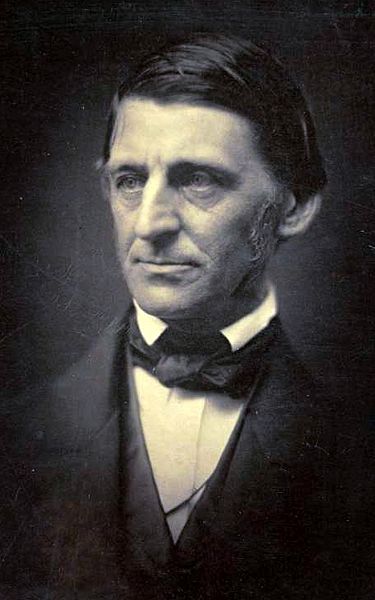
Anastas rails against the essay Self-Reliance by Ralph Waldo Emerson. The only nice thing he has to say about Emerson (as a parenthetical insert) was that the philosopher spoke out against slavery and the poor treatment of American Indians. Anastas suggests Emerson’s essay should be eliminated from the canon of required reading. This desire to censor ideas that he (or his collective) find objectionable is a telling indicator of why he finds Emerson so vile. In my ideal world, students would read Emerson and Marx and Jefferson and Socrates and Confucius and eventually even the likes of Hitler and they’d make up their own minds about what ideas were sound and which were suspect. I’m confident that on the whole that a free-thinking people will overwhelming reject the poorest and most vile of ideas. Obviously, not all will draw the same conclusions as I about which ideas are best, but I prefer the company of such people to those who completely agree with me but have turned their thinking caps off. Anastas seems to favor control of the flow of ideas to those society or teachers or some collective finds agreeable.
An undeniably powerful idea:
About all that Anastas and I agree on is that the thesis of Emerson’s Self-Reliance is powerful. By a powerful idea, I mean one that has the ability to grab a reader by the collar and demand his or her attention –whether they like it or not. Where Anastas sees Emerson’s ideas as perniciously powerful, I see them as sagely powerful. While we seem to be in near complete disagreement, I don’t want to go into a point by point refutation. I want to focus on what I believe is Anastas’s central point, that our current political dysfunction is the fault of Emersonian thinking. On this I think Anastas is shows perfection in his wrongheadedness.
The reason I don’t bother arguing point by point is because much of my difference of opinion with Anastas comes down to being on radically different places on the Borg-Anarchist continuum. Reasonable people may disagree. I have a set of beliefs that inform my position on the Borg-Anarchist continuum that range from my opinion on free will to ideas about the value of optimizing (minimizing) what I would call “social friction” (others have used that term in another way.) That’s neither here nor there, Anastas may have his own justification for his views, though he doesn’t lay them out. For example, he uses the phrase, “excessive love of individual liberty” without indicating what he believes would be the appropriate amount to love liberty, let alone how he drew his conclusion. It may be that he doesn’t have a rationale, but rather has suborned his views to some collective that he believes is representative of society (that would be the true anti-Emersonian approach.)
The Borg-Anarchist continuum:
I should explain what I call the “Borg-Anarchist continuum” for those who are neither Star Trek fans nor wonky. Humans are inescapably both individualistic and social creatures. We know that people get morbidly depressed when they feel they aren’t valued as individuals (Tom Hanks at the beginning of Joe Versus the Volcano), but it’s also true that people go nuts when they are completely isolated from others (Tom Hanks in Castaway.) [Please, don’t draw conclusions about which is “better” on the relative merit of those two movies.] This leads to one of our most fundamental dilemmas. Where our individuality bumps up a social unit, how does one reconcile theses conflicts?
We can imagine a continuum where at one end are the Borg and at the other end are Anarchists. Borg were a powerful enemy in the Star Trek universe. The Borg were a collective in which any given individual was inconsequential and all gave themselves fully to the objective of the collective (i.e. universal domination.) Anarchists are those who feel there should be no authority over the individual. Virtually no one fits into the extreme camps because they’re both blatantly flawed. No one would have any incentive to do anything in Borg world, and an anarchy will inevitably devolve into chaos. No one would invite the Borg or Anarchists to their cocktail party. In practice, one might think of a Communist-Libertarian continuum. Communists believe the state owns the means of production and should be able to regulate ideas as intimately personal as religion, but they don’t attempt to completely stamp out all vestiges of individuality (e.g. people still have names instead of the Borg’s “4 of 7.”) Libertarians believe that authority over the individual should be minimal, but that there’s a role for governance in punishing the illegitimate use of force or the use of fraud.
Yes, I realize that in being one-dimensional, a Republican and a Democrat could occupy the exact same space on the continuum (i.e. wanting the same amount of governance, just not in the exact same domain.)
Is political dysfunction a product of Emersonian thought?:
So, let’s go back to the issue of blaming political dysfunction on Emersonian ideals. It’s my belief that we have political dysfunction because politicians aren’t following Emerson’s advice, rather than that too many are doing so. Let’s consider Anastas’s argument.
“’A man is to carry himself in the presence of all opposition,’ Emerson advises, ‘as if every thing were titular and ephemeral but he.’ If this isn’t the official motto of the 112th Congress of the United States, well, it should be.”
Anastas is saying that the idea that one shouldn’t bend to the ideas of other men, as suggested by Emerson, is the cause of the problem. However, this requires us to believe that politicians engaged in free thinking consistently come down in the perfectly bifurcated set of positions required for grid-lock to take hold on a wide range of issues. This is dubious. I find it much more probable that politicians do not think freely, but rather they subordinate their opinion to their party and to what the people of their district think. That, my friends, is the source of the problem. Politicians are doing exactly what Anastas wants, which is subordinating their opinion to the majority in their districts. The two-part problem is that: a.) districts are drawn to have clear winners. b.) our society has abandoned the Emersonian idea and taken party and sect as a substitute for thinking. We’ve created a two-party grid-lock machine, and we’re surprised that it works.
Yes, Emerson tells us to be obstinate in holding to ones own beliefs in the face of other people. If every politician did this, our political field would be much richer with many sets of opinions and not just the two captured by the party platforms of the two ruling parties. (At least it wouldn’t hold sway always on anything important.) What Emerson does not ask of us is to be obstinate in the face of new or better information. Anastas’s own selection of quotes says as much.
“Speak what you think now in hard words,” Emerson exhorted, “and tomorrow speak what tomorrow thinks in hard words again, though it contradict every thing you said today.”
In other words, Emerson is suggesting that one should be able to change one’s mind (one just shouldn’t do this in deference to the views of other people.) One should changes one’s mind when one has new or better information or one’s thinking about the subject is clearer. Changing one’s mind has a bad rap in our political system. There’s a kind of changing of one’s mind that should leave us with a bad taste in our mouths, and that’s pandering. However, not all mind-changing is pandering. If we ask a politician why he changed his mind and he says, “Because I learned X, and that new information made me conclude Y,” then that person should be applauded. The ideas of people of party and sect don’t change regardless of new information. This stagnancy is part of the problem as well. An individual can change his or her mind rapidly but an ideological organization is never swift. When people subordinate their thinking to their sect, this is when we end up unable to get out-of-the-way of slow-moving freight train problems like many that we face today.
The animus that characterizes our political domain is not a function of Emersonian thinking. While Emerson may not address it because it isn’t part of what he’s trying to get across in this essay, it stands to reason that if everyone thinks for themselves people will draw different conclusions. The Maytag repairman is not the loneliest person; the loneliest person in the world is a free-thinker who can’t get along with people who don’t share his exact slate of thinking across a range of subjects. Thinking for oneself is not only consistent with tolerance, it breeds it. It’s only when one conforms one’s thinking to that of a collective that one can afford to act like people who think differently from one are pure evil.
Other thoughts on the subject:
For another post of mine about Emerson’s Self-Reliance see here.
Also, Emerson was not the only one in the 19th century who was dismayed by the trend toward subordinating political views to party, Mark Twain had a lighter essay on the subject called Corn Pone Opinions.
Share on Facebook, Twitter, Email, etc.

 The Blue Zones: Lessons for Living Longer From the People Who’ve Lived the Longest by Dan Buettner