How would I know? When I’m doing either – by definition – my mind is wandering. Ergo, I have no metacognitive engagement. (i.e. I’m not timing or encoding— and certainly not recording— mental objects.)
Category Archives: Psychology
PROMPT: Admiration
Have intense confidence that they can achieve anything, but only when they’re not an ass about it. So, have humble confidence or cool confidence?
PROMPT: First Impression
My conscious mind would only tell lies about this. While I’ve long been aware that I’m an introvert, it’s only more recently come to my attention that I have resting-“get the hell away from me”-face. It’s nothing I ever purposeful cultivated, and — now, being aware of it –I’m trying to be more discerning. (But I have a lot of decades of programming to work against.)
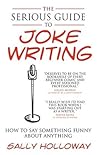
BOOK: “The Serious Guide to Joke Writing” by Sally Holloway
The Serious Guide to Joke Writing: How to Say Something Funny about Anything by Sally HollowayMy rating: 4 of 5 stars
Google Books Page
This book presents a textual version of the author’s joke writing seminar. It offers a few techniques for joke writing that are informed by the premises that: 1.) jokes exist out in the world for one to find — rather than to create; 2.) Anyone who is funny with his or her friends can be a funny joke writer, BUT not without effort. That effort comes in the form of training oneself to look at words and phrases in unconventional ways and in applying (largely mechanical) processes to coax or wheedle the jokes out of the ether. I say “largely mechanical” because there is a chapter on stream-of-consciousness joke writing, but the heart of the book is a process called joke-web building that is a step-by-step approach to finding humor wherever it may hide.
The book alternates practical and “theoretical” chapters. The “theoretical” chapters are mostly about the psychology that gets in one’s way as a joke writer and the ways around it. That is, those parts deal with the value of breaks and the need to manage anxiety. The practical chapters explain the procedures and have Q&A style troubleshooting sections in addition to a description of the process.
I found the book to be interesting and a quick read. Some of the procedures seem a bit tedious, but they do produce results. It may be possible to streamline them to one’s own situation.
View all my reviews
PROMPT: Podcasts
I don’t properly listen to any, but I watch clips and segments from many on YouTube — mostly those of comedians, but some of a popular science or current events / international affairs / macroeconomic nature.
PROMPT: Historical Event
The Holocaust and other killings of massive scale (e.g. Cambodia’s Killing Fields, Stalin’s Great Purge, etc.) How does villainy triumph on such vast scales? Is there something in our nature that’s just not right, that’s ripe for lunacy under some conditions? What the hell is wrong with humanity?
BOOKS; “Rental Person Who Does Nothing” by Shoji Morimoto
Rental Person Who Does Nothing by Shoji MorimotoMy rating: 5 of 5 stars
Publisher Site — Harper Collins
This quirky little book is the memoir of a man who formed a business lending himself out as “rental person who does nothing.” At the time the book came out, Morimoto did this without charging his “customers” anything except travel expenses and any food and beverages consumed as part of the activity in question. [As I understand it, he eventually began charging a per session fee ($85 USD at the time of the 2022 BBC piece on him that I watched.)] The book does discuss Morimoto’s thoughts about how to charge (i.e. hourly or per session,) how much to charge, whether to find a different financing model (e.g. sponsorship or patronage,) and why he ultimately rejected them all (at least for a time.) In fact, the whole penultimate chapter (ch. 4) is about the economics of his business.
The most interesting aspect of the book is the psychological insight on offer. The first question that arises is why people would use a stranger for these activities, and not a friend. One might jump to the conclusion that the people who use his service have no friends, but this is generally wrong. There are a number of reasons why people who have friends use his service. First, many times friends can’t just sit and listen empathetically, but rather they have to try to solve the problem. This can be irritating because it is often dismissive of the challenges confronting the other person. But also, as Morimoto points out, it also creates a hierarchy (a top dog) in what would otherwise be a co-equal relationship. A fascinating second factor pointed out by the author is that adults, unlike children, rarely have general-purpose friends. Adults, instead, have contextual friends. So, if one wants to engage in an activity that is outside the domain of one’s contextual (work, bar, hobby, etc.) friendship, it might not be easy. There are many other psychological insights relating to what people ask him to do, the issue of reciprocity, and what Morimoto defines as “doing nothing” for the purposes of this business.
I found this quick and simple book to be packed with insights into human nature, and I’d highly recommend it for readers interested in what makes people tick.
View all my reviews
PROMPT: Brands
Unless and until they cut me a check, I have no “association” with any brand.
I believe loyalty to friend, family, and nation can all be great virtues, but loyalty to a corporation is just silly. (They certainly won’t be loyal to you when it conflicts with what is best for the profit margin.)
BOOK: “Gut Feelings” by Gerd Gigerenzer
Gut Feelings: The Intelligence of the Unconscious by Gerd GigerenzerMy rating: 4 of 5 stars
Publisher Website – Penguin
Like Malcolm Gladwell’s Blink, Gut Feelings explores the circumstances under which intuitive decision-making has been shown to outperform rigorous and systematic reasoning. Gigerenzer is a psychologist and the Director of the Max Planck Institute for Human Development.
The central idea of this book is that our brains have evolved to engage in intuitive decision making, and that sometimes what looks like sloppy thinking has underlying benefits. Take – for example – the fact that many times people are asked a question that they don’t know the answer to, but they exploit their selective ignorance in a way that allows them to not only outperform those more ignorant than they, but also those less ignorant. Gigerenzer uses the example of students asked whether Milwaukee or Detroit has a bigger population. Often those who’ve only heard of one of the cities will guess that the one they know is bigger, and this tends to be right more often than not. Students familiar with both cities (but not knowing the precise answer) are more likely to stumble.
The book suggests that we tend to decide based on one key factor rather than the full “pros and cons” list for which many teachers and leaders advocate. The book has a fascinating chapter on how this all applies to healthcare decision-making. It provides insight into why the American healthcare system is so screwed up (high cost, low health outcomes.)
If you are interested in decision-making and the divergence between what we are taught to do and what most of us actually do most of the time (and why,) I’d highly recommend this book.
View all my reviews
PROMPT: Better with Age
Equanimity and emotional resilience — i.e. the ability to give fewer f___ks.